At some point in every student’s academic life, something strange happens.
Assessment pivots from worksheets, projects, and pop quizzes to formal, sit-down examinations. And without much explanation, they're suddenly expected to start studying.
No one explains which strategies actually work, which ones only feel productive, or why hours of rereading and highlighting so often lead to disappointing results. That gap in instruction is exactly what this infographic is designed to fill.
Passive Studying: Comfortable, Familiar... Yet Ineffective
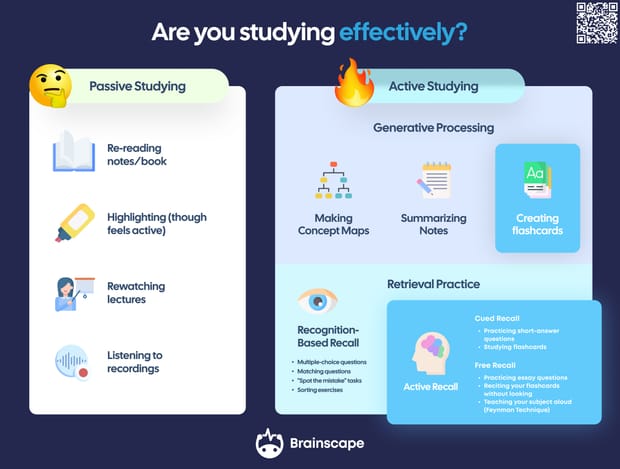
On the left side of the infographic, you’ll see passive study techniques:
- Re-reading notes or textbooks
- Highlighting or underlining
- Re-watching lectures
- Listening to recordings
These methods are popular because they’re easy and familiar. But cognitive science shows that they involve minimal mental effort. Information passes through the brain without being challenged, reconstructed, or retrieved, which is why it fades so quickly.
If learning feels calm and effortless, students usually aren't learning very much.
Active Studying: Where Learning Actually Happens
On the right side, the infographic breaks active studying into two research-backed pillars that drive long-term retention and transfer.
1. Generative Processing
This is learning by creating meaning, not just consuming information. Examples include:
- Summarizing notes in your own words
- Creating concept maps
- Explaining ideas out loud
- Creating flashcards
Generative processing compels students to organize, interpret, and articulate ideas, thereby strengthening understanding before memorization even begins.
2. Retrieval Practice
This is learning by pulling information out of your brain, rather than putting more in. The infographic further breaks this down into:
- Recognition-based recall (e.g., multiple-choice questions)
- Active recall, which includes:
- Cued recall (e.g., answering flashcard questions)
- Free recall (e.g., brain dumps, practice essays, teaching from memory)
The more effortful the retrieval, the stronger the memory. That’s why free and cued recall consistently outperform passive review techniques.
Why This Matters for Educators (and Motivated Learners)
If there’s one thing missing from most school curricula, it’s a clear, explicit education in how learning works.
This infographic gives students a shared mental model for:
- Understanding why certain strategies work
- Replacing ineffective habits with evidence-based ones
- Making smarter study choices across every subject
And the QR code connects students directly to Brainscape’s deep dive into the 16 cognitive principles behind effective learning, helping them go beyond tactics and understand the science beneath them.
Download. Print. Share. Repeat.
- Educators: Download this poster, print it, and hang it in your classroom as a daily reminder of how learning actually works.
- Students: Print it for your bedroom, save it to your phone, share it with classmates, and revisit it before every exam.
Learning isn’t just about time spent; it’s about how you're spending that time. This poster makes that truth impossible to ignore.
Want to go deeper? Explore the rest of our Cognitive Science of Learning series to understand more about how we learn, remember, and master knowledge!
Get Brainscape's Educator User Guide
Curious to learn more about how to introduce Brainscape into your physical or virtual classroom? Our Educator User Guide provides a detailed walkthrough of how to get set up. It'll also give you all the material you need to motivate for its adoption among your students, your students' parents, and/or the faculty of your school or college.