Describe the regulation of GI function.
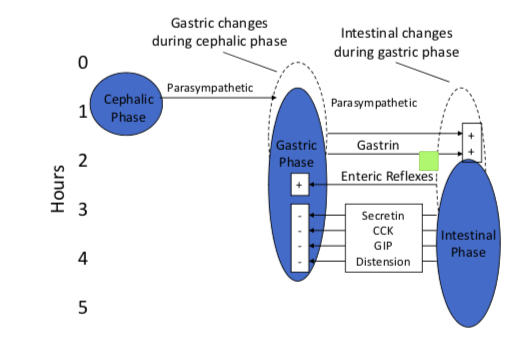
- GI function is co-ordinated by the integration of neural and hormonal signals.
- Signals can be physical (stretch receptors) or chemical (sight and presence of food).
- In addition, there is considerable input from higher centres.
- These signals can be split into three phases:
- Cephalic
- Gastric
- Intestinal
Describe the 3 regulatory phases of GI function.
- Cephalic phase
- Gastric phase
- Intestinal phase
- Enteric NS feeds back and forth signals in the GI tract.
- For example, the stomach can feed forward to the intestine to tell it food is coming and the intestine can feed back to the stomach to tell it not to put in any more food.
Describe secretion in the GI tract.
- Addition of substances (fluids, enzymes, ions etc.) into the lumen of the GI tract.
- Produced by salivary glands (saliva).
- Cells of the gastric mucosa (gastric secretion).
- Exocrine cells of the pnacreas (pancreatic secretion).
- Liver (bile).
Describe the secretion of saliva.
What are the functions of salivary secretion?
- Initial digestion of starches and lipids (very little).
- Dilution and buffering of ingested foods.
- Protection of teeth and gums.
- Lubrication of ingested foods with mucous (mucin).
How much saliva is secreted in a day (approximately)?
1 litre
Where do salivary secretions come from?
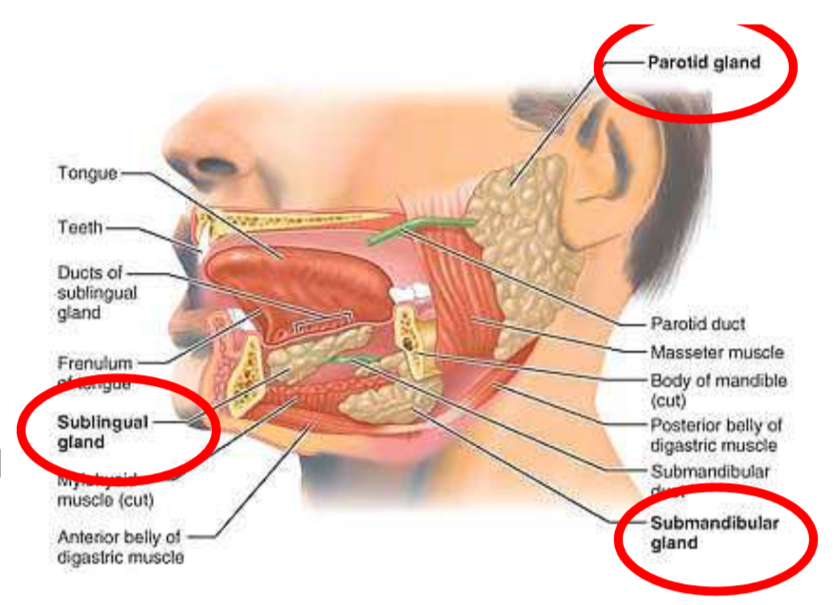
- Sublingual glands
- Deep in floor of mouth, underneath tongue, mostly mucous cells.
- Submandibular glands
- Under lower edge of mandible, mixed glands containing serous and mucous cells.
- Parotid glands
- Below ear and over the masseter, serous cells secreting an aqueous fluid composed of water, ions and enzymes.
Describe the 3 stages of salivation.
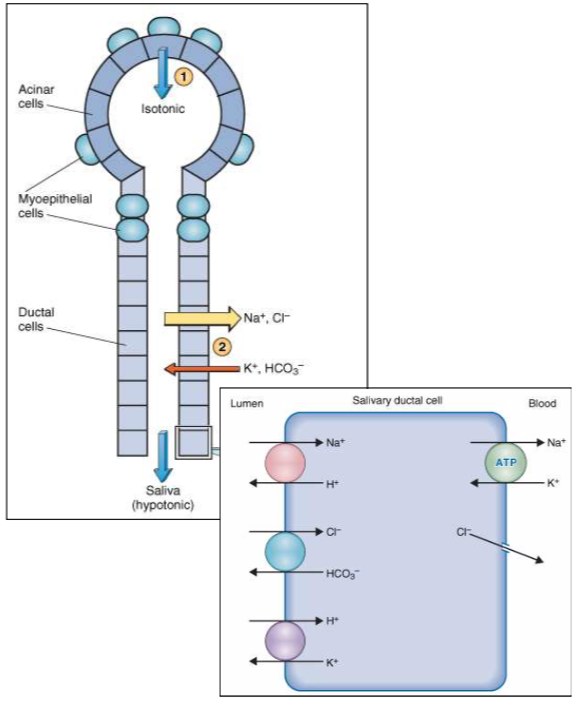
- Acini cells secrete primary secretion (isotonic).
- Na+, Cl-, K+, HCO3-.
- Amylase and mucin production.
- Myoepithelial cells stimualted by neural input to eject saliva.
- Duct cells secrete a secondary modification.
- Reabsorb Na+ and Cl- and add K+.
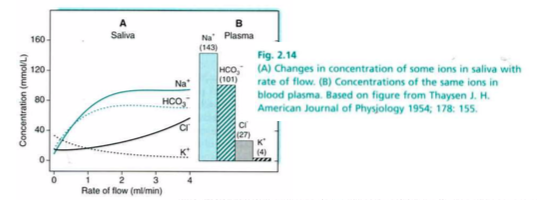
- HCO3- concentration is alteres depending on flow rate.
- At high flow rate, saliva has increased HCO3-.
- At low flow rate, more HCO3- is extracted.
- In the mouth saliva is hypotonic - more dilute than plasma.
- In the
Describe the changes in concentrations of the important ions in saliva.
- When food is in the mouth the bacteria in the mouth and on the teeth feed on the food.
- The more food in the mouth, potentially the more food supply for the bacteria and the more acid is produced.
- We need to increase bicarbonate to neutralise the acid so the teeth are not melted by the acid.
Desribe the types of salivation reflexes.
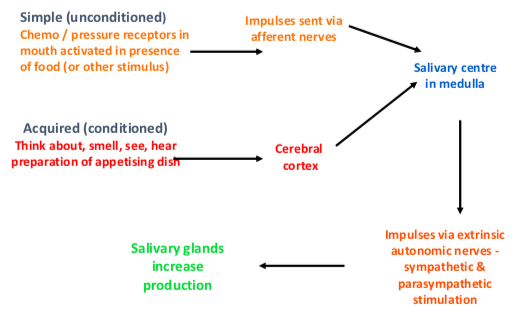
How is saliva secretion increased?
- Simple (unconditioned)
- Acquired (conditioned)
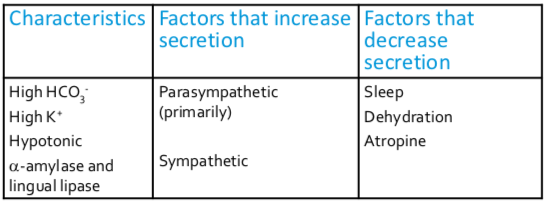
- Increase in salivation is the response of both sympathetic and parasympathetic stimuli.
- Balanced accordingly based on the situation you are in. They both increase saliva secretion.
Describe the regulation of salivary secretion.
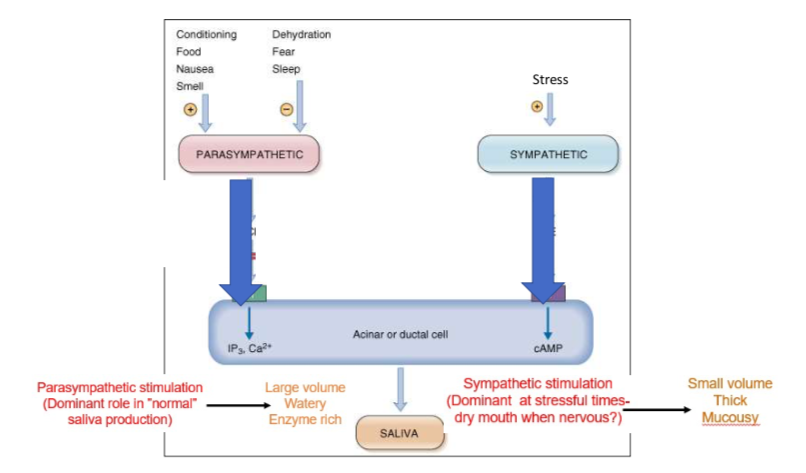
- Parasympathetic - dominant in ‘normal’ secretion.
- Sympathetic - dominant in stressful times.
What is deglutition?
What are the stages of deglutition?
- Swallowing
- Moving food from the mouth into the stomach.
- Stage 1 - oropharyngeal
- Mouth → Pharynx → Oesophagus
- c. 1 second
- Stage 2 - oesophageal
- Oesophagus → Stomach
- c.4-10 seconds
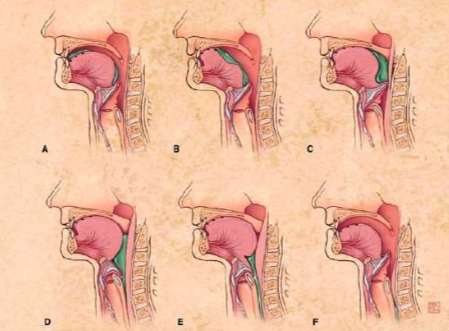
Describe the oropharyngeal phase of deglutition.
- Oral phase
- (A) Bolus held against hard palate by tongue. Requires taste, temperature, touch and proprioception senses for formation of a bolus the right size and consistency for being swallowed.
- Oral transit phase
- (B and C) Lifting bolus on to front of tongue then pushing it posteriorly, towards the pharynx. Pharyngeal phase triggered as bolus moves into the pharynx.
- Pharyngeal phase
- (D and E) Elevation and retraction of velum (soft palate) → velopharyngeal closure (prevents material entering nasal cavity).
- Bolus then pushed further into the pharynx by movement of the tongue base and sequential contraction of pharyngeal muscles.
- Larynx closes preventing material from entering the airway.
- Upper oesophageal sphincter opens, allowing bolus to pass into the oesophagus.
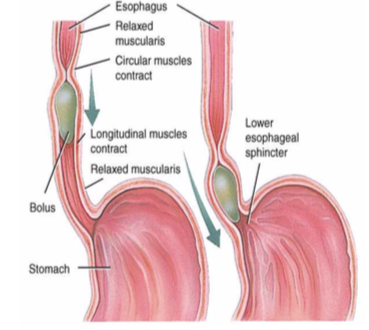
Describe the oesophageal phase of deglutition.
- Swallowing centre (brain) triggers primary peristaltic wave.
- Oesophageal peristalsis
- Primary peristaltic wave from beginning to end of oesophagus (c.25cm) takes 4-10 seconds - too quickly for absorption to occur).
- Peristalsis pushes food to stomach.
- Circular fibres behind bolus squeeze bolus down.
- Longitudinal fibres in front of bolus shorten distance of travel.
- Water will descend quicker than wave but is blocked out of stomach for 4-5 seconds until wave reaches end and triggers gastrooesophageal sphincter opening.
- Sticky food may become lodged in oesophagus, stimulating pressure receptors, causing:
- Secondary peristaltic wave - more forceful than primary (no imput from higher centre).
- Increased saliva production.
- Food enters the stomach through lower oesophageal sphincter.
Describe the oesophageal secretions.
- Only secretes mucous for lubrication / protection (no real digestive function).
- Main body lined with simple mucous glands.
- Protects against mechanical damage.
- Gastric end (especially) has compound mucous glands.
- Protects against chemical damage.
Describe the satiety mechanism.
Receptive relaxation in the stomach means that we can store large volumes of ingesta (several litres) before feeling uncomfortably ‘full’ after a meal.
Describe why we get hunger pangs.
- Caused by peristaltic waves in the stomach occuring when the stomach is empty.
- Can be intense and tetanic (fused) for 2-3 minutes.
- Very intense in young healthy people when blood sugar is low and most intense after fasting for 3 or 4 days.
How is food intake regulated?
Interactions of the feeding centre and satiety centre of the hypothalamus play a large role in the regulation of food intake. This is strongly linked with the apetite centre in the amygdala.
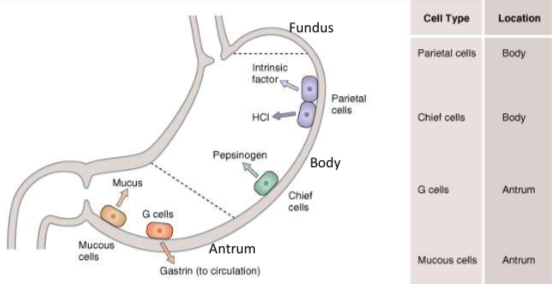
What are the components of gastric secretion?
- HCl
- Protein digestion (a little) - mostly for pepsinogen activation at acid pH, creates pH~2.
- Pepsinogen
- Protein digestion (a little).
- Intrinsic factor
- Vitamin B12 absorption (in te ileum) - very important.
- Mucous
- Protection and lubrication.
Which factors increase and decrease the secretion of HCl in the stomach?
- Increased secretion caused by:
- Gastrin
- Decreased secretion caused by:
- H+ in the stomach
Which factors increase and decrease the secretion of pepsinogen in the stomach?
- Increased secretion caused by:
- Acetylcholine
- Decreased secretion caused by:
- Chyme in duodenum
Which factors increase and decrease the secretion of intrinsic factor in the stomach?
- Increased secretion caused by:
- Histamine
- Parasympathetic stimulation
- Decreased secretion caused by:
- Atropine
- Cimetidine
- Omeprazole
What are the secretory products of each type of gastric cell?
Where in the stomach are these cells found?
What is pepsinogen?
Pepsinogen is an inactive enzyme, which under the action of HCl is converted into pepsin which progresses protein digestion.


-
Secretion and Swallowing58
-
Fluid and Electrolyte Prescribing26
-
Intestinal Infections61
-
Acute Abdominal Pain in Adults19
-
Digestion and Absorption44
-
ADME of Medicines38
-
Bloodborne Pathogens31
-
Alcohol as a Risk Factor18
-
Clinical Presentation and Management of Liver / Gallbladder Disease37
-
Surgical Management of the Gallbladder22


