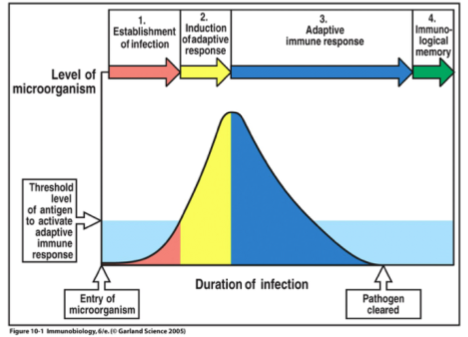
Describe the changes in microorganism levels following the duration of an infection
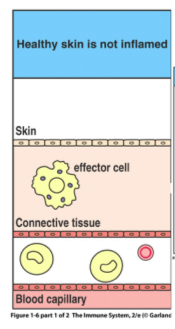
Describe the histological structure of healthy skin
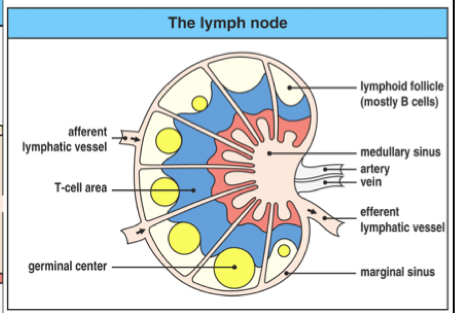
Describe the basic structure of a lymph node, with reference to the T cell area and B cell area
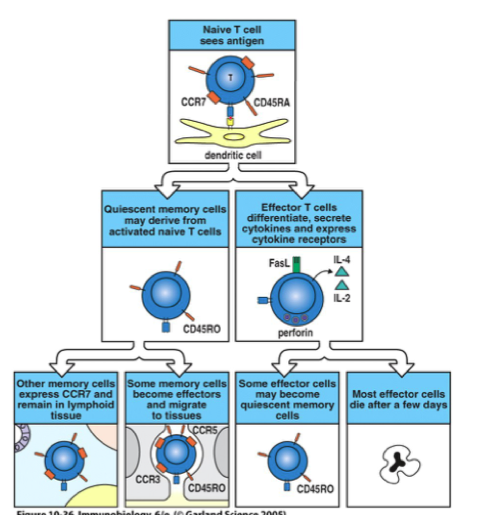
What happens to skin following inflammatory response?
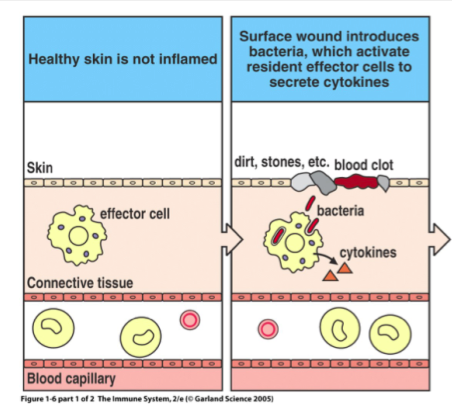
In initial immune response which complement pathways are activated?
- Alternate or Lectin but not classical
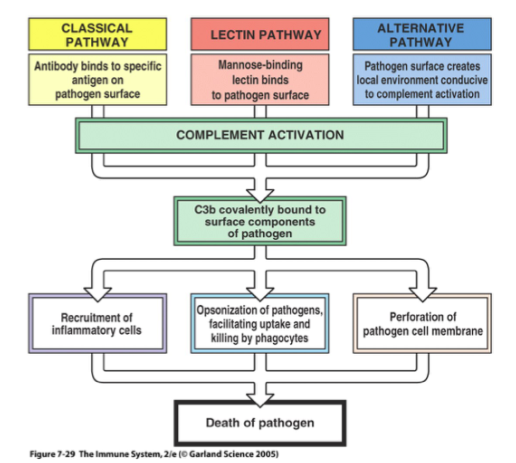
What happens when a phagocyte comes into contact with a bacteria?
- Bacterial binding to endocytic receptors of macrophages induce their engulfment and degradation.
- Bacterial components binding to signaling receptors of macrophages induce the synthesis of inflammatory cytokines.
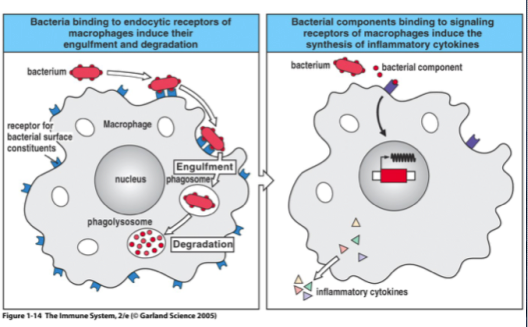
What are the consequences of cytokine influence on the surrounding vasculature?
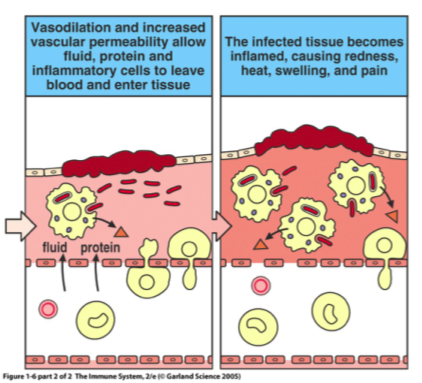
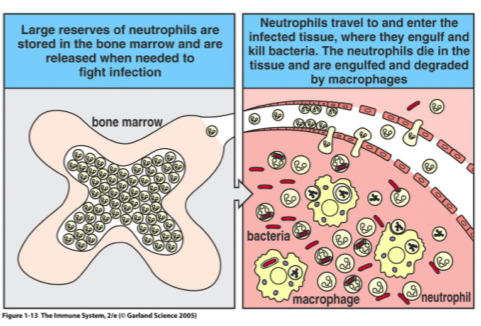
Where do phagocytic cells come from?
- Neutrophils travel to and enter the infected tissue, where they engulf and kill bacteria. The neutrophils die in the tissue and are engulfed and degraded by macrophages.
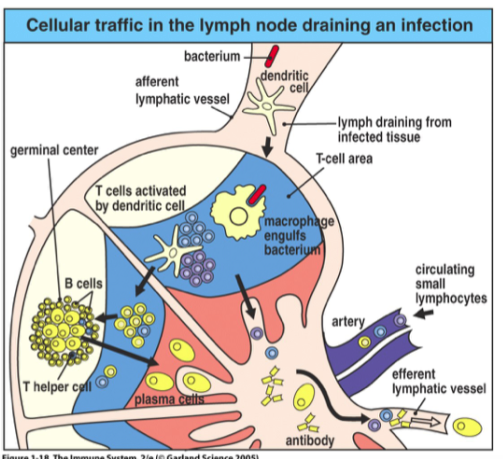
Describe cellular traffic in the lymph node draining an infection
- Information transmitted via afferent lymphatic vessels.
- Leave through efferent lymphatics.
Explain the role of dendritic cells in T cell responses..
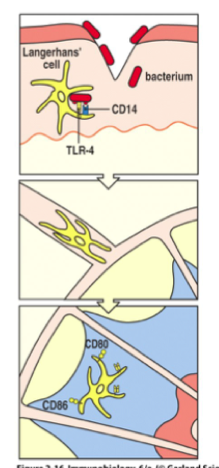
- Specialised dendritic cells are required to turn on T cell responses
- They can capture and process antigen
- They can migrate from peripheral tissues
- They have MHC Classs II molecules
- They can provide ‘costimulation’ - a second signal required to activate T cells
Dendritic cells can also sense the environment:
- They have a range of PRR, including TLRs
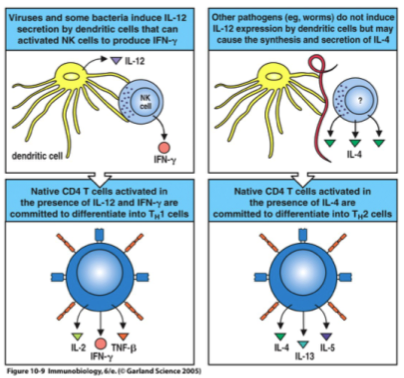
- They make a range of cytokines to influence T cell differentiation
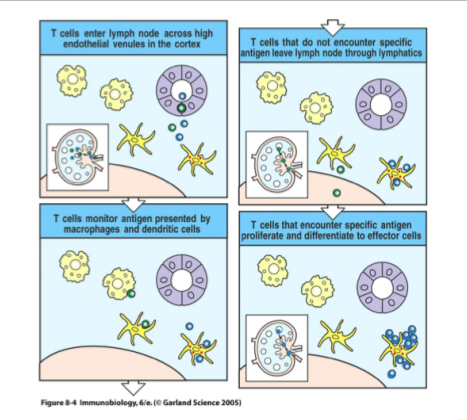
What is the process by which T cells enter the lymph node and generate into effector cells?
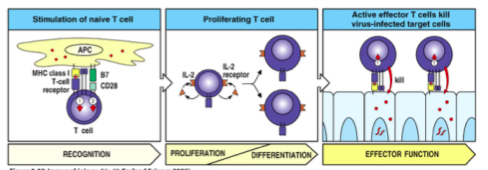
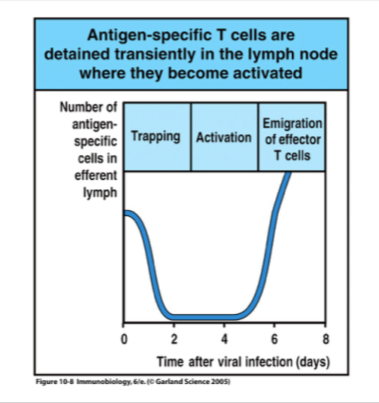
- T cells enter lymph node across high endothelial venules in the cortex.
- T cells monitor antigen presented by macrophages and dendritic cells.
- T cells that do not encounter specific antigen leave lymph nodes through lymphatics.
- T cells that encounter specific antigen proliferate and differentiate into effector cells.
How are naieve T cells stimulated?
Why do we get swollen lymph nodes?
How are Th1 and Th2 cells created?
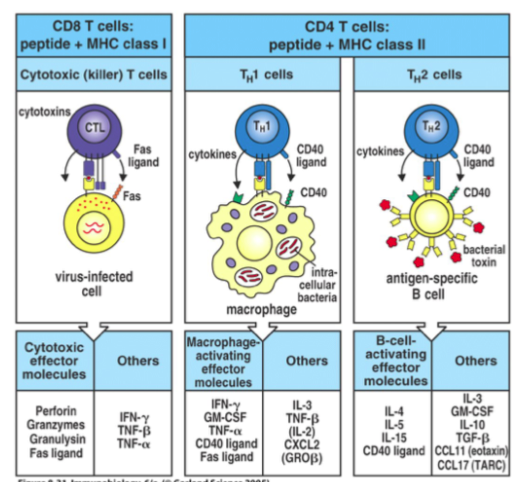
How are CD8, CD4 cells created?
How are B cells created?
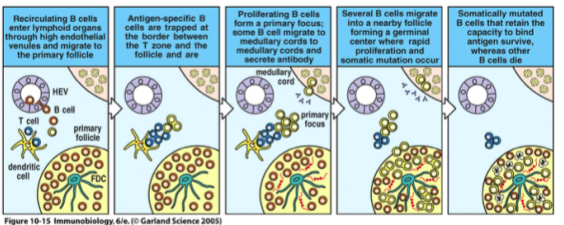
- Recirculating B cells enter lymphoid organs through high endothelial venules and migrate to the primary follicle.
- Antigen-specific B cells are trapped at the border between the T zone and the follice.
- Proliferating B cells form a primary focus: some B cells migrate to medullary cords and secrete antibodies.
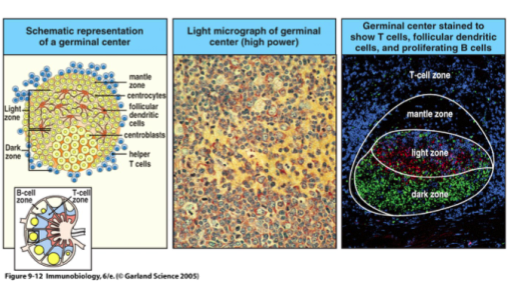
- Several B cells migrate into a nearby follicle forming a germinal center where rapid proliferation and somatic mutation can occur.
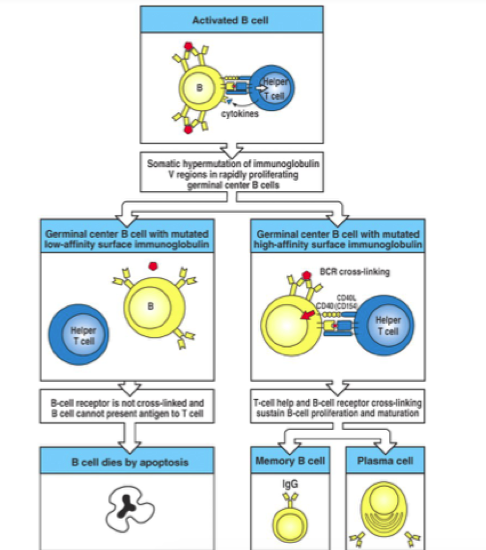
- Somatically mutated B cells that retain the capacity to bind antigen, survive, whilst other B cells, die.
Label the germinal centres of a lymph node
How do B cells die?
When do most T effector cells die?