What are the problems of distance and transport within neurons?
- Essentially all synthesis of proteins and organelles takes place in the cell body. Even the structural components of synapses are synthesized here, and must be transported to the axonal terminal
- at the axon hillock, the division between two components of the neuron the cell body and the dendrites vs the axon can only propagate signals (cell body and dendrites can do almost everything)
- so problem if transport as axon cannot make protein or lipid you need to transport from the cell body, so have a sophisticated system of transport within the cell, to transport from the cell body to the axon terminal/shaft
- we lose neurons all the time, there is some neurogenesis in some parts but every limited, neurons are limited, born with them
- the damage tends to be most prominent in the cytoskeleton of the axon (the cytoskeleton needed for the structure and the transport via the axon)
How far does nutrition usually get in this picture?
- this is all in cell body and dendrites, as go further no structures, beyond D only have mitochondria to supply ATP to allow APs to propagate but no other structures
- even in the adult system the axons remodel themselves so need protein and nutrition
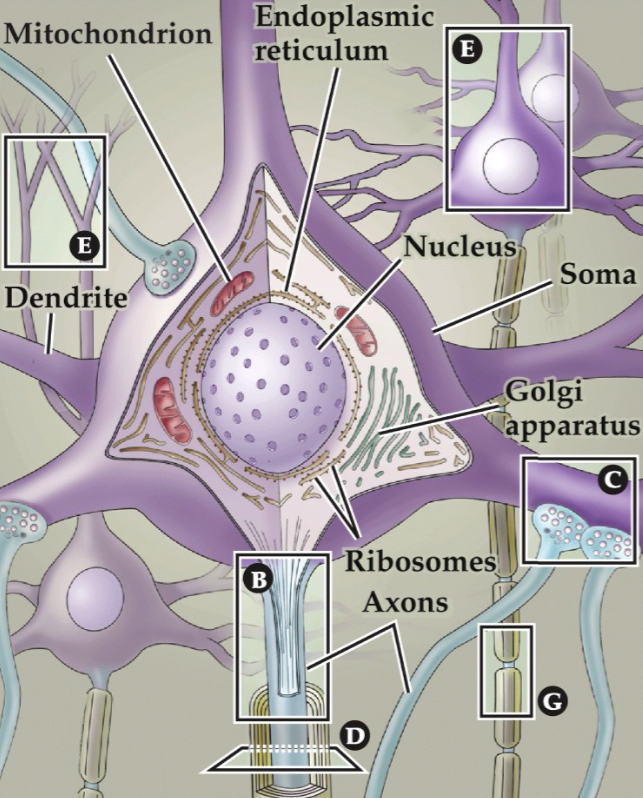
What is special about Purkinje cells and what issues does it face?
- the Purkinje cell= 99% of mass and volume is in the axon, but the small cell body needs to supply the axon
- in dendrites can get some creation and synthesis of lipids and proteins etc.
- the nutrition or particular protein needs to find a particular dendrite end sometimes, complex process
- retrograde transport= when goes from axon or dendrite to cell body
Are neural circuits completely fixed?
• Neural circuits are not completely fixed
– activity dependent
– neurotrophin dependent
– major culling during development
Can new synapses be formed in the adults CNS?
• New synapses can be formed in the adult CNS eg long term memory requires formation of new synaptic contacts -during development there is a competition between axons, they grow out towards the part of the body and number of outgrowing axons that make succesful connections depends on the supply of NGF and other growth factors that are manufactured by teh target tissue , teh amount of neurotrohin and type will determine the type and number of neurons that it will support
What is needed in all neurons?
• There is a continual need to repair, regenerate, modify and construct axonal terminals
How does receptor activation at the axon terminal stimulate responses in the cell nucleus?
- via retrograde signalling
- Retrograde Axonal Transport is essential for NGF signalling
- But what exactly needs to be transported? NGF? Or a signal
What is neuronal survival dependent upon?
- sensory neurons:cell body in dorsal root ganglia and axons grow to the periphery, twice as many are generated (axons) whether they survive is dependent upon if they take up neurotrophins from a particular cell
- if a skin cell is secreting lot of neurotrophin then it will support more nerve endings than for example a cell on your back where you don’t feel as easily
- the problem is that the receptor binding iccurs at teh axon terminus in the periphery, removed from the cell body where the decisions about protein synthesis and survival occur
- sowhat needs to be transported
- it is called retrograde signalling (signal propagates backwards)
What is the problem with retrograde signalling?
-even in a CNS neuron the axon terminal is far removed from the cell body, this is even more extreme in the PNS
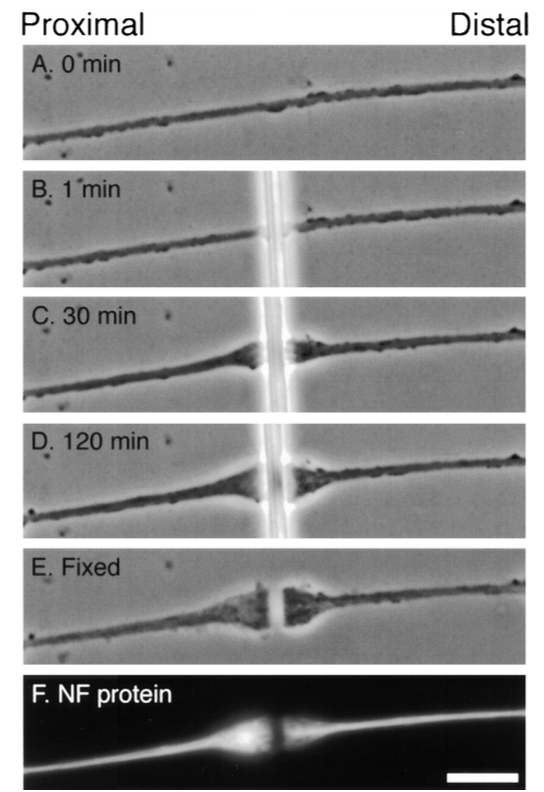
What does this picture show?
- the retrograde and anterograde transport take place at the same time
- sometimes signaling vesicles go from terminus, internalization and transported to the cell body
- gradual built of of material when cut into two so retrograde and anterograde transport occur at the same time
What are the main components of the axonal skeleton?
- Microfilaments (actin): 8 nm diameter
- Intermediate filaments (neurofilament): 10 nm
- Microtubules: 24 nm diameter
- Actin is most abundant at the axon terminus and close to the plasma membrane. It interacts with actin-binding proteins, including membrane proteins such as spectrin – involved in cell-cell contact
- large filaments= microtubules, they account for the mechanism of the anterograde and retrograde transport
- all the cytoskeletal components are globular proteins that are polymerised without branching -in nervous system= neurofilament (specialised intermediate filament) so can identify neurons that way, slightly larger than intermediate filaments and tend to be cross-linked by actin filaments
- the microtubules= they are responsible for transport and important role in structure, and in different cells have diffeent roles, they are presnt in all cells but only in axons are they this long and good for transport, responsible for the way cells change shape, and transport in in the cell body
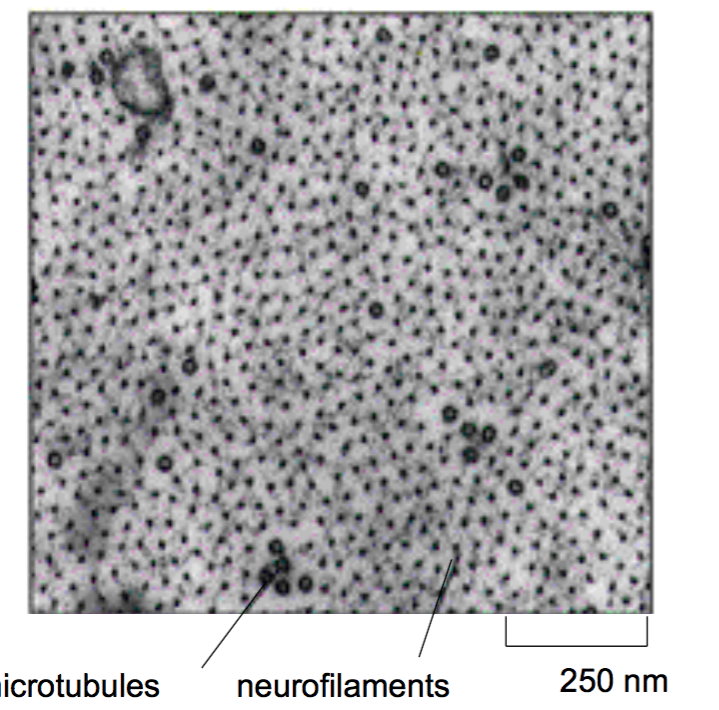
What is this?
- cross section of an axon -neurofilaments= intermediate filaments
- be impressed by how parallel they are, no tangential, immaculate this is what a healthy neuron looks like, in a 70 year old neuron has tangles of the intermediate filaments (this is what happens in Alzheimer’s)
- vulneraibility as need
- actin mainly present in axon terminals and presnet cross linking the different neurofilament
- also many microtubule associated proteins have a role in holding this in shape
What are the main functions of microtubules?
- axonal transport
- contribute to cell shape and strength
- shuttle organelles inside the cell body
What are the roles of dynein and kinesin?
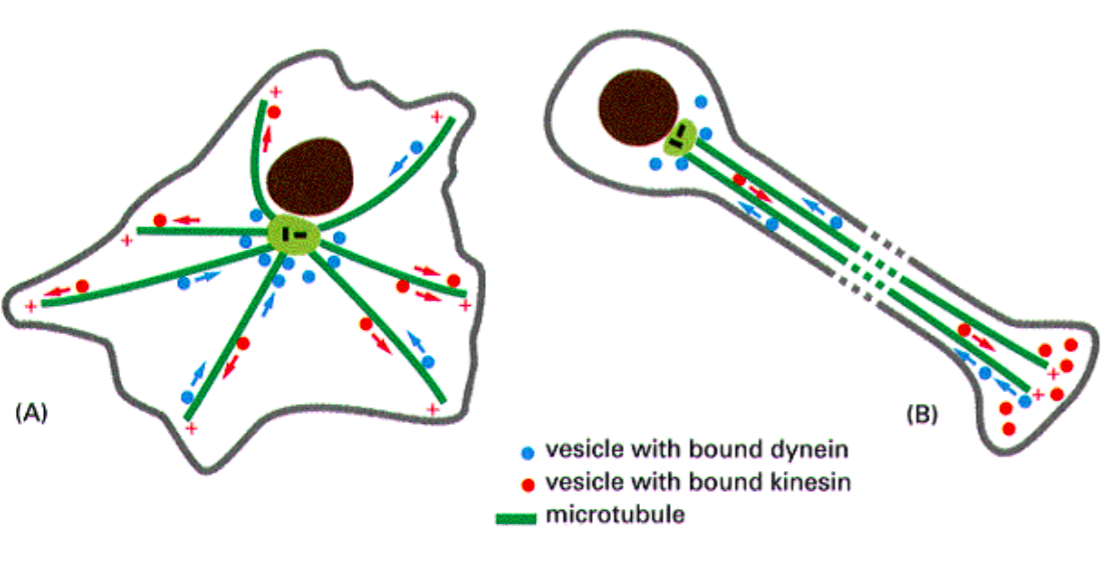
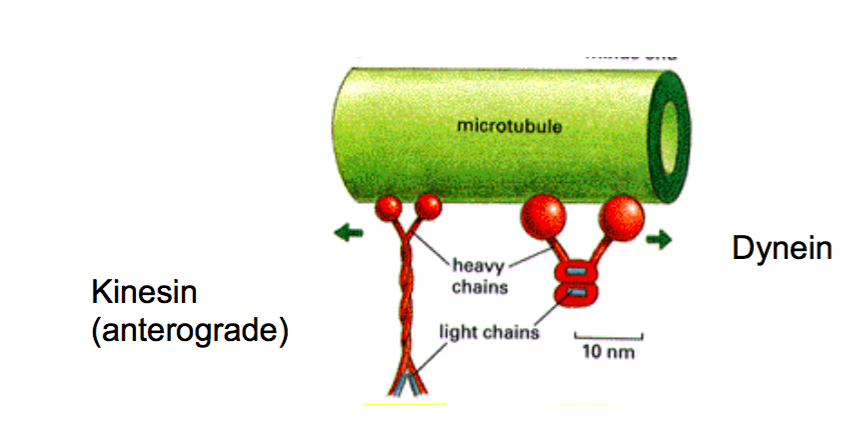
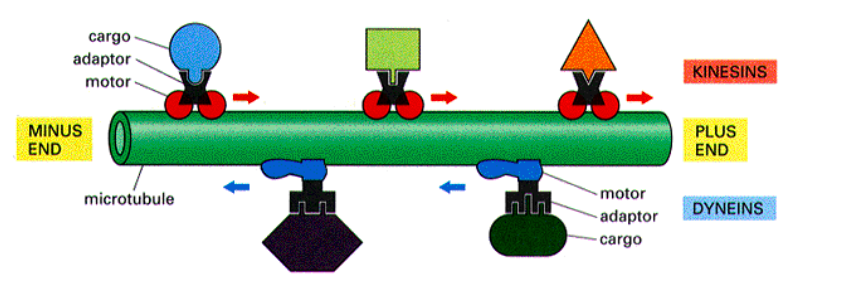
left: normal cell, microtubules go from the center to the periphery, have a minus and plus end, the hub has the minus end and the plus end is at the periphery, all movement of structures happens via specific transport mechanisms on the microtubules (on the outside of it).
- the red structures moving away from center= kinesin, the motor molecules, pulling the cargo along, agents of anterograde transport
- agents of retrograde transport are the dynein molecules
- both kinesin and dynein are similar, need ATP for each step they take
- family of kinesin and dynein, different ones specialised for different cargo, but in general all fast transport the cargo is carried by dynein and kinesin and always a lipid bound structure that is transported (as small as an endosome or as large as mitochondria)
How are microtubules made?
• Synthesized by polymerisation of αβ tubulin heterodimers.
-The β end is called the + end and undergoes preferential extension and shortening
• The α end is the–end and is the site of nucleation and anchoring
- microtubules are dimers, have alpha and beta tubulin, first dimerise the alpha and beta tubulin and then those polymerise but always in the same head to tail order, the minus end (closest to the nucleus) is the alpha molecule, at the plus end (near the neuron terminal) is the beta molecule
- so it goes alpha beta alpha beta etc.
Where does the action (transport) occur?
- all the action happens outside the tubule
- the dynein and kinesin molecules can easily move along the filament (cannot switch them easily but once on there can move)
- there are 13 units of transport in each tubule, each capable of supporting transport, 13 filaments form the microtubule, and on each filament more than one dynein and kinesin (100s)
- can have on one filament dynein going one way and kinesin the other, somehow nothing happens when they meet
Are microtubules dynamic?
- microtubules are dynamic by nature, always elongating or shortening, related to GTP
- when extending (axon etc) the tubule needs to be activated by GTP to be extended, in time the GTP is hydrolysed to GDP that becomes unstable and if you have that it is unstable microtubule, so always growing or falling back, this is useful so axons can change shape when needed
What are some of the microtubule associated proteins?
- there are microtubule associated proteins keeping the microtubules in their array, right spacing
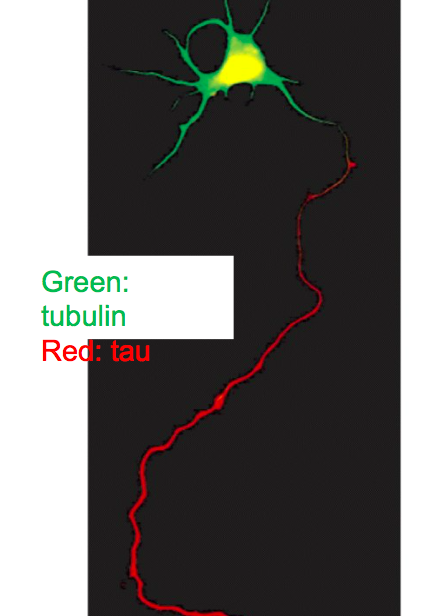
- in axons one of the main microtubule associated proteins is tau, in dendrites it is tubulin and there are many others (eg. MAP2)
- tau is responsible for holding microtbules in their direct orientation and spacing and for some reason tau is a protein that often goes wrong as aging occurs (so many rare but numerous neurodegenerative diseases due to disfunction of tau so have a family of diseases called tauopathies)
How does kinesin work?
- The Mw of kinesin = 380,000
- The head region binds to the microtubules, and acts as the motor by hydrolysing ATP.
- The tail region binds to the cellular vesicles in a specific manner. Each type of membrane vesicle has its own type of kinesin motor protein.
- Kinesins move along a single protofilament of the microtubule.
-both kinesin and dyinein have two heads that attach to a single filament and walk by moving one head in front of the other, they essentially walk along the single protofilament (this is in fast axonal transport), each step requires hydrolysis of ATP, capable at stepping quickly 1000s of steps a second (each step a fe nanometers)
Can anterograde and retrograde transport occur at the same time?
• Anterograde and retrograde transport can occur on one microtubule, and the vesicles can cross without collision.
PIC7How does fast axonal transport work?
- Vesicles are carried along the outside of microtubules by kinesin
- Transport occurs in 5 nm hops and consumes ATP. The maximum speed of transport is 3 microns per second (12 mm per hour)
- Vesicles carry membrane proteins (e.g. receptors, channels)
- Vesicles may contain soluble proteins, but these are to be secreted (e.g. neuropeptides) or retained within the membrane
- it depends on what they are carrying, if carrying an organelle then slower than the max. with a mitochodria maybe a 1mm per hour
- the fast transport only applies to lipid bound structures so presents a problem, how do you transport thing not coated in membrane like structural proteins ,enzymes needed for synthesis of neurotransmitetr (the one for acetylcholine one is water soluble so not a membrane protein) so these are carried via slow axonal transport, while less understood it is the less efficient version of the fast transport, use dinein and kinesin
- the difference is: that the binding of the cargo that is maybe semipolymerised chunk of proetine, means that the kinesin molecule is now incapable of fast and efficient stepping along the protofilament, so what you observe is lots of stopping strating etc. not efficient so seems like fast transport not working very well, during halts it appears as if the kinesin staays boudn to cargo but detaches from the protofilament then reattaches and then moves and detaches again…
- the growth of axon is dependennt on how quickly you can transport the semipolymerised chunks of tubulin etc. can only go via slow anetrograde transport and this limits speed of neuroregeneration
What are the characteristics of kinesin?
- MW = 380,000
- Consists of two identical heavy chains and a light chain
- The head region binds to the microtubules, and acts as the motor by hydrolysing ATP.
- The tail region binds to the cellular vesicles in a specific manner. Each type of membrane vesicle has its own type of kinesin motor protein.
- Kinesins move along a single protofilament of the microtubule.
- Anterograde and retrograde transport can occur on one microtubule, and the vesicles can cross without collision.
How does retrograde transport work?
- Membrane - bound vesicles are returned to the cell body from the distal axon.
- (i) endocytotic retrieval of synaptic vesicle membrane
- (ii) ligand-induced internalisation of receptors at clathrin- coated pits
- Mitochondria are returned to the cell body
- Also:
- Multi-lamellated vesicles of unknown function
- Structural proteins - possibly damaged by oxidation, nitrosylation and other unwanted modifications
How does slow axonal transport work?
Slow Axonal transport
- Necessary for structural proteins such as neurofilament
- Also necessary for soluble cytosolic proteins?
- Structural proteins such as neurofilament appear to be transported in polymerised form along the existing cytoskeleton, but the mechanism is unknown.

-
Lecture 1- Introduction34
-
Lecture 2- Neurons and glia42
-
Lecture 3- Ionotropic receptors I: Excitation29
-
Lecture 4- Ionotropic receptors II: Inhibition18
-
Lecture 5- AP and AIS28
-
Lecture 6- Mechanosensory Transduction20
-
Lecture 7- Special sensory transduction mechanism15
-
Lecture 8- Measuring neural activity I28
-
Lecture 9- Measuring neural activity II25
-
Lecture 10- Introduction to metabotropic receptors50
-
Lecture 11- Modulation of neuronal functions by metabotropic receptors30
-
Lecture 12- Dopamine27
-
Lecture 14- Stem Cell Therapies for Parkinson's disease32
-
Lecture 15- Synaptic release and presynaptic proteins42
-
Lecture 16- Axonal transport24
-
Lecture 17- Neurotrophins24
-
Lecture 18- Postsynaptic density7
-
Lecture 19- Autonomic nervous system I40
-
Lecture 20- Autonomic nervous system II17
-
Lecture 21- Autonomic nervous system III17
-
Lecture 22- Autonomic nervous system IV14
-
Lecture 23- Spinal injury26
-
Lecture 25- Enteric nervous system I22
-
Lecture 26- Enteric nervous system II12
-
Lecture 27- Modelling of neurons16
-
Lecture 28- Neuropsychiatry and gut14
-
Lecture 29- Gut microbiome16
-
Lecture 30- Injury to the nervous system I27
-
Lecture 31- Injury to the nervous system II23
-
Lecture 32- Repairing the nervous system22
-
Lecture 33- Neuroplasticity I12
-
Lecture 34- Neuronal plasticity II21
-
Lecture 35- Neuronal plasticity III13


