Define personality
Personality is our character.
Should be thought of as both our social reputation (the observer’s view) and our inner nature (the actor’s view, your identity).
Personality as identity is the story you tell others about your self, your aspirations, goals, your fears, theories how to get along, find meaning – it is your part played in a social interaction.
Personality as a reputation is the evaluation of your past performances during social interaction and shared by the members of your community.
Reputation is used to predict behaviour; Identity to explore behaviour.
2 ways to understand individual personality
Traits (Neuroticism, Openness)
Types (Type A/B; choleric; INTP of Myers-Briggs)
Type Research vs. Trait Research
Types
Aims to define general dimensions that best define our personality. Greek philosopher Galen described four types of people: sanguine, choleric, melancholic and phlegmatic.
- Benefits: intuitive simplicity, generalisation
- Limitations: delimitations between types are vague
Traits
Traits that are universal in predicting behaviour
- Benefits: more precision, statistical validity
- Limitations: massive number of traits
Myers-Briggs Type Indicator (MBTI)
Description + Issues
Example of Type Research:
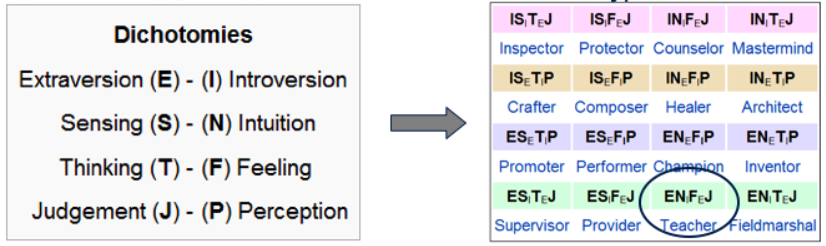
Tries to identify individual differences, assesses individual preferences for perceiving the world and making decisions. Any individual can be assigned to one of 16 categories.
Issues with this test:
- Underlying assumption that we have our preferences.
- test-retest factor is extremely low
- questions don’t acknowledge that an answer might be on a spectrum
- test does not include all human characteristics like selfishness, laziness, being mean, etc.
Based on Carl Jungs untested classification (theory). Types are based on 4 principal psychological functions.
- How do we make decision: thinking or feeling
- How do we take in information: sensation or intuition
- How do we prefer to live our lives
- How do we interact with outside world
Is “achievement-motivated” a type or a trait?
We are achievement-motivated to varying degrees. Thus, it’s not necessary to type-cast individuals on achievement but only to notice individual differences in the trait.
Research on Personality Traits
Allport and Odbert (1936) used the dictionary to allocate 17,953 words to 4,504 personality traits that can describe individuals.
Factor analyses were conducted to reduce the number of measurable traits to a manageable level
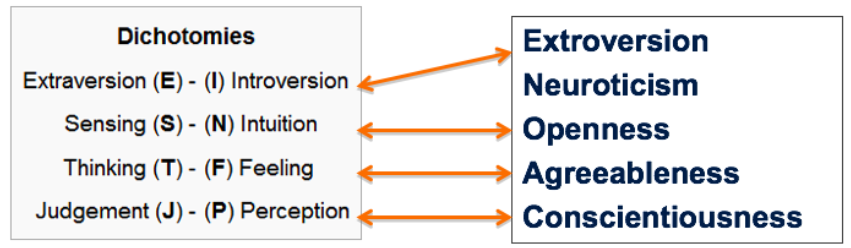
Five-Factor Model “The Big Five” aka NEO
This model is highly reliable in describing people’s personalities over time, across observers, and in different cultures (more so than Myers-Briggs type indicator!).
- Neuroticism: Related to levels of anxiety and emotionality, worry and insecurity
- Extraversion: Sociable, gregarious, assertive, talkative and active
- Openness to Experience: Culture, intellect, imagination and creativity. (most difficult to identify)
- Agreeableness: Likeability, friendliness, compliance and altruism
- Conscientiousness: Dependability, reliability, will to achieve and hardworking
These traits were identified through extensive factor analysis of over 17,000 words used to describe people’s personality.
Strengths and Weakness of the Five Factor Model (NEO)
Strengths
- Accumulation of research:
- Precision of trait research
- Reliability across cultures and over time
- Research demonstrates that some factors are related to several job-related criteria
- Narrowly defined measures of the factors (i.e. facets) provide superior predictive ability for more narrowly defined criteria
Weaknesses
- Actual explanatory power of personality factors has been inconsistent and generally low.
- This even includes conscientiousness, which explains only 4 to 6% of variance in job performance
- As organizations are “strong situations”, individual differences are rarely salient (noticable nor important)
- Because people tend to model their behaviour to fit the firm culture or to emulate those they aspire to be like.
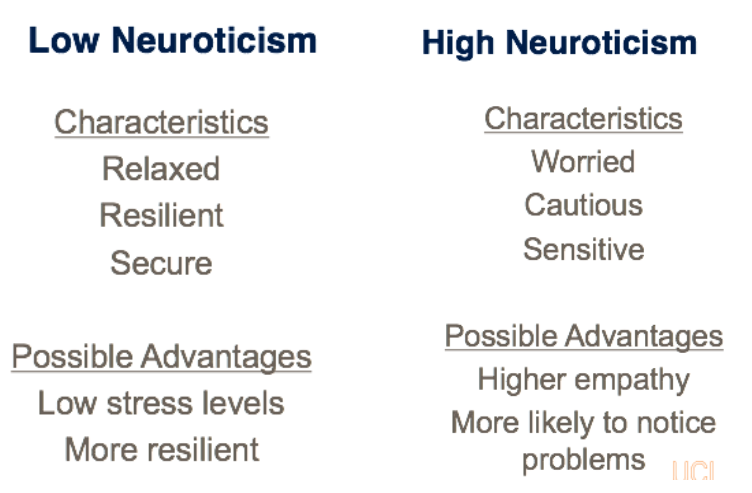
Neuroticism in detail
Way of responding to negative emotion
Intensity and frequency of negative emotions arising from negative beliefs about life in general, oneself and other people and the impact of this on emotional adjustment
Extraversion in detail
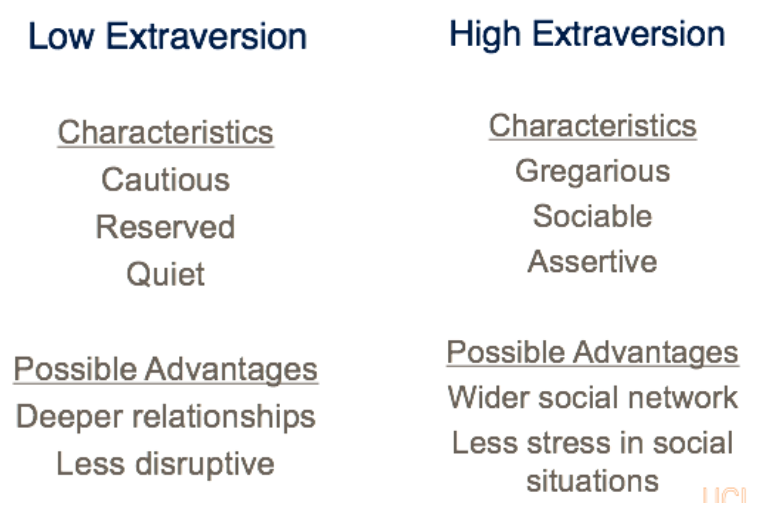
Way of interacting with external world
The amount of energy directed outwards into the external environment and the need for external stimulation.
Openness to Experience in detail
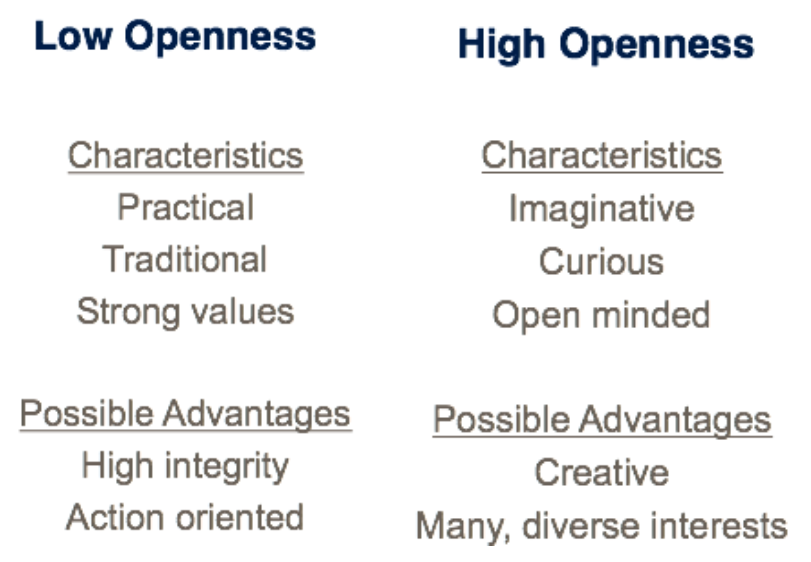
Way of responding to experiences & information
Receptivity to a range of external and internal sources of information and new input
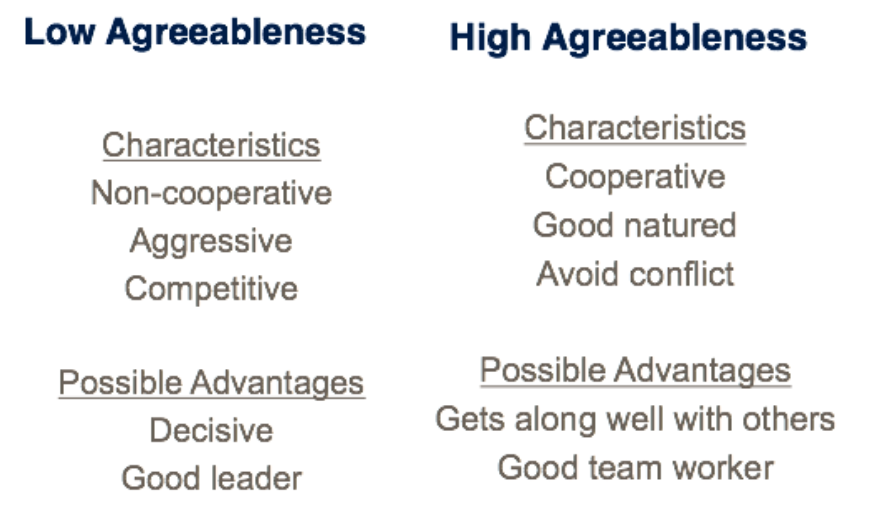
Agreeableness in detail
Way of interacting with others
The role a person adopts in relationships along a continuum from compassion to antagonism; the likelihood of being influenced by others
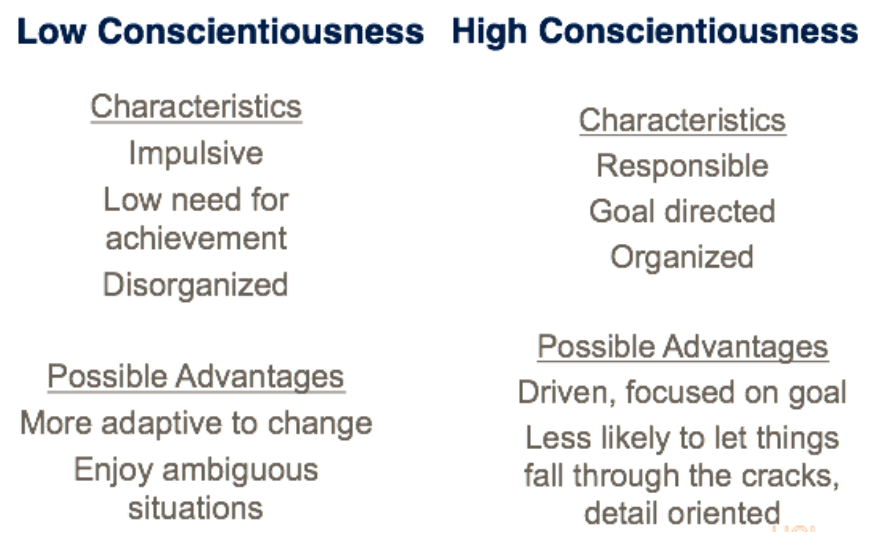
Conscientiousness in detail
Way of approaching tasks
Strength of purpose and drive to goal accomplishment
Comprised of:
- Duty
- I pay my debts promptly and in full.
- I keep my promises.
- Achievement Striving
- I work hard to accomplish my goals.
- I strive to achieve all I can.
‘Spouse Personality’ Reading
Dual earner couples put more time in at work if there relationship is going well, since the absence of drama at home gives them greater emotional, cognitive, and physical vigour to bring to the workplace.
- conscientious spouses handle a lot of household tasks, freeing employees to concentrate on work
- employees tend to imitate their conscientious spouses’ hardworking habits.
- Successful people have often strong relationships
- CEO’s can run their company sometimes better if they are single
- These employees are more receptacle to flextime and telecommunication to spend more time with their SO
Only conscientiousness [Gewissenhaftigkeit] (predicts income, number of promotions and job satisfaction) is influenced by the spouses personality (the more your spouse is it, the more likely you are as well to be it)
Do MBTI and NEO measure the same thing?
NEO is more reliable!
NEO can evaluate personality comprehensively in different cultures, and languages.
High level of test-retest reliability (after age 30)
- Both over small and large spans of time
- Also correlates with others’ assessments of own personality
However, some changes in personality occur with age:
- Less emotional and less extroverted as we get older
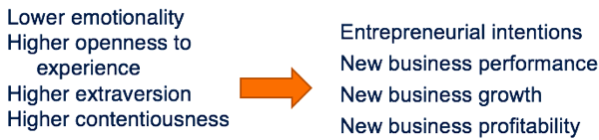
Influence of personality on entrepreneurship
Why does personality have little relevance in organisations?
Social Identity Theory
- We model our behaviour on those around us or after those that we aspire to be like
- Organisations are “strong situations” in which individual differences such as personality do not exert significant impact
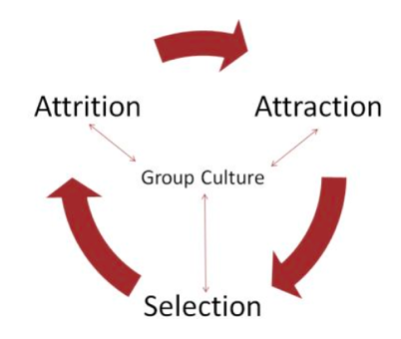
- Ben Schneider’s model: Attraction-Selection-Attrition (see img)
- suggests that organisations over time may become relatively homogenous with regard to the kinds of people in them, in which case the differences in personality are very small, giving insufficient power to explain differences in individual performance
Do organisations have personalities?
Ben Schneider’s ASA Model:
Situations are defined in terms of the attributes of the persons present in the situation
- People select themselves into and out of situations (e.g., career environments) based on how they fit
- Individuals are attracted to, selected by, and are likely to remain in organisations that help them achieve their personal goals
So…
- “People make the organisation”: Over time, organisations become defined by the persons in them, as a natural outcome of A-S-A.
- Founders and top management have long-term effects on organisations
- Matching personal and organisational personality is good for individual goal achievement
Broadly defined measures vs. Narrowly defined measures
Broadly defined measures = mediocre general predictors
- e.g., Conscientiousness and job performance
Narrowly defined measures = superior predictors
- e.g., Duty and Achievement as facets of Conscientiousness
How is Duty and Achievement striving related to
- innovative suggestions
- job proficiency
- escalations of commitments to a losing proposition
- overall job performance
- does conscientiousness generally influence these things?
- Duty good for innovation
- Achievement striving negatively related to innovative suggestions
- Duty is positively related to job profiency for health care workers while unrelated amongst managers.
- Achievement striving is positively related to job profiency for managers, while negative among health care workers.
- Duty is associated with a de-escalation of commitment to a losing proposition
- Achievement striving is associated with an escalation.
- For overall job performance, duty and achievement striving are mutually important, but may diverge when considering other behaviours (especially those tapping self versus other centred interests).
- The broad measure of conscientiousness shows no relationship with the above things.
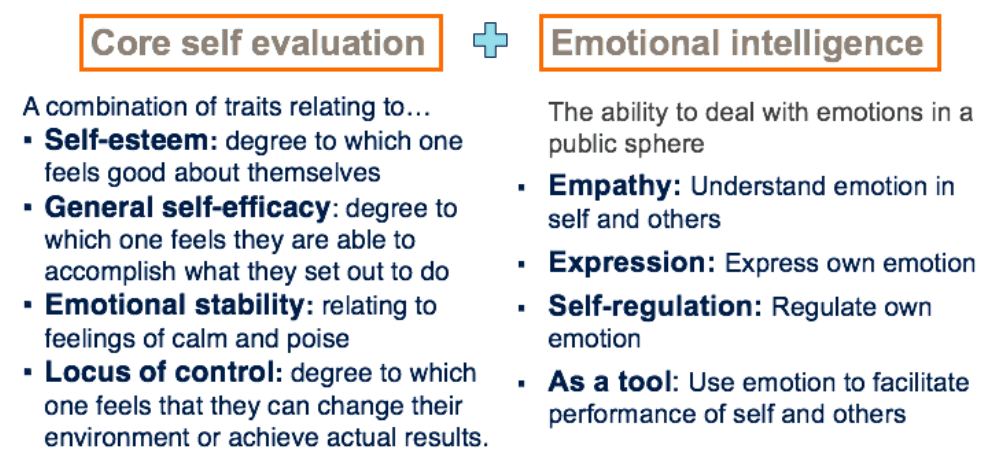
What is a “Healthy” Personality made of?
Kelley’s Attribution Theory aka Covariation Model
How we attach meaning to other’s behaviour or our own.
Is someone angry because bad-temper (internal) or because something bad happened (external)? It is usually a mix!
Internal Attribution (Dispositional)
The process of assigning the cause of behaviour to some internal characteristic, rather than to outside forces. When we explain the behaviour of others we look for enduring internal attributions, such as personality traits.
External Attribution (Situational)
The process of assigning the cause of behaviour to some situation or event outside a person’s control rather than to some internal characteristic. When we try to explain our own behaviour we tend to make external attributions, such as situational or environment features.
Covariation
- Define
- What factors influence covariation
- Issues
Covariation means that a person has information from multiple observations, at different times and situations, and can perceive the covariation of an observed effect and its causes.
- If the person consistently displays a behaviour over time, then we are more likely to think their behaviour is caused by their the character instead of environment.
- If a behaviour is distinct, we attribute the behaviour to situational factors.
- If the consensus is in line with the person’s character, then we attribute behaviour on the environment. For instance, most people come late to one meeting. People think that it has probably to do with the bad weather, parking issues, etc.
Issues
- insufficient information to judge right. For example, we might not know if behaviour is consistent.
- information about consensus, distinctiveness & consistency needs multiple observations
- people tend to avoid cognitive work; close attention is needed for this theory
According to the Attribution Theory, we fall back on past experience and look for either:
- multiple necessary causes
- multiple sufficient causes
Multiple necessary causes. For example, we see an athlete win a marathon, and we reason that she must be very fit, highly motivated, have trained hard etc., and that she must have all of these to win.
Multiple sufficient causes. For example, we see an athlete fail a drug test, and we reason that she may be trying to cheat, or have taken a banned substance by accident or been tricked into taking it by her coach. Any one reason would be sufficient.


