When should a team be applied?
when
- answer is difficult
- ideally, easy to divide the task
Organizational trends that make teams more important:
- Increased need to make decisions quickly
- Increasing amount & complexity of information & types of tasks
- Globalisation
- Increased accountability of decisions
- Focus on creativity & innovation
Team vs. Group
A team interacts with each other, is interdependent, and shares a goal, not like a group.
Also, team members are:
- bounded through membership
- relatively stable over time
- operate in a larger context (organization, program, etc.)
What Defines Good Team Performance?
- Completing the task
- Maintaining social relations
- Individual benefit (members satisfied with their result)
Pros and Cons of Teamwork
Pros
- Pooling of resources, skills, abilities
- Specialisation of labour
- Multiple different perspectives on an issue
- Creativity & innovation
- Decisions tend to be more easily accepted by others
- Can set high performance standards
- It’s more enjoyable to work in a group (usually)
Cons
- Potential waste of time – groups tend to be less efficient than individuals
- Group conflict
- Some members over-contribute while others under-contribute
Why have teams the potential to outperform individuals on a task and what hinders teams to perform?
Teamwork Potential
Teams have more resources, information, and skills to use on the problem.
Actual Performance = Potential Productivity + Synergy (emergent) - Process Loss
Teamwork Issues (Process Losess)
Coordination losses:
- Occur due to time and effort spent trying to divide up tasks between group members and reintegrating products of multiple individuals (e.g. duplication of effort)
Communication losses:
- difficult to communicating
- convincing and persuading
- miscommunication
Social loafing/Free-riding
- less individual accountability, may lead to less contribution
- Rely on others to accomplish work
Contribution bias:
- Group members tend to think that they are contributing more than their fair share to the group
- Results in lower contribution
Other
- low norms
- anxiety
- production blocking (difficult to generate ideas while others are speaking and having to mentally hold on to ideas until others stop speaking)
Complex Projects + Teamwork
In very complex projects, because of process losses, in general, groups produce fewer and lower quality ideas than individuals do when they’re working alone!
Majority Influence & Minority Influence
Majority Influence
People tend to say what others say.
Reasons:
- Assume majority must be right
- Trying to fit in
- Fear of rejection from the group
Leads to:
- Avoid voicing our views
- Succumb to convergent thinking
- Seeing issues exclusively from the perspective of the majority
Minority Influence can overcome Majority Influence.
When the group has a consistent minority, who stick to a different view point, the majority group members tend to think more divergently, creatively and more thoroughly about issues.
This happens even if the minority members are incorrect, and even if they don’t actually convince the majority that they are right.
Thus, minority influence is less about changing people’s minds, and more about changing how the entire group thinks.
Usually requires:
- More than one person to be in the minority
- Consistent, committed disagreement from the minority
How to drive innovation and diversity?
Diversity drives innovation, innovation drives diversity.
For gender diversity to take an affect on innovation, you need to have more than 20% of leadership positions filled with women.
It will not happen naturally; more female graduates exist but the same high male % of leadership positions. Don’t do it because you feel the need to be PC or comply with regulation. Do it because it makes business sense.
Types of Conflict
Task conflict: conflict over ideas/opinions related to the task
- Generally beneficial
- Helps group to see different perspectives, be vigilant in considering all relevant information
- Task conflict is encouraged by differing group roles and expertise
- Have structural approaches in case different opinions
Process conflict: differing problem approaches, coordination, work distribution, methodology…
- Beneficial in early stages, to ensure good process is established
- Harmful if continues once process begins
Interpersonal conflict: differences in personality; friction between individual group members
- Harmful to group cohesion & performance
- should we have seen this coming — personality tests?
What encourages task conflict?
group roles, functional/expertise diversity
tips for mitgating bad conflict
- Create common goals that can lift the group beyond differences
- Enforce a psychologically safe environment, where questions, new ideas, and critique is accepted
- Enable sharing and trust
- Do social activities for bonding
- Maintain a high level of social capital — trade favours and affective related events
- Maintain multiple mindsets by role playing, trying to see others’ perspectives
Psychological Safety
A state in which team members do not feel a fear of being rejected by the team for engaging in risky interpersonal behaviours:
- Asking questions
- Challenging opinions
- Share concerns
- Experimentation
- Making suggestions
Creating psychological safety:
- Be explicit about the need for questions, suggestions, contributions of group member
- Be accessible to group members and open to questions and concern
- Actively solicit group member feedback and input
- Model risky interpersonal behaviour
- Recognise, reinforce, & reward group member input
- Each person is important. Everyone is respected.
- Bring up conflict directly; they don’t let it fester.
- Listen carefully
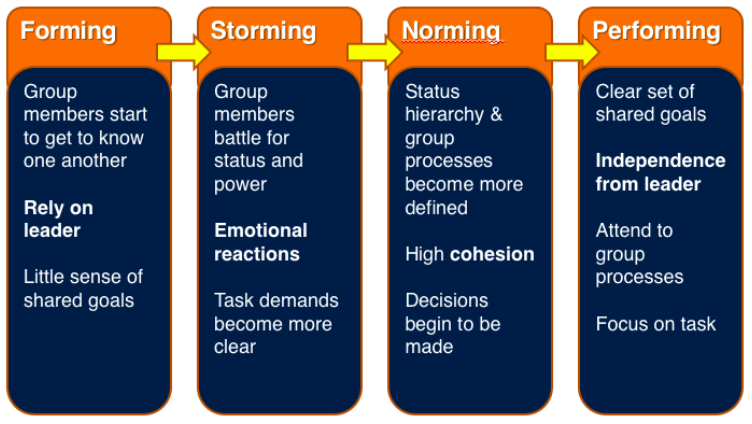
Group Development Stages
BUT REALLY, GROUP DEVELOPMENT IS NOT WELL UNDERSTOOD.
Defintion of Group Cohesion + Types
Group cohesion: a force that draws members together
- Affective cohesion based on how much they like each other
- Task-based cohesion based on how much members pull together to work
High cohesion can cause groupthink: tending towards consensus seeking
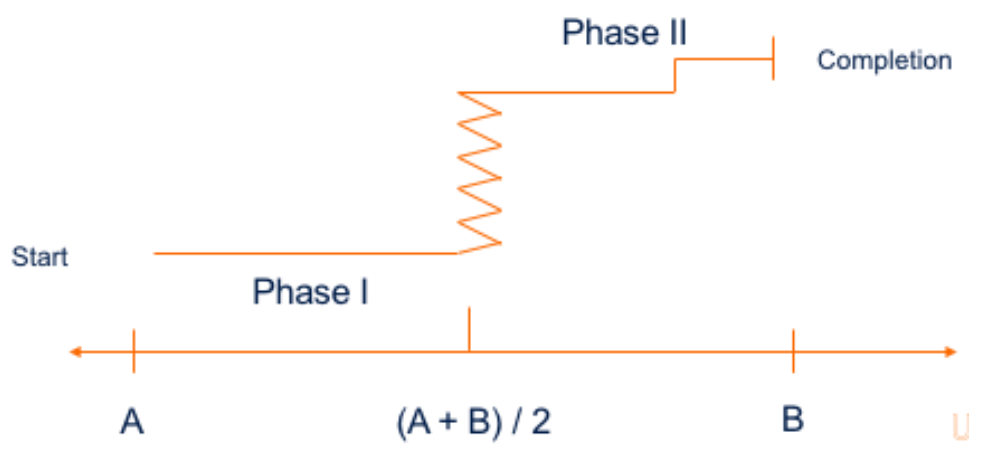
Gersick’s Punctuated Equilibrium (in group development)
Groups tend to demonstrate a “punctuation” of activity revolving around the mid-point of the team’s lifespan. The mid-point is a critical paradigmatic shift where high performing teams engage in a concentrated burst of activity and adopt a new perspective
Rhythmic Sonata Model:
Successful teams experience 3 stages
3 unique and relatively independent stages:
- Commitment – early stage
- create shared goal
- Productivity – middle stage
- group decisions, conflicts
- Resolution – final stage
- review and feedback
Consistent with the historic views of Tuckmanand Gersick.
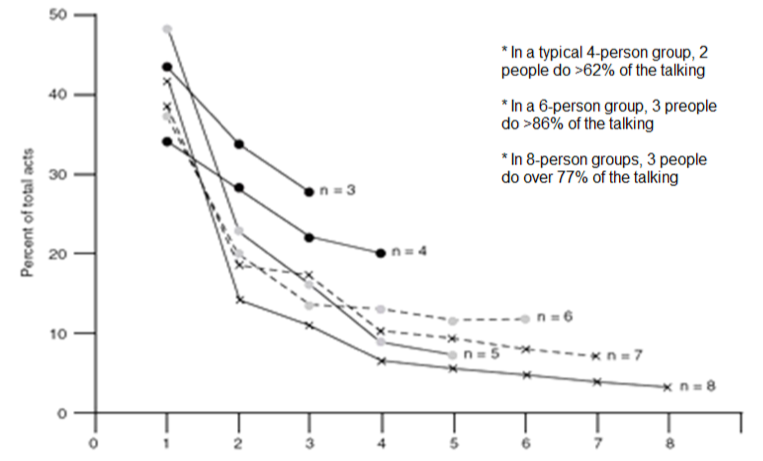
Distribution of participation as a function of group size (meh)
The group size affects how many people participate. Usually it’s not equal.
Define Interdependence in Teamwork
the challenge of integrating the discrete contributions of various specialists
Types of interdependence (mutual reliance) seen in teams:
think in terms of team performance, compensation, and interdepence
pool or additive - low interdependence
- team performance equal to sum of each team member’s performance, which they are solely responsible for
- individual compensation
- more like a group (e.g. cashiers)
sequential - moderate interdepence
- team performance equals to least productive member
- limiting factor (e.g. nurses and ambulance drivers)
reciprocal - moderate-high interdependence
- team performance equals to most productive member
- e.g. product development team
- most common
- difficult to award performance
- not sure who had important ideas
- but usually one person taks credit
- Issue with reciprocal team structure:
- Typically, achievement strivers will receive more recognition, even though dutiful individuals are more task-focused.
- The achievement strivers will focus on their own individual work and recognition, while the duty-minded will concentrate on the team productivity as a whole. Inevitably, the achievement strivers will always receive more recognition and the dutiful individuals will get tired of blending in with the team and subsequently quit.
networked - high interdependence
- team performance is single output
- everyone is important (e.g. sailing team)
- sometimes social loathing occurs
- compensation: team level
- “healthies” team structure
Structural Contingency Theory / Organisational Structures
functional structure:
- grouping individuals according to their function (e.g. sales)
- may become more efficient; less duplication
- but not rewarding and creativity
divisional structure:
- grouping individuals by product related functions (e.g. everything iPhone)
- better because everyone knows what’s going on, more creativity, flexibility, and motivation;
- thats what Apple does
Team structures should be formed according to…
… their environments.
- turbulent (high levels of change & complexity) = divisional
- placid (low levels of change & complexity) = functional
It’s easier to change from functional to divisional, than the other way.
functional —> divisional
- Somewhat difficult because all team members may not have the knowledge needed to do all parts of the task; requires more training
divisional —> functional
- This change limits a team member’s scope. May lead to dissatisfaction as one must rely on others’ work. More difficult because people lose autonomy over their work.
Common Knowledge Effect + Reduction Methods
We tend to share stuff we have in common, instead of sharing our unique knowledge because it gives us social identity.
Can be reduced by:
- writing down information in advance and referring to it during meetings;
- assigning SMEs,
- logging information,
- actively discing uniquely held info


