
Imagine ordering a beautiful meal at a cafe on the steps of the Eiffel Tower; taking a tour of a centuries-old vineyard in Bordeaux while the 5th-generation owner describes the complex wine flavors; or making friends at a lively bar in Montreal … all in flawless French. Sounds fun, huh?
I have good news for you: You can learn French, and we’ll help you get there.
To learn French, you need a plan, dedication, and, most importantly, tools. There are now more great tools than ever for learning French. But not all of them are effective.
Digital flashcard apps like Anki or Brainscape have been developed based on years of research to be one of the most effective and efficient ways to learn French.
But how do you actually use your favorite French study app? How do you build in other activities that make use of native French texts? And in general, how do you build a learning plan to learn French more efficiently?
In this article, we’ll answer all those questions and provide you with a step-by-step guide so that you can learn French more efficiently. I’ll cover:
- Why you haven’t been successful learning a language in the past
- Step 1: Create a French learning plan
- Step 2: Review what you think you already know
- Step 3: Use dynamic grammar exercises
- Step 4: Engage with a variety of resources
- Step 5: Look up what you don’t know
- Step 6: Maximize time with tutors
- Step 7: Practice pronunciation
On y va!
1 Why Haven’t You Learned French in the Past?
Have you tried learning French in the past and failed?
It’s common for people to think back to when they studied French in high school, with all those discouraging memories of bad grades and boring grammar drills. Maybe your teacher suggested you stick with the piano or rugby. Maybe the experience even made you think that you’re bad at languages.
There’s a myth about language learning that you have to be smart to do it. The myth goes that some people are “good at languages” and some people aren’t.
The truth is this: you don’t have to be smart to learn French.
You also don’t need to live in France, you don’t need to be married to a French person (although, if you can, pourquoi pas?), and you don’t need to take expensive classes from the Alliance Française.
1.1 Which Activities Actually Work?
What you do need is language activities that actually work.
There are more great tools for learning and practicing French on your own than ever before: videos, courses, chatbots, and websites for easily finding your own personal tutor or conversation partner. You may have already tried out a bunch of these.
But what's missing is a way to study French efficiently. All the slick apps and games out there may be great at being fun and engaging, but they may not be a very effective way to actually learn a language.
You are a serious learner; you care about actually making the language stick.
1.2. How Can Cognitive Science Help You Learn Faster?
Flashcard apps such as Quizlet or Brainscape apply cognitive science to help you actually learn French. Here's how they work:
- Spaced repetition. At the core of flashcard systems such as Mochi or Brainscape is an algorithm for spaced repetition. The algorithm is designed to show you the content that you’re the least comfortable with so that you are constantly practicing your weaknesses. The result is learning French fast.
- Active recall. Rather than simply showing you a list of possible answers and letting you select the right one, digital flashcards require you to actually think of the answer. This mimics real life. If you’re in a boulangerie, there’s no multiple-choice list for you to choose from. You actually have to reach into your memory and pull out the phrase: je voudrais un croissant, s'il vous plait. ("I would like a croissant, please.") Flashcards train you with active recall rather than simply recognition, just like real life.
- Metacognition, or thinking about thinking, is one of the most important skills for learning. You use metacognitive skills when you rank a flashcard; you’re asking yourself, “How well do I know this answer?” That process actually helps build neural pathways and teach you French faster.
Because they're designed based on cognitive science principles, digital flashcard apps such as Brainscape or RemNote will help you learn French many times faster than "fun", gamified apps.
If you’ve tried learning French before and had difficulty, it might be because you weren’t using apps that are actually that effective. Do yourself a favor and try software that’s based on the science of language learning.
2. How Can You Learn French More Efficiently Step-by-Step?

Now that you’re determined to learn French using the most effective activities, here’s a step-by-step guide for how to learn French more efficiently.
Step 1: Create a French Learning Plan
One of the most important things to do to be successful in learning French is to actually set up a plan. That means thinking about what your goal is and designing a strategy to accomplish it.
There are a few reasons this is an important first step: (1) thinking about your goal (the reason you’re learning French) is one of the best ways to ensure that you will actually stay committed and continue working at it each day; (2) accomplishing goals is rewarding, so you’ll want to keep studying; and (3) writing out a plan will help you stay focused on what works instead of drowning in the sea of online resources.
How do you create a learning plan? Follow these steps.
- Write out your goals. Make sure your goals are specific and measurable. And feel free to make several. For example, your first goal could be “learn how to introduce myself to another person”. Then, when you accomplish that, your next goal could be “learn to order a meal”. You can keep going all the way until “be able to watch a French movie without subtitles and understand it”.
- Make a schedule. Part of your plan needs to be when you’re going to study. For example, maybe you’re going to study for 30 minutes before bed. Or, maybe you’re going to build your studying into your other daily activities. And the appropriate form of studying might be listening to a podcast while you’re on the treadmill, reading in French on your commute to work, watching a French TV show instead of an English one on Netflix, or simply running through some French flashcards while you have your morning coffee. However you do it, you need to build the time you’re going to study French into your schedule.
- Study every day. You not only need to find time in your schedule, but you need to find it every day. It doesn’t have to be a lot: even just 15 to 20 minutes of studying flashcards helps you make real progress. But without consistent exposure, you’re not going to improve.
- Take tests. When you’re starting out, take a French test to see what level you’re at. You can find several French tests online, like these ones from ILA or RFI Savoirs. They’re not perfect, but they’ll give you a sense of your starting level. Then, every few months, take the tests again to see how you’ve improved. It’ll be motivating to see your progress, and it will help you adapt your learning activities to be most appropriate for your level.
Step 2: Review What You Think You Already Know
I know it doesn’t seem particularly efficient to review things you already know, but if you’re coming back to French after some time away from it, it may still be good to run through the basics.
By going through it from the beginning, even if you’re above a beginner level, you’ll make sure you’re filling out your knowledge and providing yourself a good foundation.
How?
One way to do this quickly and easily is to start from the beginning of a set of digital flashcards from a provider such as Memrise or Brainscape. It’s easy to just quickly scan through all the "easy" cards in the first several decks, so that you can refresh your knowledge and establish some momentum with all the words you already know.
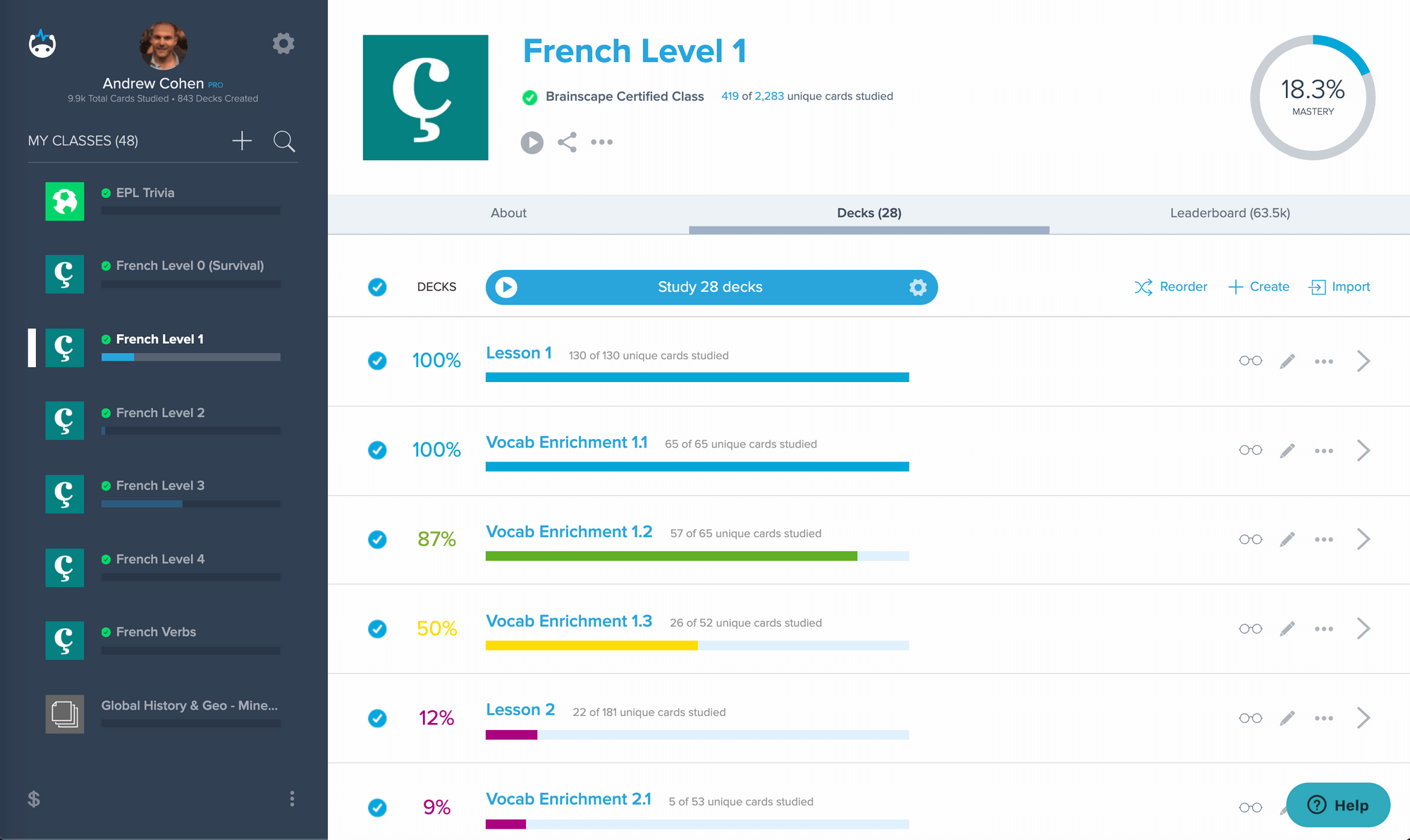
It may be just a review at first, but at some point, you'll start to bump into words and grammatical concepts that you didn’t know. At that point, you’ll resume your more rigorous learning process from a stronger underlying foundation.
Step 3: Use Dynamic Grammar Exercises
There are some people in the language learning space who don’t think you need to study grammar at all. They think you can pick it all up through listening, reading, or speaking.
While we at Brainscape agree that exposure to language and language input are both essential for learning French, you really do still need to learn some grammar. Sorry!
But that doesn’t mean you need to do a ton of boring grammar exercises. You don’t. And actually, those fill-in-the-blank and word recognition exercises may not even be particularly useful.
Instead, we encourage you to practice and learn grammar using dynamic exercises. These help you learn the grammar in the context of a sentence rather than simply memorizing rules.
You can find a variety of approaches to grammar among digital flashcard apps such as Brainscape or Anki, but we've designed custom decks and cards that are designed for this. Our sentence-builder cards are designed to build on each other, so that you can learn how to construct a sentence with the correct grammar. Most off-the-shelf French flashcards can’t do this.
Step 4: Find and Use a Variety of Resources
There are tons of resources online to learn French, and you really should make use of them. Specifically, make sure your language plan builds in activities designed to target each of the four skills: speaking, listening, reading, and writing.
Here are some of our favorite resources, divided according to language skills, that are specifically designed for people learning French.
Skill 1: Ear-eye Training
One of the first exercises you should do when learning French is to listen to a text at the same time that you read it. Native English speakers who are starting to learn French often face a huge challenge knowing where one word ends and the next one begins. They seem to all run into each other like a long river of gentle, soft sounds.
Eye-ear training exercises can help you get better at parsing the words as well as hearing how they’re pronounced. These are, in our opinion, some of the most effective activities to learn French.
Here are some ideas for ear-eye training activities:
- Listen to podcasts with transcripts. The Inner French podcast is great for this because there are transcripts for each episode. Another option is listening to broadcasts from French news stations, which often provide transcripts on their websites.
- Listen to an audiobook and read along. There are tons of great places to find audiobooks on the internet, both for free and paid options. Once you’ve found a book you like, find the print version and read along.
- Watch a documentary with subtitles. Really, you could watch any video with subtitles, but we find that some films don’t always have subtitles that match the audio. We prefer documentaries because we find that they typically have the best translations.
- Listen to songs with their lyrics. You can find the lyrics to both modern and traditional songs online. Pro tip: they’re also usually posted in the YouTube comments by other fans.
Skill 2: Speaking
You need to speak French to learn it. Like, have to. Speaking is as essential to learning French as bubbles are to champagne. You need to speak.
But how? Not all of us get to do Erasmus and live in a European apartment with French roommates.
Try any of these strategies for finding a French-speaking partner.
- Meetup. Find a language group in your city easily with Meetup. These get-togethers are usually free, but if they’re held in a bar, you might have to buy a drink.
- Language exchange. There are tons of language exchange applications. My Language Exchange, Tandem, Conversation Exchange, Speaky, HiNative, and Polyglot Club are just some of them. CraigsList and Reddit can also work. You can even find people on Facebook groups.
- Online Dating. French is the language of love, right? Why not broaden your romantic possibilities while practicing speaking? Set your favorite dating app to be located in France (or another French-speaking region), and you could meet some fun locals who are willing to chat with you. (If it goes well, consider sending us an invite to the wedding.)
- Find a tutor. Honestly, we don’t love formal language classes … there are a few reasons why they aren’t necessarily the best way to learn a language. Still, some people find them useful. Here’s a list of sites that offer French tutoring for varying costs: Verbling, Superprof, Cambly, Italki, and Preply.
With all those options, you really shouldn’t have any issues finding a speaking partner. But you might still be making up some excuses for yourself. If you aren’t ready for a speaking partner just yet, then start a bit smaller and try these activities for practicing speaking by yourself.
- Have a conversation with yourself. Yes, it’s a bit weird, but it’s actually really effective. Imagine yourself in a situation, maybe at a grocery store, ordering lunch, or meeting a new person, and just play both sides of the conversation. “Bonjour, ça va bien?” “Oui, ça va. Et vous?” This will not only help you practice in different situations, but also help you find out where you’re struggling and need to learn some more words. Do it in the shower if you’re shy.
- Record yourself. Recording yourself talking on a subject for a minute or two is a great way to test your fluency and hear where you’re having difficulties. In a few months, listen again to see how much you improved.
- Shadowing. To “shadow” audio, you simply repeat after it as if you were an 8-year-old trying to annoy your older sibling. It’s great for practicing the physical aspects of fluency, like pronunciation, getting the rhythm of French, the tone, and helping your mouth muscles get used to working a bit differently. Do this with radio, videos, or podcasts.
- Reading out loud. This is another great option for practicing pronunciation and fluidity. Just take any French text and practice saying the words out loud as you’re reading. See the reading section below for ideas on how to do this.
Skill 3: Listening
Practice your listening skills by surrounding yourself with French audio as often as possible. There’s no shortage of high-quality French listening material online, and you can easily find content that matches your level and interests.
- Podcasts. French podcasts are one of the easiest ways to build listening comprehension. Some are designed specifically for learners at different stages, from complete beginners to advanced speakers, while others are made for native audiences. If you search for “French podcasts” in your favourite podcast app, you’ll find plenty of options to explore.
- Radio. Listening to French radio helps you get used to natural pacing, pronunciation, and real-world vocabulary. Advanced learners can listen to general-interest stations on any topic they enjoy, while intermediate learners may prefer broadcasts created with learners in mind, where the language is slower and clearer.
- Movies and TV. Streaming platforms offer a huge range of French-language films and series. Watching shows in French helps reinforce listening skills in a visual context. Try using French subtitles instead of English, or turn subtitles off entirely if you want an extra challenge and feel confident enough to follow along.
- Music. French-language music is a great way to train your ear while discovering new artists. Explore popular charts to hear what’s trending, then branch out into music from other French-speaking regions such as Quebec, Belgium, Morocco, Senegal, Haiti, and French Guiana. This variety exposes you to different accents, styles, and expressions.
Skill 4: Reading
Reading regularly in French is essential for building vocabulary, improving comprehension, and getting comfortable with sentence structure. At an advanced level, you can engage with classic French literature, but there are plenty of effective reading options for learners at every stage.
- Newspapers. Reading the news in French is a useful way to practice while staying informed about current events. Beginners can start with simplified news written in clear, accessible language. Intermediate learners can move on to mainstream newspapers with shorter articles, while advanced learners can tackle more complex publications with in-depth reporting and opinion pieces.
- Social media. Social platforms offer a constant stream of short, real-world French. Follow French-speaking politicians, artists, influencers, or public figures whose content interests you. Posts are usually brief, conversational, and full of everyday expressions, which makes them great for quick reading practice.
- Articles. Online articles are easy to tailor to your interests and level. Try searching for topics you care about using French keywords such as work, personal development, or health. If full-length articles feel overwhelming, look for content written for younger readers or language learners, which tends to use simpler vocabulary and clearer structures.
- Books. Beginners can start with children’s books to build confidence and basic vocabulary. At an intermediate level, rereading books you already know and enjoy helps you focus on language rather than plot. Advanced learners can challenge themselves with new books on topics that genuinely interest them, even if the language is demanding.
Skill 5: Writing
Writing well in French is not high on the list for lots of people. Most of us would rather be able to have a conversation with French friends than write a novel in French. Still, writing is essential in lots of contexts, so it’s worth practicing at least a little. Here are some ideas for how to do that.
- Keep a journal. Especially at the beginning, journaling is a great way to practice the new words you’re learning and the basics: what you did that day, how you’re feeling, what you ate, and so on. Even at an advanced level, this can be a very useful activity.
- Write letters and postcards. Writing short texts is great for people at all levels, and getting a letter is like an unexpected warm hug. So why not send one? To find French-speaking friends abroad, you can find online penpals (who might also be up for calls).
- Post on social media. Nothing says “classy” like posting in French. Show off to your friends and gain new followers by being clever on les réseaux sociaux.
- Write a blog. Maybe this is a bit more advanced, but it might be great for intermediate or advanced learners, especially if you’re living abroad.
Step 5: Look up What You Don’t Know

Great, so now you have all these amazing resources and tons of ways to access authentic French speakers and writers. You’re cooking with gas, absorbing tons of language input.
Inevitably, there’s going to be lots you don’t know. The thing about learning a language is that there are always words you won’t know. Even as a native English speaker, I’m constantly finding words I don’t know.
You’re going to find words, phrases, idioms, and even grammatical structures that you won’t understand. To learn French most efficiently, take the time to look these up and then record them. If you're using a flashcard app like Brainscape or Quizlet, you can write your own flashcards and add them to your rotation for regular review.
Step 6: Maximize Time With Tutors
You don’t need teachers or tutors to learn French, but they can be useful. If you do end up hiring a tutor, we really suggest that you don’t just rely on them to guide your learning. Especially if they’re just some random Jean-Paul off the Internet.
Instead, to optimize your time with tutors, you need to take charge of your own learning. Here’s how we suggest you make the best use of your teaching time to learn French the most efficiently.
- Bring up difficult concepts. One of the best uses of tutors is to get them to explain things you don’t understand. Like when to use apporter vs amener or why L'Étranger is so famous (Why do people think it's so good? Like, actually though?). If you're using a digital flashcard app like Mochi or Brainscape, you can even use the "bookmark" feature to identify difficult flashcards that you'd specifically like to review with your tutor.
- Focus on real-world situations to practice. If you’re paying to talk to someone, you want to get the most out of it as possible. In our experience, you do that by focusing on real-world situations. Pretend you’re at a restaurant and your tutor is the waiter, or you’re at a cafe and the tutor is the barista. (For a little extra culture, try pretending you’d like a cafe latte after lunch and get a sense for how the French express disgust.)
Step 7: Practice Pronunciation
Speaking French can feel like having a mouth of cotton balls and lips of taut nylon. I remember actually experiencing the muscles in my mouth feeling sore the first time I spent any significant time in France.
French pronunciation is very different from English. Part of learning French is leaving behind the English way to pronounce words and developing the muscle memory required to speak French.
You may never develop an accent that sounds like a native French person, Quebecer, or Congolese person, without extensive time in those countries (and probably some phonetics training). You may never really say “rue” properly. That’s fine.
But you can learn to sound not so American (or British, or Australian). You can learn to speak in a way that other French speakers can understand you. If you’re greeting people with a loud “BON-JER”, please ... do better.
Here are some ideas:
- Native conversation partner. Your native conversation partner that you’ve found can help you with this. Any time they have trouble understanding what you’re saying, take a moment to work on that.
- Shadowing. We talked about shadowing above as a speaking exercise, but it’s also great for the physical aspects of pronunciation because it helps you create muscle memory and learn how to form words. It’s also great for learning the different rhythms, stresses, and tones that French has.
- Flashcards. French flashcards from an app like Quizgecko or Brainscape are great for pronunciation practice. For instance, we’ve included French speakers pronouncing each of the words and sentences on the cards. When you’re using the flashcards, take the extra moment to repeat what’s on the card. Really say it out loud.
- Think beyond France. Remember: 29 countries over four continents speak French. When you’re learning pronunciation, it’s fine to focus on one accent for ease of learning. But it’s worth at least listening to other accents so that you can understand them. There are many, many varieties of French, including those spoken in Quebec, Louisiana, Haiti, Cambodia, Vietnam, Morocco, Senegal, and the Congo. Be aware that “French” is actually a whole collection of different dialects.
3. How Do You Get Started, Stay Consistent, and Use What Works?
Ooh la la, that was a lot of information.
We’ve packed this step-by-step guide to learning French with tons of activities, ideas, and useful resources because we know that, while the Internet is full of stuff, it can be hard to find what’s good. What works.
The trick to learning French efficiently is finding activities that work, using them consistently, and working at it for a long period of time.
If you do those things, you’ll learn French. If you don’t (if all you do is play on a fun app to keep an owl happy), you probably won’t get past, “Voilà l'autobus”.
So make a commitment to yourself to really learn it. Follow the steps we’ve outlined:
- Get started by making a plan;
- Build your foundation by reviewing what you know;
- Learn the grammar basics;
- Engage with a variety of exercises in speaking, listening, reading, and writing;
- Look up what you don’t know;
- Use tutor time effectively;
- Practice your pronunciation.
If you do those things, and you do them consistently for a year or more, you’ll see a drastic improvement in your French ability. It’s hard work, but you can do it.
Additional Reading
- The Top 8 YouTube Channels to Learn French in 2026
- The top 25 French words used in English
- Must-have French phrases for eating out
References
Butterfield, B., & Metcalfe, J (2006). The correction of errors committed with high confidence. Metacognition and Learning, 1(1), 69-84.
Dartmouth, U. of M. (2025, March 24). Smart goals for students. UMass Dartmouth. https://www.umassd.edu/fycm/goal-setting/resources/smartgoals/
Free French level test online: Ila French Language School. ILA. (n.d.). https://www.ila-france.com/french-tests/french-level-test
What is shadowing and why should you use it to improve your English speaking skills?. Leonardo English. (n.d.). https://www.leonardoenglish.com/blog/what-is-shadowing