You’re at an event with English speakers from different countries. You’re having fun. You might even be making some new friends. Suddenly, you find yourself talking to someone new.
They’re talking fast. So fast. They’re using unfamiliar words in an accent you’ve never heard. Soon, you’re politely nodding, hoping that a “haha, yeah” will get you through to the end of this conversation.
If this sounds familiar, you already understand the terror of the TOEFL Listening section.
Listening to English on the test is different from hearing it in the comfortable settings where you are familiar with the people and topics. To do well on the test, you need to keep your brain locked in while someone speaks at native speed for five solid minutes about coral reefs, 19th-century economics, or the mating habits of frogs.
According to ETS, the organization that runs the exam, the Listening portion of the TOEFL iBT assesses how well you understand spoken English in academic settings. It measures comprehension, inference, and the ability to connect ideas. And it all happens in real time, with no rewind button. It’s intense.
But it’s also trainable. With the right TOEFL listening practice, you can improve both your comprehension and your confidence before test day.
This is what you’ll need for university lectures or professional environments, so it’s a useful skillset to master, even looking at your life beyond the exam.
In this guide, we’ll explore:
- What the Listening section looks like,
- How to practice for it effectively, and
- How to drill yourself on vocabulary, grammar, and pronunciation with tools like TOEFL digital flashcards.
We’ll then put what you learned to the test with three (totally free) listening practice videos. (Because, yes, practice really does make perfect, especially when it’s the right kind of practice.)
What Is The TOEFL Listening Section Like?
The TOEFL iBT Listening section reflects what you’d experience in a real college classroom. You’ll listen to short academic lectures and campus conversations, then answer questions that test your understanding.
Here’s the format:
- 3 Academic lectures (3 to 5 minutes each, with 6 questions each)
- 2 Campus conversations (3 minutes each, with 5 questions each)
That makes a total of 28 questions in around 36 minutes. Each recording is played only once and without subtitles or captions. You’ll answer while it plays or right afterward, using your notes to recall details.
You’ll be tested on skills such as identifying main ideas versus supporting details, recognizing the speaker’s tone and intent, and making logical connections. The mixture of lectures and conversations allows you to show universities that you’re fluent in English for both formal academic settings and equally important informal conversations.
Why Is TOEFL Listening Practice So Important?

Everyday listening is nothing like test-day listening. You can’t prepare for TOEFL iBT Listening only by being a good listener in real life. On the exam, you can’t pause, replay, or ask someone, “Sorry, could you repeat that please?” You get one chance to catch every idea. In that respect, it is a little unrealistic.
In the real world, in any language, we constantly ask people to repeat themselves or clarify a point. For example, researchers have observed similar patterns of behavior between elderly native English speakers and international students. For example, older native speakers with hearing difficulties may only be able to understand some of the words in a sentence, just like learners of English.
That’s why TOEFL listening practice is so important. You need to practice the skill of actively listening and then, based upon what you’re asked, recall the content of what was said (and how), to select the correct answer. No repeats, no second chances. To improve your scores on the TOEFL Listening test, you need to practice.
Is TOEFL Listening Hard?
Many students find the Listening section the most intimidating part of the test, especially when compared with Reading or Speaking. There are a few key challenges that crank up the difficulty.
The speed and intonation of speakers are two of the biggest factors affecting TOEFL Listening capacity. On the test, 100% of the speakers are native, while in the real world, only 25% of English conversations are between native speakers. That means that most TOEFL learners are more familiar with non-native speakers, and can find the speech patterns of native speakers unfamiliar.
Add to this the mix of accents from the U.S., Canada, the U.K., New Zealand, and Australia: a much wider range than even a native speaker would face in a day! In fact, native speakers from these countries often find it tricky to understand each other.
The question is… how do you overcome this?
The most effective way to improve your scores is to practice with TOEFL Listening questions (and we have a series of videos that’ll help you do just that, which we’ll introduce shortly). Within just weeks of consistent listening practice, your test scores will improve. The more you practice, the more prepared you will be for the exam.
What Types Of Questions Are On The TOEFL Listening Section?
You’ll find seven types of questions, each with its own purpose:
- Gist-content. When listening for gist-content, you need to identify the main topic or key idea of the conversation or lecture.
- Gist-purpose. When listening for purpose, your aim is to identify the reason or goal behind a speaker’s statement or action.
- Detail. If a question asks you to listen for detail, you need to identify and remember specific facts or information mentioned in the passage.
- Function. These questions ask you to identify the speaker’s true meaning or purpose beyond the literal words.
- Attitude. When listening for attitude, try to identify the speaker’s feelings, opinion, or emotional stance about the topic.
- Organization. For these questions, your goal is to understand how the speaker structures their speech and why certain examples or ideas are mentioned. These are almost always excerpts from lectures.
- Connecting content. The aim of these questions is for you to show understanding of the relationships between ideas, such as cause and effect. These may include making inferences, that is, identifying information that is implied but not directly stated in the listening passage.
How Should You Prepare For The TOEFL Listening Section?
Listening is a skill. It’s about bringing together everything you’ve been learning about, like grammar, vocabulary, and pronunciation, stitching it together as you hear someone talk, and then constructing a response. In order to become good at listening, you need to practice, practice, practice.
To help you do that, we created three listening practice videos, which are great practice for anyone learning English as a second language (not just TOEFL students); however, they are geared at the level of skill of a TOEFL candidate.
Each one of these videos includes academic-style audio clips, conversational listening practice, and answers. How to use them is simple:
- Turn off your closed captions on YouTube
- Listen carefully to the audio passage
- Listen again: this time you’ll see subtitles. Try to match up what you’re hearing with the words on the screen. Alternatively, if you really want to challenge yourself, skip through the repeated audio segment to the question. This will more closely mimic the format of the TOEFL, which does not repeat the passage nor provide the written transcript.
- You’ll then be asked a TOEFL-style question (see previous section) on what you’ve just heard. Pause the video to give yourself a bit of time to answer.
- We’ll then show you the answer. Take a moment to reflect. How well did you know this? Were you confident in your answer? Or did you struggle a bit? Give yourself a score out of 5 and come back to those you scored less than 5 on.
- Once you’ve finished listening to all three videos, start over! The more you practice with awareness and intention, the better.
It’s that simple!
TOEFL Listening Practice Video #1
TOEFL Listening Practice Video #2
TOEFL Listening Practice Video #3
Once you’ve worked through these listening practice videos, you should be ready to move on to more TOEFL-focused practice. The key difference here is that on the TOEFL:
- You’ll only hear the audio passage ONCE
- The passages are MUCH longer at about 2 to 5 minutes each
- You won’t see any subtitles/text on the screen
This means you’ll be answering questions based purely on listening. Here are some guidelines to help you prepare for that challenge more effectively:
1. Practice Under Exam Conditions: The first time you practice any listening questions, set yourself up somewhere quiet where you can listen without interruptions. Keep a pen and paper handy to make notes. Put your phone and any distractions away: this is your moment to simulate the exam.
We say “the first time” because you can always listen to or watch these videos over again, next time while doing other things, like driving, cooking, or doing laundry. The more you practice for the TOEFL listening section of the exam, the more confident you’ll become!
2. Practice Active Listening: Don’t just let the words wash over you. Use practice questions so that you have an expectation of what you’re listening for. As you listen to the passage, you should be looking out for details you need to capture. High-ability listeners don’t necessarily understand every word, but instead have a variety of strategies to make sense of the words they do understand.
3. Make Notes: Remember, your notes are not assessed. They’re for your eyes only. That means you can use arrows, shorthand, diagrams, or whatever you like! It’s not possible to transcribe the whole passage, so get used to summarizing and abbreviating the main ideas in a way that suits you. You have a very short time to answer the question, so use shorthand such as bullet points, lists, or clear diagrams to make your life as easy as possible.
4. Listen Once, Just Like The Exam: Set a timer and play your TOEFL sample listening tests straight through. No rewinding. Treat every session like a real exam so you can build stamina and focus.
5. Study vocabulary and grammar
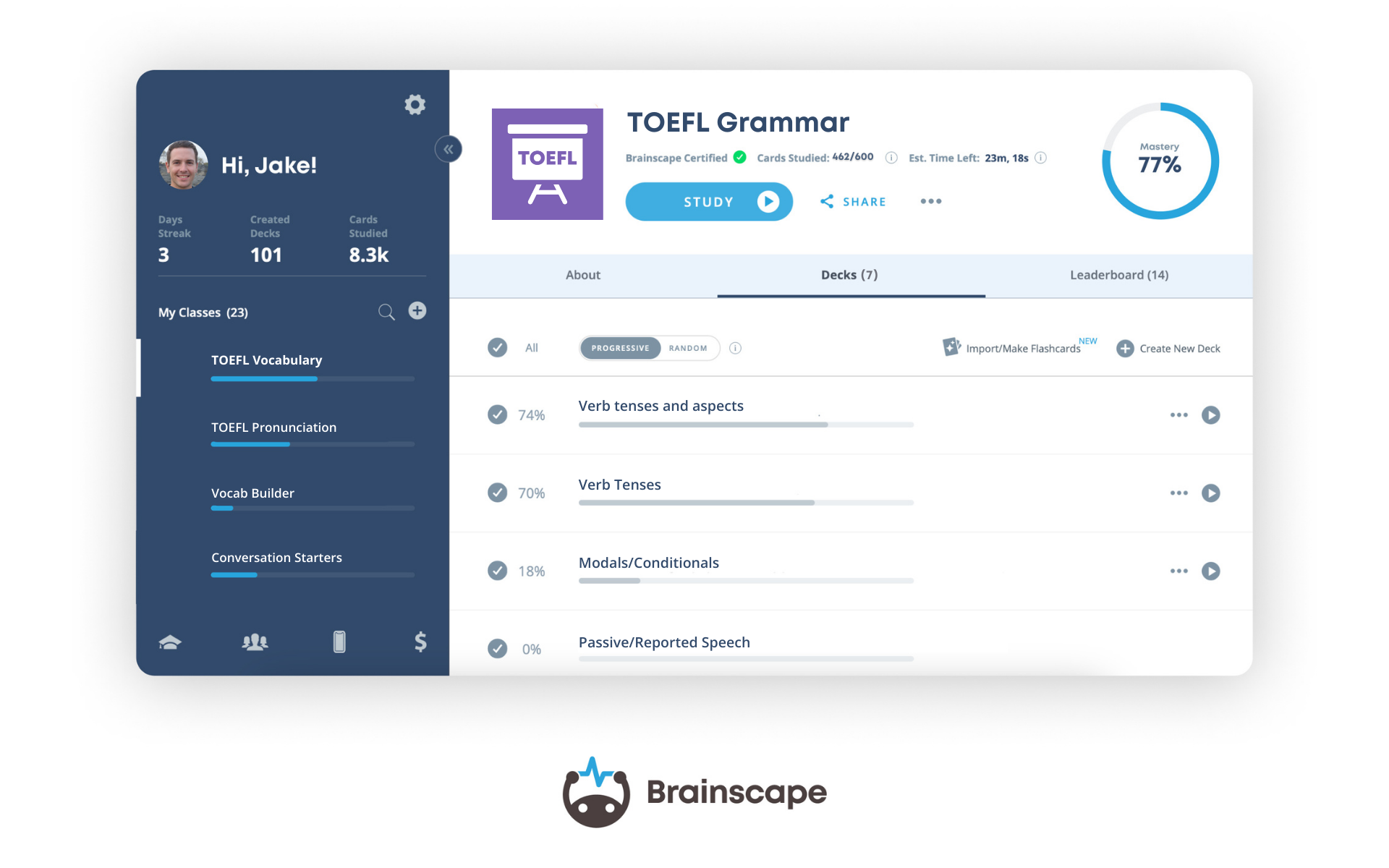
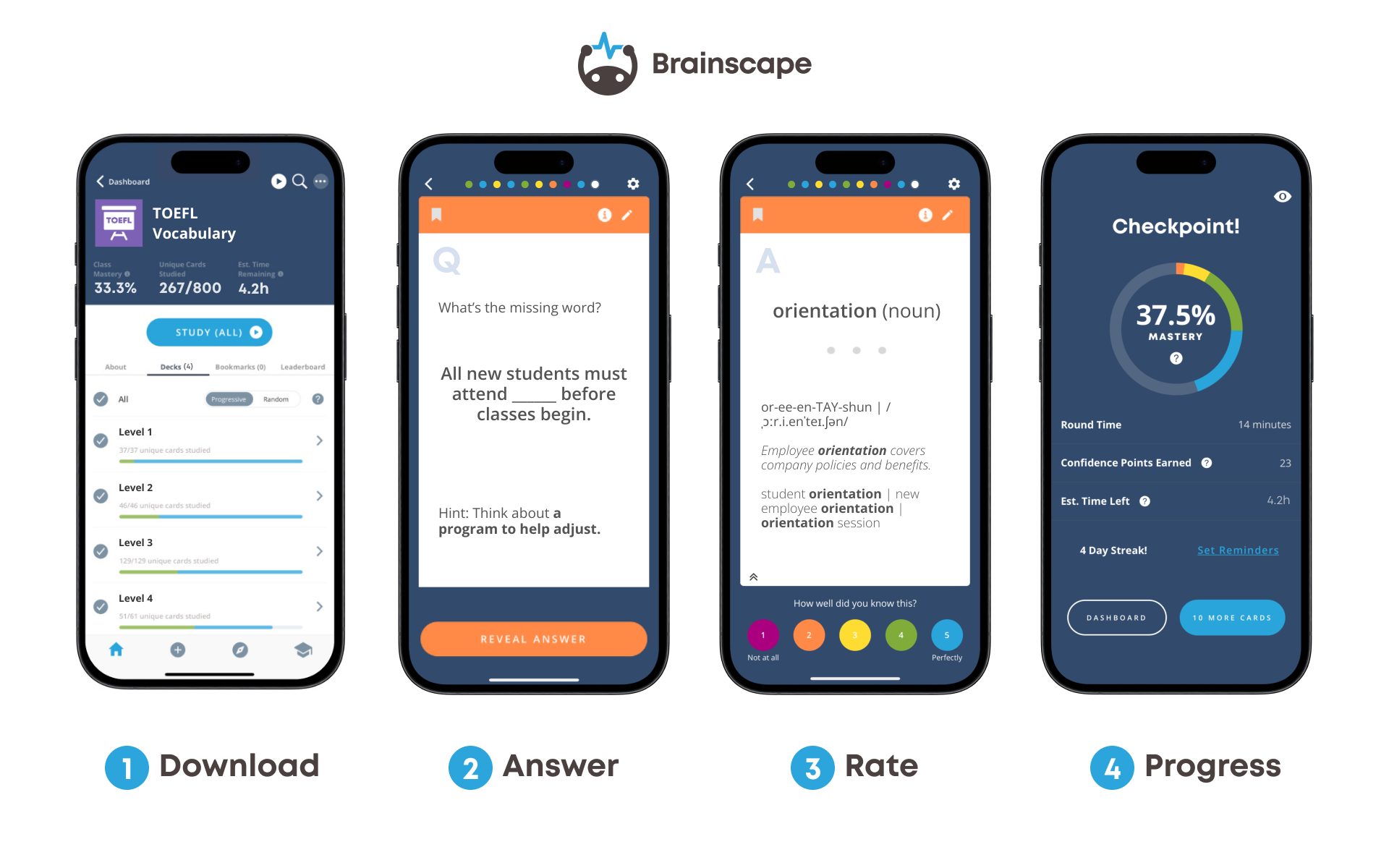
Those core vocabulary and grammar skills are essential for all four parts of the TOEFL. The Listening section of the TOEFL exam challenges your vocabulary, especially because you only hear each word once. Throughout your language learning, make a note of unfamiliar words and topics, and use web and mobile TOEFL flashcards like you’ll find in Brainscape and Quizlet to memorize their meaning. Their algorithms make sure that you’re shown words at just the right time intervals to lock them into your memory and have been proven to double learning speed.
6. Mix Up Your Immersion: While TOEFL Listening questions should be your main focus, learning a language is a marathon, not a sprint. Plus, you need to be familiar with a variety of vocabulary. You should also listen to real English texts, such as news, TED talks, lectures, and podcasts that interest you. Engaging with a variety of topics is a great way to keep your motivation high.
What Are The Best TOEFL Listening Tips For Test Day?

Here’s what separates calm test-takers from panicked ones…
Tip 1: Use Orientation Time Wisely: Prepare your materials so that you’re ready to take notes as soon as the recording starts. Remember the details that you needed in practice questions, and prepare to write down those key words in your notes.
Tip 2: Listen For Signal Words: Transitions like however, therefore, in conclusion tell you what matters. Whenever they appear, that’s a cue that the detail immediately afterwards will be important.
Tip 3: Don’t Panic If You Miss A Detail: Questions test comprehension of overall meaning, not perfect recall. Missing one small point won’t ruin your score.
Tip 4: Guess Strategically: There’s no penalty for wrong answers. Eliminate choices that are obviously wrong and trust your instincts.
Can TOEFL Listening Practice Make You Fluent?
Fluency in English (or any language) covers a range of abilities, from the four sections of the TOEFL exam to social and interpersonal skills.
Practicing for the TOEFL iBT Listening test builds your ability to listen and understand information under pressure, which will certainly improve your listening skills in real life. It focuses heavily on the kind of language that you’d find in an academic setting, from formal lectures to more relaxed dialogue.
In summary, there's not one particular section of the TOEFL exam that can make you fully fluent. However, the capacities you develop while preparing for the exam will make you a more confident learner overall, especially in academic contexts.
FAQ Section
How Long Is The TOEFL Listening Section?
It lasts about 36 minutes, depending on the length of the passages on your test.
How Many Questions Are On The TOEFL Listening Section?
You’ll answer 28 questions, all multiple-choice.
What’s The Best Way To Practice TOEFL Listening At Home?
Practice listening to passages that mimic the style of the TOEFL exam. Stick to timed, one-listen conditions.
Are TOEFL Listening Practice Tests Enough To Pass?
They’re essential, but not enough alone. Combine them with flashcards that drill you on vocabulary, grammar, and pronunciation. You should also use practice questions for note-taking drills and comprehension exercises.
Do You Get To Hear The TOEFL Listening Audio Twice?
No. Each passage is played once. It’s important to practice listening to audio only once as your preparation.
Is TOEFL Listening Harder Than IELTS Listening?
TOEFL is more academic and lecture-based, while IELTS mixes everyday and academic English. The difficulty level depends on your comfort with university-level material.
Conclusion: Train Your Ears, Master The TOEFL Listening
Success on the TOEFL Listening section comes from practice. (That’s why we made these listening practice videos.) The more time you spend training your brain to follow academic English, the calmer and sharper you’ll be when the test starts.
Use structured TOEFL listening practice as part of your regular study routine. Take advantage of practice videos (like Brainscape’s) to build the skillset you need for the exam: knowing what to listen for, how to take relevant notes, and produce an answer after hearing information only once.
When that final audio clip fades out and you’re ready to move on, you’ll know all those hours of practice were worth it.
Additional Practice Resources For The TOEFL
- How to Practice Your TOEFL Speaking Skills
- 6 Tips for TOEFL Reading Practice (Plus Question Bank)
- 5 Tips for TOEFL Writing Practice (Plus Question Bank)
References
Chang, A. C.-S., & Millett, S. (2013). The effect of extensive listening on developing L2 listening fluency: Some hard evidence. ELT Journal, 68(1), 31–40. https://doi.org/10.1093/elt/cct052
Chang, A., Millett, S., & Renandya, W. A. (2018). Developing listening fluency through supported extensive listening practice. RELC Journal, 50(3), 422–438. https://doi.org/10.1177/0033688217751468
Clayton, D. (2018). Introduction. In Attitudes to language (pp. 1–18). essay, Cambridge University Press.
Fitria, T. N. (2021). An analysis of the students’ difficulties in TOEFL prediction test of listening section. ENGLISH FRANCA : Academic Journal of English Language and Education, 5(1), 95. https://doi.org/10.29240/ef.v5i1.2212
GeeksforGeeks. (2025, July 23). TOEFL listening section: Structure, question types, tips & more. https://www.geeksforgeeks.org/toefl/toefl-listening-section/
Goh, C. C. M. (1998). How ESL learners with different listening abilities use comprehension strategies and tactics. Language Teaching Research, 2(2), 124–147. https://doi.org/10.1191/136216898667461574
La’biran, R., & Dewi, R. (2023). Exploring students’ difficulties in Toefl listening. ENGLISH FRANCA : Academic Journal of English Language and Education, 7(2), 343. https://doi.org/10.29240/ef.v7i2.8065
Terui, S. (2012). Second language learners’ coping strategy in conversations with native speakers. Journal of International Students, 2(2), 168–183. https://doi.org/10.32674/jis.v2i2.530
TOEFL IBT listening section. (n.d.). https://www.ets.org/toefl/test-takers/ibt/about/content/listening.html
Wallwork, A. (2014). Understanding why you don’t understand native English speakers. Meetings, Negotiations, and Socializing, 111–117. https://doi.org/10.1007/978-1-4939-0632-1_13