
You have 29 minutes. A blinking cursor. And a question that requires a strong essay.
That is the challenge of the TOEFL Writing section, a part of the test that many students underestimate. It requires more than just writing in English. You need to write quickly, with structure, logic, and precision, while keeping your grammar and vocabulary accurate.
The TOEFL Writing section measures how well you can organize your thoughts and express them clearly in an academic setting. Both of the writing tasks test skills that universities care about: your ability to think critically, connect ideas, and communicate clearly under time pressure.
That is why consistent TOEFL writing practice is so important. It helps you train your brain to plan quickly, type efficiently, and express ideas in a clear, logical way. The more you practice, the more automatic these skills become. When the clock starts, you will already know what to do.
In this guide, you will learn:
- What the TOEFL Writing section looks like
- Why regular practice makes a big difference
- The main challenges students face and how to overcome them
- Proven strategies to write strong essays every time
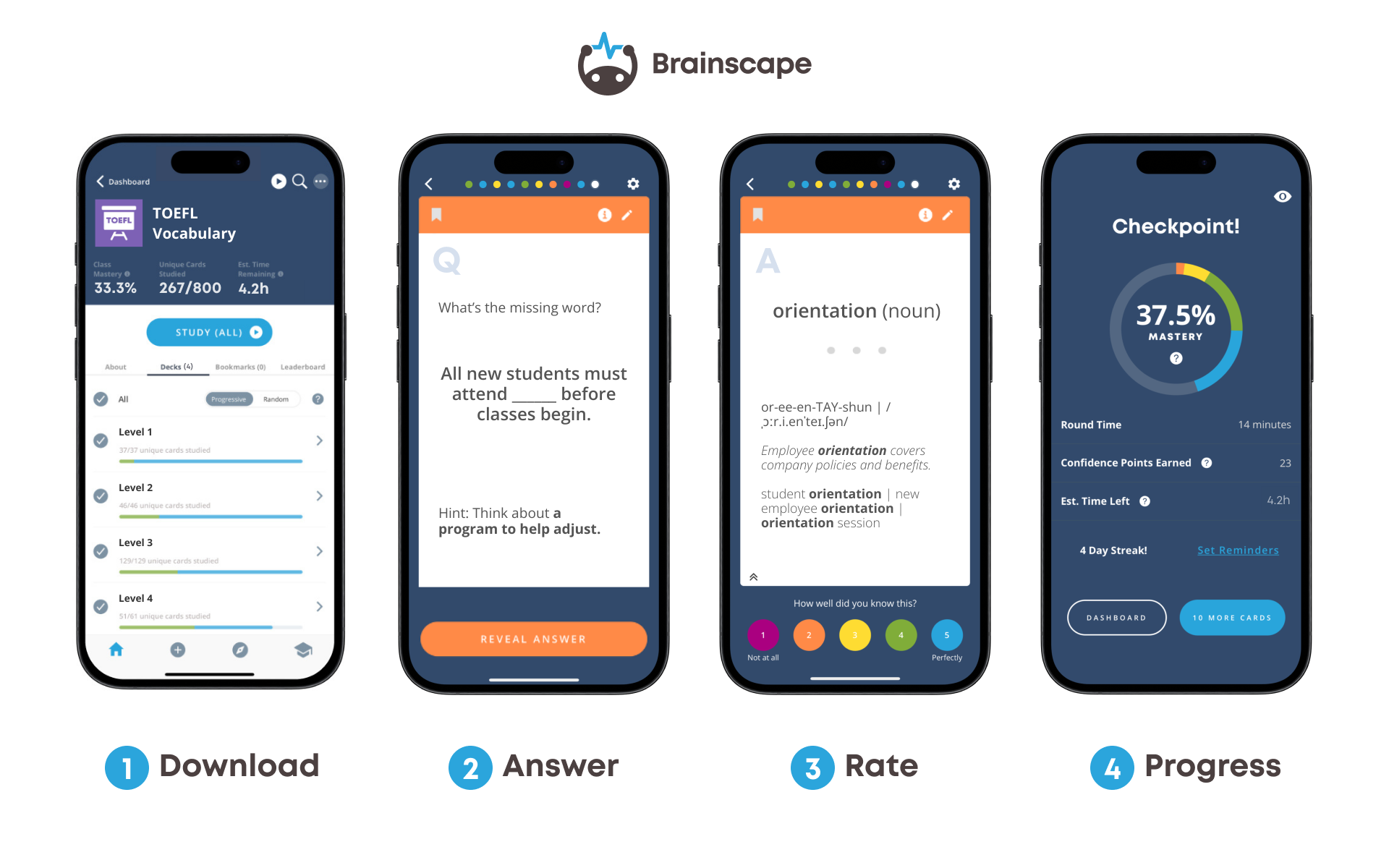
- How to use digital TOEFL flashcards from digital apps like Brainscape or MemRise to learn twice as fast
- Step-by-step methods for practicing at home
Plus, we will share our free TOEFL Writing Practice Question Bank, which has been designed to help you improve your structure, vocabulary, and timing: all the skills you need for success on test day.
By the end, you will know how to turn blank-screen panic into clear, confident writing.
What Is The TOEFL Writing Section Like?
The TOEFL iBT Writing section checks how well you can express ideas in clear, organized academic English. You will complete two writing tasks on a computer. Together, they take about 29 minutes.
Here is what to expect:
- Integrated Writing Task (20 minutes): You will read a short passage and then listen to a short lecture on the same topic. Your task is to explain how the information in the lecture relates to the reading. You should write a clear, well-organized summary of about 150–225 words.
- Independent Writing Task (30 minutes): You will write an essay on a general topic, such as “Is it better to study alone or in a group?” You need to state your opinion, give reasons, and support them with examples. A strong essay is usually about 300 words or more.
Each task is scored from 0 to 5 based on clarity, structure, vocabulary, and grammar. These two scores are then combined into a total score out of 30 for the Writing section.
The TOEFL writing tasks test your ability to summarize, compare, argue, and organize ideas using academic language. You are not graded on your personal opinions but on how clearly and logically you express them.
Regular practice with both task types helps you develop the writing skills needed not only for the TOEFL but also for university assignments that require essays, summaries, and written discussions.
Why Is TOEFL Writing Practice Essential?

Writing in English is very different from reading or listening. When you write, you are not only understanding ideas. You are producing and organizing them. You have to recall information, structure it clearly, and express it correctly. Meanwhile, the clock is ticking!
That pressure is exactly what makes the TOEFL Writing section challenging. You must type quickly and accurately, use correct grammar, choose the right words, and build strong paragraphs that flow logically from one to the next. For many students, this combination feels like juggling flaming torches in essay form: exciting, but risky without practice.
Common mistakes include:
- Grammar that sounds unnatural or too simple
- Word choices that do not fully match the meaning
- Essays that lack a clear structure or logical flow
Regular TOEFL writing practice helps you avoid these issues. It trains your brain to organize ideas faster, choose better vocabulary, and write with confidence under time pressure.
Cognitive scientists call this deliberate practice. It means focused repetition that strengthens the mental connections involved in retrieval and organization. Each time you write a practice essay, your brain becomes more efficient at turning thoughts into sentences and sentences into well-structured paragraphs.
Furthermore, one of the biggest difficulties is not being familiar with the topic presented in the question. If you practice writing responses to a broad range of questions across multiple topics, you increase your chances of understanding the question on test day.
In the end, writing practice prepares you not only for the TOEFL but also for real academic work. It helps you think clearly, structure your ideas, and communicate them with precision.
What Are The Biggest Challenges In TOEFL Writing?
Even confident, advanced English speakers find the TOEFL Writing section difficult. You have to think, plan, and write in English quickly while staying calm under time pressure. Here are the most common challenges test-takers face and why regular TOEFL writing practice makes all the difference.
Challenge #1: Managing Time
You only have about 20 minutes for the Integrated Writing Task and 30 minutes for the Independent Writing Task. That means you need to read or listen, plan your ideas, and write clearly within strict limits. Many students spend too long on introductions and run out of time for their main points. Practice with a timer to develop the rhythm you need on test day.
Challenge #2: Generating Ideas Quickly
For the Independent Task, you might be asked to write about topics such as education, technology, or social issues. The real difficulty is thinking of strong examples and reasons fast enough. Building an “idea bank” of common themes can help you brainstorm more efficiently during the test. You want ideas that suit your personality and are easy for you to write about.
Challenge #3: Grammar and Vocabulary Accuracy
Mistakes in grammar or word choice can confuse the reader or weaken your argument. While small errors will not destroy your score, clear and consistent language is essential for a high mark. Reviewing key sentence patterns and academic vocabulary before the test can make your writing sound more natural and precise.
Strong writing is a process of planning, drafting, and revising. By practicing this process with real TOEFL-style tasks, you can learn to manage time, generate ideas, and express them clearly under time pressure.
Challenge #4: Organizing Essays Clearly
Under pressure, it is easy for your thoughts to become disorganized. Essays without a clear structure lose points for coherence. Good organization means dividing your essay into clear paragraphs, using linking words like first, next, and in conclusion, and guiding the reader smoothly from one idea to another. Build up word banks of terms that you can use to introduce, connect, and conclude ideas. Digital flashcards are the most efficient way to memorize these.
Here’s an example word bank to get you started:
And remember, cognitive science shows that the fastest way to memorize word banks is with digital flashcard apps such as Brainscape or MemRise.
What Are The Best TOEFL Writing Strategies?
Strong writing scores come from strategy as much as skill. The TOEFL Writing section rewards clarity, structure, and good time management. Here are the most effective ways to prepare and perform well on test day.
Strategy #1: Build a Structure from Templates
What is a template? It’s a flexible outline that helps you plan your essay from start to finish. Think of it as a structure you can reuse on any TOEFL Writing task. Planning a clear structure for your writing improves your writing scores.
Templates don’t give you exact sentences to memorize. Instead, they help you organize your ideas quickly, stay focused under time pressure, and make your essay easy to follow.
You’ll use slightly different templates for the Integrated Writing Task and the Independent Writing Task.
For the Integrated Writing Task, use a four- or five-paragraph structure:
- Introduction: Summarize the topic and mention both the reading and the lecture.
- Body paragraphs: Compare or contrast the key points from each source.
- Conclusion: Summarize the relationship between them.
Here’s an example of that template in action:
Question: The reading passage argues that electric cars are the best solution for reducing air pollution. The lecture disagrees. Summarize the lecturer’s opinion and explain how it relates to the reading.
Response Outline (using the template):
- Introduction: The reading and the lecture both discuss electric cars as a way to reduce pollution. The lecturer disagrees with the reading’s claims.
- Body Paragraph 1: The reading says electric cars lower emissions. However, the lecturer argues that producing electricity for these cars still causes pollution.
- Body Paragraph 2: The reading suggests electric cars are affordable. The lecturer disagrees, saying battery production and replacement make them expensive.
- Conclusion: The lecturer challenges the reading by showing that electric cars still have environmental and economic drawbacks.
For the Independent Writing Task, use a five-paragraph essay:
- Introduction: State your opinion clearly.
- Body paragraphs: Give two or three strong reasons with examples.
- Conclusion: Restate your opinion confidently.
Here’s how that could look with a real question:
Question: Some people prefer studying online, while others prefer studying in a classroom. Which do you prefer, and why?
Response Outline (using the template):
- Introduction: I prefer studying in a classroom because it helps me stay focused and connected with others.
- Body Paragraph 1: My first reason is that teachers can answer questions immediately. For example, in my math class, I improved faster after getting direct feedback.
- Body Paragraph 2: Another reason is that classmates keep me motivated. When others study around me, I feel more responsible to stay on track.
- Conclusion: For these reasons, I believe classroom learning is more effective than online study.
Templates give your essays a clear, professional structure. Once you memorize them through regular writing practice, you can focus on strong ideas and clear language instead of worrying about format..
Strategy #2: Manage Your Time
You have 20 minutes for Task 1 and 30 minutes for Task 2. Spend about three to five minutes planning and use the rest to write. Keep the final two minutes to check your work. Write a short outline at the start, so you save time throughout the task by keeping your thoughts organized.
Strategy #3: Practice Typing
The TOEFL iBT is typed, not handwritten, so your typing speed matters. Practice writing full essays on a computer so you can type quickly and accurately.
Strategy #4: Review Common Topics
Many TOEFL writing questions focus on themes such as education, technology, the environment, and culture. Practicing these topics helps you think of examples more easily and write with confidence.
Strategy #5: Proofread Carefully
Always keep at least two minutes at the end to check your grammar, spelling, and punctuation. Fixing small mistakes can make your essay easier to read and help you earn a higher score for clarity and organization. You may find that reading your essay "aloud" in your head can help you catch errors like missed words or run-on sentences.
These strategies work best with consistent practice. The more you write under timed conditions, the more natural these habits will become when you take the test.
How Should You Prepare For TOEFL Writing At Home?
Preparing for the TOEFL Writing section at home requires structure, focus, and regular practice. You can make real progress by following a clear plan that targets both skill development and exam strategy.
Step 1: Practice Integrated Tasks with Short Readings and Lectures
Begin with the Integrated Writing Task. Read a short passage, then listen to a short lecture about the same topic. Take notes on both and write a short summary explaining how the lecture supports or disagrees with the reading. Focus on comparing main points and use linking words such as however, in contrast, and as a result.
Step 2: Collect Sample Independent Prompts and Time Yourself
For the Independent Writing Task, find past or sample TOEFL essay questions. Choose one prompt and give yourself 30 minutes to plan and write. This helps you become comfortable with the timing and structure of the test.
Step 3: Build an Idea Bank of Common Essay Themes
Many TOEFL essay topics focus on education, technology, culture, and the environment. Prepare examples, facts, and personal observations for each theme. Having an “idea bank” helps you think more quickly and stay organized during the exam.
Step 4: Use Flashcards to Reinforce Academic Vocabulary, Grammar, and Transition Words
A strong TOEFL essay depends on accurate vocabulary and grammar. Use adaptive flashcard apps like Brainscape or Anki to review grammatical structures, academic words, and linking phrases. Their repetition systems help you remember words and use them naturally in your writing.

Step 5: Get Feedback from Others
Practice is most valuable when you understand your mistakes. Ask a teacher, tutor, or study partner to review your essays. You can also compare your writing to high-scoring samples. Look for repeated errors and focus on improving one skill at a time, such as grammar, structure, or vocabulary.
Using ChatGPT or another AI tool can help you improve your writing if you use it as a teaching aid, and not as a crutch. Try this prompt:
"Review this sample TOEFL question and my response. Give me feedback based on TOEFL writing standards. Find up to three patterns of error, give me two examples of each, and tell me how to correct them.”
Following these five steps creates a balanced TOEFL writing practice routine that fits easily into your study schedule. With steady effort, your writing will become clearer, faster, and more confident.
TOEFL Writing Practice Questions
You’ve studied the format and learned the strategies. Now it is time to put your writing skills into action.
Our free TOEFL Writing Practice Question Bank includes realistic tasks that reflect the actual exam. You will find examples of both Integrated and Independent Writing prompts, along with sample answers that show what a strong response looks like. These exercises are designed to help you improve your timing, organization, and clarity so you can perform with confidence on test day.
Before you begin, follow these tips to make your practice more effective:
- Find a quiet space where you can concentrate.
- Set a timer to match real TOEFL conditions (practice bursts of 20 or 30 minutes to match the two tasks in the Writing section).
- Review your writing after finishing. Compare it with the sample answers and notice how the best responses are structured.
- Keep track of your common mistakes and focus on improving them in future sessions.
When you are ready, visit the full TOEFL Writing Practice Question Bank (with example answers included) to test your skills and build confidence step by step.
After you have practiced your essays, explore our TOEFL Reading, Listening, and Speaking Practice resources to strengthen every part of your preparation.
FAQ Section
How Many Writing Tasks Are In The TOEFL Writing Section?
There are two tasks in the TOEFL Writing section: one Integrated Writing Task and one Independent Writing Task.
How Long Is The TOEFL Writing Section?
You have a total of 50 minutes for the TOEFL Writing section, with 20 minutes for the Integrated Task and 30 minutes for the Independent Task.
What Is The Hardest Part Of TOEFL Writing?
Many students find it difficult to organize their ideas quickly and write clearly within the time limit. Practicing timed essays is the best way to improve your TOEFL writing skills.
Do I Need To Use Very Advanced Vocabulary To Get A High Score on TOEFL Writing?
No. Clear and accurate writing is more important than using difficult words. Focus on writing sentences that are easy to understand and show good grammar and structure.
How Can I Practice TOEFL Writing Every Day?
Spend 15 to 20 minutes writing short essays on sample topics. Review your work, correct mistakes, and ask a teacher or classmate for feedback. Regular practice will help you write faster and more confidently.
Conclusion: Prepare To Write With Confidence
The TOEFL Writing section can feel challenging, but every essay you practice makes you a stronger writer. Each time you plan, type, and review your work, you build the habits that lead to clear, confident writing on test day.
You do not need perfect English to earn a high score. What matters most is structure, organization, and steady practice.
Use TOEFL writing practice questions to train your timing and essay planning skills. Combine them with TOEFL flashcards to build the vocabulary and grammar you’ll need for both tasks. With focused preparation and smart study tools, you’ll be ready to write essays that stand out for their clarity and precision.
Additional Practice Resources For The TOEFL
- How To Practice Your TOEFL Speaking Skills
- How To Practice TOEFL Listening Skills (With Free Videos)
- 6 Tips For TOEFL Reading Practice (Plus Question Bank)
References
Barkaoui, K. (2013). Examining the impact of L2 proficiency and keyboarding skills on scores on TOEFL-IBT writing tasks. Language Testing, 31(2), 241–259. https://doi.org/10.1177/0265532213509810
Kim, S. (2021). Prepping for the TOEFL IBT writing test, Gangnam Style. Assessing Writing, 49, 100544. https://doi.org/10.1016/j.asw.2021.100544
Putri, F., Abdullah, U., & Sukma, F. A. O. (2025). COGNITIVE MAPPING IN THE WRITING CLASSROOM. Didascein: Journal of English Education, 6(2).
Revising drafts – The Writing Center • University of North Carolina at Chapel Hill. (n.d.). https://writingcenter.unc.edu/tips-and-tools/revising-drafts/
Stirling, B. (2019). Speaking and writing strategies for the TOEFL IBT. Nova Press.
TOEFL IBT test writing section. TOEFL iBT Writing Section. (n.d.). https://www.ets.org/toefl/test-takers/ibt/about/content/writing.html