
If your mind goes blank the moment it’s your turn to speak, you’re not alone. The stress of the TOEFL Speaking section can feel like trying to sing on karaoke night with a broken screen: you know the tune, but the words don’t show up!
This part of the exam tests how well you can express yourself clearly, logically, and confidently in academic English. You’ll have to organize your thoughts and express them, all while the clock is ticking. It’s a high-pressure performance, and it can feel strange talking into a computer instead of to a person.
According to ETS, which runs the TOEFL iBT, the Speaking section measures your ability to communicate ideas effectively in English within academic settings. It assesses pronunciation, vocabulary, grammar, organization, and how naturally you can connect your ideas.
The good news? These skills can be trained! With the right TOEFL speaking practice, you can learn to stay calm, speak clearly, and deliver confident, structured, high-scoring responses.
In this TOEFL speaking guide, we’ll break down the Speaking section, explore the main challenges, share proven strategies, and show you how to improve your vocabulary and pronunciation with adaptive web and mobile TOEFL flashcards. Plus, we’ll give you our free TOEFL speaking practice prompts (with sample answers) to boost your preparation with some real practice speaking to a computer.
Let’s begin!
What Is The TOEFL Speaking Section Like?
The TOEFL iBT Speaking section measures your ability to think and speak in English in a structured, academic way. It’s short but intense, at around 16 minutes in total.
Here’s what you can expect:
- Task 1: Independent Speaking. You’ll express your opinion on a familiar topic, like “Do you prefer to study alone or with others?”
- Tasks 2–4: Integrated Speaking. These combine reading, listening, and speaking. You might read a short passage, listen to a short lecture, and then summarize or explain the relationship between them.
Timing: For each task, you’ll have 15 to 30 seconds to prepare before speaking for 45 to 60 seconds.
Scoring: Each task is rated from 0 to 4 by a mix of AI and human assessors, then scaled to a total score out of 30.
In short, TOEFL Speaking measures how well you can express complex ideas naturally, under pressure, in English.
Why Is TOEFL Speaking Practice Essential?
Speaking English in an exam setting feels completely different from chatting with friends. You’re being recorded, there’s a timer counting down, and you have no chance to ask for repetition or clarification. Plus, you’re talking to a computer.

Performing well requires fluency under pressure. The biggest challenge for most learners is juggling everything at once: generating ideas, recalling vocabulary, organizing sentences, and speaking smoothly. You can improve your performance by practicing each of these individual skills, so that fluency starts to feel natural. That way, you’ll have more working memory to handle the question in front of you under exam pressure.
Think of it like training for a performance. No one improvises confidence; instead, you build it through repetition. The more you practice, the more automatic your responses become. Your brain learns to focus less on the “how” and more on the “what.”
Practicing with real TOEFL speaking prompts helps you internalize structure, timing, and rhythm, so test day feels familiar rather than frightening.
What Are The Biggest Challenges In TOEFL Speaking?
1. Time Pressure
You only have 15 to 30 seconds to prepare before speaking. Many test-takers freeze or start rambling without structure. You can beat this by repeatedly answering TOEFL speaking practice questions with a timer, so you get used to structuring your thoughts in that timeframe.
2. Organizing Ideas
A clear, logical structure separates a high-scoring answer from a rushed one. Without it, even good English can sound disorganized.
3. Academic Vocabulary
Using precise vocabulary and sophisticated transition words like “as a result” or “in contrast” shows academic fluency, but takes time to develop. (Mobile TOEFL flashcards like these will help you drill yourself on the advanced vocabulary you need to overcome this sore spot.)
4. Pronunciation and Clarity
You don’t need a native accent, but you do need to be easy to understand. Clarity and rhythm matter more than speed.
5. Integrated Tasks
These require you to read, listen, and then speak, and you only have one chance. Balancing multiple inputs while staying coherent is one of the toughest parts of the test. Instead of a natural human conversation, the online setting increases the risk of cognitive overload. It’s important to practice speaking in front of a computer so that you get used to it before the exam.
You can find free practice resources for the TOEFL speaking section and other core skills here:
- Speaking practice prompts
- Listening practice videos
- Writing practice question banks
- Reading practice question banks
What Are The Best TOEFL Speaking Strategies?
1. Use Speaking Templates
What is a template? It is a flexible outline that guides your response from start to finish. Think of it as scaffolding: a repeatable structure you can adapt to any prompt so you spend less energy figuring out how to speak and more energy saying something clear and organized.
You’ll need to apply different templates to the two kinds of tasks on the TOEFL Speaking section. Question 1 is called the Independent Task, in which you respond to a question with your own ideas, opinions, or experiences. In Questions 2, 3, and 4, also called the Integrated Tasks, you combine multiple skills: you read and/or listen, then you speak to explain, summarize, or connect the source texts.
For example, a simple Independent template might be: Opinion → Reason → Example → Mini-conclusion. An Integrated template might be: Reading main point → Listening main point → How they relate or differ → Wrap-up.
Templates give you a simple process to follow. They give your responses shape without making them sound memorized. Instead of panicking about what to say, use templates so that you have a starting point for your speech and a map to guide you all the way through.
Here’s a strong speaking template format for Independent Tasks:
- State your opinion clearly.
- Give one main reason.
- Add a short, specific example.
- Conclude confidently.
Here’s an example of that template in action:
Question: Some people prefer to study in the morning, while others prefer to study late at night. Which do you prefer, and why?
Response: I prefer studying in the morning because my mind feels fresh after a good night’s sleep. For example, when I was preparing for my chemistry exam, I used to wake up early and review formulas before breakfast. I noticed I could remember the material much better than when I tried to study late at night. That’s why I believe morning study sessions are more effective for me.
For Integrated Tasks, try this:
- Summarize the main idea from the reading.
- Summarize the speaker’s point.
- Explain how they relate or contrast.
- Wrap up with a final summary.
Here’s how that could look in practice:
Question: The reading passage explains that university libraries are replacing printed textbooks with digital versions to save space and money. The speaker disagrees with this change. Summarize the speaker’s opinion and explain how it relates to the reading.
Response: The reading passage argues that switching to digital textbooks helps universities reduce costs and free up library space. However, the speaker disagrees, saying that printed books are still necessary for deep learning. She explains that many students find it easier to concentrate when reading on paper and that digital screens cause eye strain after long periods. While the reading focuses on efficiency, the speaker believes that physical books improve comprehension and are worth keeping.
It's good to experiment with different structures. The best template is the one that suits you and allows you to express yourself clearly.
2. Complete Practice Questions With A Timer
Use a clock on your phone or a stopwatch every time you practice your speaking responses. During the prep time, jot down quick notes: just keywords, not full sentences. In your 45 to 60 seconds of speaking, focus on delivering two strong, connected ideas rather than too many details.
3. Record Yourself When You Speak
Listening to your own voice helps you identify pacing problems, filler words, and pronunciation habits. You’ll be amazed at how quickly this builds self-awareness.
4. Build Academic Vocabulary With Flashcards
Strong vocabulary is the foundation of great TOEFL Speaking. The more academic words and connectors you know, the easier it is to express ideas clearly and smoothly under pressure. Words like therefore, however, consequently, and in summary can transform a simple response into one that sounds polished and confident.
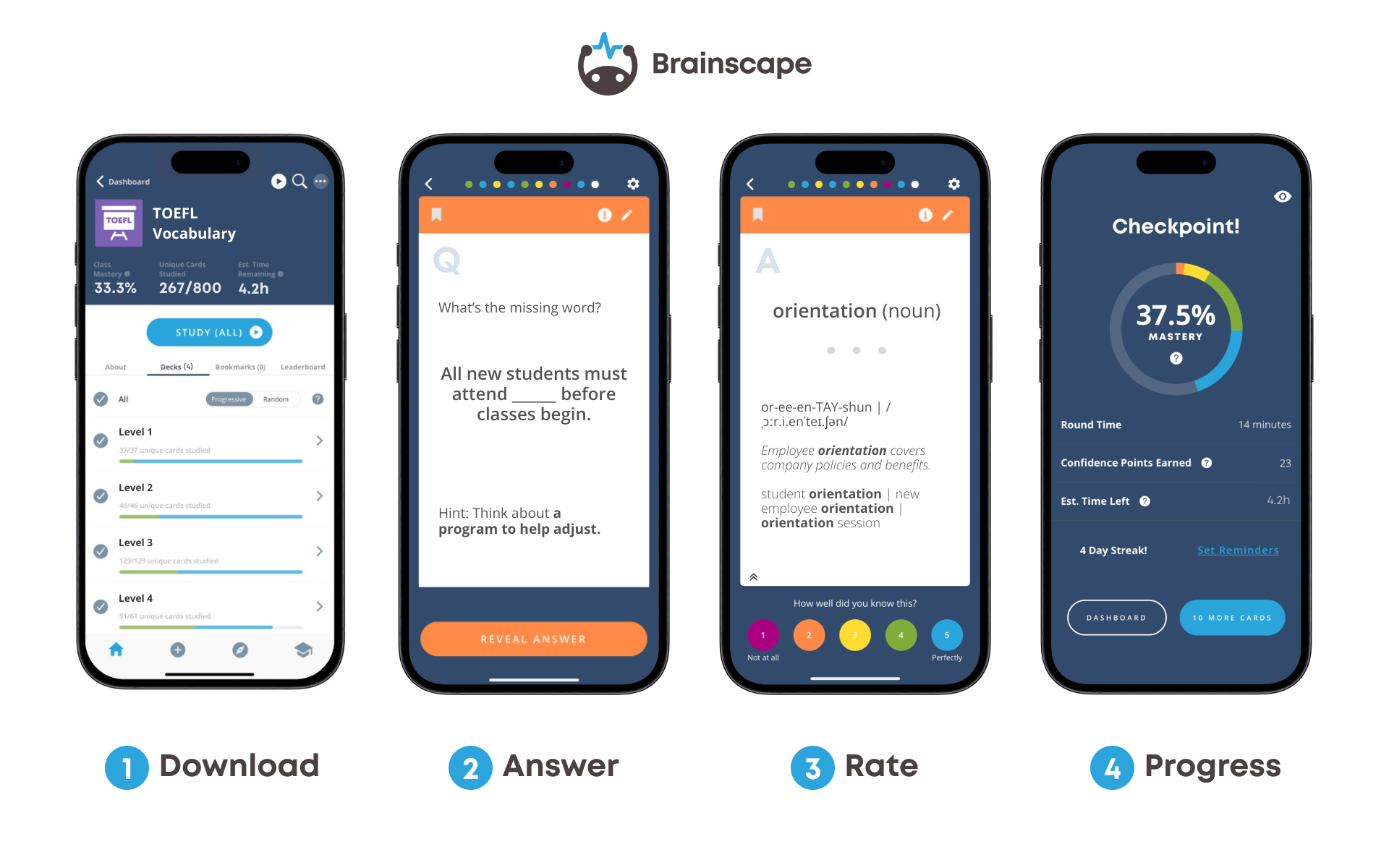
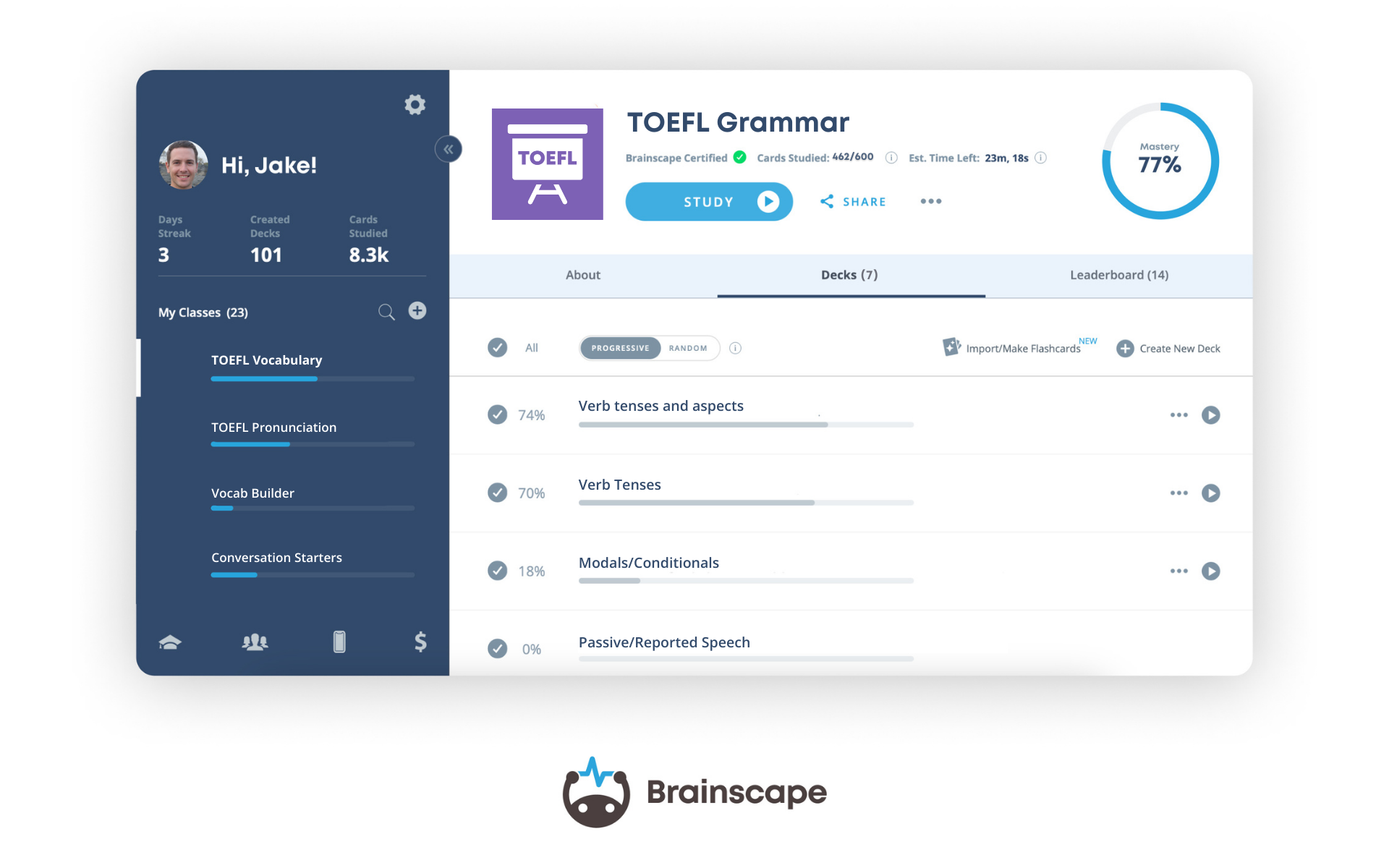
To strengthen your vocabulary efficiently, make a note of new words as you study and review them with digital flashcard apps such as Brainscape or Anki. Their adaptive algorithms automate a process called spaced repetition. That means that they resurface words at just the right time, helping you learn them twice as fast and remember them longer. By revisiting your flashcards daily, you’ll build a flexible bank of phrases ready to use in every part of the exam.
5. Prioritize Pronunciation Over Speed
You’re not scored on the number of words you can say within 60 seconds. Many students try to fit in as much information as possible, but clarity always scores higher than volume. Speak at a steady, confident pace.
With these tips explained, you should be more than ready to dive into some actual speaking practice…
How To Use Speaking Practice Prompts To Prepare For The TOEFL
It’s time to siiiiing! Well, that’s optional. But it is time to speak. This is the point in the article when we hand the microphone to you.
We’ve created a diverse array of English speaking practice prompts to help you build confidence and fluency under real exam conditions. Each question includes authentic-style prompts for both Independent and Integrated Speaking tasks, with guided timing and sample responses to help you compare and improve.
Importantly:
- Find a quiet space where you can speak out loud without interruptions.
- Carefully read the instructions so that you understand how to get the most out of it.
- Record your answers on your mobile device so you can listen back and self-evaluate.
- Focus on structure and clarity, not on speaking fast.
- Review the sample responses to learn how top scorers organize their ideas.
With consistent practice using these free advanced English speaking prompts, you’ll strengthen your timing, pronunciation, and overall confidence, so you’re ready to speak clearly and naturally when it counts.
Oh, and as you’re practicing them, make sure you’re aware of the following…
What Are the Most Common TOEFL Speaking Mistakes?

Even confident English speakers make small mistakes that cost big points in the TOEFL Speaking section. The good news? Every one of them is fixable with a bit of awareness and practice.
1. Spending too long on the introduction
Many test-takers waste precious seconds restating the question or overexplaining their opinion, then run out of time for their second reason or conclusion. Keep your intro short at one or two sentences, maximum. Then, move straight into your first supporting point. Practice this with a timer until it feels natural.
2. Giving vague examples
Saying “It’s nice” or “That’s better for me” doesn’t show much language skill. Instead, use clear, specific examples that sound personal and real. For instance, “I prefer studying at home because I can control the noise level and stay focused.” Being specific makes your response more believable and engaging.
3. Overusing filler words
Nerves often make people rely on “um,” “uh,” or “like.” This breaks your rhythm and lowers your delivery score. To fix it, pause silently when you need to think, or use transition phrases like “First,” “Next,” or “In contrast.” Recording yourself is one of the fastest ways to spot and reduce these habits.
4. Forgetting to use comparisons
Using contrast words like “whereas” or “unlike” makes your answers more sophisticated. For example, “I prefer working in a team because it allows for collaboration, whereas working alone can feel isolating.” This kind of structure shows strong logical connections between ideas, which is exactly what TOEFL assessors love.
FAQ Section
How Many Speaking Tasks Are On The TOEFL?
There are four speaking tasks on the TOEFL: one independent and three integrated.
How Long Is The TOEFL Speaking Section?
The TOEFL Speaking section is about 16 minutes long.
Do You Get Preparation Time Before Each Task?
Yes, you get about 15 to 30 seconds before each task on the TOEFL Speaking section, depending on the task.
How Long Should Each Response Be?
On the TOEFL Speaking section, each response should be between 45 and 60 seconds.
What’s The Hardest Part Of TOEFL Speaking?
Most students find organizing ideas quickly under time pressure the most difficult. You can overcome this by learning templates, applying them under timed conditions, and using flashcards to build your vocabulary, pronunciation, and grammar foundations.
How Can I Improve My TOEFL Speaking Skills Daily?
You can improve your TOEFL speaking skills by practicing with official prompts, recording yourself regularly, using structured templates, and reviewing new vocabulary with flashcards.
Is It Helpful To Memorize Answers For The TOEFL Speaking Section?
No, it is not helpful to memorize answers for the TOEFL Speaking section, as you may be faced with an entirely different topic on the day. You need to be able to speak naturally and respond to new information. Use digital flashcards like Quizlet or Brainscape to memorize vocabulary, grammar, and pronunciation, then apply these building blocks to create new answers for every question.
Conclusion: Speaking Comes From Practice
The TOEFL Speaking section isn’t about a perfect, inspiring speech for the history books. Those are scripted. This is improvised. It’s about thinking swiftly so you can communicate ideas clearly and confidently within a limited time.
By practicing regularly with TOEFL speaking questions, learning flexible templates, and training under real conditions, you’ll be prepared. Build your foundational knowledge with digital flashcards, then apply those with practice questions.
It might be hard the first time you have to speak with only 15 seconds of preparation, but it’ll be a lot easier the hundredth time. With the right preparation, the TOEFL exam will be the easiest set of speaking questions you’ve ever answered!
Additional Practice Resources for the TOEFL
- How to Practice TOEFL Listening Skills (With Free Videos)
- 6 Tips for TOEFL Reading Practice (Plus Question Bank)
- 5 Tips for TOEFL Writing Practice (Plus Question Bank)
References
Gromik, N. A. (2012). Cell phone video recording feature as a language learning tool: A case study. Computers & Education, 58(1), 223–230. https://doi.org/10.1016/j.compedu.2011.06.013
Kang, S. H. (2016). Spaced repetition promotes efficient and effective learning. Policy Insights from the Behavioral and Brain Sciences, 3(1), 12–19. https://doi.org/10.1177/2372732215624708
Mabini, D. A. (2023). Improving persuasive speaking skills using a student-developed template in an online learning environment. Journal of Language Teaching, 3(5), 12–22. https://doi.org/10.54475/jlt.2023.011
Stirling, B. (2019). Speaking and writing strategies for the TOEFL IBT. Nova Press.
TOEFL IBT speaking section. (n.d.). https://www.ets.org/toefl/test-takers/ibt/about/content/speaking.html
Warrick, A. (2021). Strategies for reducing cognitive overload in the online language learning classroom. International Journal of Second and Foreign Language Education, 1(2), 25–37. https://doi.org/10.33422/ijsfle.v1i2.124