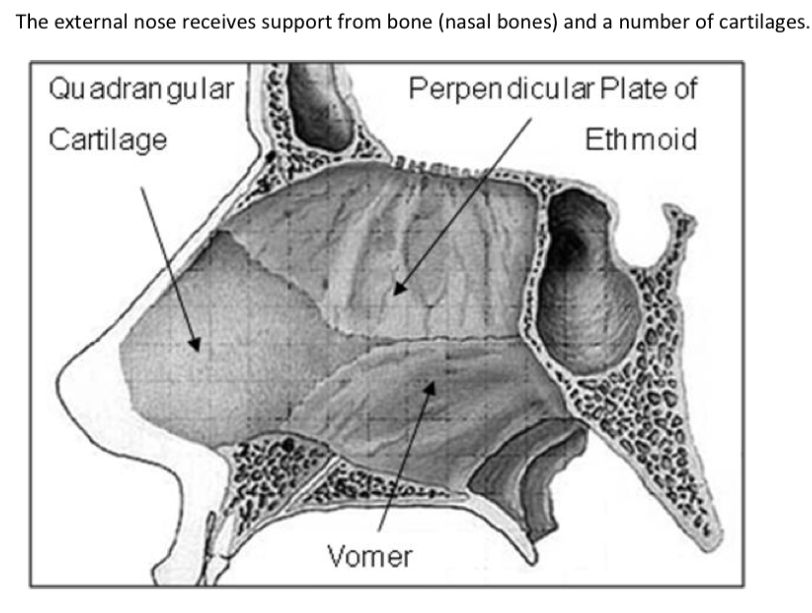
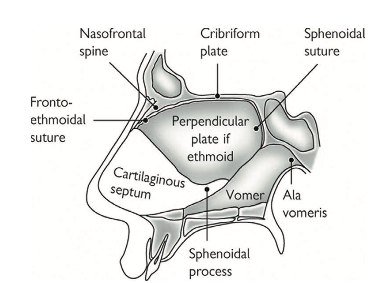
What bones make up the nose?
- Ethmoid
- Vomer
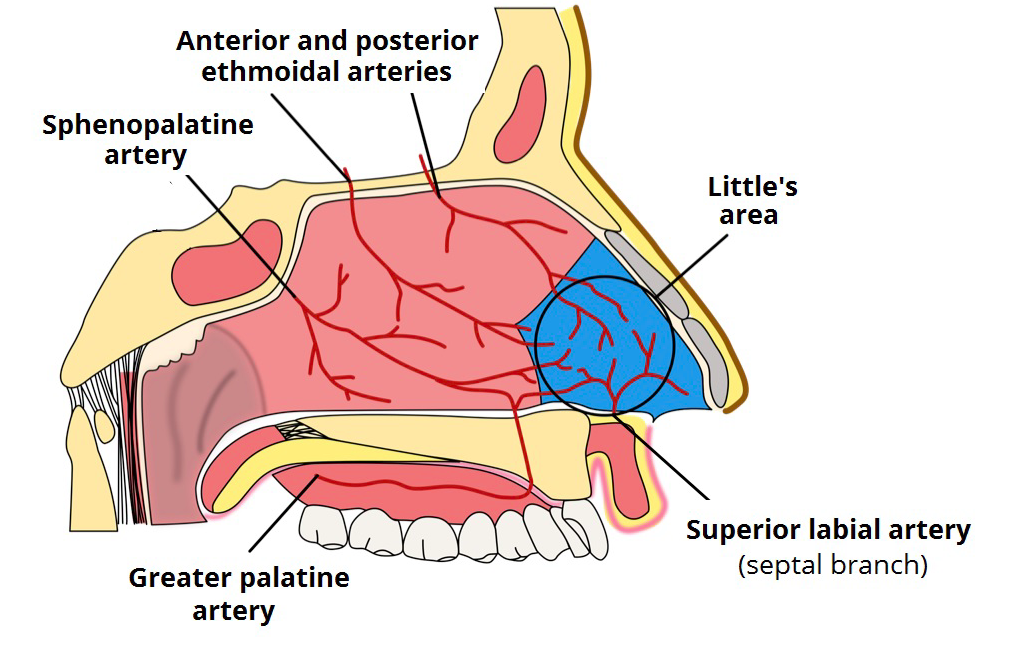
What is the blood supply to the nose?
All comes from internal and external carotid arteries
Little’s Area (Kiesselbach’s) (SEPTAL): LEGS
L - Septal branch of the superior labial artery
E - Anterior and Posterior Ethmoidals
G - Greater Palentine
S - Sphenopalentine
What are some of the causes of epistaxis?
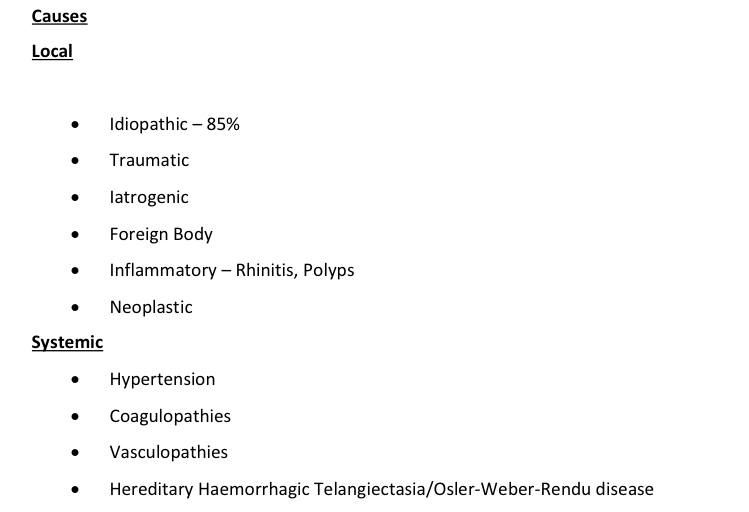
- Idiopathic
- Traumatic e.g nose picking
- Iatrogenic e.g anticoagulants
- Foreign body
- Inflammatory e.g polyps, rhinitis
- Malignancy
- Cocaine use
- Coagulopathies
- HTN
- Hereditary haemorraghic telengectasia
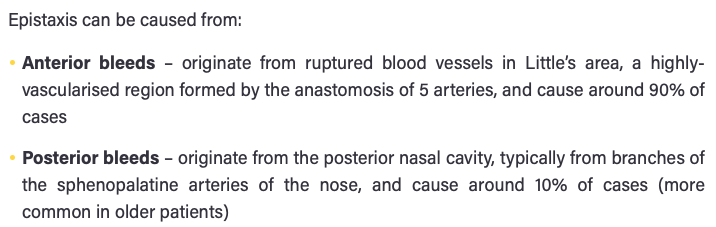
What are some important questions to ask in a history when a patient presents with epistaxis?
- Side, duration, approximate blood loss
- Previous episodes and treatment?
- Risk factors:
- Recent trauma e.g pituitary surgery BEWARE
- Recent URTI
- HTN
- Anticoagulants
- Smoker?
- Cocaine?
- PMHx e.g coagulopathies
How should you treat epistaxis - is it an emergency?
All epistaxis should be deemed an emergency and as severe until proven otherwise.
e.g Posterior bleed may not be externally bleeding but could be swallowing a lot of blood
When is epistaxis classed as life-threatening and what is the management for this?
- Large volume bleeds
- Haemodynamically unstable
- Not stopping with interventions
Mx: A to E, Airway trained personnel present, adequate IV access, resuscitation with blood products
What is the management of epistaxis in general (non-life threatening)?
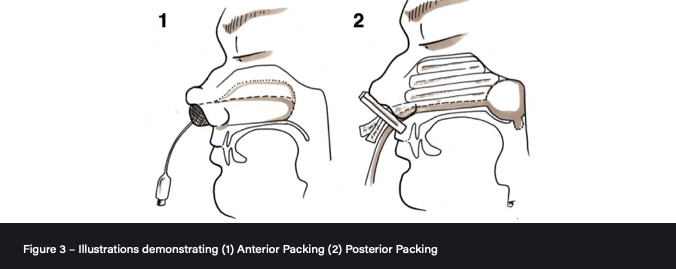
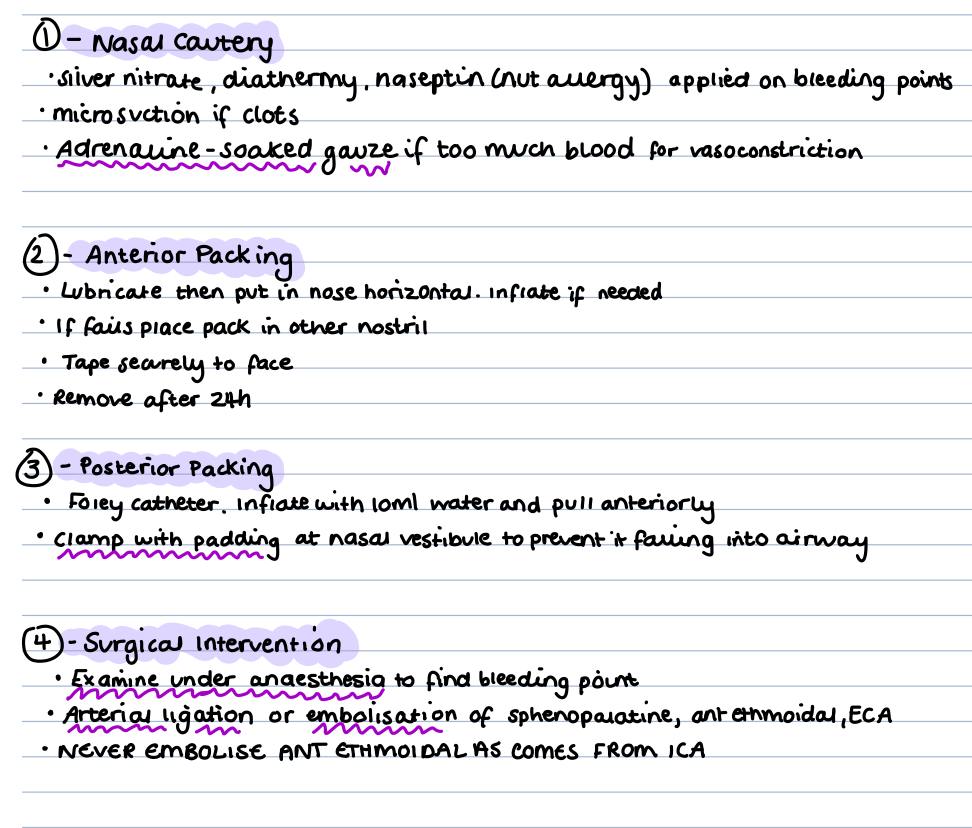
STEPWISE TREATMENT - MONITOR OBS AND RESUS AS NEEDED
General:
- Sit up and head forward
- Spit out any blood in mouth
- Pinch soft part or put nasal clip on anterior nose for 20 minutes for continuous compression
- Ice on nose for vasoconstriction
- Look for source of bleeding on septum with thudicum and in patients mouth (ant or pos?)
- Send off for bloods e.g FBC, G+S, Clotting and reverse and coagulopathies
- offer topical vasoconstrictor + local anaesthetic
(e.g. lidocaine + phenylephrine or oxymetazoline) - Cauterisation if bleeding site is visible
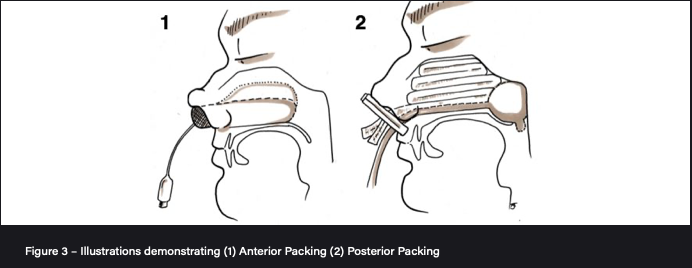
→ Use silver nitrate sticks (only 1 side of septum at a time) - Anterior nasal packing (e.g. with Merocel or ribbon gauze with BIPP)
If still bleeding: Posterior nasal packing (e.g. balloon catheter)
SEE IMAGE FOR FURTHER MANAGEMENT
What advice should you give to patients post-cautery?
- Avoid hot showers
- Don’t bend, lift or strain
- No food or hot drinks
- Avoid picking nose
- Send sneezes through mouth
- Come back to A and E if bleeding again for >20minutes
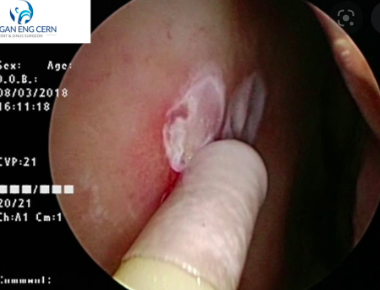
Why should you not use silver nitrate if actively bleeding to cauterise and why shouldn’t you cauterise both sides?
. First Aid
Pinch nose and lean forward
Cold compress
Suction if available
- Apply topical vasoconstrictor
e.g. lidocaine with adrenaline or phenylephrine spray
This helps constrict vessels and reduce bleeding to allow visualisation - Once bleeding slows/stops → then consider:
Silver nitrate cautery if a single, visible bleeding point can be identified
👉 Only one side of the septum at a time to avoid perforation
- Once bleeding slows/stops → then consider:
- Bleeding will wash the chemical away and can burn lips
- Risk of perforation
What are some of the risks with posterior packing and surgical embolisation for the treatment of epistaxis?
Posterior Packing:
- Aspiration of Foley catheter
- Packing induced OSA (nasopulmonary reflex - watch resp rate)
Embolisation:
- Risk of stroke
- Never embolise anterior ethmoidal as comes off of ICA
After treating a nose bleed what can you prescribe a patient?
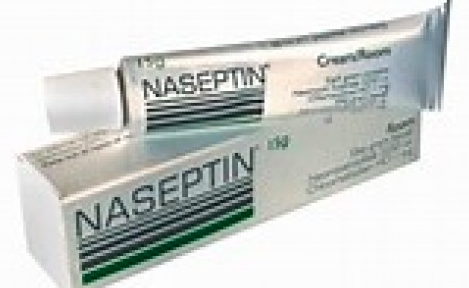
Naseptin (chlorhexadine and neomycin) for 10 days to prevent crusting
Avoid in peanut and soy allergy
What are some examples of anterior packing devices and why should you avoid them if possible?
- Rapid Rhino and Nasal tampons
- Means they have to have an admission
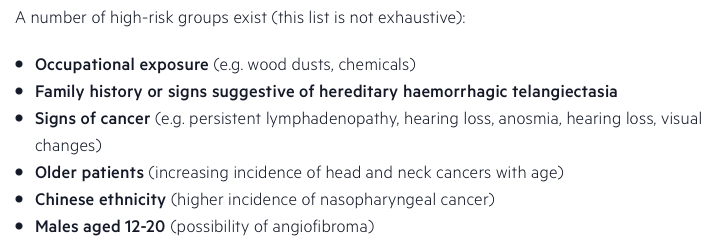
What pathologies could cause recurrent epistaxis?
Always consider leukaemia
What are some important questions to ask with nasal trauma?
- Mechanism of injury (impact, force, direction)
- Pain?
- Nasal deviation?
- Obstruction?
- Epistaxis?
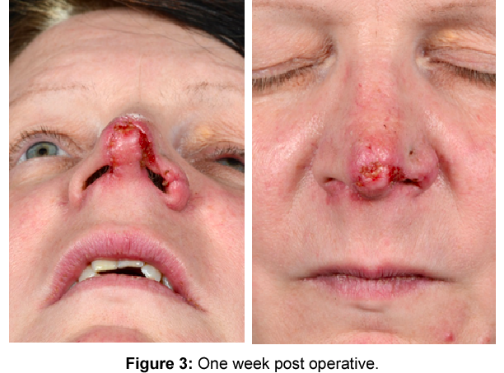
How do you manage a nasal laceration?
- Clean wound
- Consider if need tetanus prophylaxis based on mechanism of injury
- Oppose edges of skin with steri-strips or sutures for primary intention healing
- If cannot get skin to oppose, refer to plastics as may need to heal by secondary intention
After nasal trauma what are two complications you need to assess for?
- Septal haematoma (risk of AVN if left)
- Rhinorrhea (CSF leak from basilar skull fracture)
- Anosmia
How does a septal haematoma present?
On anterior rhinoscopy a boggy red/purple swelling from the nasal septum
Use a Jobson-Horne probe to see if fluctuant as this distinguishes it from a septal deviation
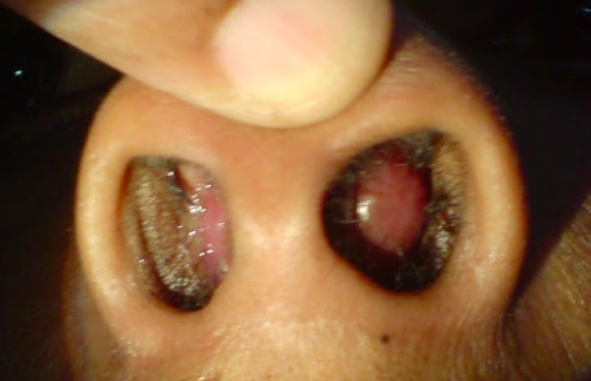
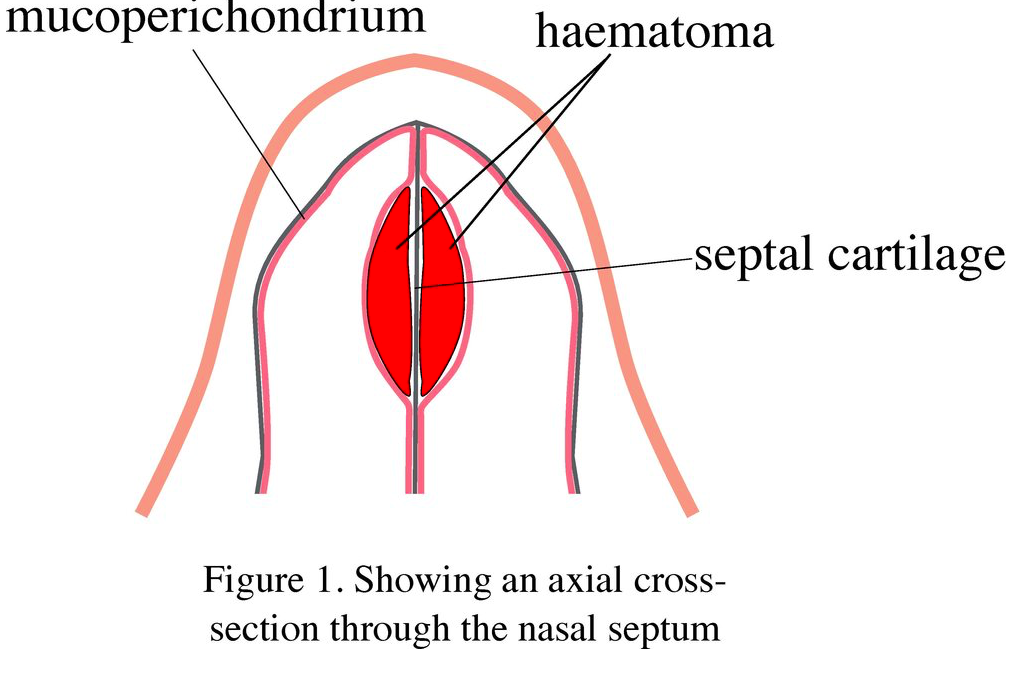
How is a septal haematoma treated and why does it need to be treated?
- Incision and drainage under general anaesthetic
- Risk of avascular necrosis as septum gets its blood supply from overlying perichondrium
- Avascular necrosis of septum can lead to saddle nose deformity, septal perforation and infection/abscess formation
What is the risk with a nasal septum abscess?
Ascending cavernous sinus infection and the associated intracranial or ocular complications
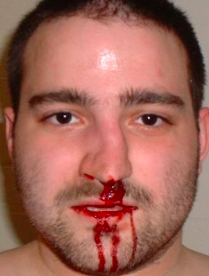
How may a nasal fracture present and what investigations should you do?
- New nasal deformity with swelling and black eyes
- Look for septal haematoma and treat promptly if so
- Treat any epistaxis
- No X-ray needed, if suspect other facial fractures then can do CT
- If uncomplicated nasal fracture (no septal haematoma) can send home and see in clinic after 7-10 days
When a patient with a nasal fracture comes to ENT clinic 7-10 days later, what are you assessing for? (seen 7-10 days later to allow swelling to settle)
Nasal deformity – objective assessment for any bony or septal deviation, patient’s perception of the appearance of their nose
Nasal obstruction – ask how the patient is symptomatically, air flow can be assessed by holding a metal tongue depressor below the nose and observing misting during nasal breathing
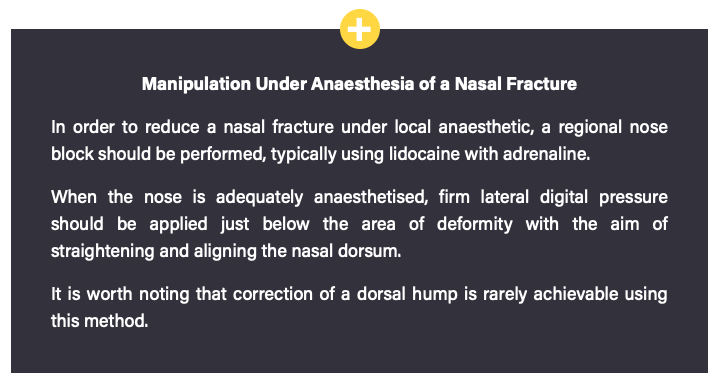
How is a nasal fracture treated if there are symptoms?
- Manipulation under anaesthesia: local or general anaesthetic within 2-3 weeks before bones set
- If still issues after this can have rhinoplasty (changing shape of nasal bones) and septoplasty (nasal septum alteration)
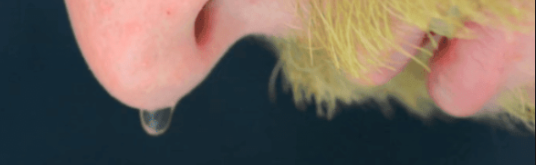
Why can rhinorrhea occur after nasal trauma and how can you test it to see if it is CSF?
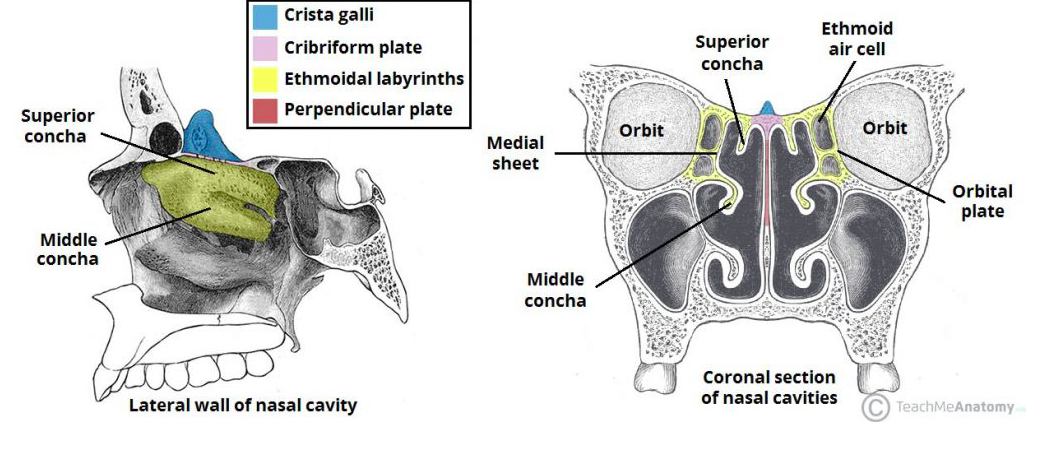
- Fracture through cribriform plate
- Test the fluid for high levels of beta-2 transferrin
How is a CSF leak following nasal trauma managed?
Conservative: most will resolve spontaneously after 2 weeks with some bed rest and head elevation of 10-15 degrees. Avoid coughing and sneezing
Surgical: not often needed



-
1 - Neurology History, Examination and Localisation55
-
2 - Neurological Common Presentations and Investigations88
-
3 - Neurological Emergencies104
-
4 - Common Neurological Disorders 1106
-
5 - Common Neurological Disorders 237
-
6 - Common Neurological Disorders 375
-
7 - Less Common Neurological Disorders77
-
8 - Ophthalmology Anatomy, History and Examination70
-
9 - Ophthalmology Presentations 141
-
10 - Ophthalmology Presentations 258
-
11 - Ophthalmology Conditions 193
-
12 - Ophthalmology Conditions 277
-
13 - Dermatological History, Examination and Drugs55
-
14 - Skin Infections and Infestations86
-
15 - Emergency Dermatology47
-
16 - Common Dermatological Conditions53
-
17 - Benign and Malignant Skin Tumours39
-
18 - Dermatology Common Drugs52
-
19 - ENT History, Examination and Presentations101
-
20 - Ears107
-
21 - Nose69
-
22 - Throat74
-
23 - Gland Pathology and H+N Cancers57
-
Random key facts52


