1.
The Human Brain:
List 3 statments
The human brain weighs 1.3 kg and is made up of 100 billion neurons (85 billion??) with 100 trillion connections.
- It is thought to have ten times a many glial cells as neurons.
- It is one of the most the most complex structures in the known universe.
- The human brain may be estraordinary but is it in absolute terms?
NO:
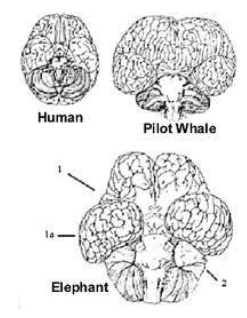
During the course of our development, humans build big brains, but there are animals that develop bigger brains than ours:
- The elephant has a brain 3.5 bigger than human’s.
- The Blue Whale’s brain is 5 times bigger than ours (Passingham 1982).
3.
What is the Encephalisation Quotient (EQ)?
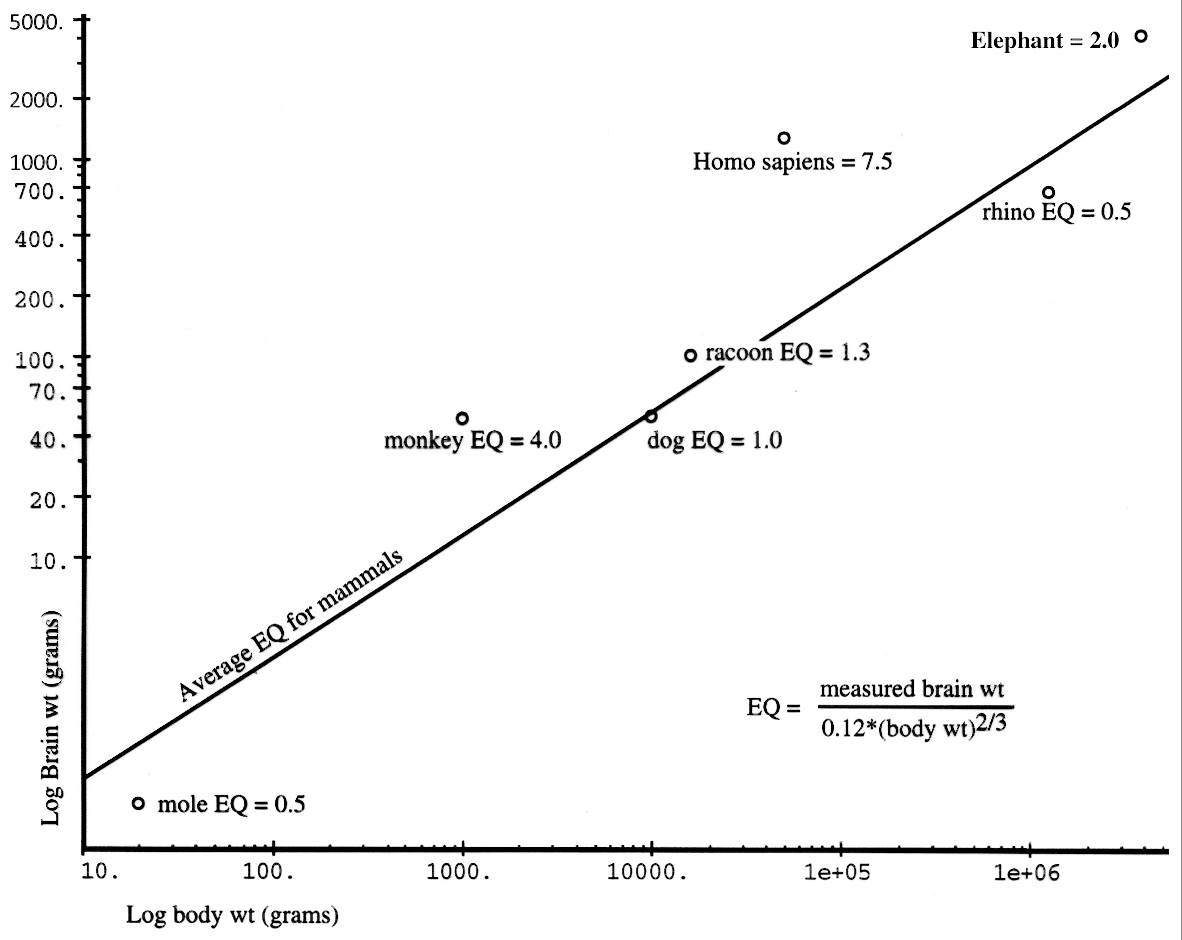
A measure of relative brain size defined as the ratio between actual brain mass and predicted brain mass for an animal of a given size, which is hypothesized to be a rough estimate of the intelligence or cognition of the animal.
Actual brain size
___________________________________________Average brain size for a mammal of that body weight
Human EQ = 7.5. Hence, we have a brain 7.5 times bigger than one would expect of an average mammal of our body size (Jerison 1973)
4.
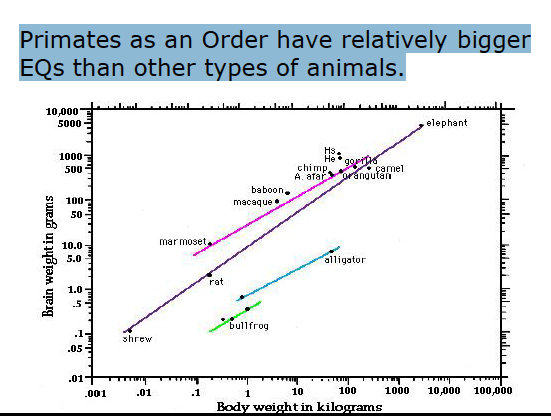
Primates as an Order have relatively bigger EQs than other types of animals.
5.
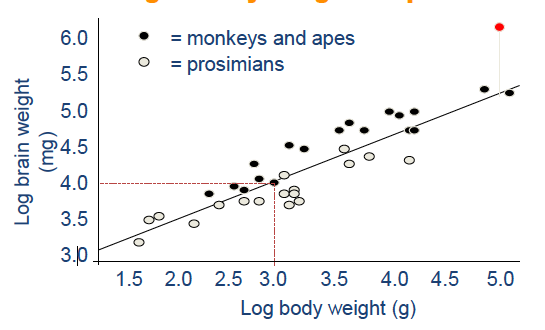
Brain weight /body weight for primates?
Our brain is 3.1 times as big as one would expect for an average primate of our body size.
- Thus, in absolute terms humans do not build the biggest brains on the planet during the course of development. Nevertheless, it is a much bigger brain than one would expect for an average mammal, or even primate, of our body size.
- Our brain size has a profound effect upon all aspects of our development across our lifespan.
6
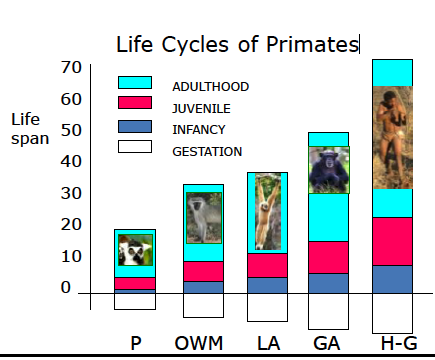
Life Cycles of Primates
This is based on hunter gatherers (H-G) as with modern medicine lifespans have been extended extensively.
- P = Prosimians (before money - Lemur etc)
- OWM = Old World Monkey
- LA =Lesser Apes (Gibbons)
- GA = Great Apes (closer genetically)
- HG = Hunter Gatherers
7.
Discuss big body development.
- In general, animals with big bodies develop slowly.
- However, even when we allow for body size primates develop particularly slowly compared to other mammals.
- The rate of development is correlated with adult brain size.
8.
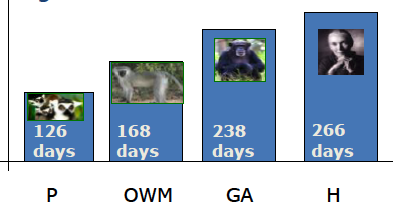
Length of gestation in primates:
The length of gestation is determined by the size of brain that needs to be built. However, by such logic, our gestation should last 3 times longer than a chimpanzee’s: i.e., 714 days or 24 months!
Why is human gestation cut short?
9.
List brain capacity at birth in %:
- Rhesus macaque
- Chimpanzee
- Human beings
Brain capacity at birth (compared to adult)
- Rhesus macaque 60%
- Chimpanzee 46%
- Human beings 23% (less than a 1/4 of adul rate!)
Undeveloped young is a primate feature.
10.
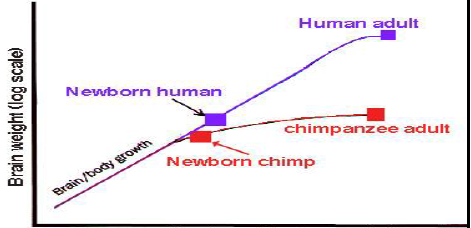
In _______________ continues to grow at the foetal rate for _______________ (Bogin 1997). By 3 year of age it is at __ adult capacity and _____ by five years of age (Dekaban & Sadowsky 1978)
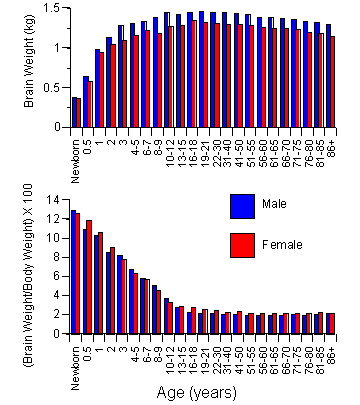
In humans the brain continues to grow at the foetal rate for two years after birth (Bogin 1997). By 3 year of age it is at 80% adult capacity and 90% by five years of age (Dekaban & Sadowsky 1978)
11.
What is human brain weight at:
- Neborn
- Age 3
- Age 5
- Newborn’s brain: about 25% of adult size
- Age 3: about 80% of adult size
- Age 5: about 90% of adult size
12.
Is it only brain size that is underdeveloped in humans?
• It is not just in terms of brain size that we seem underdeveloped at birth:
- Human beings seem to be born before they are fully developed. Our bones do not fully calcify until one year after birth (born in a foetal state)
- Rhesus macaques have a gestation period of 24 weeks, their bones have fully calcified by the 18th week of gestation (way before birth)
13.
What does bipedal locomotion make particulalry difficult?
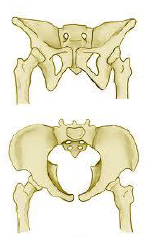
- Humans develop a very large brain and yet because of bipedal locomotion the female of the species has a long and narrow birth canal.
- Hence rather than waiting, we push our babies out early.
Img: Human (above); chimpanzee (below)
14.
The fontanelles:
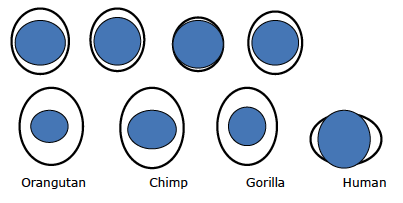
Size of neonate’s head relative to the pelvic outlet
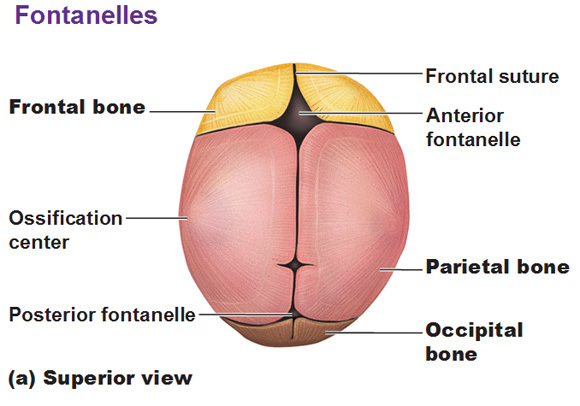
- At the points where the plates of the skull meet are little gaps called fontanelles. The anterior fontanelle in newborn humans is a diamond shaped aperture of an inch in diameter. It allows the bones to slide over each other slightly reducing the dimensions of the cranium during birth.
- The cranial plates do not grow together until about 2 year of age.
- There must have been intensive selection pressure for large brain in humans, which seems to have started early…
15.
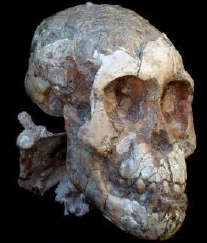
(Alemseged et al 2006) Australopithecus afarensis
The 3.5Myrs old skull of an Australopithecus afarensis child estimated to be 3 years old (Alemseged et al 2006).
- Brain size estimated at 330 cubic centimetres, about the same as a 3 year-old chimpanzee.
- However, compared to the adult values of its species, the Dikika baby had formed only between 63 and 88% of the adult brain size, which is lower than that of a 3 year only chimpanzees whereby over 90% of the brain is formed.
- This relatively slow brain growth observed in A. afarensis is slightly closer to that of humans, pointing to a possible behavioural shift in this species (Science Daily 2006).
16
One cell to trillions:
What is the zygote?
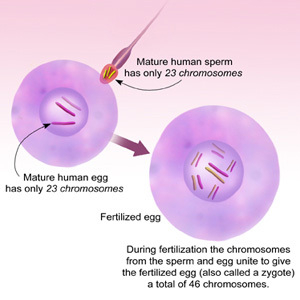
- All human life starts with one cell: the fertilized egg or zygote. How can a single cell be responsible for such wondrous complexity?
- A zygote contains the blueprint for our brains and body. Each is comprised of 23 pairs of chromosomes. Each chromosome is packed full of long strands of DNA, which can be divided into functional units called genes.
17.
Gene-environment interaction
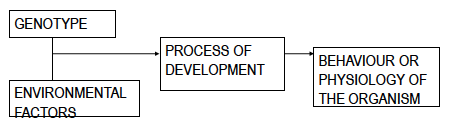
- Although brain development is “gene-driven”, there is also a vital interaction with environment factors.
- All aspects of development are the result of an interaction between genes and the environment. The development of the brain constitutes an interplay between biologically inherited processes and environmental influences (Smith et al. 2003).
18
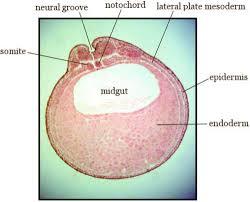
What is the neural groove?
The neural groove is a shallow median groove of the neural plate between the neural folds of an embryo.
This becomes the neural tube (27 days) and is the embryo’s precursor to the central nervous system (CNS)
19.
What is Encephalisation?
- In humans, the cephalic (head) portions of the neural tube grow tremendously and this disproportionate growth is referred to as “encephalisation”.
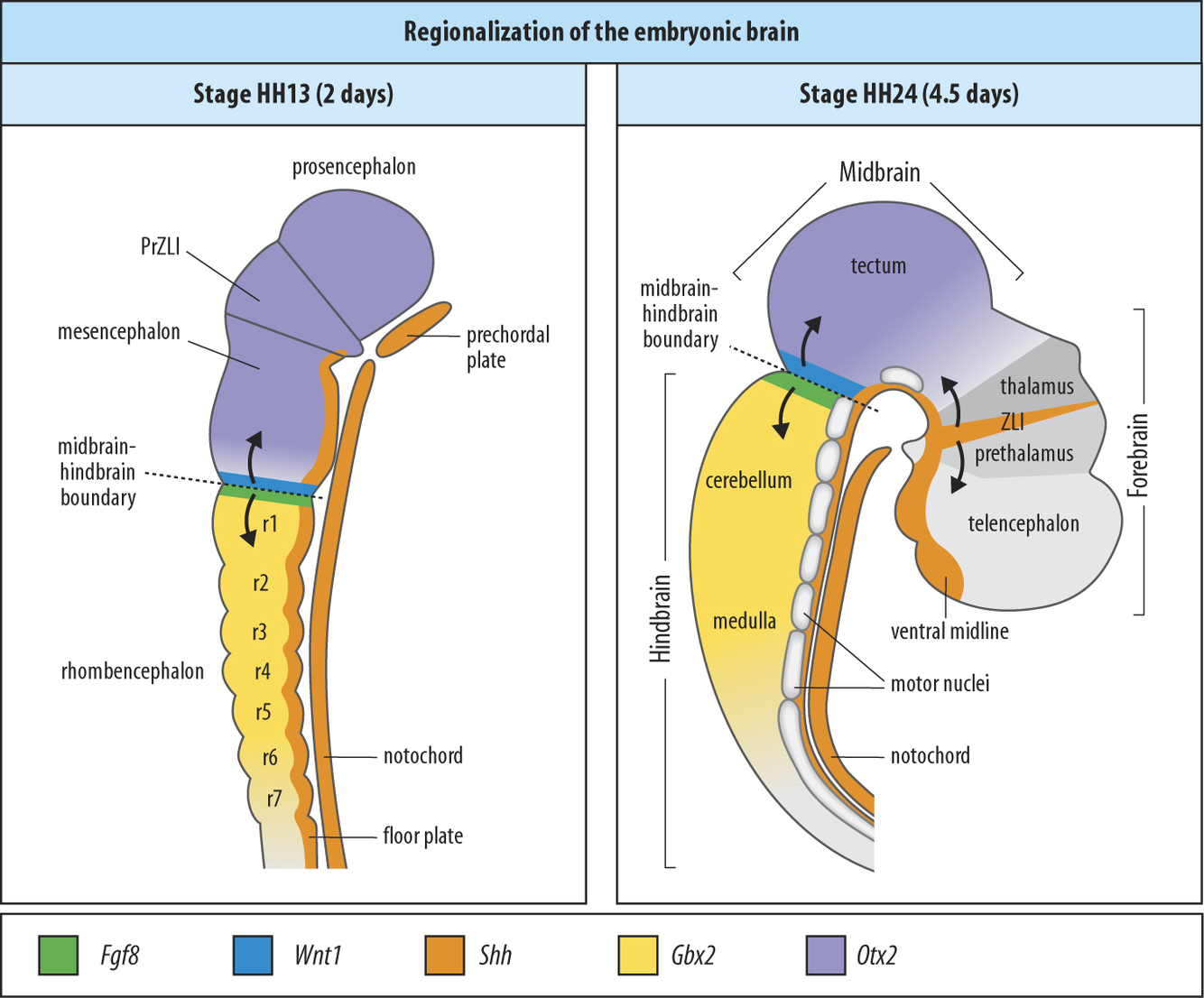
- Even before closure of neural tube is complete, the cephalic part of the neural tube differentiates into 3 primary spaces, or ventricles that will become the CNS.
- Three clear sections as early as 26 days
- forebrain (prosencephalon)
- midbrain (mesencephalon)
- hindbrain (rhombencephalon)
20.
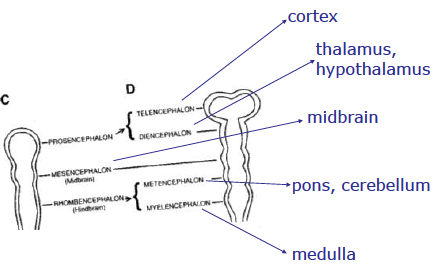
EVENTUAL ADULT BRAIN STRUCTURES
- Telencephalon -> cortex
- Denencephalon -> thalamus and hypothalmus
- Mesencephalon -> midbrain
- Metencephlon -> pons, cerebellum
- Mylencephalon -> medulla
Increasing complexity
21.
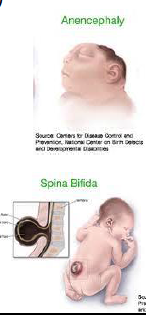
– One of the most sensitive periods in brain development occurs at the very beginning, when the neural tube is closing.
What is
- Anencephaly
- Spina bifida
- Anencephaly literally means a lack of cerebralcortex. The neural tube fails to close at anterior (or front) end and babies are born with no brain. The condition is always fatal.
- Spina bifida is caused by a failure of the neural tube to close properly at posterior (rear) end so that part of the spinal cord develops outside the spine, rendering it vulnerable to damage. The condition has varying outcomes.
22.
Human brain vs. others?
- 25 days human CNS like worm
- 40-50 days like vertebrate
- 100 days like mammalian
- 5 months, primate uniquely human: vast expansion forebrain and cerebral cortex
23.
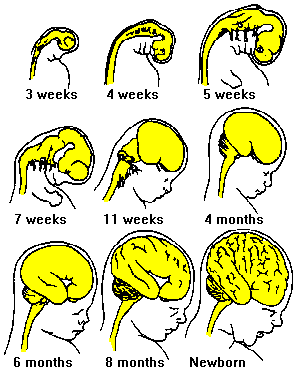
Describe the humna brain at 5 weeks:
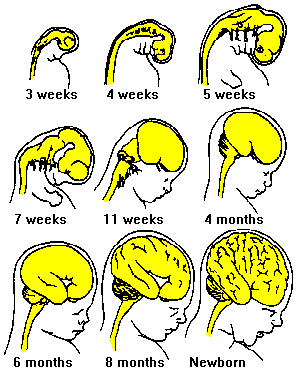
After the first five weeks, the brain’s gross features are formed by growth and flexion (or bending) of the neural tube’s anterior (front) portions. The result is a cerebral cortex that envelops the subcortical and brainstem structures that started out in line with the cortex along the neural tube. The final gross structural form are the product of continued cortical enlargement and folding.
24.
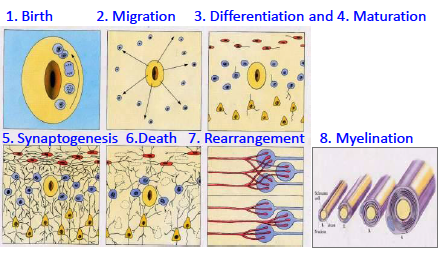
What are the stages of brain cell development?
- Birth
- Migration
- Differentiation and
- Maturation
- Synaptogenesis
- Death (synaptic pruning and neuronal)
- Rearrangement
- Mylenation