What is a metabolic pathway?
Series of enzyme-catalyzed reactions
- metabolites or metabolic intermediates are the chemical intermediates
The chemical intermediates of metabolic pathways are called:
Metabolites or Metabolic intermediates
All metabolic pathways share the same ________ and _________ principles
All metabolic pathways share the same fundamental chemical and thermodynamic principles
What are the two major purposes of Metabolism?
- To obtain usable chemical energy from the environment
- capturing solar energy (photosynthesis)
- Consuming and breaking down nutrient molecules
- To make the specific molecules that cells need to live and grow
Differences between cells in different organisms and different tissues come down to differences in their ________
Differences between cells in different organisms and different tissues come down to differences in their metabolic pathways
- active sets of pathways determine function
What are anabolic pathways?
Pathways that use energy (require energy) to build larger molecules and are generally reductive (electrons are used to make new bonds)
- Biosynthesis
- Require precursors
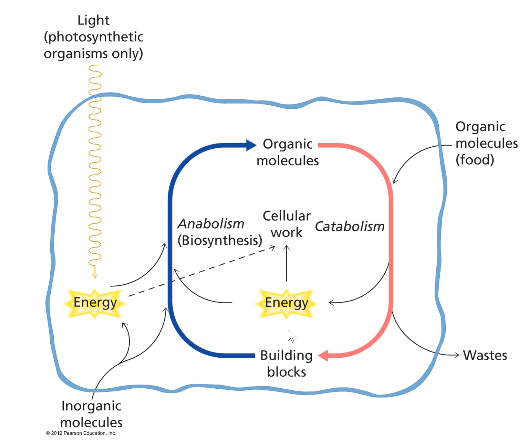
What are catabolic pathways?
Release energy (some of which is stored) and are generally oxidative (electrons are removed as bonds are broken)
- generates precursors (building blocks)
What are amphibolic pathways?
Operate in both catabolic and anabolic processes (depending on conditions)
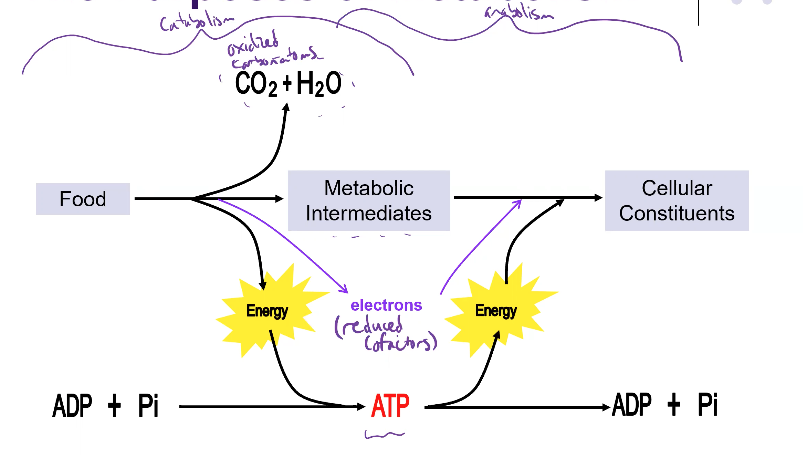
Three ways food can be used in metabolism?
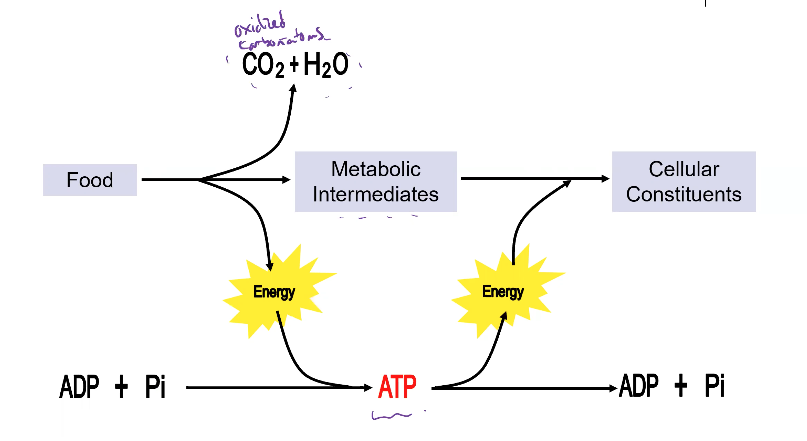
- Generate oxidized carbon atoms (CO2) and water = catabolism
- Generate metabolic intermediates for formation of cellular constituents (Anabolism)
- Storage of energy as ATP (electrons as reduced cofactors for anabolism)
What are the four dietary macromolecules?
What do they break down into?
- Nucleic acids
- nucleotides
- not a significant fuel source
- Proteins
- amino acids
- Polysaccharides (complex carbs)
- monosaccharides (simple sugars)
- Triacylglycerol (Fat)
- fatty acids
Which two dietary macromolecules are the most significant fuel sources (ie greatest energy)?
Polysaccharides and Triacylglycerol
Are proteins used as an energy source?
Not typically. We can, but the amino acids are better used elsewhere
- We use the amino acids from protein breakdown for the synthesis of our own proteins
- Some amino acids we can only get from outside sources
Between polysaccharides and triacylglycerol, which provides more energy?
Triacylglycerol (fat) provides more energy than polysaccharides (carbohydrates) but both represent significant fuel sources.
Both are less useful as precursors than they are as energy sources
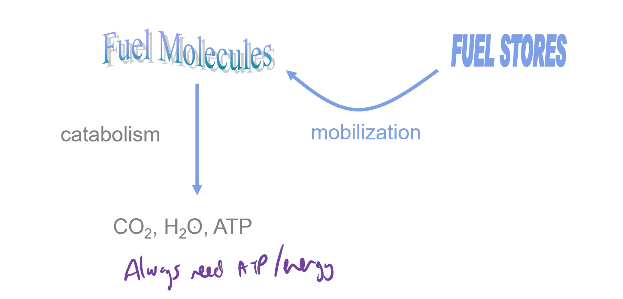
What is something that we ALWAYS need?
ATP/energy
Food is catabolyzed into ATP
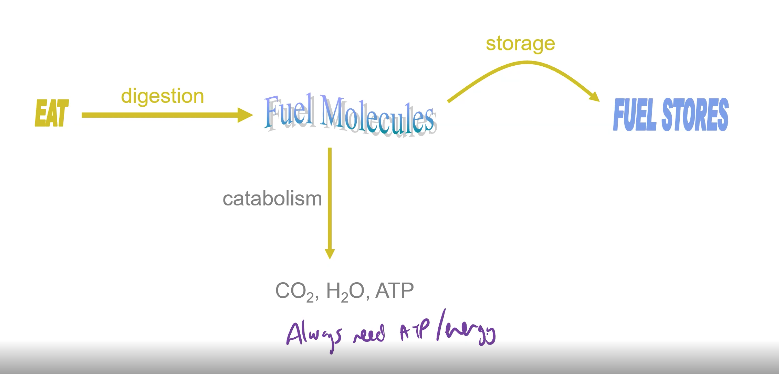
What happens in the absence of food?
Fuel stores are mobilized to generate fuel molecules which can be catabolized to form ATP
The way we store fuel molecules depends on ________
The way we store fuel molecules depends on the type of molecules in question
- Major ways:
- As carbohydrates
- As fats
Carbohydrates are generally stored as _________ in the _________ and ________
Carbohydrates are generally stored as glycogen (polymer of glucose molecules) in the liver (hepatocytes) and skeletal muscle (myocytes)
Fatty acids are stored as ______ in _________
Fatty acids are stored as fat (triacylglycerols) in adipocytes
Liver glycogen is used to maintain:
Skeletal muscle glycogen is used for:
Liver glycogen is used to maintain a Continuous glucose supply in the bloodstream.
Skeletal muscle glycogen is used for those myocytes = not available for the rest of the body
Which stores more energy, fat or carbohydrates?
Fat (1g:7g ratio)
Fat can store the same amount of energy in one gram as carbohydrates can in 7g
What is the biochemical standard state?
(what the prime ‘ refers to in deltaG‘)
- pH 7 ([H+] = 10^-7 M)
- (for chemical standard state, [H+] = 1 M)
- [Substrates] & [Products] = 1M
- consistent with chemical standard state
- Temperature = 25°C/298K
- Pressure = 1atm
- [H2O] = 55M
- (large amount of water)
IGNORE [H+] and [H2O] in calculations
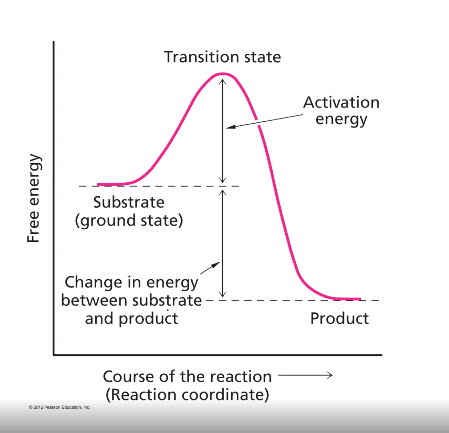
A reaction will only proceed in the forward direction when the associated value of deltaGreaction is _______
A reaction will only proceed in the forward direction when the associated value of deltaGreaction is negative (<0)
- ACTUAL delta G (not the standard delta G)
- ΔG’reaction = biochemical actual
- ΔG’°reaction = biochemical standard
What is the difference between:
ΔG’reaction
ΔG’°reaction
ΔG’reaction = biochemical actual free energy change
ΔG’°reaction = biochemical standard free energy change
How would you describe a reaction with
ΔG’reaction < 0
ΔG’reaction < 0
Reaction is:
- exergonic
- spontaneous
- “down-hill”
- Favourable
- Reaction proceeds forward


