- Monique is a 33-year-old administrative assistant who has had intermittent lower abdominal pain approximately one week a month for the past year. It is not related to her menses. She notes relief with defecation, and a change in form and frequency of her bowel movements with these episodes. Which of the following is most likely?
A) Colon cancer
B) Cholecystitis
C) Inflammatory bowel disease
D) Irritable bowel syndrome
Ans: D
Chapter: 11
Page and Header: 418, The Health History
Feedback: Although colon cancer should be a consideration, these symptoms are intermittent and no note is made of progression. Cholecystitis usually presents with right upper quadrant pain. Inflammatory bowel disease is often associated with fever and hematochezia. Because there is relief with defecation and there are no mentioned structural or biochemical abnormalities, irritable bowel syndrome seems most likely. This is a very common condition which can be triggered by certain foods and stress.
- Mr. Martin is a 72-year-old smoker who comes to you for his hypertension visit. You note that with deep palpation you feel a pulsatile mass which is about 4 centimeters in diameter. What should you do next?
A) Obtain abdominal ultrasound
B) Reassess by examination in 6 months
C) Reassess by examination in 3 months
D) Refer to a vascular surgeon
Ans: A
Chapter: 11
Page and Header: 434, Techniques of Examination
Feedback: A pulsatile mass in this man should be followed up with ultrasound as soon as possible. His risk of aortic rupture is at least 15 times greater if his aorta measures more than 4 centimeters. It would be inappropriate to recheck him at a later time without taking action. Likewise, referral to a vascular surgeon before ultrasound may be premature.
- Linda is a 29-year-old who had excruciating pain which started under her lower ribs on the right side. The pain eventually moved to her lateral abdomen and then into her right lower quadrant. Which is most likely, given this presentation?
A) Appendicitis
B) Dysmenorrhea
C) Ureteral stone
D) Ovarian cyst
Ans: C
Chapter: 11
Page and Header: 418, The Health History
Feedback: The presentation of right flank pain spiraling down to the groin is typical of a ureteral stone. There would most likely be microscopic hematuria as well. The migration pattern of this condition makes the others less likely.
- A 15-year-old high school freshman is brought to the clinic by his mother because of chronic diarrhea. The mother states that for the past couple of years her son has had diarrhea after many meals. The patient states that the diarrhea seems the absolute worst after his school lunches. He describes his symptoms as cramping abdominal pain and gas followed by diarrhea. His stools are watery with no specific smell. He denies any nausea, vomiting, constipation, weight loss, or fatigue. He has had no recent illness, injuries, or foreign travel. His past medical history is unremarkable. He denies tobacco, alcohol, or drug use. His parents are both healthy. On examination you see a relaxed young man breathing comfortably. His vital signs are normal and his head, eyes, ears, throat, neck, cardiac, and pulmonary examinations are normal. His abdomen is soft and nondistended. His bowel sounds are active and he has no tenderness, no enlarged organs, and no rebound or guarding. His rectal examination is nontender with no blood on the glove. You collect a stool sample for further study.
What is the most likely explanation for this patient’s chronic diarrhea?
A) Malabsorption syndrome
B) Osmotic diarrhea
C) Secretory diarrhea
Ans: B
Chapter: 11
Page and Header: 458, Table 11–4
Feedback: Usually related to lactose intolerance, watery diarrhea often follows meal ingestion. Crampy abdominal pain, distension, and gas often accompany symptoms. Diarrhea is often provoked by pizza, milkshakes, yogurt, and other lactose-containing foods. This condition is more common in African-Americans, Latinos, Native Americans, and Asians.
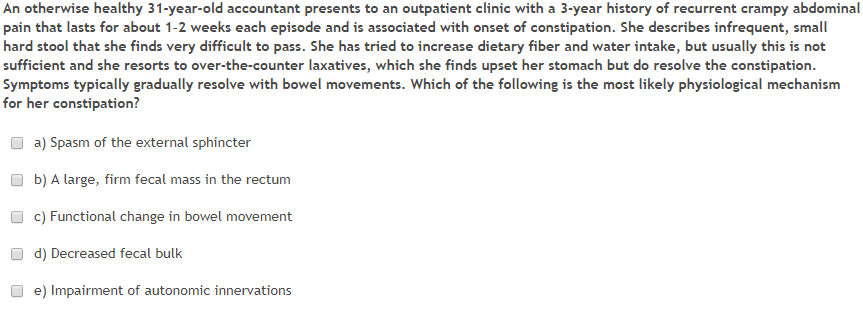
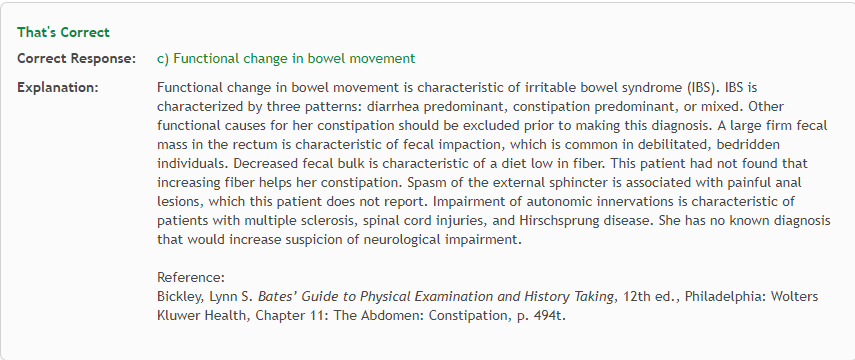
- Which of the following is consistent with obturator sign?
A) Pain distant from the site used to check rebound tenderness
B) Right hypogastric pain with the right hip and knee flexed and the hip internally rotated
C) Pain with extension of the right thigh while the patient is on her left side or while pressing her knee against your hand with thigh flexion
D) Pain that stops inhalation in the right upper quadrant
Ans: B
Chapter: 11
Page and Header: 434, Techniques of Examination
Feedback: Obturator sign is seen in appendicitis. It is pain with the stretching of the internal obturator muscle because of inflammation. Pain distant from the site used to check rebound tenderness is Rovsing’s sign and is a reliable sign of peritonitis. Answer “C” describes psoas sign, which is also seen in appendicitis. Palpation in the right upper quadrant that causes pain severe enough to stop inhalation is consistent with inflammation of the gallbladder and is called Murphy’s sign.
- Which is the proper sequence of examination for the abdomen?
A) Auscultation, inspection, palpation, percussion
B) Inspection, percussion, palpation, auscultation
C) Inspection, auscultation, percussion, palpation
D) Auscultation, percussion, inspection, palpation
Ans: C
Chapter: 11
Page and Header: 434, Techniques of Examination
Feedback: The abdominal examination is conducted in a sequence different from other systems, for which the usual order is inspection, percussion, palpation, and auscultation. Because palpation may actually cause some bowel noise when the bowels are not moving, auscultation is performed before percussion and palpation in an abdominal examination.
- A 22-year-old law student comes to your office, complaining of severe abdominal pain radiating to his back. He states it began last night after hours of heavy drinking. He has had abdominal pain and vomiting in the past after drinking but never as bad as this. He cannot keep any food or water down, and these symptoms have been going on for almost 12 hours. He has had no recent illnesses or injuries. His past medical history is unremarkable. He denies smoking or using illegal drugs but admits to drinking 6 to 10 beers per weekend night. He admits that last night he drank something like 14 drinks. On examination you find a young male appearing his stated age in some distress. He is leaning over on the examination table and holding his abdomen with his arms. His blood pressure is 90/60 and his pulse is 120. He is afebrile. His abdominal examination reveals normal bowel sounds, but he is very tender in the left upper quadrant and epigastric area. He has no Murphy’s sign or tenderness in the right lower quadrant. The remainder of his abdominal examination is normal. His rectal, prostate, penile, and testicular examinations are normal. He has no inguinal hernias or tenderness with that examination. Blood work is pending.
What etiology of abdominal pain is most likely causing his symptoms?
A) Peptic ulcer disease
B) Biliary colic
C) Acute cholecystitis
D) Acute pancreatitis
Ans: D
Chapter: 11
Page and Header: 418, The Health History
Feedback: Acute pancreatitis causes epigastric and left upper quadrant pain and often radiates into the back. There is often a history of long-standing gallbladder disease or recent alcohol ingestion. Severe abdominal pain and vomiting are often seen. Medications such as proton pump inhibitors can also cause pancreatitis in people without these other risk factors. Treatment includes hydration, pain management, and bowel rest.
- A 26-year-old sports store manager comes to your clinic, complaining of severe right-sided abdominal pain for 12 hours. He began having a stomachache yesterday, with a decreased appetite, but today the pain seems to be just on the lower right side. He has had some nausea and vomiting but no constipation or diarrhea. His last bowel movement was last night and was normal. He has had no fever or chills. He denies any recent illnesses or injuries. His past medical history is unremarkable. He is engaged. He denies any tobacco or drug use and drinks four to six beers per week. His mother has breast cancer and his father has coronary artery disease. On examination he appears ill and is lying on his right side. His temperature is 100.4 and his heart rate is 110. His bowel sounds are decreased and he has rebound and involuntary guarding, one third of the way between the anterior superior iliac spine and the umbilicus in the right lower quadrant. His rectal, inguinal, prostate, penile, and testicular examinations are normal.
What is the most likely cause of his pain?
A) Acute appendicitis
B) Acute mechanical intestinal obstruction
C) Acute cholecystitis
D) Mesenteric ischemia
Ans: A
Chapter: 11
Page and Header: 418, The Health History
Feedback: Appendicitis is common in the young and usually presents with periumbilical pain that localizes to the right lower quadrant in an area known as McBurney’s Point, described above as one third of the way between the anterior superior iliac spine and the umbilicus on the right. Rebound and guarding are common. Remote rebound or Rovsing’s sign is also seen commonly when the course of appendicitis is advanced. Bowel movements are usually unaffected.
- Bill, a 55-year-old man, presents with pain in his epigastrium which lasts for 30 minutes or more at a time and has started recently. Which of the following should be considered?
A) Peptic ulcer
B) Pancreatitis
C) Myocardial ischemia
D) All of the above
Ans: D
Chapter: 11
Page and Header: 418, The Health History
Feedback: Epigastric pain can have many causes. History and physical will help discern which causes are most likely, but it is important to realize that any of the above, including myocardial ischemia, is always a possibility. Pneumonia and gallbladder pain can also cause pain in this location.
- Chris is a 20-year-old college student who has had abdominal pain for 3 days. It started at his umbilicus and was associated with nausea and vomiting. He was unable to find a comfortable position. Yesterday, the pain became more severe and constant. Now, he hesitates to walk, because any motion makes the pain much worse. It is localized just medial and inferior to his iliac crest on the right. Which of the following is most likely?
A) Peptic ulcer
B) Cholecystitis
C) Pancreatitis
D) Appendicitis
Ans: D
Chapter: 11
Page and Header: 418, The Health History
Feedback: This is a classic history for appendicitis. Notice that the pain has changed from visceral to parietal. It is well localized to the right lower quadrant, making appendicitis a strong consideration.
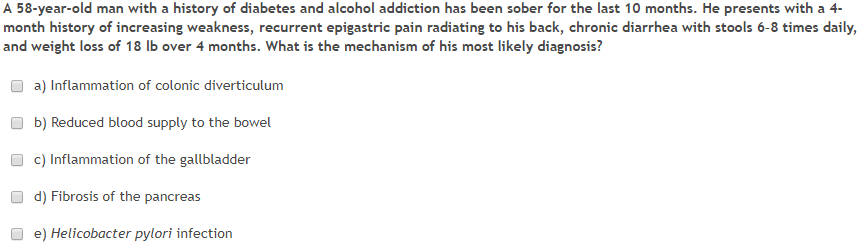
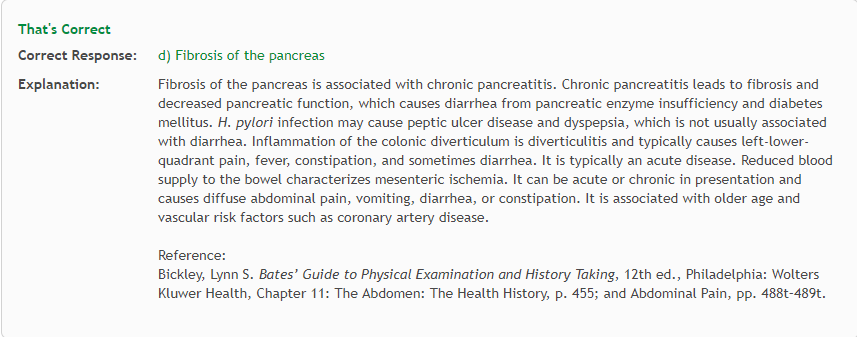
- Josh is a 14-year-old boy who presents with a sore throat. On examination, you notice dullness in the last intercostal space in the anterior axillary line on his left side with a deep breath. What does this indicate?
A) His spleen is definitely enlarged and further workup is warranted.
B) His spleen is possibly enlarged and close attention should be paid to further examination.
C) His spleen is possibly enlarged and further workup is warranted.
D) His spleen is definitely normal.
Ans: B
Chapter: 11
Page and Header: 434, Techniques of Examination
Feedback: This scenario is not uncommon in infectious mononucleosis. The presence of dullness with inspiration should definitely increase your attention to further examination of the spleen, although dullness can occur in normal patients too.

- A daycare worker presents to your office with jaundice. She denies IV drug use, blood transfusion, and travel and has not been sexually active for the past 10 months. Which type of hepatitis is most likely?
A) Hepatitis A
B) Hepatitis B
C) Hepatitis C
D) Hepatitis D
Ans: A
Chapter: 11
Page and Header: 418, The Health History
Feedback: The lack of contact with blood and body fluids makes hepatitis B, C, and D unlikely. She regularly changes the diapers of her clients and is at risk for hepatitis A. Vaccine against hepatitis A is recommended for daycare workers.
- Mrs. LaFarge is a 60-year-old who presents with urinary incontinence. She is unable to get to the bathroom quickly enough when she senses the need to urinate. She has normal mobility. Which of the following is most likely?
A) Stress incontinence
B) Urge incontinence
C) Overflow incontinence
D) Functional incontinence
Ans: B
Chapter: 11
Page and Header: 418, The Health History
Feedback: Stress incontinence occurs with increased intra-abdominal pressure such as with coughing, sneezing, or laughing. This history is most consistent with urge incontinence secondary to detrusor overactivity. Overflow incontinence occurs with anatomic obstruction such as prostatic hypertrophy (obviously not in this case, as the patient is a woman), urethral stricture, or neurogenic bladder. Functional incontinence results from lack of mobility severe enough to impair getting to the bathroom quickly enough.
- A 42-year-old florist comes to your office, complaining of chronic constipation for the last 6 months. She has had no nausea, vomiting, or diarrhea and no abdominal pain or cramping. She denies any recent illnesses or injuries. She denies any changes to her diet or exercise program. She is on no new medications. During the review of systems you note that she has felt fatigued, had some weight gain, has irregular periods, and has cold intolerance. Her past medical history is significant for one vaginal delivery and two cesarean sections. She is married, has three children, and owns a flower shop. She denies tobacco, alcohol, or drug use. Her mother has type 2 diabetes and her father has coronary artery disease. There is no family history of cancers. On examination she appears her stated age. Her vital signs are normal. Her head, eyes, ears, nose, throat, and neck examinations are normal. Her cardiac, lung, and abdominal examinations are also unremarkable. Her rectal occult blood test is negative. Her deep tendon reflexes are delayed in response to a blow with the hammer, especially the Achilles tendons.
What is the best choice for the cause of her constipation?
A) Large bowel obstruction
B) Irritable bowel syndrome
C) Rectal cancer
D) Hypothyroidism
Ans: D
Chapter: 11
Page and Header: 418, The Health History
Feedback: Many metabolic conditions can interfere with bowel motility. In this case the patient has many symptoms of hypothyroidism, including cold intolerance, weight gain, fatigue, constipation, and irregular menstrual cycles. On examination, thyromegaly and delayed reflexes can help to make the diagnosis. Medication will usually correct these symptoms.
- A 27-year-old policewoman comes to your clinic, complaining of severe left-sided back pain radiating down into her groin. It began in the middle of the night and woke her up suddenly. It hurts in her bladder to urinate but she has no burning on the outside. She has had no frequency or urgency with urination but she has seen blood in her urine. She has had nausea with the pain but no vomiting or fever. She denies any other recent illness or injuries. Her past medical history is unremarkable. She denies tobacco or drug use and drinks alcohol rarely. Her mother has high blood pressure and her father is healthy. On examination she looks her stated age and is in obvious pain. She is lying on her left side trying to remain very still. Her cardiac, pulmonary, and abdominal examinations are unremarkable. She has tenderness just inferior to the left costovertebral angle. Her urine pregnancy test is negative and her urine analysis shows red blood cells.
What type of urinary tract pain is she most likely to have?
A) Kidney pain (from pyelonephritis)
B) Ureteral pain (from a kidney stone)
C) Musculoskeletal pain
D) Ischemic bowel pain
Ans: B
Chapter: 11
Page and Header: 418, The Health History
Feedback: The pain from a kidney stone causes dramatic, severe, colicky pain at the costovertebral angle that radiates across the flank and down into the groin.
- Mr. Patel is a 64-year-old man who was told by another care provider that his liver is enlarged. Although he is a life-long smoker, he has never used drugs or alcohol and has no knowledge of liver disease. Indeed, on examination, a liver edge is palpable 4 centimeters below the costal arch. Which of the following would you do next?
A) Check an ultrasound of the liver
B) Obtain a hepatitis panel
C) Determine liver span by percussion
D) Adopt a “watchful waiting” approach
Ans: C
Chapter: 11
Page and Header: 434, Techniques of Examination
Feedback: A liver edge palpable this far below the costal arch should not be ignored. Ultrasound and laboratory investigation are reasonable if the liver is actually enlarged. Mr. Patel has developed emphysema with flattening of the diaphragms. This pushes a normal-sized liver below the costal arch so that it appears to be enlarged. A liver span should be determined by percussing down the chest wall until dullness is heard. A measurement is then made between this point and the lower border of the liver to determine its span; 6–12 centimeters in the mid-clavicular line is normal. Percussion is the only way to assess liver size on examination, and in this case it saved the patient much inconvenience and expense.
- A 62-year-old woman has been followed by you for 3 years and has had recent onset of hypertension. She is still not at goal despite three antihypertensive medicines, and you strongly doubt nonadherence. Her father died of a heart attack at age 58. Today her pressure is 168/94 and pressure on the other arm is similar. What would you do next?
A) Add a fourth medicine
B) Refer to nephrology
C) Get a CT scan
D) Listen closely to her abdomen
Ans: D
Chapter: 11
Page and Header: 434, Techniques of Examination
Feedback: At this point, it is important to consider secondary causes for this woman’s hypertension because of its severity, rapidity of progression, and lack of response to therapy. While you will most likely add a fourth medicine, it is important to carefully examine the abdomen for the presence of renal artery bruits. These are usually heard best in the upper quadrants. It may be necessary to have the patient hold her breath, to have a very quiet room, and to listen with the diaphragm for a very soft, high-pitched sound with systole. It may also help to simultaneously feel the patient’s pulse (a bruit with both a systolic and diastolic component is very specific for a significant blockage, while a lone systolic bruit may not be abnormal). Obtaining a CT scan is not likely to be useful, and you may save the delay, expense, and inconvenience of a nephrology referral if you can hear a bruit
- A 77-year-old retired bus driver comes to your clinic for a physical examination at his wife’s request. He has recently been losing weight and has felt very fatigued. He has had no chest pain, shortness of breath, nausea, vomiting, or fever. His past medical history includes colon cancer, for which he had surgery, and arthritis. He has been married for over 40 years. He denies any tobacco or drug use and has not drunk alcohol in over 40 years. His parents both died of cancer in their 60s. On examination his vital signs are normal. His head, cardiac, and pulmonary examinations are unremarkable. On abdominal examination you hear normal bowel sounds, but when you palpate his liver it is abnormal. His rectal examination is positive for occult blood.
What further abnormality of the liver was likely found on examination?
A) Smooth, large, nontender liver
B) Irregular, large liver
C) Smooth, large, tender liver
Ans: B
Chapter: 11
Page and Header: 469, Table 11–12
Feedback: With his past history of colon cancer and with recent weight loss and fatigue, a relapse of his colon cancer would be expected. Colon cancer usually metastasizes to the liver, creating hard, irregular nodules, which can sometimes be palpated on examination. A smooth, large liver which is tender is often seen in hepatitis.
- Mr. Kruger is an 84-year-old who presents with a smooth lower abdominal mass in the midline which is minimally tender. There is dullness to percussion up to 6 centimeters above the symphysis pubis. What does this most likely represent?
A) Sigmoid mass
B) Tumor in the abdominal wall
C) Hernia
D) Enlarged bladder
Ans: D
Chapter: 11
Page and Header: 434, Techniques of Examination
Feedback: It is possible that this represents a sigmoid colon mass, but this is less likely than an enlarged bladder. Prostatic hypertrophy is very common in this age group and can frequently cause partial urinary obstruction with bladder enlargement. If the mass resolves with catheterization, this is a likely cause. Other forms of urinary obstruction such as neurogenic bladder, urethral stricture, and side effects of drugs can also be contributing to the problem. A hernia would most likely not be dull to percussion. Midline abdominal wall tumors of this size would be unusual but could be discerned by having the patient tense his abdominal muscles.
- Mr. Maxwell has noticed that he is gaining weight and has increasing girth. Which of the following would argue for the presence of ascites?
A) Bilateral flank tympany
B) Dullness which remains despite change in position
C) Dullness centrally when the patient is supine
D) Tympany which changes location with patient position
Ans: D
Chapter: 11
Page and Header: 434, Techniques of Examination
Feedback: A diagnosis of ascites is supported by findings that are consistent with movement of fluid and gas with changes in position. Gas-filled loops of bowel tend to float so that dullness when supine would argue against this. Likewise, because fluid gathers in dependent areas, the flanks should ordinarily be dull with ascites. Tympany which changes location with patient position (“shifting dullness”) would support the presence of ascites. A fluid wave and edema would support this diagnosis as well


