What is the ICD-10 definition for a depressive episode?
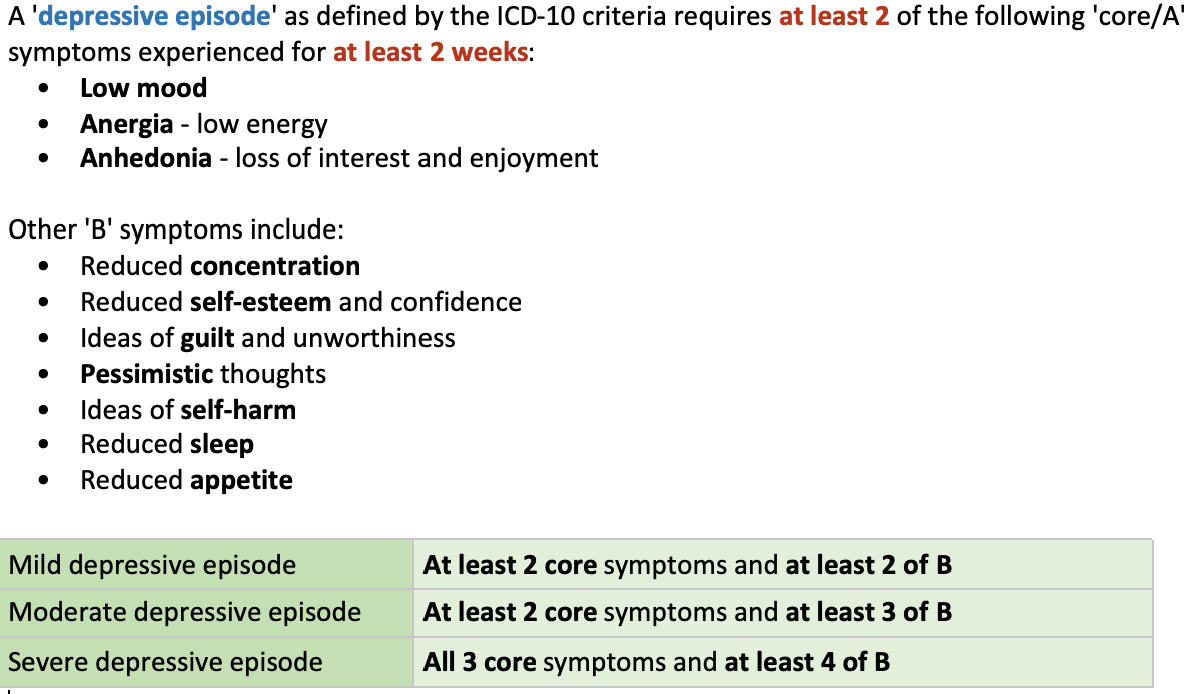
A ‘depressive episode’ as defined by the ICD-10 criteria requires at least 2 of the following ‘core/A’ symptoms experienced for at least 2 weeks:
- Low mood
- Anergia - low energy
- Anhedonia - loss of interest and enjoyment
Other ‘B’ symptoms include:
- Reduced concentration
- Reduced self-esteem and confidence
- Ideas of guilt and unworthiness
- Pessimistic thoughts
- Ideas of self-harm
- Reduced sleep
- Reduced appetite
What is the ICD-10 criteria for mild, moderate or severe depression?
What are the subtypes of depression?
- Severe depression with psychosis
- Seasonal affective disorder (SAD) presents with predictably low mood in winter. There is usually reversal of biological symptoms
- Atypical depression is reversal of biological symptoms, so hypersomnia, weight gain and hyperphagia.
- Agitated depression is depression with psychomotor agitation instead of retardation.
What is the epidemiology of depression?
Recurrent depressive disorder affects females more than males (2:1) and average age of onset in in the late 20s:
- 5-12% lifetime risk in males
- 10-35% lifetime risk in females
Describe the clinical presentation of depression
In a severe episode of depression, the central features are low mood, lack of enjoyment (anhedonia), negative thinking, and reduced energy, all of which lead to decreased social and occupational functioning.
Appearance
Dress and grooming may be neglected. The facial features are characterized by a turning downward of the corners of the mouth, and by vertical furrowing of the center of the brow. The rate of blinking may be reduced. The shoulders are bent and the head is inclined forward so that the direction of gaze is downward. Gestures and movements are reduced. It is important to note that some patients maintain a smiling exterior despite deep feelings of depression.
Cognitive symptoms
The negative cognitive symptoms of depression can be divided into feels of:
- Worthlessness
- Guilt - often takes the blame of unreasonable self-blame about minor-matters
- Pessimism - patient’s expect the worse of the future.
Biological symptoms
- An altered sleep pattern is common, typically as initial insomnia (difficulty falling asleep) or early morning wakening (waking at least 2 hours earlier than normal). However there may also be hypersomnia which may co-exist with hyperphagia and weight gain in atypical depression.
- Weight loss due to loss of appetite
- Constipation
- Loss of libido
- Amenorrhea more common in severe depression
Psychomotor changes
Psychomotor retardation is frequent. The retarded patient walks and acts slowly. Slowing of thought is reflected in their speech; there is a significant delay before questions are answered, and pauses in conversation may be unusually prolonged.
Psychotic depression
These may emerge in very severe depression and involve the patient experiencing hallucinations or delusions. Auditory hallucinations are often unpleasant derogatory voices. Delusions are often nihilistic or persecutory. Furthermore the cognition of guilt may progress to a delusional level, such as the patient being convinced they committed some terrible crime despite being blameless.
What are the investigations for depression?
Collateral history
Physical examination
Blood tests: FBC, TFTs, CRP
Urine drug screen
The PHQ-9 depression questionnaire or Hospital Anxiety and Depression Scale (HADS).
What are the differential diagnoses for depression (including organic causes)?
- Organic causes such as:
- Hypothyroidism
- Hyperparathyroidism
- Cushing’s syndrome
- Stroke
- Parkinson’s disease
- Multiple Sclerosis
- Adjustment disorder - unpleasant but mild affective disorder following a life event, however does not reach severity needed to diagnose depression.
- Normal sadness - people are allowed to be sad at times
- Anxiety disorders - Mild depressive disorders are sometimes difficult to distinguish from anxiety disorders.
- Bereavement - normal grief should not be diagnosed as depression.
- Bipolar Affective Disorder (BPAD)
- Substance misuse
- Postnatal depression
- Dementia - depression can affect memory so badly that the patient appears to have dementia (i.e. pseudodementia). Dementia can also begin as affective changes.
Describe the management approach for depression
- A biopsychosocial approach is taken to the management of depression, meaning the patient’s biological, psychological and social aspects of the illness are considered. A record of a biopsychosocial assessment is required by the Quality and Outcomes Framework (QOF) [NICE].
- Assess risk of suicide by asking questions and looking for risk factors.
- Assess safeguarding concerns for children or vulnerable adults in the care of someone with depression.
- Lifetyle modification - Advice the patient on sleep hygiene, exercise, and healthy nutrition.
- Psychotherapy to be used as a first-line for mild depression, and should always form part of treatment for moderate-severe depression.
- Pharmacological only for patients with moderate-severe depression, or those who have not benefited from psychological treatments.
- Electro-convulsive therapy
Describe the use of psychological treatment for depression
This is always the first-line in treating mild depression and is ideally always involved in moderate or severe depression.
Low intensity psychological interventions are recommended for subthreshold depressive symptoms or mild depression and includes:
- Individual guided self-help, based on the principles of CBT - usually consists of 6-8 sessions over 9-12 weeks
- Computerised cognitive behavioural therapy (CCBT) — usually takes place over 9–12 weeks.
- Group based physical activity programme over a 3 month period
- Group-based peer support.
High intensity psychological interventions are recommended for subthreshold depressive symptoms or mild depression and includes
- Cognitive behavioural therapy (CBT) - CBT is a way of thinking about thinking. The therapist helps the patient to notice how negative automatic thoughts (NATs) influence unhelpful moods and behaviours. Mood, thought, and behaviour are mutually reinforcing. With time, the patient learns how distorted core beliefs and dysfunctional assumptions often set up in childhood feed into this vicious cycle. Can be group-based or individual.
- Interpersonal therapy (IPT) - focuses on the main themes of unresolved loss, psychosocial transitions, relationship conflict, and social skills deficit.
- Counselling and short-term psychodynamic psychotherapy
Describe the pharmacological management of depression
NICE recommends antidepressants only for patients with moderate-severe depression, or those who have not benefited from psychological treatments. All antidepressants are similarly effective, so clinicians make the choice based on side-effect profiles.
- Selective Serotonin Reuptake Inhibitors (SSRIs) are the first-line antidepressants because they have the fewest side-effects. Examples include fluoxetine, sertraline, citalopram etc.
- Tricyclic antidepressants (TCAs) are falling out of fashion, as can cause a lethal overdose due to cardiotoxicity. They include amitriptyline, clomipramine, etc.
- Monoamine oxidase inhibitors (MOIs) are rarely used nowadays because of dangers of a hypertensive crisis due to build-up of noradrenaline when eating tyramine-rich foods (e.g. cheese and fermented soya beans). They should not be combined with other antidepressants.
Although antidepressants are not addictive, they can cause discontinuation symptoms if suddenly stopped. Antidepressants of different classes can interact in dangerous ways so always check before changing.
Refractory depression is the failure to respond to two adequate trials of different classes of antidepressants.
When should ECT for depression be considered?
Can be used for treatment refractory depression, or depression with severe suicidal ideation, psychotic features or severe psychomotor retardation.
Describe the prognosis for depression
50% will have at least one more episode.
Psychotic depression has a poorer prognosis
Up to 15% eventually take their own lives.
What is mania?
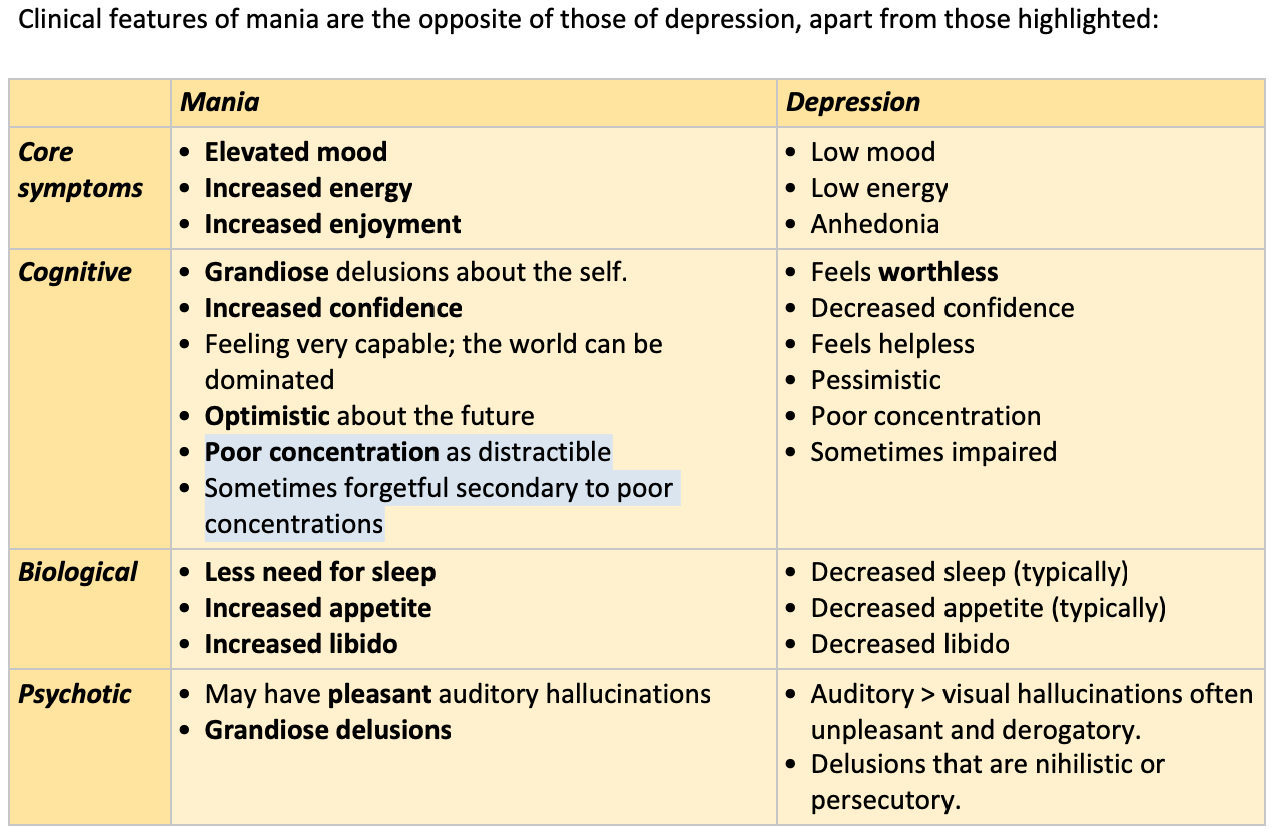
Mania is a state characterised by excitement, high energy, euphoria and delusions. To diagnose a manic episode, symptoms should last for at least a week. They should also prevent normal work and social functioning.
If the episode is less severe and allows for normal functioning, the episode can be said to be hypomanic.
What are the clinical features of mania?
What are the differential diagnoses for mania?
- Organic causes must be excluded. These include:
- Drug-induced states, e.g. amphetamines, cocaine
- Dementia
- Frontal lobe disease
- Delirium
- Cerebral HIV
- Myxoedema madness (extreme hyperthyroidism)
- Schizophrenia/schizoaffective disorder: psychotic symptoms precede and outweigh affective symptoms.
- Cyclothymia
- Puerperal disorders
What are the MSE findings in mania?
- The appearance of patients often reflects their prevailing mood. Their clothing may be brightly coloured and ill assorted. When the condition is more severe, the patient’s appearance is often untidy and dishevelled.
- The speech of manic patients is often rapid and copious as thoughts crowd into their minds in quick succession. When the disorder is more severe, there is flight of ideas.
- Expansive ideas are common. Patients believe that their ideas are original, their opinions important, and their work of outstanding quality. Sometimes these expansive themes are accompanied by grandiose delusions. Some patients may believe that they are religious prophets or destined to advise statesmen about major issues.
- Hallucinations occur. These are usually consistent with the mood, taking the form of voices speaking to the patient about their special powers or, occasionally, of visions with a religious content.
- Insight is invariably impaired in more severe manic states. Patients see no reason why their grandiose plans should be restrained or their extravagant expenditure curtailed.
What risks do manic patients pose?
Episodes of mania put patients at risk. This is not only to others, but also to themselves. Risks include
- Suicide - important and often overlooked risk. The affective lability seen in mania can involve extreme sudden distress or sadness.
- Spending/gambling
- Substance misuse
- Risky sexual behaviours
- Self-neglect and exhaustion
- Aggression and sexually inappropriate behaviour to others.
Describe the management of mania, and what medications are used.
Children should be managed by CAMHS. The treatment of mania is challenging, and the aim is to reduce physical and mental overactivity, improve features of psychosis and prevent deterioration.
- Always assess risk to ensure patient is being managed in the appropriate setting. All episodes of mania warrants anurgent referral to the Community Mental Health Team (CMHT).
- Stop all medications that may induce symptoms including antidepressants, drugs of abuse, steroids, and dopamine agonists.
- Mania can lead to exhaustion if not adequately treated, so monitor food and fluid intake and prevent dehydration.
- Manage with medications:
- If the patient is treatment free, give an antipsychotic or mood stabiliser. A short course of benzodiazepines is often added for sedation, since sleep deprivation can worsen mania.
- If the patient is on treatment, optimise the medication. Check compliance, adjust doses and consider adding another agent. Again, short-term benzodiazepine can help.
Choice of medication in treating mania:
- Oral antipsychotics are usually trailed first. They are second generation and include olanzapine, risperidone and quetiapine, although NICE also suggests haloperidol. If the first antipsychotic fails, try another antipsychotic.
- Lithium is often the second-line if antipsychotics fail. The response rate is similar to that of antipsychotics, however, they have a slower onset.
- Sodium valproate has been found to have a antimanic activity similar to that of lithium (Cipriani et al., 2011). Unsure why, or even if, lithium is tried first, as valproate works faster.
After the patient is stabilised, re-assess patient and discuss long-term management plan of bipolar disorder. See: Long-term Management of Bipolar Disorder
What is Bipolar Affective Disorder (BPAD) and its’ epidemiology?
Bipolar affective disorder (BPAD) is an affective disorder characterised by depressive episodes and at least one manic episode. Though there are epidemiological and genetic differences between depression and BPAD, there must be overlap; some patients who have been diagnosed with unipolar depression experience an episode of mania later on in life and are therefore diagnosed with bipolar affective disorder.
While depression effects females more than males, BPAD affects both equally - 1:1 MF ratio. The average rate of onset is 18 years. Late onset bipolar is rare, and may be precipitated by organic brain disease.
Describe the ICD-10 and DSM-V classification of bipolar disorder
ICD-10 requires at least two episodes of mood disturbance with at least one being mania or hypomania for a diagnosis of Bipolar Affective Disorder. This means that patients do not require depressive episodes for a BPAD diagnosis.
DSM-V splits bipolar into two subtypes based on whether mania or hypomania has occurred:
- Bipolar I is when mania has occurred on at least one occasion.
- Bipolar II is when only hypomania has ever occurred. However, there must also be a history of a depressive episode. Hypomania without depression is not a psychiatric condition.
Describe the long-term management of bipolar affective disorder
Long-term treatment is needed even after a single manic episode, since further episodes are highly likely and potentially devastating.
Mood stabilisers are used and other drugs are added when symptoms arise (e.g. antipsychotics or benzodiazepines).
- Lithium is clearly effective in preventing manic relapse but may not be as effective as treating depressive relapse. Lithium has a narrow therapeutic range: 0.6-1.0mmol/L. Anything above 1.2mmom/L is toxic.
- Valproate can treat acute mania and act as a mood stabiliser. Generally less effective than lithium.
- Carbamazepine is another anticonvulsant that is used as a mood stabiliser. Often used when patients respond poorly to lithium.
Antidepressants are usually not recommended as they can precipitate a manic episode. Therefore they should only be given in combination with mood stabilisers or antipsychotics.
Psychological therapies such as CBT are useful in identifying triggers and preventing mood disturbances. Relapse prevention strategies include developing routine, ensuring good-quality sleep, promoting a healthy lifestyle, avoiding excessive stimulation/stress etc.
Social interventions including family support and therapy can also aid in returning to education or work.
What is the therapeutic and toxic range for lithium?
Lithium has a narrow therapeutic range: 0.6-1.0mmol/L. Anything above 1.2mmom/L is toxic.
What is the epidemiology of suicide?
- 1% of all deaths are suicides
- The elderly and younger (15-30) age groups are at the highest risk of suicide
- Men are 3-4 times more likely to die than women by suicide in the UK. This is partly due to more violent method chosen.
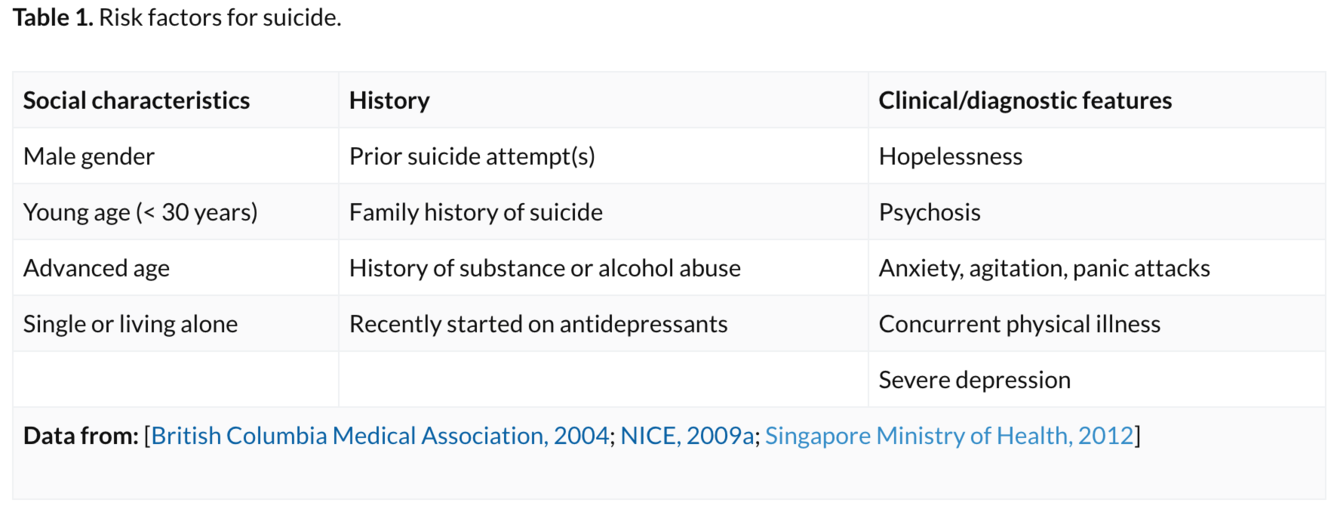
What are the risk factors of suicide?


-
In Practise16
-
Psychopharmacology44
-
Affective Disorders and Self-Harm29
-
Schizophrenia18
-
Anxiety and Obsessions22
-
Child and Adolescent Psychiatry20
-
Neuropsychiatry29
-
Substance Misuse22
-
Reactions to Stress17
-
Eating Disorders12
-
Problems following Childbirth18
-
Personality Disorders14
-
Psychopathology15


