Kidney percentage of O2 and CO
O2 about 7%
CO 20-25%>> brain
Kidneys are OVer perfused because the extra blood is used for functions other thanjust keeping thekidney alive.
O2 is high (relative to 1% weight) because of all the active tranport needs of the kidneys
3 main kidney functions- how
1 Maintain a relatively Constant EC Environment- This is accomplished by the excretion in urine of many waste products of metabolism (e.g., urea, creatinine) as well as any excess water and solutes that arise from dietary intake. In short, kidneys adjust the content and volume of urine as dietary
and metabolic challenges arise in order to keep the extracellular environment relatively constant.
- Generatin of Hormones- Involved in production of renin and prostaglandin and erythopoitein that stimulates RBC production. ALso activating Vitamin D
- Miscellaneous- gluconeogensis and catabolims of peptide hormones
What ways does the kidney maintain EC constant
- Regulation of water and electrolyte composition of blood- ensures input=output especially for salts and water
- Control of blood osmolality (moles of osmotic particles/liter)- this is mainl y done by controlling NaCl
- Elimination of Metabolic waste from blood- for instance removal of uric acid to avoid gout (-uria means abnormal amounts in urine)
- Eliminatio of other substances from blood (exogenous drugs)- drugs often eliminated from body– peniciliin can be given often because we exrete it quikcly. Pyrogens (proteins released during fever) canbe reduced in the blood by increasing urine flow so hydration is important for fevers
- Regulatin of acid-base- acidic urine removes the H+ that can’t be neurlized by bicarb. Unless the kidney itself isdamage it normally compensates for imbalances in pH caused by other illnessed keeping te body at 7.4
- Regulation of BP- regulate BV by changing overal body water content. increase BV—> increase CVP—> increase CO (also through hormones)
Explain the kidneys functions in homrones production
- Hormonal regulation of BP- kidneys secrete renin which ultimately increase angio II— a vasoconstrictor
- Makes erythropoiten- low blood O2 stimulates more RBC production by the interstitial cells in renal cortex. Erthropoiten stimulates RBC precurosors in the bone maros to mature. This can counter anemia.
** done in blood doping too to improve atheletic preformance with possible side effects of thickening blood**
- Production of active Vitamin D (calcitriol)- Vitamin D produced in skin and by diet. It is activated by two hydroxylations– one of which is in the kidney (other in liver). Calcitrol promotes Ca2+ uptake in the GI tract so vital in keeping Ca2+ levels normal. Low Vitamin D leads to Rickets and osteoporosis
Parts of a kidney
think of the pathway of urine flow
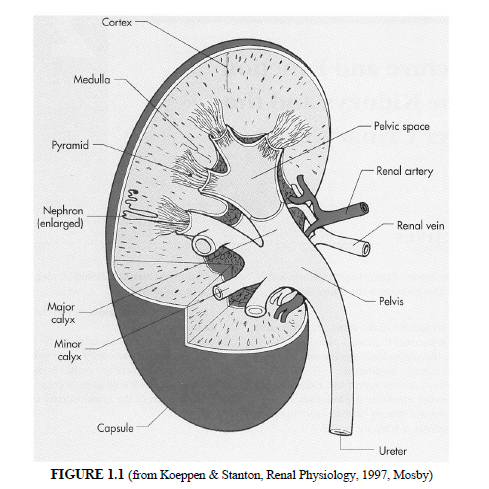
- Outer cortex and medulla
- Medulla further divide dinto inner and outer medulla
- Nephrons- functional unit in both the cortex and medulla
- Ther are 8-18 conical regions calls renal pyramids that have apexs call papilla that project into the minor calyx.
- Renal pyramids—> Minor calyx act a collecting cup for urine forming and empty into the majoy calyces —->renal pelvis drains into —-> ureter—>bladder.
parts of a nephron
Each nephron consists of a
- glomerulus (with BC is called Renal Corpuscle)
- Bowman’s capsule
3proximal tubule
- loopof Henle
- distal tubule
6 collecting duct (multiple nephrons may share a CD)
What happens at the renal corpuscel
At renal corpsucle (BC + glomeruls) this is the site of filtraiton of the blood and the filter fluid enters the BC and goes through the rest of the nephron.
As you travel down the nephron we have secretion and reabsorption and the end product is urine.
Explain the pathway of renal circulation
Renal artery–> Interlobular arteries– arcuate/arciform arteries—> interlobular arteries (radiate towards renal corpuscle)
The interlobular narrow —> afferent arteriole—> ball of glomerular capilllaries
Explain the importance of parallel blood flow
It means that one interlobar feeds many glomeruli so change in flow locally to one glomerulsu will not affect nerighboring glomeruli
Dicuss path of blood after glomerulus
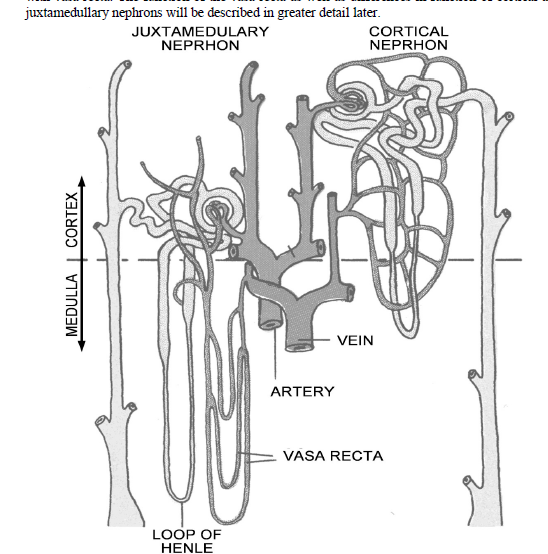
Glomerulus coalesce to make efferent arteriole which carry blood to a second capillary bed called the peritubular capillaries either the vasa recta in jxtamedullary nephrons or branching peritubular in corticol nephrons
What are the two types of neprhons and their major differnece
Corticol (superfiicla)- high in cortex, have a short loop of henle that doesn’t reach inner medulla, have branching peritubular capillary network
Juxtamedullary nephrons- arise in cortex but close to cortex medulla boundry, have long loop of henle that goes into inner medulla, have vasa recta which are loop like peritubular capillaries
Explain features of glomerulus that benefit its function (think larger scale)
Extensive branching of the glomerular capillaries maximizes their surface area for filtration.
The endothelium of the glomerular capillaries is fenestrated to promote filtration.
Encompassed by the BC that gather filtrate and is the start of the nephron
Explain the 3 layers of the glomerulus
- *Filter Layer 1 : the capillary endothelial cells (form holes of ~70 nm)**—This layer is fenestrated to allow filtratio. Fenestrations are too small for RBC but wide enough for most plasma proteins.
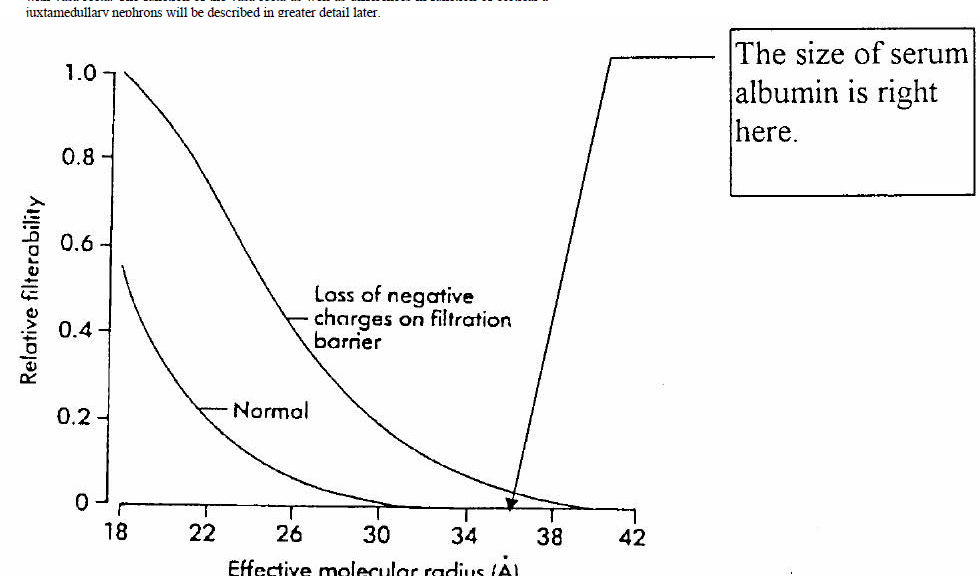
- *Filter Layer 2 : the glomerular basement membrane (charged barrier)-**- this layer has a net negative charge (as do plasma proteins) so although they pass through enothelial cells. So generally anything greater than 3nm with a charge isn’t filtered (like albumin and Hb)– note that even with a charge it doesnt affect small negatively charged particles like Cl- (.2nm)
- *Filter Layer 3 : the podocytes (form slits of ~8 nm)**- considered visceral of Bowman’s capsule. These cells have “foot processes” that inter-digitate to form “slit-like holes” or “filtration slits”. These slits do not permit the filtration of molecules in plasma with dimensions greater than ~8 nm.
explain function (2) and location of medangial cells
They re embedded in the mesangial matrix (MM). These phagocytic cells are not part of the filtration pathway, but instead serve a “cleansing function” in the renal corpuscle.
Also, their contraction status (under autonomic control) can regulate total filtration.
- Phagocytes
- Can control contraction and regulate filtration
What happens with distruction of of the Glomerular basment membrane
Loss of GBM negative charge results in filtration of relatively large
plasma proteins. This produces proteinuria (increased concentrations of plasma proteins in urine).
Remember that the first layer allows negative charges through and the GBM is what stops negative charges like albumin and Hb.
Explain what happens when pinching off either afferent or efferent arterioles attach to glomerulua
If you pinch at afferent upstream will have an increase in pressure and the pressure in the glomerulus will decrease thus the filtration will ????
If you pinch the efferent pressure up stream will rise (in golmerulus) and filtration will ????
Pinching both will cause an increase in pressure between teh two points– strenghting only the second pinch will further increase the pressure between the two points
Explain what is at the juxtaglomerular appartus and it’s function
Has the mascula densa (sensors of blood flow and can release ateriolar vasoconstrictor reducing hydrostatic pressures) and the secretory granular cells.
The actual process of how macula dense senses or what it realase (maybe ATP) is unclear.
The nephron tubules come into close association with the afferent and efferent arterioles that supply its own glomerulus (site where the tubular fluid first formed). This represents a point where feedback signaling can occur. JGA senses the filtratio and regulates back to the filtrate formation at the glomerulus– atuorregulation often called tubuloglomerular feedback
Explain effect of increase BP
Incrase arterial BP—-> increase driving pressure at glomerulus so increase GFR—> increase rate of flow through tubues–> Stimulation of mascula dense that release chemicasl to induce afferent arteriole to constrict–> Decrease flow to glomerulus–> Decrease capillary pressure so GFR returns back to normal
Renal innervation
No parasym
mainly sym to the afferent, efferent, juxtamglomerular appartus and some parts of the tubes
Expain the basic renal process of forming excretion
- Filtration- nonselective bulk movement of plasma (blood without cells just fluid and solutes) into the BC
- Reabsorption- selective transport of things in filtrate back into plasma of peritubular capillaries through various transport mechanisms
- Secretion- selective addition of various solutes from plasma of peritubular into filtrate/lumen of tubules. Selective due to transport mechanisms
- Excretion-= Filtration -Reabsoprtion+ Secretion

-
Basic Renal Structure and Function20
-
Structure of the Urinary System17
-
Early Embrylogical Development32
-
Renal Blood Flow. Filtration and CLearnace Week 128
-
Basic Transport Mechanisma and Renal Handling of Organic Solutes22
-
Alport Workshop9
-
Anatomy of Posterior Abdominal Wall17
-
Renal Handling of Na, CL, Water Week 229
-
Perineum and External Genitalia- Week 222
-
Control of Sodium and Water eXcretion22
-
Renal Handling of K, Ca, PO4 3-27
-
Renal Handling of Acid Base Balance20
-
Acid Base Balance 1- Week 213
-
Buffering Response to AB IMbalance- 2 Week 214
-
Compensatory Response to an Acid/Base Imbalance20
-
Fluid Imbalances Week 232
-
Pelvis and Perineum Week #31
-
Steroid Hormones- Week 3 (in week 4 CN)15


