What is cardiac arrest?
cessation of effective pumping action of heart, due to:
- heart stops beating all together -> asystole
- normal electrical activity without pumping activity -> pulseless electrical activity (PEA)
- rapid, chaotic, ineffective electrical + ventricular activity of heart -> VT/VF
there is abrupt loss of consciousness, absence of pulse and breathing stops. If not treated promptly, irreversible brain damage/death follows within mins. Can be caused by myocardial infarction.
Cardiac arrest is synonymous with cardiopulmonary arrest and it can be divided into shockable or non-shockable, based on ECG rhythm.
When unexpected cardiac arrest leads to death this is called sudden cardiac death (SCD).
What is respiratory arrest?
- cessation of breathing
- pulse is present
- medical emergency + usually related to or coincides w/ cardiac arrest
- causes: opiate overdose, head injury, anaesthesia, tetanus, drowning
- treated with artificial ventilation
Shockable refers to whether the arrhythmia is treatable by defibrilator. Shockable rhythms have a better prognosis.
What are examples of shockable cardiac arrests?
- pulseless ventricular tachycardia - rapid, chaotic electrical and mechanical activity of the heart -> can lead to VF + degenerate to asystole
- ventricular fibrilation - uncoordinated contraction of cardiac muscle of ventricles which can degenerate to asystole. Death often occurs if normal sinus rhythm is not restored within 90 seconds of onset of VF, esp if it has degenerated further into asystole
What are examples of non-shockable cardiac arrests?
- pulseless electrical activity (PEA) - normal electrical activity without mechanical pumping activity of heart
- asystole (flatline) - state of no cardiac electrical activity, hence no contractions of the myocardium and no cardiac output or blood flow. Asystole is one of the conditions required for a medical practitioner to certify death
How do you diagnose cardiac arrest?
Lack of carotid pulse is pretty gold standard
What is the aetiology of cardiorespiratory arrest?
6Hs:
- Hypovolaemia
- Hypoxia
- Hydrogen ions (acidosis)
- Hyperkalaemia or Hypokalaemia
- Hypoglycaemia or Hyperglycaemia
- Hypothermia
6Ts:
- Tablets or Toxins
- (cardiac) Tamponade
- Tension pneumothorax
- Thrombosis (MI)
- Thromboembolism (pulm embolism)
- Trauma
What is the cardiopulmonary resssucitation?
- 30 compressions and 2 rescue breaths
What is synchronised cardioversion? How is this not the same as defibrilation?
- if pt has a pulse, VT can be terminated w/ a direct current shock across heart synchronised to pt’s heartbeat
- this is different from defibrilating the pt
- if pt still had a pulse, defibrilating pt could potentially send him into asystole
What is unsynchronised cardioversion (defibrilation)?
- if pt has a pulseless VT or a VF
- given high energy (360J w a monophasic defib, or 200J w a biphasic defib) unsynchronised cardioversion
- shock may be delivered to outside of chest using external defibrilator
- or internally to heart by an implantable cardioverter-defibrilator (ICD) if one has prev been inserted
What does a pacemaker do?
- medical device that uses electrical impulses
- delivered by electrodes contacting heart muscles
- to regulate beating of heart
- primary purpose is to maintain adequate HR
- either bc the heart’s native pacemaker is not fast enough (bradycardia)
- or there is a block in heart’s electrical conduction system
What does an ICD do? How is this different to a pacemaker?
- implantable cardioverter-defibrilator
- small battery-powered electrical impulse generator
- implanted in pts who are at risk of sudden cardiac death
- due to ventricular fibrilation + ventricular tachycardia
- device programmed to detect cardiac arrhythmia + correct it by delivering jolt of electricity
- pacemakers are more often temporary + gen designed to consistently correct bradycardia, while ICDs are often permanent safeguards against sudden abnormalities
What does the cardiac arrest team do?
- cardiac arrest = “code” or “crash”
- medical team responsible for resuscitating pts following cardioresp arrest
- in some hosps, they have role changed to that of medical emergency team (MET)
- this team not only responds to cardiac arrests but also to pts w acute physiological deterioration
- the MET usually comprises medical + nursing staff from intensive care + general med and responds to specific calling criteria
How have resuscitation decisions impacted on patient care?
improved knowledge, training and DNAR decision-making have improved pt care + have prevented futile CPR attempts
Pts for whom CPR will not prolong life, but may merely prolong the dying process, should be identified early. Medical emergency teams may have an important role in improving end-of-life and DNAR decision making.
A DNAR decision should be considered when the pt:
- does not wish to have CPR
- will not survive cardiac arrest even if CPR is attempted
What is the role of BLS?
- BLS maintians airway, breathing + circulation
- to ensure effective oxygen transfer to tissues
- airways maintained using optimal angles or insertion of oral/nasal adjuncts to keep airways open
- breathing maintained using artificial respiration often assisted by emergency oxygen
- circulation is maintained using CPR techniques + bleeding control
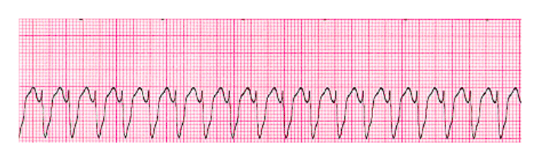
Ventricular tachycardia:
- What does it look like on an ECG trace?
- What is happening and why?
- What is the rhythm like?
- results from abnormal tissues in ventricles generating a rapid + irregular heart rhythm
- poor cardiac output usually associated w/ this rhythm thus causing pt to go into cardiac arrest
- shock this rhythm if the pt is unconscious and pulseless
- ECG:
- rhythm - regular
- rate - 18-190 bpm
- QRS duration - prolonged
- P wave - absent
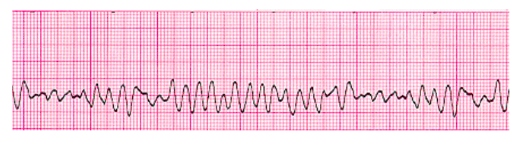
Ventricular fibrilation:
- What does it look like on an ECG trace?
- What is happening and why?
- What is the rhythm like?
- disorganised electrical signals cause ventricles to quiver instead of contract in rhythmic fashion
- pt will be unconscious as blood is not pumped to brain
- immediate treatment by defib is indicated
- condition may occur during or after a myocardial infarct
- ECG:
- rhythm - irregular
- rate - 300+, disorganised
- QRS duration - not recognisable
- P wave - absent
Why is defibrilation the definitive treatment for the life-threatening cardiac arrhythmias, VF and VT?
- consists of delivering a therapeutic dose of electrical energy to affected heart
- this depolarises a critical mass of heart muscle
- terminates the arrhythmia
- allows normal sinus rhythm to be re-established by body’s natural pacemaker (SAN)


