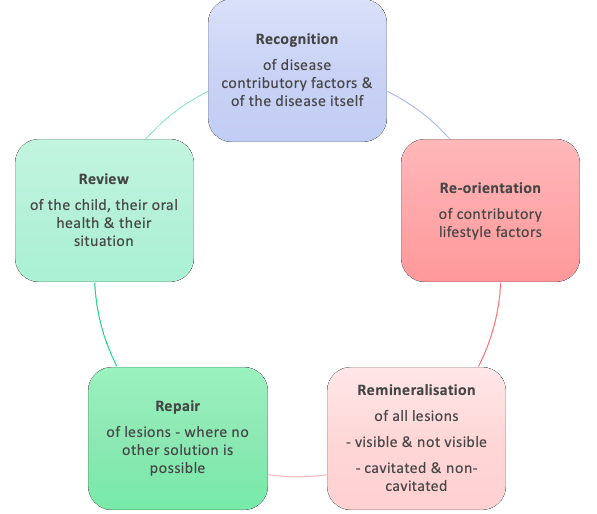
What is the core principles of Minimum Intervention Dentistry?
When should bitewings be part of the assessment for children?
And what is the UK FGDP guidance?
Should be part of assessment for children aged 4 years and above.
In the UK FGDP guidance (risk based):
→For children at increased risk of developing caries: 6-–12 months.
→For all other children: 12-–18 months for primary teeth and approx. 2 yearly for permanent teeth.
How would you Diagnosing sepsis?
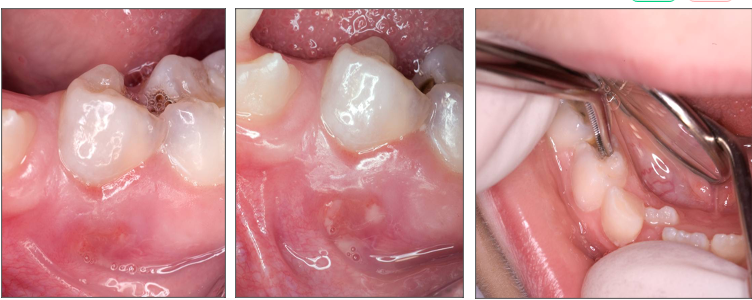
- chronic suppurating dental infection is often asymptomatic
- can be difficult to diagnose, as the presentation can vary
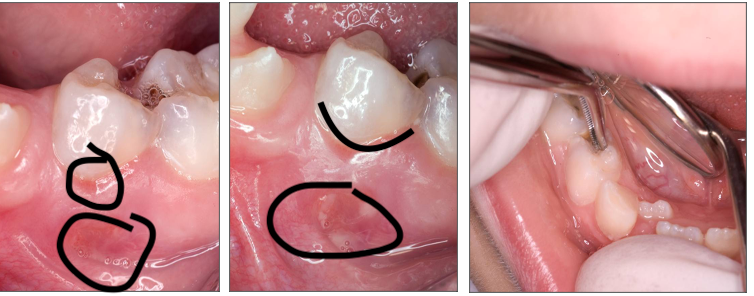
- sinuses are not always obvious
- if present are usually located on the non-attached mucosa adjacent to the attached mucosa
- slight cleft, or notch, may also be noted in the adjacent gingival margin
- Can be slight proping depth
- The pus in this photo is brought to a head by running a finger along the infected area.
How often should Flouride Varnish be applied in children?
What is the main allergen in Flouride Varnish?
Should be applied 2-4 times a year where child is at increased risk of caries. (Mark Robertson recommends on all children tho)
Colophony is a very potent alergen!
What 2 questions MUST you ask before you apply Duraphat (Fluoride Varnish)?
Have you ever been hospatilized with asthma?
If yes then you must not apply Duraphat!
Do you have any allergies to elastoplasts?
If yes do not give it.
When do you apply Fissure Selants Resin in Children?
Or what is a temporary option instead of Fissure Selants?
Applied, and maintain in all susceptible pits and fissures where child is at increased risk of caries.
Althought SDCEP says it should be applied to all 6s regardless of the caries risk
Glass ionomer selant as “temporary” option.
What is the summary of REMINERALISATION?
·Use remineralisation (prevention) strategies for all carious lesions (The Fantastic 4)
·Consider other remineralising technologies such as silver diammine fluoride
·Be sure to follow-up all caries being managed with remineralisation strategies; the only true definition of an arrested caries lesion is one that does not get bigger over time!
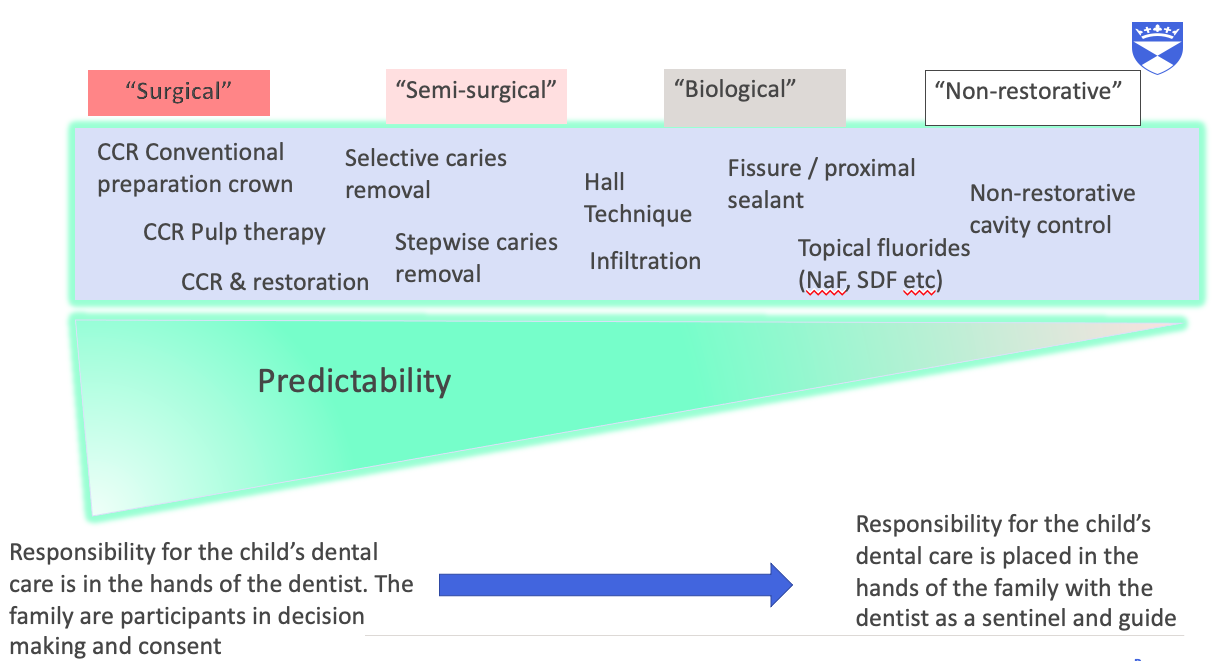
Learn this diagram.
As is goes towards the right it becomes less predicatble, more child friendly but also more outwith dentists hand and into hand of carer and child.
In a Repair what are the 2 main approaches for Managing carious lesion/ biofilm?
- Sealing in carious lesion
a) The Hall Technique (crowns)
b) Fissure sealants
c) Selective caries removal & restorative material - Non-restorative cavity control
± Fluoride varnish/ (SDF)
What is the Hall Technique?
The Hall Technique is a simple method for using metal crowns (SSCs) to manage carious primary molar teeth by seating a correctly sized crown over the tooth, and sealing the carious lesion in using a glass ionomer luting cement.
- Local anaesthesia is not required
- Tooth preparation is not carried out
- No carious tissue is removed
- •The crown is supposed to fit tightly and the gum will adjust (will initially blanch)*
- •Child will get used to the feeling of the crown within 24 hours*
- •The occlusion tends to adjust within a few weeks*
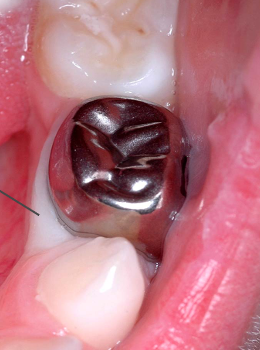
When can you use the Hall Technique?
- A full history and clinical examination including bitewing radiographs has been completed
- The tooth is asymptomatic (or reversible pulpitis)
- There must be a band of “normal” looking dentine visible between the pulp chamber and the cavity on the radiograph
What are Non-Restorative Cavity Control - advantages?
- can allow the child to develop intellectually and cope with something bit more invasive
- very little technical skill required
- don’t need injections
→if access available and don’t need to cut through sound dentine
- very low patient tolerance required
- may slow caries enough to allow tooth to exfoliate without causing pain/ abscess
What are Non-Restorative Cavity Control - disadvantages?
- Only works in about 50% of cases… low success rate
- pulp may be too damaged already
- needs particular conditions
- at the mercy of the carers!!!!
→will require more of your clinical skill than finding the fourth canal in an upper first permanent molar in a patient with trismus and a profound gag reflex!!
- might be interpreted as watchful neglect
- other dentists might not recognise what you’ve done
- difficulty monitoring – photographs
- doesn’t look nice
- does it feel satisfying? no
Silver and Flouride are becoming more common.
Why is silver growing in use?
Bacteria – interacts with bacterial cell membranes and bacterial enzymes that can inhibit bacterial growth. Silver ions degrade cell walls, disrupt bacterial DNA synthesis and disrupt intracellular metabolic processes leading to cell death.
Incorporates into HA to make silver-doped HA
Strong inhibitory effect on cathepsins (protease enzyme which will degrade proteins e.g. collagen) which inhibits dentine collagen degradation
Flouride (mineral formation &collagen degradation inhibition)


