Describe the reactivity of Group 2 metals and their consequent abundance in elemental form.
EXTENSION: Why are they called alkaline earth metals?
The elements in Group 2 of the periodic table are reactive metals and do not occur in their elemental form naturally.
EXTENSION: The name comes from the alkaline properties of the metal hydroxides.
- Compare the electron configuration of Group 2 elements to noble gases.
- Describe the general redox reaction of Group 2 elements.
- What is the reducing agent in this reaction?
- Each Group 2 element has two outer shell electrons in its outer s-sub-shell, two more than the electron configuration of a noble gas.
- In a redox reaction, each metal atom is oxidised, losing two electrons to form a 2+ ion with the electron configuration of a noble gas.
- Another species will receive these two electrons and be reduced. The Group 2 element is called a reducing agent because it has reduced another species.
Describe the redox reaction of Group 2 elements with oxygen.
Give the general formula and comment on which reactant is oxidised and which is reduced.
- The Group 2 elements all react with oxygen to form a metal oxide, with the general formula MO, made up of M2+ and O2– ions.
- The metal is oxidised, with a positive change in oxidation number. It is the reducing agent.
- The oxygen is reduced, with a negative change in oxidation number.
- Describe the redox reaction of Group 2 elements with water.
- Comment on the trend in reactivity.
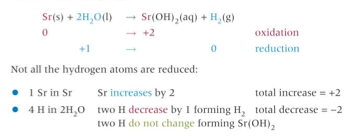
- State the balanced equation for the reaction between Sr and H2O. Describe and explain the changes in oxidation number.
- The Group 2 elements react with water to form an alkaline metal hydroxide [M(OH)2] and hydrogen gas [H2].
- Magnesium and water react very slowly, but the reacion becomes more and more vigorous with metals further down the group – reactivity increases down the group.
- Image attached.
- Describe the redox reaction of Group 2 metals with dilute acids.
- Describe the reactivity trend in Group 2 for this reaction.
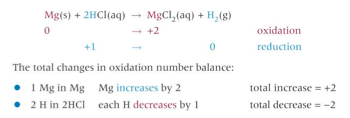
- State the balanced equation for the reaction between Mg(s) and HCl(aq). Describe and explain the changes in oxidation number.
- What observations could be made in a reaction of magneisum ribbon with dilute hydrochloric acid in a test tube?
- The Group 2 elements react with dilute acids to form a salt and hydrogen.
- The reactivity increases down the group.
- Image attached.
- The magnesium would react with the dilute hydrochloric acid to give off tiny bubble (of hydrogen).
Why does the reactivity of Group 2 elements increase down the group? Explain.
Comment on how they react and the reactivity’s relationship to ionisation energy.
The atoms of Group 2 elements react by losing electrons to form 2+ ions. Therefore the formation of 2+ ions from gaseous atoms requires the input of two ionisation energies.
The ionisation energies decrease down the group. This is because the attraction between the nucleus and the outer electrons decreases as a result of increasing atomic radius and increasing shielding.
The total energy input to form 2+ ions decreases down the group. Hence, the Group 2 elements become more reactive and stronger reducing agents down the group.
Describe the reaction of water with oxides of Group 2 elements. Use the example of calcium oxide reacting with water.
The oxides of Group 2 elements react with water, releasing hydroxide ions [OH–] and forming alkaline solutions of the metal hydroxide.
CaO(s) + H2O(l) → Ca2+(aq) + 2OH–(aq)
The Group 2 hydroxides are only slightly soluble in water. When the solution becomes saturated, any further metal and hydroxide ions will form a solid precipitate.
Ca2+(aq) + 2OH–(aq) → Ca(OH)2(s)
Describe the trends in solubility of Group 2 hydroxides. Compare Mg(OH)2(s) to Ba(OH)2(s).
The solubility of water increases down the group, so the resulting solutions contain more OH–(aq) ions and are more alkaline.
- Mg(OH)2(s) is only very slightly soluble in water. The solution has a low OH–(aq) concentration and a pH≈10.
- Ba(OH)2(s) is much more soluble in water. The solution has a high OH–(aq) concentration and a pH≈13.
Describe an experiment to show the trend in solubility of Group 2 oxides.
- Add a spatula of each Group 2 oxide to water in a test tube.
- Shake the mixture. On this scale, there is insufficient water to dissolve all of the metal hydroxide that forms. You will have a saturated solution of each metal hydroxide with some white solid undissolved at the bottom of the test-tube.
- Measure the pH of each solution. The alkalinity wil be seen to increase down the group.
Describe the uses of Group 2 oxides, hydroxides and carbonates.
- Agriculture. Calcium hydroxide is added to fields as lime by farmers to increase the pH of acidic soils. This neutralises acid in the soil, forming neutral water.
- Ca(OH)2(s) + 2H+(aq) →→ Ca2+(aq) + 2H2O(l)
- Medicine. Group 2 bases are often used as antacids for treating acid indigestion. Many indigestion tablets use magnesium and calcium carbonates as the main ingredients. Milk of magnesia – a suspension of white magnesium hydroxide in water – can also be used.
- Mg(OH)2(s) + 2HCl(aq) →→ MgCl2(aq) + 2H2O(l)
- CaCO3(s) + 2HCl(aq) →→ CaCl2(aq) + H2O(l) + CO2(g)
Describe the characteristic physical properties of halogens.
The halogens, Group 17 (7) of the periodic table, are the most reactive non-metallic group. The elements do not occur in their elemental form in nature. On Earth, the halogens occur as stable halide ions dissolved in sea water or combined with sodium or potassium as solid deposits.
At RTP, all the halogens exist as diatomic molecules. The group contains elements in all three physical states at RTP, changing from gas to liquid to solid down the group. In their solid states, the halogens form lattices with simple molecular structures.
Explain the trend in the boiling point of halogens.
The boiling point of halogens increases down the group. This is because, as you go down Group 7
- there are more electrons
- there are stronger London forces
- more energy is required to break the intermolecular forces
- the boiling point increases.
Explain the redox reactions of halogens.
Redox reactions are the most common type of reaction of the halogens. Each halogen atom is reduced, gaining one electron to form a 1– halide ion with the electron configuration of the nearest noble gas.
Another species loses electrons to halogen atoms – it is oxidised. The halogen is called an oxidising agent because it has oxidised another species.
Describe the reactivity of halogens. Refer to halogen-halide displacement reactions.
The results of halogen-halide displacement reactions show that the reactivity of the halogens decreases down the group.
How is a halogen-halide displacement reaction carried out?
A solution of each halogen is added to aqueous solutions of the other halides. If the halogen added is more reactive the the halide present
- a reaction takes place, the halogen displacing the halide from solution
- the solution changes colour.
- Why is cyclohexane added to solutions of halogens in water?
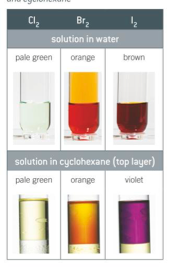
- Describe the colours of halogen solutions in water and cyclohexane.
- Solutions of iodine and bromine in water can appear a similar orange-brown colour, depending on the concentration. To tell them apart, an organic non-polar solvent such as cyclohexane can be added and the mixture shaken as the non-polar halogens dissolve more readily in cyclohexane than in water.
- Image attached
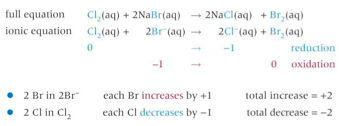
Give the full and ionic equation of the redox reaction between aquesous solutions of chlorine and sodium bromide. What is the change in oxidation number.
Why are fluorine and astatine not considered in halogen-halide displacement reactions?
- Fluorine is a pale yellow gas, reacting with almost any substance that it comes in contact with.
- Astatine is extremely rare because it is radioactive and decays rapidly.
Explain the reactivity trend of Group 7 elements.
In redox reactions, halogens react by gaining electrons. As you go down the group
- the atomic radius increases
- there are more inner shells so shielding increases
- there is less nuclear attraction to capture an electron from another species
- reactivity decreases.
In the halogens, fluorine is the strongest oxidising agent, gaining electrons from other species more rapidly than the other halogens. The halogens become weaker oxidising agents down the group.
What is disproportionation? Give two examples.
Disproportionation is a redox reaction in which the same element is both oxidised and reduced. The reaction of chlorine with water and with cold, dilute sodium hydroxide are to examples of disproportionation reactions.
Describe and explain the disproportionation reaction between chlrine and water.
When small amounts of chlorine are added to water, a disproportionation reaction takes place. For each chlorine molecule, one chlorine atom is oxidised and the other chlorine atom is reduced.

- Describe how bacteria are killed by the products from the disproportionation reaction between chlorine and water.
- How can the bleachening effect of chloric(I) acid be demonstrated?
- The two products of the reaction are chloric(I) acid [HClO) and hydrochloric acid [HCl]. The bacteria are killed by chloric(I) acid and chlorate(I) ions [ClO–].
- By adding some indicator to a solution of chlorine and water. The indicator first turns red, from the presence of two acids. The colour then disppears as the bleaching action of chloric(I) acid takes effect.
Describe and explain the disproportionation reaction between chlorine and cold, dilute aqueous sodium hydroxide.
The reaction of chlorine and water is limited by the low solubility of chlorine in water. If the water contains dissolved sodium hydroxide, much more chlorine dissolves and another disporportionation reaction takes place.
The resulting solution contains a large concentration of chlorate(I) [ClO–] ions from the sodium chlorate [NaClO] that is formed.
What are the benefits and risks associated with chlorine use?
Although chlorine is beneficial in ensuring that our water is fit to drink and that bacteria are killed, chlorine is also an extremely toxic gas. Chlorine is a respiratory irritant in small concentrations, and large concentrations can be fatal.
Chlorine in drinking water can react with organic hydrocarbons such as methane, formed from decaying vegetation. Chlorinated hydrocarbons are formed, which are suspected of causing cancer.


-
Chapter 2: Atoms, Ions and Compounds0
-
Chapter 3: Amount of Substance24
-
Chapter 4: Acids and Redox14
-
Chapter 5: Electrons and Bonding31
-
Chapter 6: Shapes of Molecules and Intermolecular Forces35
-
Chapter 7: Periodicity26
-
Chapter 8: Reactivity Trends31
-
Chapter 9: Enthalpy27
-
Chapter 10: Reaction Rates and Equilibrium34
-
Chapter 11: Basic Concepts of Organic Chemistry29
-
Chapter 12: Alkanes14
-
Chapter 13: Alkenes26
-
Chapter 14: Alcohols19
-
Chapter 15: Haloalkanes19
-
Chapter 16: Organic Synthesis19
-
Chapter 17: Spectroscopy25


