1
Q
What is thyroiditis?
A
Inflammation of the Thyroid Gland
2
Q
What is the most common cause of Thyroiditis?
A
HASHIMOTO’S THYROIDITIS - an autoimmune condition and is the most common cause of hypothyroidism in the UK
3
Q
List some of the causes of thyroiditis…
A
- Hashimoto’s Thyroiditis- autoimmune lymphocytic infiltration of the thyroid
- De Quervain’s thyroiditis (viral thyroiditis): painful dysphagia, pyrexia. Virus attacks the thyroid gland – patient first presents with hyperthyroidism as stored thyroid hormone is released, then patient becomes hypothyroid. Once virus clears, patient becomes euthyroid.
- Postpartum thyroiditis
- Drug-induced thyroiditis- lithium, amiodarone, iodine
- Acute or infectious thyroiditis
- Riedel’s thyroiditis- chronic inflammatory disease of thyroid (causes thyroid fibrosis)
4
Q
List some of the common causitive viruses of thyroiditis
A
- Common URTIs
- influenza
- adenovirus
- mumps
- coxsackie
- echo
- H1N1
5
Q
List some of the presenting symptoms of thyroiditis…
A
- If Viral thyroiditis: thyrotoxicosis –> hypothyroid –> euthyroid
- neckpain + painful swallow
- symptoms of viral infection: fever, myalgia, malaise
- symptoms of thyrotoxicosis: palpitations, tremor, heat intolerance
- Tender, firm, enlarged goitre
- If Hashimoto’s
- Symptoms of hypothyroid: dry skin, fatigue, depression, weight gain, constipation, oligomenorrhoea
- Small, non-tender goitre
6
Q
List some investigations you could peform on someone with thyroiditis
A
- BLOODS: elevated TSH, anti-TPO and anti- TG antibodies, elevated ESR/CRP
- IMAGING:
- Thyroid ultrasound
- Radionuclide isotope scanning – in viral thyroiditis, there will be no uptake as stored thyroxine is released
- Histology:
- Hashimoto’s: diffuse lymphocytic and plasma cell infiltration with formation of lymphoid follicles
- Viral: Multi-nucleated giant cells, degenerated follicular epithelium cells, granulomas
7
Q
How would you manage a patient with thyroiditis?
A
- PHARMACOLOGICAL
- Thyrotoxic: Beta-blockers (+hydrocortisone)
- Hypothyroid: Thyroid hormone replacement - oral levothyroxine sodium
- SURGICAL: If symptomatic large goitre compressing surrounding structures/ malignant nodule
- Hashimoto’s: Radioactive/ Surgical ablation if recurrent thyroiditis
8
Q
List some of the potential complications of thyroiditis…
A
- Thyroid storm
- AF from thyrotoxicosis
- Exacerbation of IHD/ CHF
- Long-term hypothyroidism
- Myxoedema Coma
9
Q
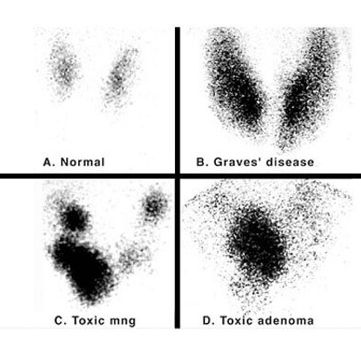
Describe what you would see on a radioisotope scan of someone with:
- Grave’s disease
- De Quervain’s thyroiditis
- Toxic Multinodular Goitre
- Adenoma
A
- Grave’s disease- diffuse increased uptake
- De Quervain’s thyroiditis- NO uptake
- Toxic Multinodular Goitre- multiple areas of increased uptake
- Adenoma- single area of increased uptake
10
Q
How is DeQuervain’s thyroiditis managed?
A
Usually self-limiting
If pain- advise to take NSAIDs

Yr 3 ENDO
flashcards
Decks in class (27)
# Cards
-
Condition- Hypothyroidism14
-
Condition- Grave's15
-
Condition- Thyroid Nodules6
-
Condition- Thyroid Cancer7
-
Condition- Thyroiditis10
-
Condition- Acromegaly13
-
Condition- Prolactinoma16
-
Condition- Diabetes Mellitus (Type 1)15
-
Condition- Diabetes Mellitus (Type 2)16
-
Condition- DKA8
-
Condition- Obesity3
-
Condition- Diabetes Insipidus16
-
Condition- SIADH12
-
Condition- Cushing's17
-
Condition- Adrenal Insufficiency17
-
Condition- Phaeochromocytoma13
-
Condition- Hypopituitarism10
-
Condition- MEN10
-
Condition- pituitary tumour (non-functioning)5
-
Conditions- Carcinoid Syndrome10
-
Condition- Osteoporosis13
-
Condition- Paget's Disease8
-
Condition- Hyperparathyroidism20
-
Condition- Vitamin D deficiency and Osteomalacia11
-
Condition- Polycystic Ovarian Disease7
-
Condition- Primary Hyperaldosteronism7
-
Condition- Hypogonadism0


