What are the main molecular genetics methods for detecting allele copy number in DNA samples?
- QF-PCR
- RQ-PCR
- MLPA
- NGS
Breifly describe how QF-PCR is used for copy number detection.
Quantification of polymorphic repeat sequences to determine copy number.
Uses fluorescently labelled primers and capillary electriphoresis.
Advantages of using QF-PCR for copy number detection.
- Detects mosaicism (above 15%), triploidy and aneuploidy
- Requires little starting material
- Fast turnaround times
- Relatively inexpensive
- High resolution/High through-put
Disadvantages of using QF-PCR for copy number detection.
- No positional information obtained
- Targeted test
- MCC may prevent interpretation of results
- May not detect low-level mosaicism (<15%)
- Limited ability to detect multiple targets in a single assay due to spectral overlap of dyes
Examples of using QF-PCR for copy number detection.
- Prenatal aneuploidy screening
- Detection of trisomy in pregnancy loss or PND
- Post-transplant chimaerism monitoring
Breifly describe how RQ-PCR is used for copy number detection.
- PCR amplification in which the amount of productis measured during each PCR cycle.
- Uses fluorescent dyes (non-specific e.g. SYBR green) or probes (sequence specific e.g. Taqman).
- During the exponential phase the amount of amplified product is proportional to the amount of starting material.
Advantages of using RQ-PCR for copy number detection.
- Quantitative
- Very high resolution
- Rapid and easy to perform
- Fast turnaround time
- Requires little starting material
- Single cell analysis possible
- Detects UPD if methylation specific Res are used
- Post-PCR processing is eliminated, reducing labour, cost and possibility of cross-contamination
Disadvantages of using RQ-PCR for copy number detection.
- No positional information obtained
- Targeted test
- Specialist equipment required – thermal cycler and optical instrument to measure fluorescence
- Unlikely to detect low level mosaicism
- Multiple reactions required to examine multiple loci
- Sequence-specific probes expensive
- Non-specific fluorescent dyes such as a SYBR green intercalate with any dsDNA which may lead to false positive signals
Examples of using RQ-PCR for copy number detection.
- Quantify gene expression (mRNA)
- Minimal residual disease monitoring of gene fusion products e.g. PML-RARA in AML, BCR-ABL1 in CML
- Detection of mutations e.g. JAK2 V617F, NPM1/FLT3-ITD
- Detection of microdels/dups e.g. 22q11
- Detection of subtel del/dup
Breifly describe how MLPA is used for copy number detection.
- PCR-based multiplex reaction allowing amplification of ~40-45 targets in a single reaction.
- Detects copy number imbalances in gDNA and RNA sequences. Probes anneal to target and are then amplified and quantified
Advantages of using MLPA for copy number detection.
- Can test for ~40-50 different imbalances in one reaction
- High throughput technique
- High resolution– detects sequences of only ~60nt-can therefore detect dups/dels of a single exon
- Fast turnaround time
- Inexpensive
- Requires little starting material
- Detects methylation
Disadvantages of using MLPA for copy number detection.
- Targeted test
- More labour-intensive than QF-PCR
- Can’t be used for single cell screening i.e. PGD
- No positional information obtained
- Doesn’t detect balanced rearrangements
- Cannot detect low-level mosaicism (<20-30%)&unreliable detection at higher levels
- Unreliable for detection of maternal cell contamination
- Cannot detect triploidy (69,XXX) and unreliable for other triploidy detection
- Analysis gives average copy number per cell. Tumour analysis difficult if sample contains <50% cancer cells
- SNPs under probes can prevent binding (false positive result)
- Sensitive to contaminants
- Not easily scaled up
Examples of using MLPA for copy number detection.
- Aneuploidy screen
- Sub-telomeric imbalance screen
- Microdeletion screen
- MS-MLPA – PWS/AS testing
- Commercial gene dosage kits available for BRCA1 and BRCA2 screening, Duchenne/Becker Muscular Dystrophy, Fanconi Anaemia A and many more
- Bespoke MLPA
- Methylation and cancer screening
Breifly describe how Next Generation Sequencing (NGS) is used for copy number detection.
A number of different methods are employed, but all involve step wise addition of nucleotides to fragmented DNA.
Bioinformatic analysis of paired reads then enables the detection of deletions and duplications.
Advantages of using NGS for copy number detection.
- Very high resolution (single base change detection)
- Genome wide or targeted
- Provides positional information
- Detects UPD and LOH
- High throughput
- Detects balanced/unbalanced rearrangements (paired-end/mate-pair seq)
- More tolerant of poor quality DNA
- Detection of both single base variants and CNVs in a single assay
Disadvantages of using NGS for copy number detection.
- Difficulty with interpreting results-CNVs of unclear significance
- Vast amount of data obtained
- Requires a lot of starting material
- Expensive
- Labour intensive
- Not suitable for small genes
- Need to confirm abnormal results
Examples of using NGS for copy number detection.
Copy number detection is a relatively new use of this technology.
Bioinformatic algorithms Canvas and Manta are designed to look for copy number and structural variants in WGS data and can be used to replace array based methods for copy number change.
Cost efficient for disorders that routinely have microarray plus panel sequencing e.g. ID/Devdel.
What does MLPA stand for?
Multiplex Ligation-dependant Probe Amplification
What is MLPA?
A Multiplex PCR which detects copy number changes in up to 45 gDNA or RNA sequences in a single reaction
What is the principle behind MLPA method?
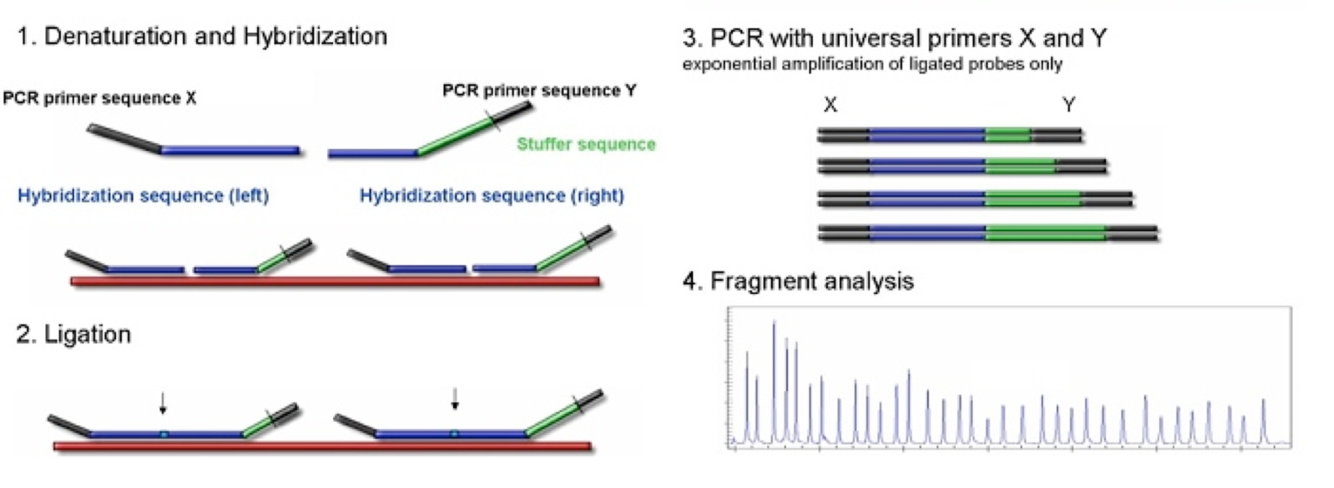
- DNA is hybridised to probe sets
- The target specific sequences are located directly adjacent to one another, therefore when the probes bind to the DNA they can be joined together using a ligase
- This generates a contiguous probe flanked by universal primers.
- All ligated probes can then be amplified in a single PCR reaction using the same universal PCR primers.
- It is therefore the probes and not the target sequences that are amplified.
- Unbound probes will not be amplified, because they only contain one primer sequence.
How are MLPA probes designed?
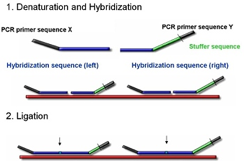
Each probe set consists of 2 halves.
- 1st half consists of target specific sequence (20-30 nucleotides) (blue) flanked by a universal primer (black).
- 2nd half consists of target specific sequence (25-43 nucleotides) (blue) flanked by a universal primer (black) BUT in-between is a random fragment of between 19-370 nucleotides, this is known as the stuffer sequence (green).
The stuffer sequence is a different length for each probe pair and allows for the generation of different sized products for electrophoretic resolution.
How does the MLPA result give information about copy number?
- The amount of ligated probe produced is proportional to the copy number of the target region.
- Following PCR amplification, comparing the relative peak heights to a control sample can indicate changes in copy number.
What are the 6 main stages in the MLPA reaction protocol?
- Denaturation of the genomic DNA
- Hybridisation of the probes to the sample.
- Ligation of the probes
- PCR amplification of the ligated probes using universal primers
- Separation of the amplified products by capillary electrophoresis
- Analysis and quantification
What control samples should be run in each MLPA reaction and why?
For each reaction;
- reference samples: should be included to normalise against test samples thus enabling detection of copy number changes in the test samples
- Negative (normal) control and positive controls and a “blank” to aid in interpretation and troubleshooting


-
Disease Gene Discover (Rare Disease)61
-
Mutation Scanning30
-
Known Mutation Detection25
-
Fragment Sizing Strategies39
-
Methylation Detection33
-
Copy Number Detection (Molecular)57
-
Copy Number Detection (Cytogenetics)46
-
Low-Level Mutation Detection18
-
RNA-Based Methods14
-
Protein-Based Methods36
-
Sanger DNA Sequencing14
-
Cell Culture and Chromosome Staining30
-
Next Generation DNA Sequencing49
-
Interpretation of Genomic Variants**61
-
Databases and Web-tools10
-
Third Generation Sequencing21
-
Disease Gene Discovery (Complex Disorders)36
-
Genetic Risk Calculations0


