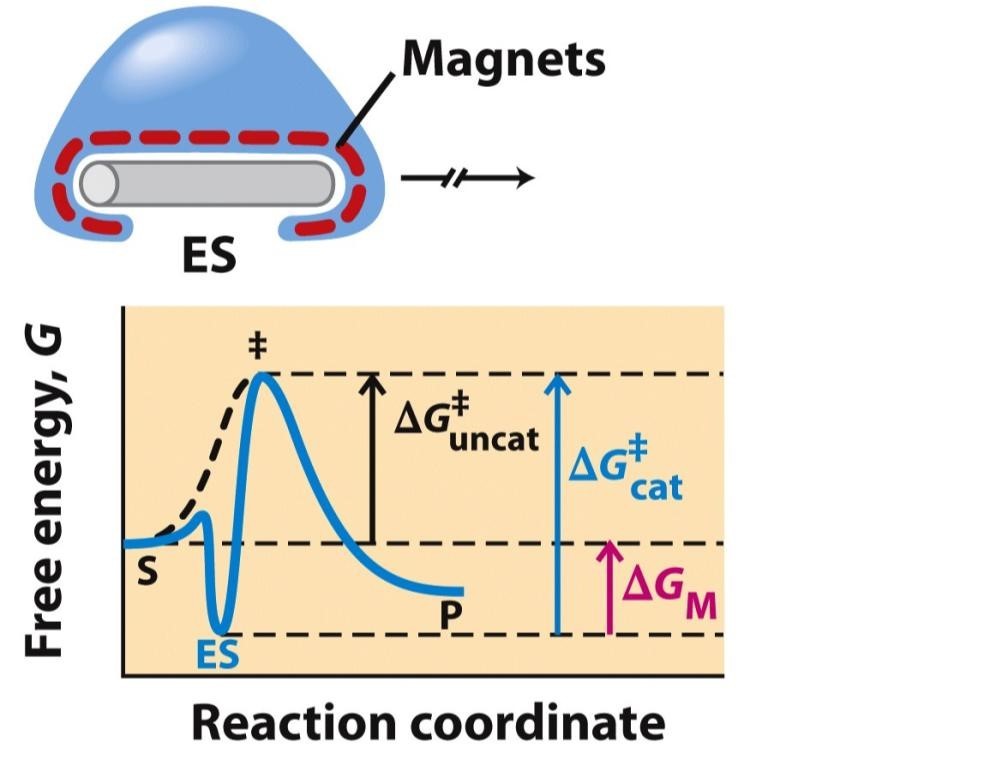
Active site complementary to substrate = no reaction!
Explain the allosteric control of enzymes?
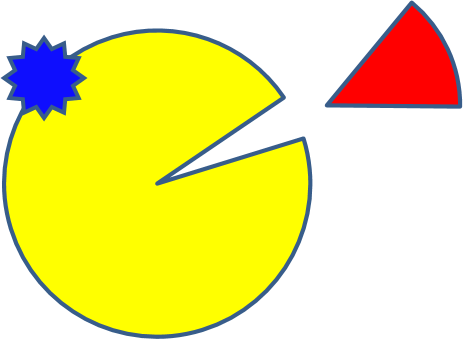
- Allosteric effectors are cell metabolites, bind non-covalently to a site on the enzyme that is not the active site
- This changes the enzymes structure
- Some effectors are activators and some are inhibitors
- Allosteric effectors are examples of non-competitive inhibitors
Explain Covalent Modification?
•Many ways enzymes (and other proteins) can be regulated through reversible covalent modification e.g phosphorylation.
What is an Enzyme?
- Globular protein
- Biological catalyst that differs from a chemical catalyst
–Catalyses very high reaction rates
–Shows great reaction specificity
–Work in mild temperature/pH conditions
–Can be regulated
Enzyme Definitions?
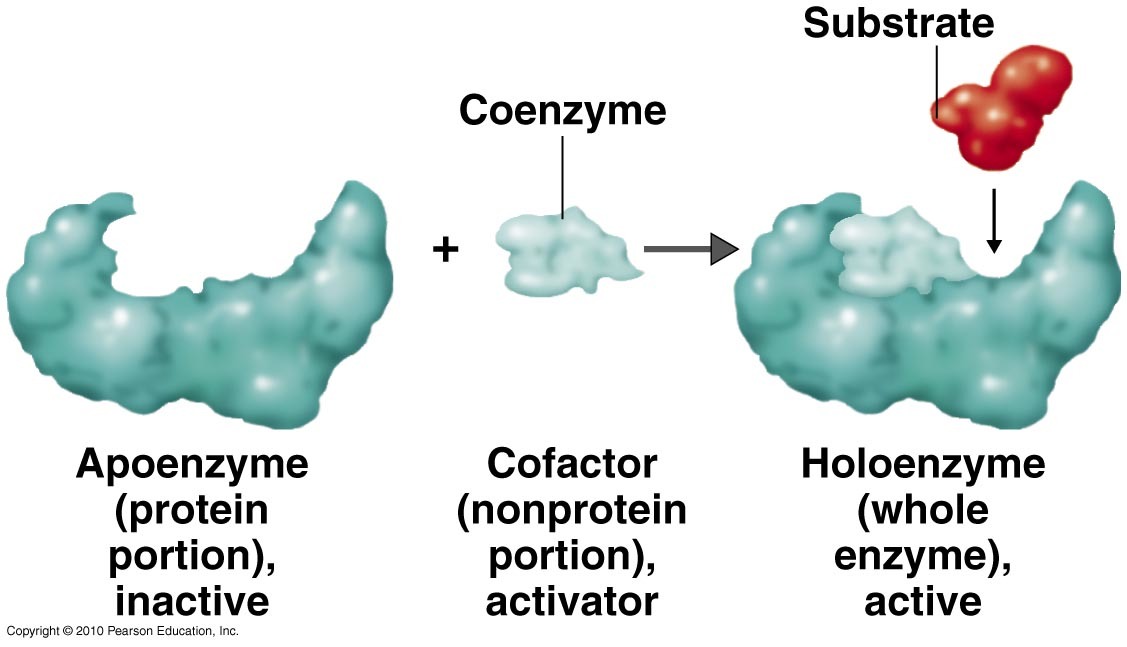
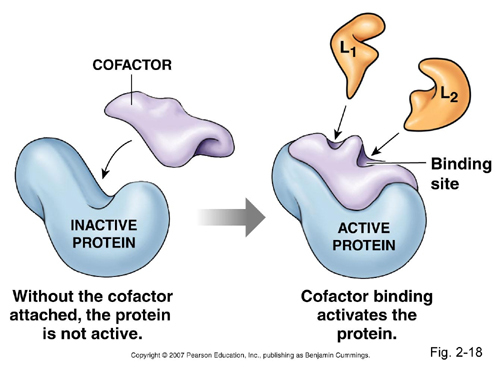
- Apoenzyme–The protein component of an enzyme that contains a cofactor
- Holoenzyme –“whole enzyme” – the apoenzyme plus the cofactor(s)
why don’t Allosteric enzymes not follow M-M kinetics?
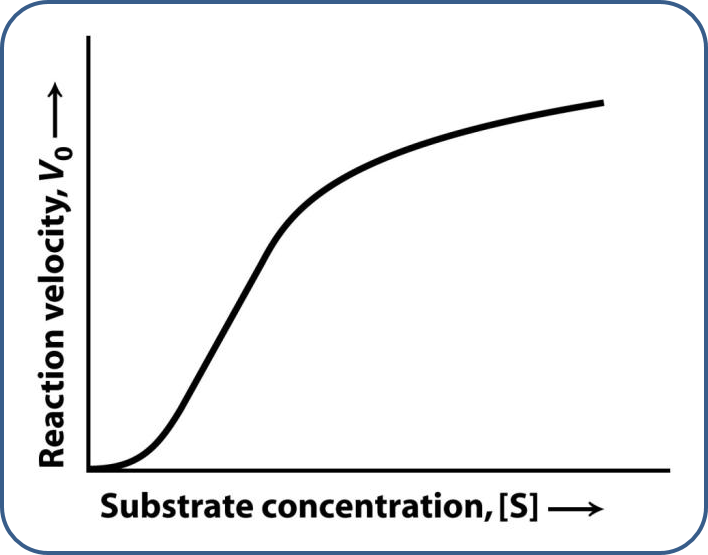
- Allosteric enzymes are made up of many subunits, which contain many active sites.
- One substrate binding to an enzyme subunit can cause changes in other active sites on other subunits
- This can lead to the concept of “cooperative binding” of substrate molecules
what is a coenzyme?
- Complex organic molecule, usually produced from a vitamin e.g NAD
What do Enzymes do?
They do NOT:
–Move reaction equilibria
–Make a non-spontaneous reaction spontaneous
They DO:
–Increase rates of spontaneous reactions
–Lower the activation energy of biochemical reactions
–Accelerate movement towards reaction equilibrium
What will affect an enzyme?
Temperature
- ↑ temp., ↑ molecule collisions
- ↑ temp., ↑ internal energy of molecules
- ↑ temp. will eventually denature enzyme
pH
- pH changes the charge of amino acids
- If the active site amino acids charge changes the enzyme will cease to function correctly
Inhibitors
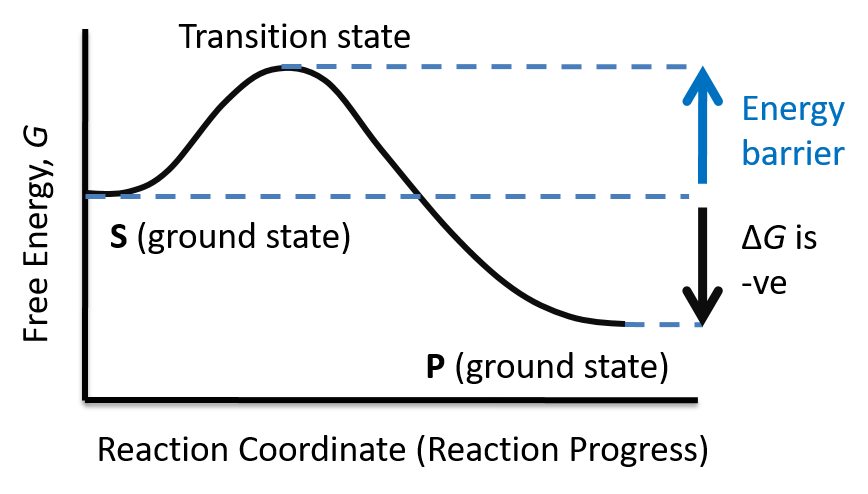
Reaction Coordinate Diagram?
- Spontaneous reaction isn’t instantaneous because of the energy barrier
- Transition state shows the moment that chemical bonds are formed and broken
- Reaction could then go either way (revert back to S or change to P)
what is a free energy?
- Energy can be converted from one form to another but is neither created or destroyed.
- Useful” energy generated from cellular reactions is termed Gibbs Free-Energy (G).
- Spontaneous reactions must have a –ve ΔG value
how do irreversible inhibitors affect enzymes?
inhibitor binds to the enzyme in a covalent, and therefore irreversible way.
what is a Prosthetic group?
- Cofactor covalently bound to the enzyme or very tightly associated with the enzyme
Measuring enzyme activity
•In clinical samples, normal activity is often given an arbitrary value:
1 U/ml or 100% = normal
•Separate different forms of enzymes by electrophoresis and examine pattern
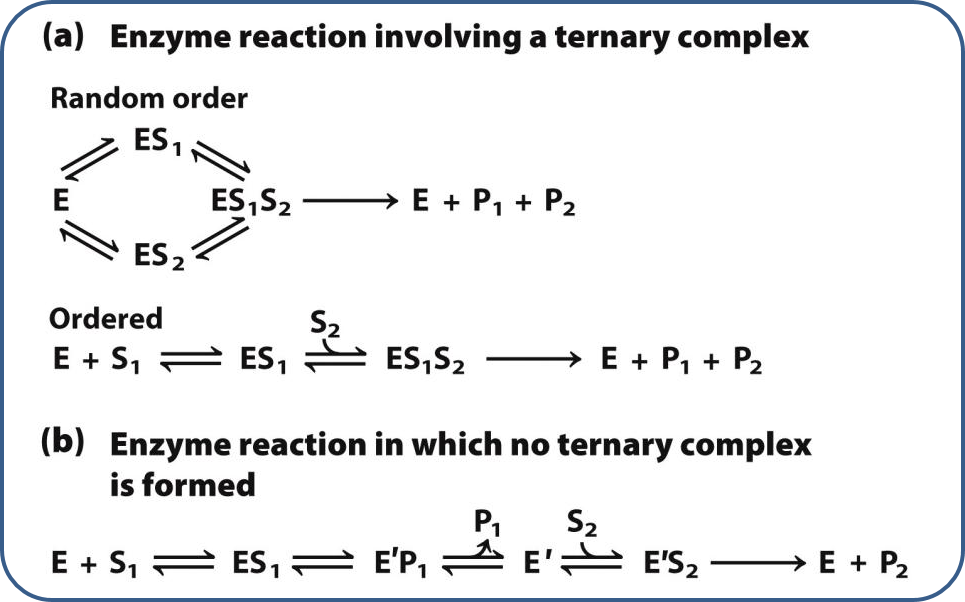
Enzymes and two or more substrates?
- Catalysing a reaction with two or more substrates usually involves transfer of groups from one substrate to the other
- This can occur in several ways:
–Random order or Ordered with a ternary complex (complex formed between two substrate molecules and an enzyme)
–No ternary complex formation
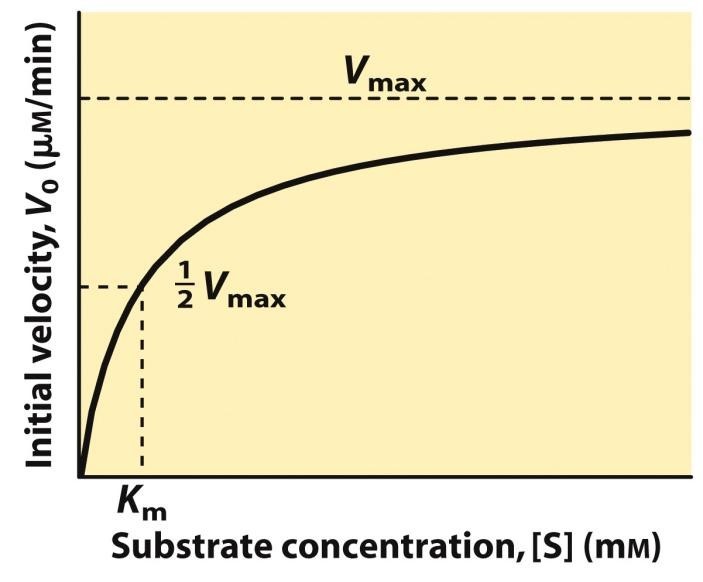
How can you measure enzyme kinetics?
- At low [S] you get an almost linear increase in V0 as ↑[S]
- At higher [S] the V0 changes very little in response to ↑[S]
- When [S] becomes so large that V0 changes are vanishingly small you get maximum reaction velocity, Vmax
- Vmax occurs because all of the enzyme active sites are saturated with substrate
what are Isoenzymes?
- Different enzymes that catalyse the same reaction e.g hexokinase (muscle) glucokinase (liver)
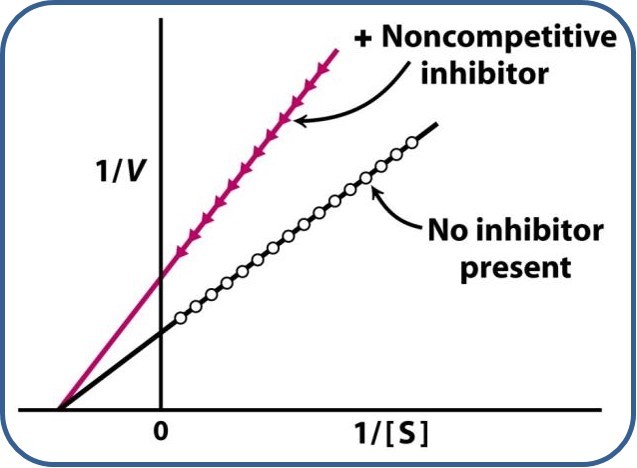
how do non-competitive inhibitors affect enzymes?
- bind to enzymes non-covalently
- The substrate is still able to bind the active site, so Km of the substrate-enzyme complex remains unchanged
- Increasing substrate concentration does not change the inhibition, Vmax will decrease
- non-competitive inhibitors= unchanged Km values but the Vmax decreases.
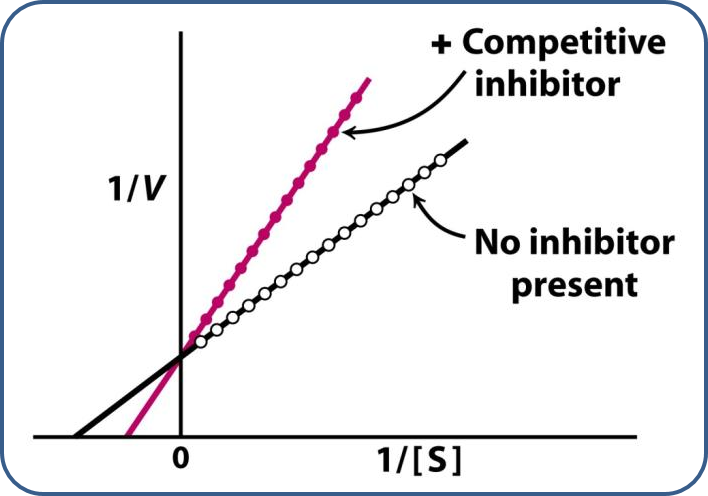
how do Competitive inhibitors affect enzymes?
- bind to enzymes non-covalently ,resemble the substrate molecule,compete with the active site
- leads to a decrease in the affinity between the active site and the substrate, so the Km increases
- Increasing substrate concentration can overcome this inhibition, so the same Vmax can be achieved
- competitive inhibitors exhibit increased Km values, Vmax remains unchanged
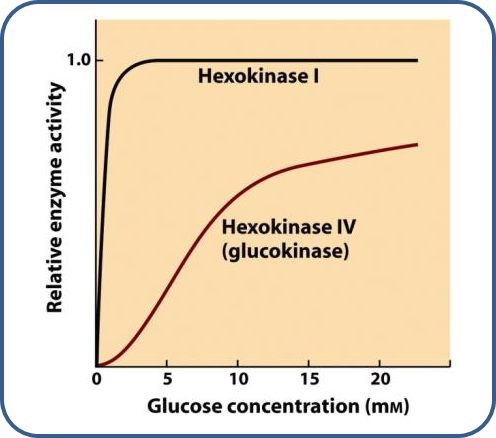
what are the functions of Glucokinase and hexokinase?
They both catalyse:
- Glucose + ATP ⇒ Glucose-6-phosphate + ADP.
- When [blood glucose] goes UP, the glucokinase activity increases but hexokinase activity does not respond as it is already working at its Vmax
- When [blood glucose] is LOW, gluconeogensis releases glucose from the liver,
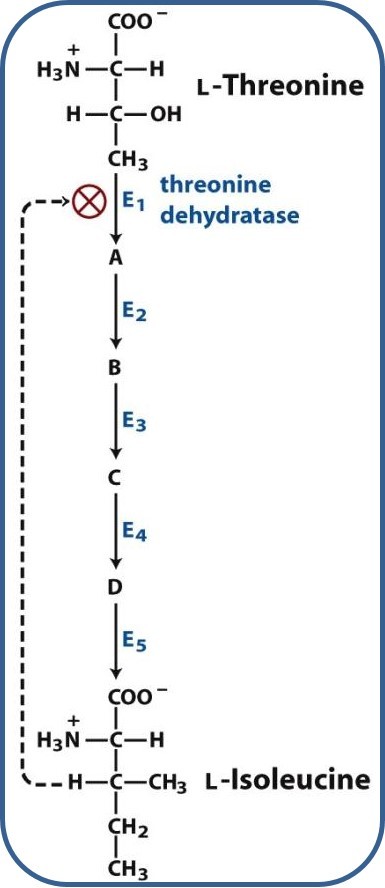
how does feedback inhibition occur?
- Some biochemical pathways regulate the enzymes involved through feedback inhibition.
- A build up of the end product of a pathway, or a key junction in a pathway, can ultimately slow the entire pathway
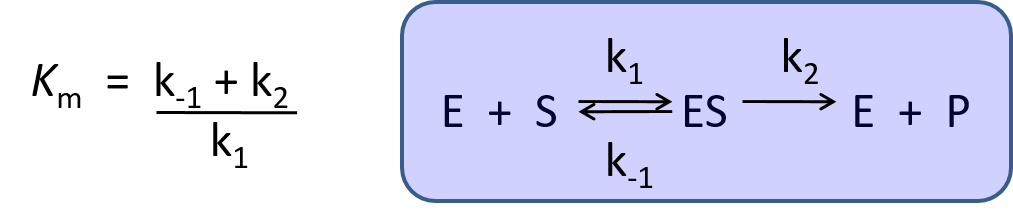
What can Km and Vmax tell us?
- Km gives you a clue to the affinity of the enzyme with it’s substrate.
- larger Km values indicate a less stable ES complex. Reduced affinity
- smaller Km values indicate a more stable ES complex. Higher affinity
- Vmax tells you how fast a reaction is proceeding when the enzyme is saturated with substrate
How do enzymes reduce activation energy?
Entropy reduction
–Molecules in free solution will only react by “bumping” into one another
–Enzymes “force” the substrate(s) to be correctly orientated by binding them in the formation they need to be in for the reaction to proceed
Desolvation
–Weak bonds between the substrate and enzyme replace H-bonds between substrate and aqueous solution
Induced fit
–Conformational changes occur in the protein structure when the substrate binds
what is a cofactor?
- Non-protein component needed for activity


-
Blood IA %%+(+20
-
reflexes mw%% (X11
-
essential pharmacology mw%% (+14
-
immunology mw%% (+32
-
Health disease IA % +7
-
Homoeostasis IA%%+(+13
-
Proteins IA %%+ (+29
-
Life at cellular level IA%%+(+30
-
Forces across membrane IA%% (+28
-
Tissues IA %%? (+37
-
nerves MW%% (+29
-
bones XXXXXXXXXXXXXXXXXXXX15
-
joints (+9
-
enzymes mw%% +29
-
Lipids %% IA (+-34
-
Bones IA (+23
-
Skin XXXXXXXXXXXXXXXXXX5
-
Autonomic Physiology %% MW (+20
-
Nitrogen IA %% (+-31
-
Carbohydrates IA %% (+42
-
muscles mw %% (+33
-
sensory receptors mw %% (+29
-
Terminal respiration IA% (+17
-
Skin IA%% (+20
-
Blood IA %%+ COPY XXXXXXXXXXXXXXXX12
-
Skin IA%% COPY XXXXXXXXXXXXX17


