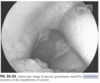
A horse presents for respiratory evaluation and chronic weight loss. The animal shares pasture with a mini donkey (Panchito), and the owner does not do any primary health care on Panchito since it is a donkey, and donkeys are tough. How would you diagnose the horses condition?
- Presence of D. arnfieldi larvae in BAL or TTW
- Increase eosinophils in TTW or BAL
Baerman usually false
Peripheral eosinophilia does not correlate.
According to the 2016 Consensus Statement, define the IAD phenotype based on clinical presentation and dx tests.
Clinical presentation:
- any age but more common in young horses
- clinical signs include poor performance (non-respiratory causes should be ruled out if this is only clinical sign) and chronic (>3 weeks), occasional coughing.
Diagnostic confirmation:
- endoscopy revealing excess tracheol-bronchial mucus (>2/5 for racehorses; >3/5 for sports/pleasure horses).
Rule out other causes of poor perfromance OR
- BAL cytology characterised by mild increases in neutrophils, eosinophils and/or metachromatic cells
- further confirmed for research purposes by documenting pulmonary dysfunction based on evidence of lower airway obstruction, airway hyperresponsiveness or impaired blood gas exchange
Exclusion criteria:
- evidenced of systemic signs of infection (anorexia, lethargy, haematologic abnormalities compatible with infection)
- increased respiratory effort at rest (heaves)
Action of macrophages in R. equi ©
Activation of IFNg by CD4+
Acute lung injury (ALI) and acute respiratory distress syndrome (ARDS) comprise a syndrome of severe pulmonary dysfunction and respiratory failure that affects foals. Which of the following statements is correct?
a) The fraction Pa02/Fi02 is >300mm Hg in cases of ALI (which is the less severe form) and >200mm Hg for ARDS.
b) It is related to pulmonary surfactant deficiency in neonatal foals
c) The pathophysiology includes dysregulation of pulmonary inflammation and coagulation
d) It is not related to an infectious etiology
c) The pathophysiology includes dysregulation of pulmonary inflammation and coagulation
ALI or ARDS arises as a complication after major infectious or noninfectious bodily injury. When this occurs, a protective response starts that involves controlled activation of the inflammatory and coagulation system. In ALIARDS an imbalance of pro inflammatory and anti-inflammatory factors produce an uncontrolled pulmonary inflammatory response and pro coagulation environment in alveoli and the pulmonary microcirculation.
Advantages of ultrasound for R. equi
Evaluation of severity of pneumonia and response to therapy
Best measure for eradication of EAV from herd ©
- Manage carrier stallions
- Vaccinate mares that are bred to the carrier stallion
What is the most effective treatment for M. capillaris?
A regimen of fenbendazole (1.25 to 5 mg/kg) 1 week on/ 1 week off/ 1 week on appeared to provide the most effective treatment.
*Resistant to levamisole
Muellerius Capillaris is probably the most common of the lungworms of sheep and goats. Infection is more pathogenic in goats than in sheep.
Several anthelmintics have been used in the treatment. Moxidectin (0.2 mg/kg oral or injectable) is effective in sheep and may be equally effective in goats. Although larvae may initially disappear in the feces after treatment, they often reappear in fecal samples again after 1 to 2 months, either because anthelmintics are ineffective against immature worms and/or because of resumption of development by inhibited larvae. Treatments that appear to eliminate adult parasites in goats include fenbendazole (15 to 30 mg/kg), albendazole (10 mg/kg), oxfendazole (7.5 to 10 mg/kg), and ivermectin (0.3 mg/kg). Better control of immature or inhibited larvae with fenbendazole was achieved by administering the drug (1.25 to 5 mg/kg) for 7 to 14 days.
Smith, Bradford P.. Large Animal Internal Medicine, Elsevier, 2014, page 628.
Mention some primary pathogenic fungi.
Primary pathogenic fungi such as Blastomyces dermatitidis, Histoplasma capsulatum, Coccidioides immitis, Cryptococcus neoformans, and Conidiobolus coronatus usually infect immunologically normal horses.
Smith, Bradford P.. Large Animal Internal Medicine, Elsevier, 2014, page 495.
Best way to determine the carrier status in strangles
- Endoscopic examination of the GP
- Culture + PCR of GP lavage
Best way to increase detection of R. equi
Culture + PCR (90% detection)
Characteristic pulmonary lesion of EIPH
Bilateral and caudo-dorsally
Cytology of a normal BAL, in horses and llamas?

- Neutrophils: < 5%
- Mast cells: < 2%
- Eosinophils: <1%
Describe gross findings in the lungs of horses with EMPF on post mortem exams.
- Lungs do not collapse on opening thorax. - All lung regions affected. - Multiple firm pale tan-white nodules with a discrete borders. Nodules are uniformly coloured and foci of fibrosis bulge from surrounding tissue. - Bronchial LNs enlarged in 50% of cases. - Two forms described: i) Coalescing: multiple coalescing nodules, 1-5cm diameter, little unaffected lung; more common form. ii) Multiple discrete nodules: larger nodules (up to 10cm diameter), same appearance as coalescing form, larger areas of normal lung tissue in between nodules.
Describe herpesviruses.
- Family: Herpesviridae. - Double-stranded DNA viruses. - Two subfamilies: alpha and gamma.
Describe histopathologic findings in the lungs of horses with EMPF.
- Marked interstitial expansion by well-organised mature collagen, infiltration of the interstium by inflammatory cells (lymphocytes > macrophages and neutrophils > eosinophils) and preservation of ‘alveolar-like’ architecture. - Alveolar luminal infiltrates may be present, predominately neutrophils and macrophages. - Alveoli are lined by hyperplastic cuboidal epithelial cells (type II pneumocytes). - Large macrophages with abundant eosinophilic cytoplasm and intranuclear viral inclusion bodies occasionally observed in the alveolar lumen.
Describe the clinical signs and necropsy findings of EAdV infections in immunocompetent yearlings and foals.
- Yearlings: nasal discharge (4-12d), serum ABs peak at 13d and decrease by 2mo. - Foals (10-35do): incubation period 3-5d, pyrexia, nasal and ocular discharge, tachypnoea, cough, dxa (25%) –> recover by day 10. - PM: atelectasis, suppurative bronchopneumonia, swelling and hyperplasia resp epi, intranuclear inclusion bodies.
Describe the clinical signs and necropsy findings of EAdV infections in immunocompetent foals with SCID.
- Rapid clinical decline and death. - PM: conjunctivitis, rhinitis, tracheitis, bronchopneumonia, pancreatitis, sialodenitis; intranuclear inclusion bodies in resp epi and pancreatic acinar and ductal cells.
Describe the clinical signs of EHV-1/EHV-4 respiratory infection in horses.
- Bi-phasic fever (24-48h then 4-8d if viraemic). - Lethargy. - Anorexia. - Nasal discharge (serous to mucopurulent d5-7). - +/- conjunctivitis, lymphadenitis, oedema/vasculitis in distal limbs.
Describe the epidemiology and pathophysiology of Hendra virus infection.
- Bats –> horses –> humans (+ dogs?) - Horse-to-horse transmission very rare but has occurred. - Majority of cases June-Aug (fruit bat birthing season) in QLD and northern NSW. - Incubation period 5-16d, CSx ~2d pre-death, 25% horses may survive if they weren’t all euthanised. - HeV uses cell surface membrane bound ephrin-B2 (wide dist inc vascular endothelial cells) and ephrin-B3 (CNS) as receptors.
Describe the epidemiology of EAdV infection.
- Worldwide distribution - Unknown if clinical signs in adults; causes dz in foals. - Transmission via direct contact or fomites. - Virus persists in URT of adults (reservoir) and enviro (1yr at 4 C).
Describe the epidemiology of EAV infection.
- Spread by respiratory and venereal routes. - 30-70% infected stallions become carriers; virus persists in ampulla of vas deferens (testosterone dependent). - 85-100% mares bred by stallions/fomites become infected –> spread via resp route to others on farm. - Infection –> immunity for several years. - Colostral ABs last until 2-6mo. - Seroprevalence varies b/w breeds: SB>TB. - Variation in host’s genome (CD3+T) and outcome.
Describe the epidemiology of EHV-1 and EHV-4 infections.
- Ubiquitous; most horses are infected in the first weeks/months of life –> latent infections –> shedding with stress –> dz in host and infection of other horses. - EHV-1: outbreaks of resp dz, abortions, myeloencephalopathy, neonatal death, chorioretinopathy. - EHV-4: outbreaks of resp dz; indv abortions, EHM, neonatal death. - Resp dz particularly of importance in young performance horses.
Describe the epidemiology of equine rhinitis virus.
- Worldwide distribution. - Horses usually infected at 1-2yo. - Survives well in the environment. - ERAV: increased risk with co-mingling, stress, concurrent dz, Winter/Spring. - ERBV: clinical significance unclear.
Describe the equine adenovirus (EAdV).
- Family: Adenoviridae. - Non-enveloped, icosahedral DNA virus. - Two serotypes: EAdV-1 (resp) and EAdV-2 (enteric, foals).