Exam 1 Review Flashcards

(171 cards)

1
Q

What is homeostasis?

A

maintenance of relatively stable internal conditions

Dynamic equilibrium

2
Q

What are the components of a control mechanism (control system)?

A
  1. Receptor: monitors environment and responds to stimuli
  2. Control Center: Determines set point, receives receptor input, determines response
  3. Effector: receives input from control center, response either reduces or enhances stimulus
3
Q

Explain what negative feedback is

A

The response reduces or shuts off the original stimulus

Most feedback in the body uses this

Ex: Regulating body temperature

4
Q

Explain what positive feedback is

A

The response enhances or exaggerates the original stimulus

Ex: Enhancement of labor contractions due to oxytocin

5
Q

What is the difference between autoregulation (intrinsic) and extrinsic regulation?

A

Autoregulation occurs automatically, wheras extrinsic regulation is controlled by the nervous and endocrine systems.

6
Q

Define supine and prone

A

Both describe anatomical positions.

Supine is face-up

Prone is face-down

7
Q

Define Ventral and Dorsal

A

Ventral means anterior (front)

Dorsal means posterior (back)

8
Q

What are the three body planes?

A

Sagittal, Frontal (coronal), and Transverse (horizontal/axial)

9
Q

What are the four abdominopelvic quadrants?
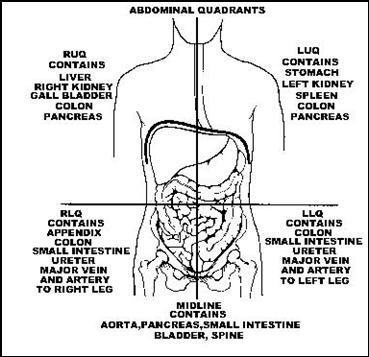
A
10
Q

What are the nine abdominopelvic regions?
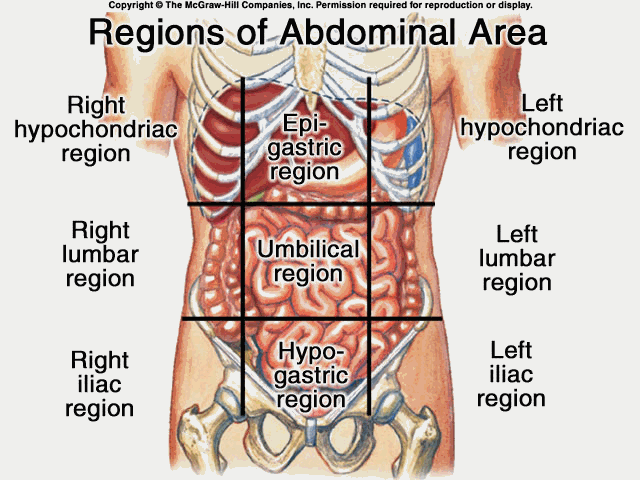
A
11
Q

What are microvilli and what is their function?

A

Membranous extensions containing microfilaments

They increase the surface area available for absorption to occur

12
Q

What are cilia and what is their functoin?

A

Cilia are long extensions containing microtubules

They help with the movement of material over the surface of the cell. Found in the respiratory and urinary tracts.

13
Q

What are the functions of the plasma membrane?

A
  1. Physical Isolation
  2. Regulation of exchange with environment
  3. Sensitivity to the environment
  4. Structural support
14
Q

What are the components of the cytoplasm?

A

Cytosol: the liquid component

Organelles: intracellular structures

15
Q

What are the components of the cell membrane?

A
  1. Phospholipids
  2. Cholesterol
  3. Carbohydrates
  4. Proteins
16
Q

What is an integral protein?

A

A membrane protein whose removal will disrubt/destroy the cell membrane

17
Q

What is a peripheral protein?

A

A protein found either on the intracellular or extracellular side of the plama membrane.

Removal of these proteins will not disrupt the membrane

18
Q

Explain the purpose of microfilaments.

A

They are found in microvilli and are used for anchoring. They also determine the fluidity of the cytosol.

19
Q

Explain the purpose of intermediate filaments.

A

They stbilize

20
Q

What is the function of microtubules?

A

They help move vesicles and organelles throughout the cytoplasm

They also are crucial for mitosis due to their role in the formation of spindle aparatuses

21
Q

How do cilia prevent resistence and maximize efficiency for movement?

A

They only beat one way with a power stroke, in which the cilia is stiff, and a return stroke where it is limp.

22
Q

Describe a tight junction

A

They prevent movement between cells. They can vary in their degree of tightness.

Frequently found in epithelial cells.

Composed of peripheral proteins from each membrane

23
Q

What is a desmosome?

A

A cellular structure that keeps cells bound together.

They help resist shearing forces

24
Q

What is a gap junction?

A

Cell-cell junction made up of proteins called connexins. They allow ions to pass between neighboring cells.

Useful for synchronicity

25
Is the plasma membrane impermeable, freely permeable, or selectively permeable?
Selectively permeable
26
What does the selectively permeable membrane restirct materials based on?
Size, Electrical Charge, Molecular shape, and Lipid Solubility
27
Which has a more negative charge: intracellular fluid or extracellular fluid?
Intracellular fluid is negative because of the presence of many negatively charged proteins.
28
Explain diffusion
Diffusion is a passive process by which molecules move from high concentrations to low concentrations (down the concentration gradient)
29
What are the factors that affect diffusion?
Distance, Molecule Size, Temperature, Concentration Gradient, Electrical Forces
30
What materials are able to diffuse through the plasma membrane by simple diffusion?
Lipid soluble compounds and dissolved gases
31
How do water soluble molecules enter the cell?
By channel mediated diffusion Ex: Aquaporins
32
What is osmosis?
Diffusion of water across the cell membrane. Water moves to equalize the concentration of solutes on either side of the membrane.
33
Does the concentration of one solute effect the diffusion of another similarly sized and charged solute?
No. Each solute diffuses as though it were the only material in the solution.
34
What is osmotic pressure?
The force of a conceentartion gradient of water.
35
What is the difference between osmolarity and tonicity?
Osmolarity refers to the solute concentration of the solution, while tonicity is a description of how the solution affects the cell.
36
Describe Isotonic, Hypotonic, and Hypertonic.
Isotonic: no change in size Hypotonic: cell will expand because it has more solutes, water diffuses into cell Hypertonic: cell will shrivel because it has less solutes, water diffuses out of cell
37
What is crenation?
When a red blood cell in a heypertonic solution loses water and shrinks
38
Is vesicular transport active or passive?
Active
39
What is a uniport carrier? Give an example
They transport one kind of substrate across the membrane Example: Glucose channel
40
What is a symport carrier? Give an example.
Move two or more substrates in the same direction across a membrane. Example: Sodium-Glucose co-transporter
41
What is an antiport carrier?
Moves substrates in opposite directions across the membrane. Example: Na/K pump
42
How is the concentration gradient for glucose maintained in the cell?
Glucose is converted to other products via glycogen and glycolosis so it doesn't contribute to the concentration gradient any more once it is in the cell.
43
Explain secondary active transport?
When the gradient for one ion is used to drive the movement of another across the membrane. Example: Na gradient allows glucose to enter the cell
44
Expllain how a primary active transporter is necessary for the functioning of secondary active transporters
The primary transport creates the concentration gradient that drives the secondary transport
45
What are the two types of endocytosis?
Phagocytosis and pinocytosis Phago: usually to destroy something in immune response Pino: intake of ECF
46
What are the four types of tissues?
1. Epithelial 2. Connective 3. Muscle 4. Neural
47
Explain what epithelial tissue does
It covers exposed surfaces, lines internal passages and chambers, and forms glands
48
What are the characteristics of epithelia?
Cellularity Polarity Attachment **Avascularity** **Regeneration**
49
How are epithelial cells maintained and repaired?
They are replaced by the division of germinative cells in the basal layer
50
What are the 8 types of cells?
1. Simple Squamous 2. Simple Cuboidal 3. Simple Columnar 4. Stratified Squamous 5. Stratified Cuboidal 6. Stratified Columnar 7. Transitional Epithelium 8. Psuedostratified columnar epithelium
51
What is epithelium always attached to?
Connective tissue
52
What is the difference between endocrine glands and exocrine glands?
Endocrine glands release hormones into the interstitial fluid whereas exocrine glands produce secretions onto epithelial surfaces through ducts
53
Explain the difference between paracrine and autocrine glands.
Paracrine glands secrete hormone that act on nearby tissues wheareas autocrine glands act on the gland/tissue that they are secreted from
54
Explain holocrine, apocrine and merocrine secretions
Holocrine: whole cell is released Apocrine: part of the cell is released Merocrine: vesicles are released
55
What are mucous (goblet) cells?
They are the only unicellular exocrine glands
56
Does connective tissue have contact with the environment?
No
57
What is the matrix (in connective tissue) made up of?
Fibers and ground substance
58
What are the three types of conective tissue?
CT Proper Fluid CT Supporting CT
59
What are the subtypes of Loose CT proper?
Areolar, adipose and reticular
60
What are the subtypes of Dense CT Proper?
Dense regular, dense irregular, elastic
61
What are the two components of a membrane?
Areolar and epithelial tissue
62
What is the primary function of a fibroblast?
They secrete hyaluronan and make ground substance viscous through the production of proteoglycans. Their secretions also from large extracellular fibers
63
What are the three parts of connective tissue?
Matrix, fibers/ground substance, and cells
64
What is the origin of all connective tissues?
Mesenchymal stem cells
65
What do macrophages do?
They engulf damaged cells and pathogens through phagocytosis
66
What connective tissue cell type is associated with inflammation?
Mast cells release heparine (anticoagulant) and histamine, which cause an inflammatory response
67
What are the two types of microphages?
Eosinophils and neutrophils
68
What is the structural difference between collagin fibers and reticular fibers?
Collagen fibers are made of 3 coiled coils that are unbranched and resist tensile forces, whereas reticular fibers are made from just one coil and are branched. Reticlar fibers are able to withstand forces in many directions
69
Describe the structure of elastic fibers.
Elastic fibers are made mostly of elastin and have branched and wavy fibers. They allow stretching and returning to the original length.
70
What is the purpose of reticular fibers?
They support organs and can also act as filters ex: removal of old RBCs in the spleen
71
Describe the structure and function of Ground Substance
Ground substance is clear, colorless, and viscous due to the presence of proteoglycans and glycoproteins. It fills the spaces between cells and slows pathogen movement because of density
72
What are the two types of embryonic connective tissue?
1. Mesenchyme 2. Mucous connective tissue
73
What type of connective tissue is found only in the umbilical cord?
Mucus CT (Wharton's Jelly)
74
What are the two epidermal pigments?
Carotene: orange-yellow pigment Melanin: brown, yellow-brown or black pigment; protects skin from UV radiation
75
How long does it take for a cell to move from the stratum basale to the stratum corneum?
7-10 days It remains in the stratum corneum ~2 weeks
76
What is the body's first line of defense from the environment?
The cutaneous membrane (skin)
77
What are the general functions of the integumentary system?
1) Protection 2) Excretion 3) Maintenance of body temp 4) Production of melanin 5) Production of keratin 6) Production of vitamin D3 7) storage of lipids 8) detection of touch, pressure, pain and temperature
78
What type of epithelial cells make up the epidermis?
Stratified squamous
79
Describe to subcomponents of the integumentary system
80
Is the subcutaneous layer considered a membrane?
No, because it does not have epithelial and connective tissue
81
What is the difference between thin skin and thick skin?
Thin skin has 4 layers of keratinocytes, whereas thick skin has 5 layers. Thick skin is only found on the palms of the hand and soles of the feet
82
Describe the stratum basalel.
The innermost epidermal layer which is made up of stem cells and is attached to the basement membrane by hemidesmosomes. This layer forms the epidermal ridges that extend into the dermis.
83
Describe the stratum spinosum.
8-10 layers of keratinocytes that are formed from the division of stem cells. Cells are still dividing in this region.
84
Describe the stratum granulosum
3-5 layers of keratinocytes derived from the spinosum these cells produce large amounts of heratin and keratohyalin cells begin to die
85
Describe the stratum lucidum
The layer that is found only in thick skin that contains flat densely packed cells This layer stains clearly, "lucidum"
86
Describe the stratum corneum
This layer is at the exposed surface and is composed of 15-30 layers of keratinized cells
87
What are Merkel discs?
Sensory receptors found in the epidermis
88
Describe the order of the layers found in the epidermis
89
What are dermal papillae?
They are projections from the dermis into the basal lamina layer. These increase the surface area for increased diffusion, and are also the reason that we have fingerprints.
90
What is insensible persperation, and how much is lost per day because of it?
Interstitial fluid is lost by evaporation throuogh the stratum corneum. 500 mL lost per day
91
What is the difference in blood color between oxygenated and deoxygenated blood?
Oxygenated is bright red, whereas deoxygenated is scarlet (dark red)
92
When does bile contribute to the color of an individual's skin?
Only in pathological situations Yellow skin = Jaundice
93
What is Addison's disease?
Excess ACTH is produced from the pituitary gland which leads to the darkening of skin.
94
What is Vitiligo?
A condition in which melanocytes are lost leading to a loss of skin color. This is not a medical condition, but causes many social problems
95
What are the different type of skin cancers?
Basal Cell carcinoma: basal cells overgrow Squamous: keratinocytes overgrow Malanoma: melanocytes overgrowing (worst in terms of survival rates)
96
What are the ABCDE's of skin cancer detection?
Asymmetry Border Color Diameter Elevation
97
What is cholecalciferol and what role does it play in the body?
Cholecalciferol is vitamin D3 Epidermal cells produce it in the presence of UV radiation. It is converted into calitriol in the kidneys and the liver, which is used for the absorption of calcium and phosphate.
98
What condition is caused by insufficient vitamin D3?
Rickets
99
Describe the Dermis.
It is the layer between the epidermis and the subcutaneous layer. It has 2 components: 1. Outer papillary layer 2. Deep reticular layer
100
Describe the paillary layer of the dermis.
It contains areolar tissue which has small capillaries, lymphatics and sensory neurons. It has dermal papillae which project between the epitermal ridges.
101
Describe the reticular layer
Made of dense irregular connective tissue and ahs larger blood vessels, nerves, and lymphatic vessels than the papillary layer It contains collagen and elastic fibers (CT proper)
102
What is Dermatitis?
An inflammation of the papillary layer that usually causes itchiness and/or pain.
103
What are cleavage lines?
lines representing the orientation of collagen and elastic fiber bundles an incision parallel to these lines will heal easily, whereas an incision perpendicular to these lines will cause much more scarring
104
What do nerve fibers in the skin primarily control?
Blood flow Gland secretions Sensory receptors
105
Describe the hypodermis
Lies below the integument Allows for separate movement of skin from underlying tissues Made up of elastic areolar and adipose tissue Has few capillaries and no vital organs
106
What are considered accessory structures of the integumentary system?
Hair, Hair follicles, sebaceous glands, sweat glands, and nails
107
Where is there NO hair on the human body?
Palms, soles, lips, anterior surface of eyeball, and portions of external genitalia
108
What are the primary functions of hair?
It protects and insulates and guards openings agains particles and insects. Also helps for sensation of touch.
109
What are arrector pili muscles?
They are the muscles that stand up hair and are under the control of the autonomous nervous system.
110
What are the two types of hair?
Vellus hair: soft, fine, covers most of body surface Terminal hairs: heavy, pigmented; found on head, eyebrows and eyelashes
111
Explain the difference between apocrine glands and merocrine glands.
Apocrine glands are found in the arm pits and groin and secrete thick odorous fluid. These glands are either on or off. Controlled by ANS Merocrine glands are found on the palms and soles and are controlled independently (some by ANS)
112
Describe the response to injury
1. Bleeding occurs; mast cells trigger inflammatory response 2. A scab stabilizes and protects the area. Granulation tissue forms from fibroblasts and endothelial cells 3. Scab undermined by fibroblasts producing meshwork of new skin cells 4. Scab is shed, epidermis is complete. Depression left behind until scar tissue forms enough
113
What is the rule of nines?
A way of estimating the percentage of skin that is affected by burns.
114
What are some of the effects of aging on the integument?
Decreased blood supply, function of hair follicles, elastic fibers, repair rate Dermal thinning, wrinkling and reduced melanocyte activity
115
What are the primary functions of the skeletal system?
1. Support 2. Storage of minerals 3. Blood cell production (red marrow) 4. Protection 5. Leverage
116
Describe the structure of a long bone
**Diaphysis** is the shaft: heavy wall of compact bone with a central space called the medullary cavity **Epiphysis** is the wide part at each end; mostly spongy bone, coveret with compact bone **Metaphysis** is where the diaphysis and epiphysis meet
117
What is hydroxyapatite?
Calcium phosphate reacts with calcium hydroxide to form these crystals in the bone that give it
118
What are the different types of bone cells?
Osteocyte: mature bone cell that maintains bone matrix Osteoblast: immature bone cell that secretes organic components of the matrix Osteoprogenitor: stem cell that divides to produce osteoblasts Osteoclast: multinucleate cell that secretes acids and enzymes to dissolve bone matrix
119
What are canaliculi?
Cytoplasmic extensions of osteocytes
120
How are osteons aligned in compact bone?
They are aligned all parallel with the long axis of the bone, making it very strong when compressed in that direction
121
What are trabeculae?
The meshwork of supporting bundles and fibers in spongy bone
122
Where is red bone marrow typically found?
In the spongy bone within the epiphyses of long bones such as the femur
123
What is yellow bone marrow
Adipose tissue deposits within bones that are important energy reserves
124
Describe the periosteum
Has a fibrous outer layer and a cellular inner layer. The collagen fibers of the periosteum are continuous with those of the bone, adjacent joint capusles, and attached tendons and ligaments
125
What is the endosteum?
This incomplete cellular lauyer lines the medullary cavity and converfs the trabeculae of spongy bone. It is active in bone growth and repair because it contains osteoblasts, osteoprogenitor cells and osteoclasts
126
What is the difference between ossification and calcification?
Ossification is the process of replacing other tissues with bone whereas calcification is the specific process of depositing calcium salts into a tissue. Calcification occures during bone ossification
127
What tissue do most bones originate as?
Hyaline cartilage
128
Describe the steps of intramembraneous ossification
1) mesenchymal cells differentiate into osteoblasts and the bone expands w/ spicules into nearby tissues 2) Spicules interconnect, trapping blood vessels 3) Over time, spongy bone structure is formed. This can later be reformed into compact bone
129
Describe the steps of endochondral ossification
1) enlarging chondrocytes within the calcifying matrix at center of shaft 2) blood vessels grow around the edges, cells of perichondrium turn into osteoblasts, leading to a superficial layer of bone 3) Blood vessels penetrate cartilage and reach central region, bringing with them osteoblasts that are able to begin to produce spongy bone in central region 4) As bone formation spreads from middle towards both ends, remodeling occurs creating the medullary cavity. 5) Capillaries and osteoblasts in epiphyses become secondary ossification centers 6) Articular cartilage remains exposed to joint cavity
130
What is appositional growth?
Bone matrix is added to the outer surface of the bones, increasing the diameter
131
What are the components of the cell membrane?
132
Describe the process of membrane transport
133
simple squamous
134
Simple Cuboidal
135
simple columnar
136
stratified squamous
137
stratified cuboidal
138
stratified columnar
139
What are the different types of connective tissues?
140
What are the components of the integumentary system?
140
What are the different types of glandular structures?
141
What type of cells are found in all connective tissue proper?
Fibroblasts and fibrocytes
142
What are aponeuroses?
Dense regular connective tissue that attach in sheets to large flat muscles Similar histologically to tendons
143
What are neuroglial cells?
Cells that maintain the physical structure of neural tissues and repair the tissue framework after injury
144
What characteristic changes occur in tissue because of inflammation?
Inflammation leads to increased blood flow, increased vessel permeability and pain. These cause increased temperature, O2 and nutrient deliver, activity and number of phagocytes and decreased toxins/waste products
145
What is necrosis?
As cells break down, lysosomes release enzymes that destroy the injured cell and attack surrounding tissues
146
What are Merkel cells?
tactile disks for sensory reception of touch
147
What are Langerhans cells?
Fixed macrophages throughout the epithelia that are active in uptake and processing of antigens for immune response.
148
What are melanosomes?
vesicles prodced by melanocytes that contain the melanin pigment these vesicles enter the keratinocytes leading to skin pigmentation
149
What is the function of myoepithelial cells?
They squeeze apocrine glands in response to nervous or hormonal signals
150
Describe the structure of spongy bone
A matrix forms an open network of trabeculae with red marrow filling in the space in between. Spongy bone is NOT organized into osteons
151
What minerals are found in the bone matrix?
Calcium phosphate: Ca3(PO4)2 Calcium hydroxide: Ca(OH)2 combine to form: hydroxyapatite: Ca10(PO4)6(OH)2
152
What vitamins are crucial for healthy bones?
Vitamin C: collagen synthesis and osteoblast differentiation Vitamin A: stimulates osteoblast activity Vitamins K and B12: help synthesize bone proteins Growth hormone, thyroxine, estrogens/androgens stimulate bone growth
153
What is the most abundant mineral in the body?
Calcium
154
How do PTH and calcitonin affect Ca2+ levels in the blood stream
PTH: increases Ca2+ Calcitonin: decreases Ca2+
155
Describe the steps in the repair of a fracture
1) Bleeding: large blood clot forms 2) Calluses form internally (network of spongy bone) and externally (cartilage and bone) 3) The external callus hardens into bone, the spongy bone expands, joining together the fracture, and fragments of dead bone are removed 4) The external callus swelling slowly diminishes over time and the bone returns to normal
156
What is a Pott's fracture?
A common ankle fracture where one of the malleoli (end of tibia or fibula) break off
157
What is a comminuted fracture?
When a bone breaks in many places at once
158
What is a greenstick fracture?
A fracture of the distal radius
159
What does cephalic mean?
Toward the head
160
What does caudal mean?
Towards the tail
161
In what abdominopelvic region is the spleen located?
Left hypochondriac
162
In what abdominopelvic region is the appendix located?
Hypogastric
163
Which plane separates superior from inferior?
Transverse plane
164
Which plane separates right from left?
Sagittal plane
165
Which plane separates anterior from posterior?
Frontal plane
166
What are the components of the Ventral body cavity?
Thoracic Cavity - Pleural cavities (L and R) - Mediastinum: trachea, esophagus, vessels - Pericardium Abdominopelvic cavity - Peritoneal Cavity - Abdominal cavity: digestive glands and organs - Pelvic cavity: bladder, reproductive organs, end of GI tract
167
What are the two components of serous membranes?
Parietal layer lines the cavity Visceral layer covers the organ
168
What is the retroperitoneal space and what organs are found there?
It is the area posterior to the peritoneum and anterior to the muscular body wall Holds the: pancreas, kidneys, ureters, and parts of the GI tract
169
Can two fluids have the same osmolarity, but different tonicity?
Yes
170
What makes up glycolipids? Glycoproteins?
Glycolipids: carbohydrates + phospholipids Glycoproteins: carbohydrates + proteins
