define Dynamic exercise
- activity characterized by recurrent and substantial body movement
–> isotonic contraction = muscle generates constant tension while changing length
define static exercise
- activity characterized by muscular contraction without substantial body movement
–> ISOMETRIC CONTRACTION = muscle generates tension without a change in length
Describe isotonic contraction
- muscle generates constant tension while changing length
–> concentric (flexing arm in bicep curl
–> eccentric (extending arm in bicep curl)
isometric contraction
- muscle generates tension without a change in length
describe the general physiological response to exercise
- increasing O2 delivery to WORKING TISSUE and remove metabolic by products
- Mediated by:
–> neural mechanisms (feedforward and feedback)
–> physical mechanisms
–> local biochemical mechanisms
describe some general themes of muscle blood flow in response to dynamic exercise
- blood flow to exercising muscle increases in proprotion to exercise intensity
- normal humans have large capacity for increasing cardiac ouput
- distribution of cardiac output is profoundly altered during exercises
- SPLANCHNIC and RENAL BLOOD FLOW are REDUCED to the greatest extent (much lower during exercise)
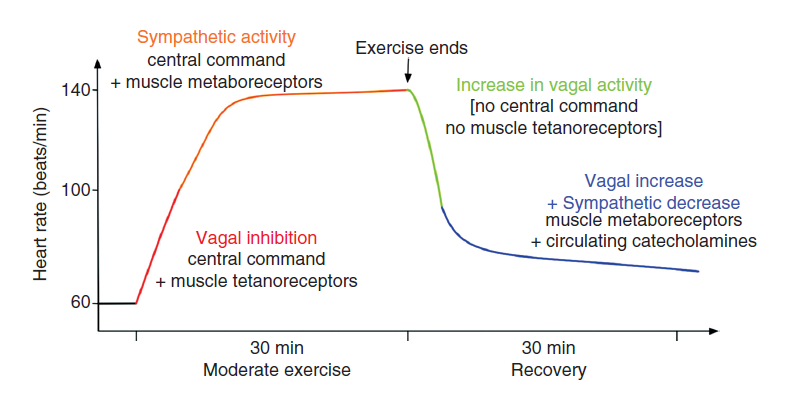
describe the cardiovascular adjustments to exercise and recovery
- initiation of exercise = vagal inhibition
- during exercise = symapthetic activity (feedback)
- initiation of recovery = increase vagal activity
- During recovery = vagal increase, sympathetic decrease
describe the resetting of the baroreflex with exercise
- baroreflex is reset ot a higher pressure at the onset of exercise
- central command sends descending output to nucleus of the solitary tract as well as to motor neurons
- Without these adaptations it would be difficult to INCREASE cardiac oupt to meet the demands of the exercising tissues
describe the mechanisms promoting venous return during Exercise
- Skeletal muscle pump
–> in the absence of mechanisms promoting venous return, increases in cardiac output would be absorbed into the venous circulation
–> mechanical forces play an important role in promoting venous return during exercise
- Respiratory pump
–> during inspiration, there is a decrease in pleural pressure and righta trial pressure
–> improves the filling of the right side of the heart (encouraging venous return)
describe type III and Type IV muscle afferents
- Thinly myelinated (group III) and unmyelinated (group IV) afferentes that originate in skeletal muscle
- Sensitive to mechanical deformation (group III) and metabolic byproduces associated with muscle contraction (group IV)
- Afferents projections synapse in the nucleus of the solitary tract and EXERT SIGNIFICAN INFLUENCE ON AUTONOMIC AND RESPIRATORY FUNCTION
describe sympathetic acivation during exercise
- sympathetic nerve activity increases progressively with increasing exercise intensity
- Sympathetic stimulaton of the arteries contributes to increase in arterial pressure as well as DIRECTING BLOOD AWAY FROM LOW-METABOLICALLY ACTIVE TISSUE
- sympathetic stimulation of venous circualtion –> contribute to venous return (muscle pump)
- contributes to neurohumoral activation (circulating epinephrine and Ang II)
describe muslce blood flow response to exercise
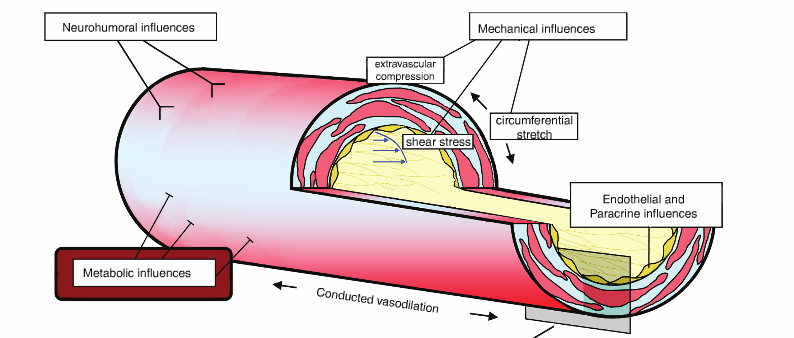
- initial increase in muscle blood flow with intitial of exercise: mechanical compression induced vasodilation + muscle pump
- steady state exercise: substance produced by exercsising muscles: adensosine, K+, CO2, H+ (metabolic influences)
describe the recruitment of capillary recruitment
- terminal arteriols are the portion of the vacular tree most sensitive to metabolic vasodilators
- dilation of terminal arterioles leads to recruitement of the additional capillary networks
- increased capillary recruitment allows for blood flow through muscle to incraese
describe the changes in O2 extraction during exercise
- exercise elicits a Bohr effects
–> decreasing the affinity of Hgb for O2 and right shifting the oxyhemoglobin dissociation curve
–> more oxygen is offloaded at the muscle
describe respiratory response to exercise
- initial increases in respiration occur very rapidly with the onset of exercise
- increases in ventilation are well matched to metabolic demands during submaximal exercise
- during high intesnity EX, ventilation and PaCO2 become uncoupled
describe the mechanisms for alveolar ventilation matching to CO2 production
- CO2 flow to the lung
- CO2 sensitive receptors in the lung that modulate afferents to CNS to affect respiration
- Central command
- descending output from cortical bran centers associated with conscious control of motor output
- Mechano/metaboreceptors
- blockade of III/IV afferents greatly reduces respiration during submaximal exercise, also not obligatory
describe the clinical importance of exercise hyperpnea
- reduced functioanl capacity has significant implications for prognosis
- conditions that affect the bioenergetics of respiration as well as the perception of effort can significantly affect functional capacity
- Dyspnea can signifcantly limit exercise capacity
cardiovascular respones to static exercise
- In isometric exercise (weight lifting) Blood pressure INCREASES MUCH MORE than in isotonic exercise
- muscle contraction compresses arteries increasing resistance
- high levels of central command
- increased intra-abdominal and intra-thoracic pressure
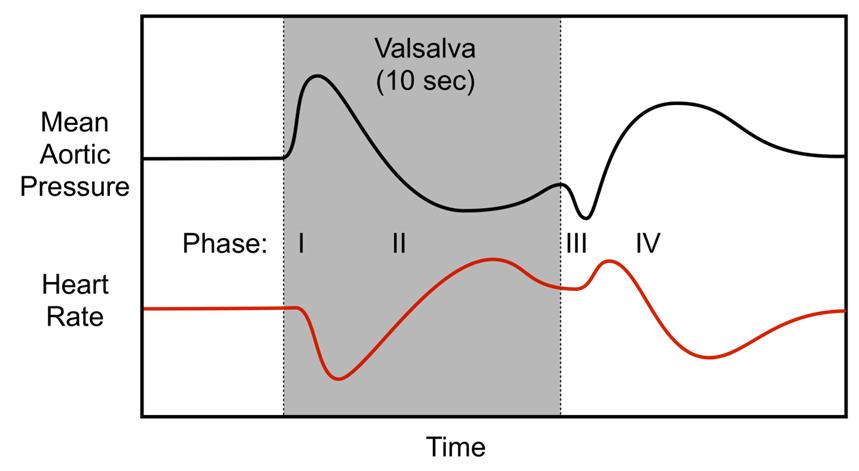
describe the valsalva maneuver
- Phase I = increase in intra-thoracic pressure, compression of aorta, veins and heart
- Phase 2 = falling aortic pressure secondary to reduced cardiac ouput
- Phase 3 = decreased compression of aorta
- Phase 4 = increased preload/cardiac filling/cardiac output