Why would a therapist perform an exercise test?
- Understanding severity of dyspnea.
- Understanding O2 saturation at rest and with activity.
- Determine exercise/activity tolerance.
- Provide information for exercise prescription.
- Evaluate for heart disease.
Prior to exercise testing…
- History
- Screening
- Lab values
- Physical exam
- Resting physiological measurements.
- PAR-Q and You
Good to add to any out-patient intake form to identify reasons to send patient back to physicians prior to commencing an exercise program.
Physical Activity and Readiness Questionnaire.
Risks with exercise testing:
- Muscle soreness.
- Diaphoresis (abnormal amount of sweating).
- SOB/SOA.
- Angina.
- MI.
- Stroke.
- Death.
*Remember you are going to screen patients prior to exercise testing
Safety with exercise testing
- CPR certification
- Emergency procedures in place.
- Monitor equipment well maintained and available.
Subjective rating of dyspnea
0 = no dyspnea
1 = mild (light barely noticeable)
2 = moderate (bothersome)
3 = moderately severe (very unconfortable)
4 = moderate / intense – you need to stop!
The American College of Sports Medicine recommend taking a pulmonary patient to what level of the subjective rating of dyspnea?
Level 3 moderately severe (very uncomfortable)
ACSM guidelines ABSOLUTE contraindications to exercise testing:
- Unstable angina
- Uncontrolled cardiac arrhythmia.
- Symptomatic critical aortic stenosis.
- Uncontrolled symptomatic heart failure.
- Acute PE.
- Acute myocarditis/pericarditis.
- Known dissecting aneurysm.
- Acute systemic infection.
- Significant EKG changes suggesting ischemia.
In terms of blood pressure, what are the upper limits of exercise testing? (reasons to stop an exercise test)
Plateau or decrease in SBP > 10 mmHg
SBP > 240 mmHg
DBP > 110 mmHg
Upper limits for exercise intensity:
(Reasons to stop exercise test)
- Plateau or decrease in SBP > 10
- SBP > 240
- DBP > 110
- Onset of angina or other symptom of cardiovascular disease.
- Increased frequency of ventricular arrhythmias.
- Onset of significant EKG onset.
- Radionuclide evidence of LV dysfunction or onset of moderate
- Other signs and symptoms of exercise intolerance.
- Patient request to stop!
Determination of HR max:
HR max = 220 – age (boards)
HR max = 208 – 0.7 X age
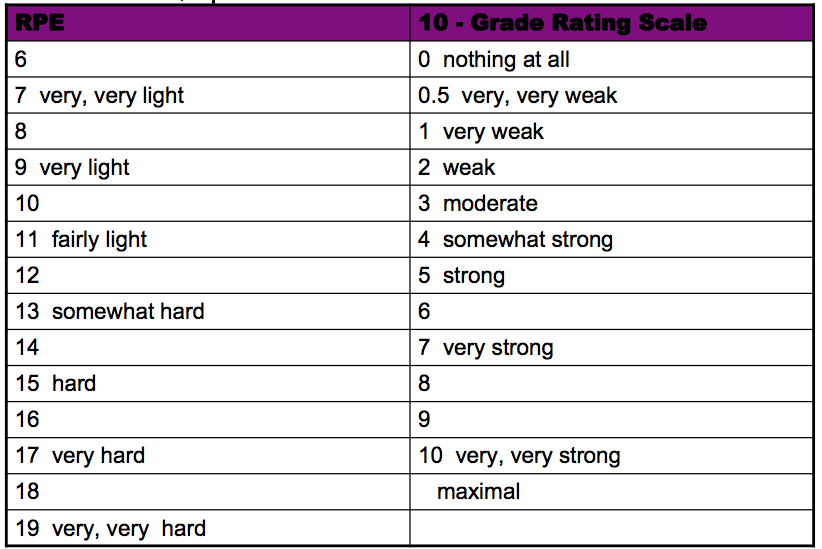
When to use Borg Scale/Rate of Perceived Exertion?
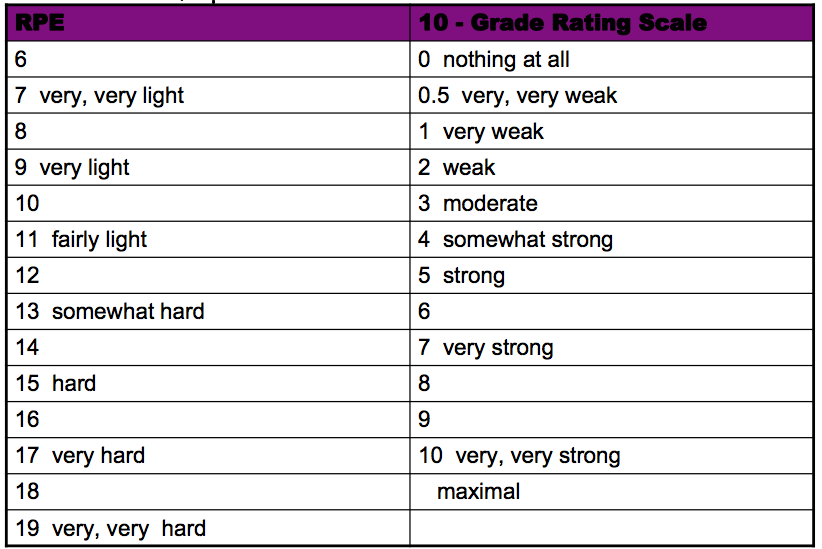
Patients on medications that blunt HR response (beta blockers, digoxin, calcium channel blocker, ace inhibitor)
The 6-20 RPE scale correlates well well with _____ if multiplied x 10.
HR
Types of exercise testing:
- Maximal Exercise testing
- Submaximal Exercise Testing
Why choose one over another?
- Do I have the necessary equipment available?
- Reason to do the test.
- The right person.
What is maximal exercise testing used for?
- To diagnose a disease
- Sensitive for coronary artery disease in asymptomatic individuals
- Assess medication levels
- Exercise prescription
- Assessment of ex/endurance training (can be an outcome measure)
How is maximal exercise testing performed?
- HR plateau,
- SBP plateau
- amount of CO2 causes sudden increase in RR, signal anaerobic work.
- Must have emergency equipment and personnel available.
Commonly used symptom limited graded exercises test:
- Bruce protocol: treadmill. More functional. Pt may achieve higher VO2 max.
- Astrand-Rhyming protocol: cycle. SCI, amputee.
to assess cardiorespiratory fitness:
Sub maximal Exercise Tolerance test (ETT)
Type of submax exercise test
- Graded Exercise Test
- Cycle
- Treadmill
- Low Level Graded Exercise Test: whe you stop ex at a predetermined point. Ex. Stop afeter 10 min of ex.
- Field test
- Individual dictates intensity
- 6 minute walk test
- Shuttle walk test
- 1 mile walk
- 1 mile run
- 100 ft walk
- Etc.
General guidelines, before exercise testing…
- Avoid recent activity
- Wait 2h after eating
- 2 hours after smoking or caffeine.
- Repeat test: 2nd more accurate.
- Choose a test that relates with the training you will select for the patient.

-
Pulmonary Anatomy And Physiology112
-
Examination Of The Pulmonary Patient41
-
Pulmonary A&P MUST KNOW13
-
Restrictive and Obstructive Lung Dysfucntion111
-
Diagnostic Testing64
-
Special Populations47
-
Medical / Surgical Management of Pulmonary Dysfunction66
-
Exercise Physiology27
-
LAB Stuff23
-
Exercise testing and prescription20


