parts of the hydrological cycle
Evaporation from the oceans
Water vapour: water in its gaseous state (mist, clouds) found in the air
Condensation: gas into liquid
Precipitation: the transfer of moisture (dew, hail, rain or snow) to the earth’s surface from the atmosphere
Runoff: precipitation that does NOT soak into the ground but flows over it into surface waters
Groundwater: water held underground in soil or porous rock
Intercept: plants capturing the rain
Evapotranspiration (EVT): the loss of water from vegetation and water surfaces to the atmosphere
eustasy and isostacy
Eustasy refers to a global change in sea level (eustatic change)
Isostacy refers to a global change in land level as a result of tectonic uplift (isostatic adjustment)
the steric effect
thermal expansion of water; increasing sea levels due to global warming
areation
opposite of saturation
water does not saturate the pores, is a transitional zone in which water is passed upwards or downwards through soil; soil moisture varies with porosity (the amount of pore spaces) in a soil, and with permeability (the ability to transmit water)
RELATED: soil moisture deficit: the degree to which soil moisture falls below field capacity (pores dry up) (could potentially become a drought) (more output than input)
elements of the Bradshaw Model
from source to mouth:
increasing
discharge
channel widh and depth
velocity
load quantity (competence)
decreasing
load particle size
channel bed roughness
slope angle
types of erosion
Abrasion (corrasion): the wearing away of the bed and bank by the load carried by a river
Attrition: the wearing away of the load carried by a river (creates smaller particles)
Hydraulic action: the force of air and water on the sides of the river and in cracks
Solution (corrosion): the removal of calcium causing rocks to dissolve (pH-acidic)
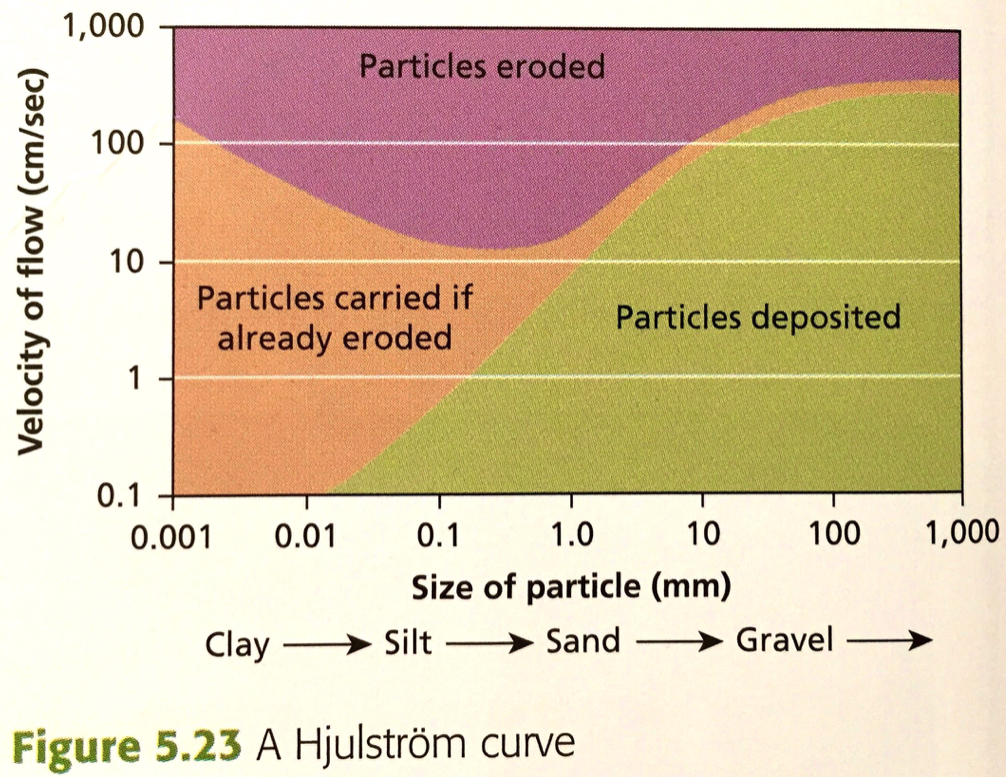
rive-channel load theory // Hjulström curve
- Capacity refers to the largest amount of debris (scattered pieces of rubbish or remains) that a stream can carry
- Competence refers to the diameter of the largest particle that can be carried.
- Critical erosion velocity is the lowest velocity at which grains of a given size can be moved.
The relationship between these variables is shown by means of a Hjulström curve:
- The smallest and largest particles require high velocities to lift them
- When velocity falls below a certain level (settling or fall velocity), particles are deposited
results from erosion
Oxbow lakes are the result of erosion and deposition. Lateral erosion, caused by helicoidal flow, is concentrated on the outer, deeper bank of a meander. During times of flooding, erosion increases. The river breaks through and creates a new, steeper channel.
Meander development occurs in conditions where channel slope, discharge and load combine to create a situation where meandering is the only way that the stream can use up the energy it posses equally throughout the channel reach.
Rapids frequently occur on horizontally bedded rocks. Layers of hard rock resists erosion and form shallow areas of turbulent flow within rivers — the Nile cataracts are a good example.
results from deposition
It occurs as a river slows down and it loses its energy, during low-flow conditions (such as in a drought); closer to the mouth.
Levees appear where the load is dropped, at the edge of the river.
River terraces are eroded floodplains, generally operated from the new floodplain by a steep slope. It is formed by changes in gradient, sediment load, climate change or human activity, or combinations of these. It is a result of both deposition AND erosion.
- Many terraces are formed by changes in base level (sea level).
- Changes in fluvial erosion and deposition, due to alternating cold and warm phases, are associated with the formation of terraces.
- Deforestation for agricultural land reduces vegetation cover. As interception increases, overland runoff increases, and there is accelerated erosion of part of the floodplain. This can lead to the formation of terraces upstream, as well as increased deposition downstream.
types of transportation
- Suspension - small particles help up by turbulent flow in the river
- Saltation - heavier particles bounced or bumped along the bed of the river
- Solution - the chemical load carried dissolved in the water
- Traction - the heaviest material dragged or rolled along the bed of the river
- Flotation - leaves and twigs carried on the surface of the river.
hydrology and urbanisation
- less infiltration, percolation and water storage
- increased runoff and flooding
- contaminants and pollution
- encroachment of channel width; more floods
- increased erosion due to less vegetation
- damns reude flood peaks by storing water

-
General7
-
People in Transition31
-
Disparities in Wealth and Development34
-
Required Definitions29
-
Patterns in environmental quality and sustainability33
-
Patterns in Resource Consumption31
-
Leisure, Sport, Tourism19
-
Freshwater11
-
Urban Environments33
-
Measuring Global Interactions21
-
Changing Space — The Shrinking World11
-
Economic Interactions and Flows20
-
Environmental Change10
-
Sociocultural Exchanges25
-
Political Outcomes17
-
Global interactions at the local level11


