Pro-Forma Financial Statements
Financial Statements forecasted for future periods. May also be referred to as a financial forecast or financial projection. In this course, we use pro-formas as a depiction of what the financial statements for the business will look like over a certain period of time, if the assumptions made when preparing them hold true.
Metropolis had net sales of ₹120 million in 2003 related to pathology services.
They expect sales of pathology services to grow by 75% in 2004.
Metropolis also plans to introduce a new service, Home Healthcare Blood Draws, which will generate sales of ₹10 million in 2004.
What will be the forecasted net sales for 2004?
₹120
₹10
₹220
₹75
₹220
Pathology revenue is expected to increase by 75% and Home Healthcare Blood Draws revenue is expected to add ₹10 million. In order to calculate, multiply the prior year’s revenue by 175% and add ₹10 million.
Calculation: (120.0 * 1.75) +10 = 220.0
Metropolis had net sales of ₹120 million in 2003 related to pathology services.
They expect sales of pathology services to grow by 75% in 2004.
Metropolis also plans to introduce a new service, Home Healthcare Blood Draws, which will generate sales of ₹10 million in 2004.
Metropolis expects sales of pathology services to grow by 75% in 2005.
Home Healthcare Blood Draws will generate sales of ₹20 million in 2005.
What will be the forecasted net sales for 2005?
HINT: You must compound the 2003 sales (₹120 million) twice rather than simply multiplying the 2004 revenue by 175% because the 2004 revenue includes ₹10 million of Home Healthcare Blood Draws revenue.
₹20
₹220
₹75
₹387.5
387.5
Pathology revenue is expected to increase by 75% and Home Healthcare Blood Draws revenue is expected to add ₹20 million. In order to calculate, multiply the 2003 revenue by 175% compounded twice and add ₹20 million.
Calculation: (120.0 * 1.75 * 1.75) + 20 = 387.5
The primary costs that make up the cost of sales for Metropolis are employee costs, chemical costs, and supplies costs. Employee costs are forecast to be 20% of revenue, chemical costs are forecast to be 20% of revenue, and supplies costs are forecast to be 5% of revenue, for a total of 45%. With forecasted sales revenue of ₹220 for 2004, what will be the forecasted cost of sales for 2004?
₹220
₹45
₹99
₹20
99
Cost of sales is forecast to be 45% of net sales (sum of employee cost, 20% + chemical cost, 20% + supplies cost, 5%). In order to calculate, multiply 2004 sales by 45%.
Calculation: (220.0 * 0.45) = 99.0
Variable costs
Variable costs are costs that rise and fall with revenue or activity. An example could be the cost of flour at a bakery which would tend to change in proportion with sales. It stands to reason that many current asset accounts, such as accounts receivable and inventory, and current liability accounts, such as accounts payable, would tend to increase or decrease proportionately with revenue.
What are the steps in creating a full Pro-Forma Statement?
- Determine the expected sales
- Look for trends and relationships among the various components of costs to forecast the cost of Sales & Operating Costs & Inventory
- Calculate Accounts Receivable . (Normally they’ll have a percentage for this. For example, 70% of sales is for credit purchases with a turn over of 6. This means to multiply revenue by .**7 and then divide by 6)
- Forcast Salaries and Wages Payable. This depends on the number of staff and the monetary value of the payroll as well as other factors such how often the employees are paid (weekly, bi-weekly, monthly, etc), whether employees are paid in arrears (often paid a few days after the end of the pay period) and how close the end of the pay period is to the end of the accounting period.
For the purposes of this forecast/module example, assume that the Salaries and Wages Payable will change in proportion to Revenue. Since, Salaries and Wages Payable will change in proportion to revenue, you will need to multiply the prior year’s Salary and Wages Payable by the change in revenue from prior year to current year.
For example, if last years revenue was 120 and this year’s revenue was 220, you would multiply last years salaries & wages payable by 220/120. - Alter P, E, & E - (Examples for altering listed below)
- new equipment could be purchased to replace older equipment.
- Second, as businesses are acquired it is anticipated that a portion of the acquisition cost is assigned to the value of the equipment of the acquired business.
- initial investments for new ventures/opening new locations.
- Depreciation- (rememer land doesn’t depreciate- also confirm what type of depreciation)
- Borrowings & Interest - This causes a circulatory problem.
The circularity problem in forecasting interest and borrowings occurs when a company is relying on borrowings to finance the business activities. However, some companies have no borrowings and, hence, no interest expense. Some other companies do have some amount of borrowings but they are not relying on those borrowings to finance their operations.- Figure out Loans (hopefully, they are predictable like mortgages and just need rounding!) and add it to current portion of debts
- If the above is a payment on long-term debt, subtract that amount from long-term debt to receive new long-term debt amount.
- Edit Interest Expenses (check to see if it’s for the beginning or end of the year)
- Income Tax Expense -
Income Tax Expenses = Tax Rate x Income Before Taxes - Forcast Common Stock-
Common stock reflects the amount of funding raised by issuing shares of stock to individuals that will hold a stake in the company. We would generally expect common stock to stay the same from year to year, unless the business is planning on issuing more stock or buying back its own outstanding shares. - Retained Earnings
How to Forcast Retained Earnings = Previous Retained Earnings + Current Year Net Income (Excluding the amounts to be distributed to shareholders) - Solve for Cash or Borrowings!
We simply subtract the balances of the asset accounts that have been forecast from the total liabilities and equity in the forecast to arrive at the forecast for cash.
CASH = EQUITY + LIABILITIES - (Sum of all ASSETS that aren’t CASH)- Note that in forecasts for businesses that finance their operations with borrowings:
- you will solve for borrowings as the plug and
- in forecasts for businesses that do not finance their operations with borrowings
- you will solve for another variable, such as cash, as the plug. In the case of a startup, it may be most appropriate to use equity as a plug, so the company can determine how much equity financing they will need to fund their operations.
- Note that in forecasts for businesses that finance their operations with borrowings:
For Metropolis, sales & marketing expenses are expected to be 12% of revenue. With forecasted sales revenue of ₹220 for 2004, what will be the forecasted sales & marketing expenses for 2004?
₹10.2
₹12.1
₹22.2
₹26.4
₹26.4
Sales & marketing expenses are expected to be 12% of net sales. In order to calculate, multiply 2004 sales by 12%.
Calculation: (220.0 * 0.12) = 26.4
How to decide the level of detail for a pro-forma statement?
The level of detail and attention given to forecasting individual expense items will depend on the purpose of the forecast.
- If the forecaster is only interested in high-level general trends, then assumptions can be broad and details sparse.
- However, if the forecast will be used to decide whether to acquire a business, the forecast should be thorough and the details plentiful.
How to get the #’s in blue…
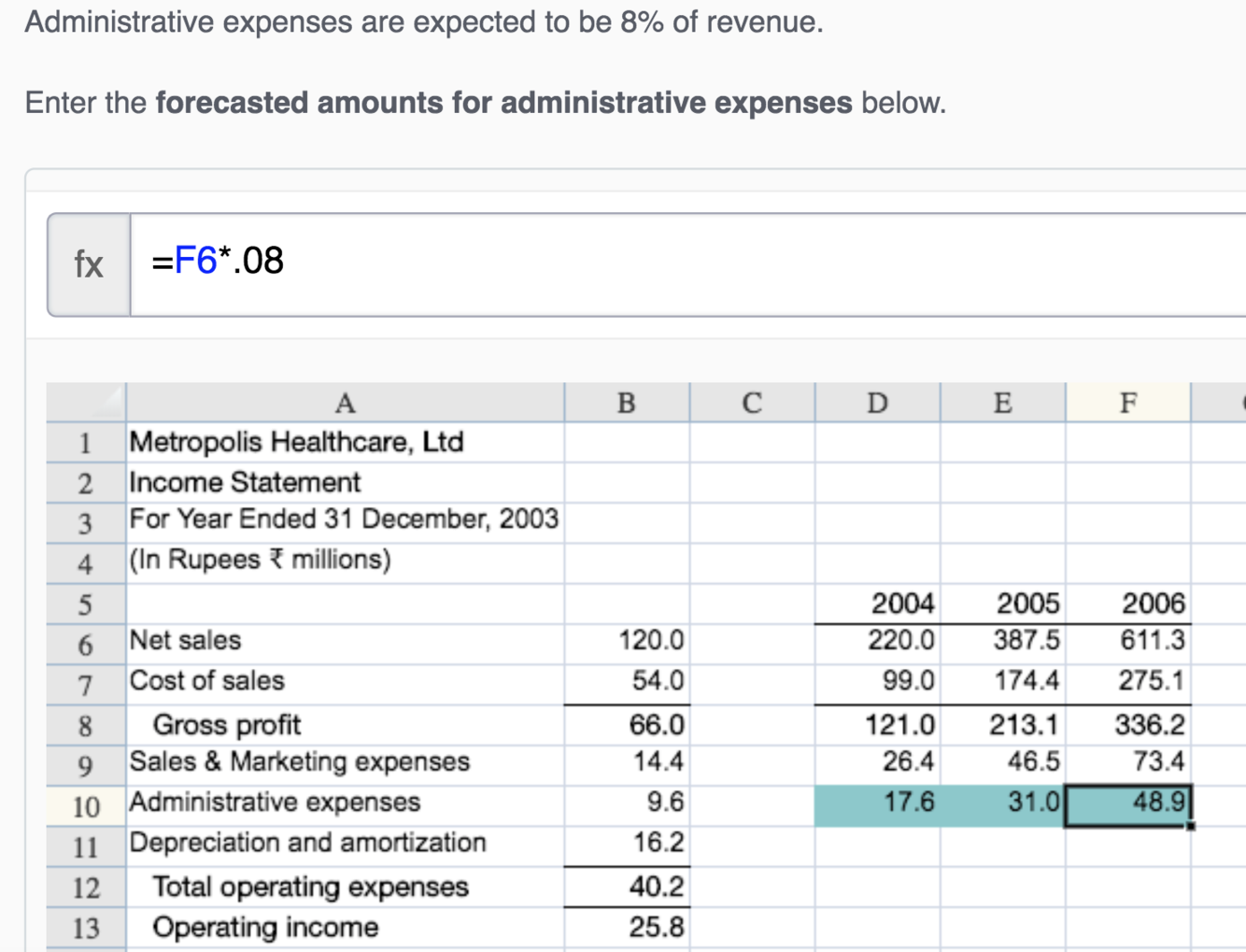
Remember: you should use formulas and linked cells whenever possible when using spreadsheets. The answers below reflect the use of the formulas shown.
2004: Administrative expenses are expected to be 8% of sales. In order to calculate, multiply this year’s sales by 8%.
Calculation: (220.0 * 0.08) = 17.6
Formula: =D6*0.08
2005: Administrative expenses are expected to be 8% of sales. In order to calculate, multiply this year’s sales by 8%.
Calculation: (387.5 * 0.08) = 31.0
Formula: =E6*0.08
2006: Administrative expenses are expected to be 8% of sales. In order to calculate, multiply this year’s sales by 8%.
Calculation: (611.3 * 0.08) = 48.9
Formula: =F6*0.08
Turnover
is an accounting term that calculates how quickly a business collects cash from accounts receivable or how fast the company sells its inventory. In the investment industry, turnover is defined as the percentage of a portfolio that is sold in a particular month or year.
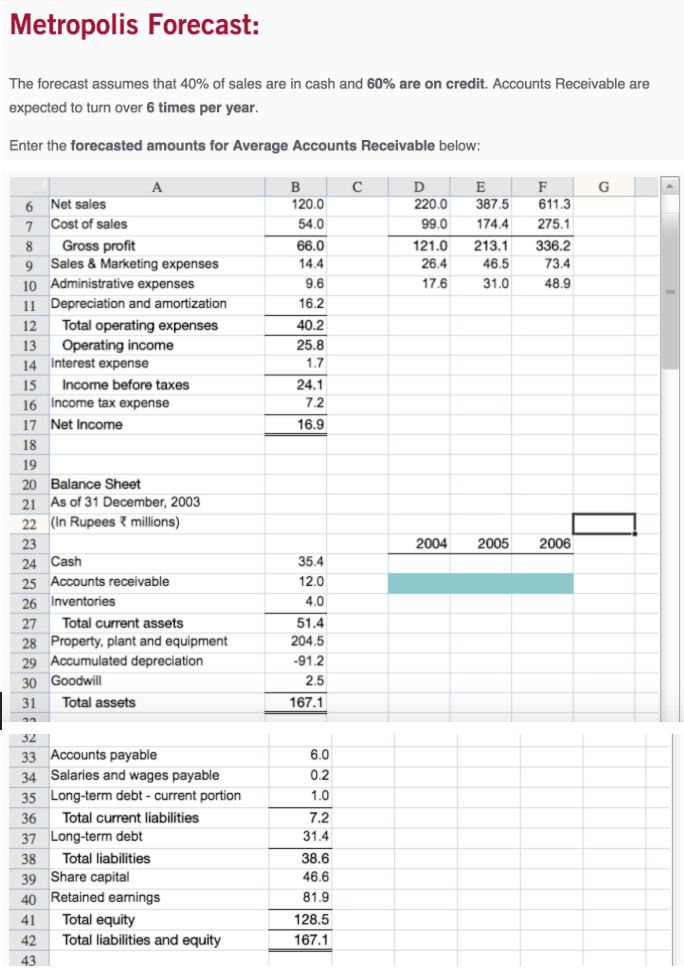
2004: 60% of sales are on credit and accounts receivable are expected to turn over 6 times per year. In order to calculate, multiply this year’s sales by 60% to get sales on credit, and divide by the turnover of 6 to get the balance of accounts receivable at the end of the year.
Calculation: (220.0 * 0.6) / 6 = 22.0
Formula: =(D6*0.6)/6
2005: 60% of sales are on credit and accounts receivable are expected to turn over 6 times per year. In order to calculate, multiply this year’s sales by 60% to get sales on credit, and divide by the turnover of 6 to get the balance of accounts receivable at the end of the year.
Calculation: (387.5 * 0.6) / 6 = 38.8
Formula: =(E6*0.6)/6
2006: 60% of sales are on credit and accounts receivable are expected to turn over 6 times per year. In order to calculate, multiply this year’s sales by 60% to get sales on credit, and divide by the turnover of 6 to get the balance of accounts receivable at the end of the year.
Calculation: (611.3 * 0.6) / 6 = 61.1
Formula: =(F6*0.6)/6
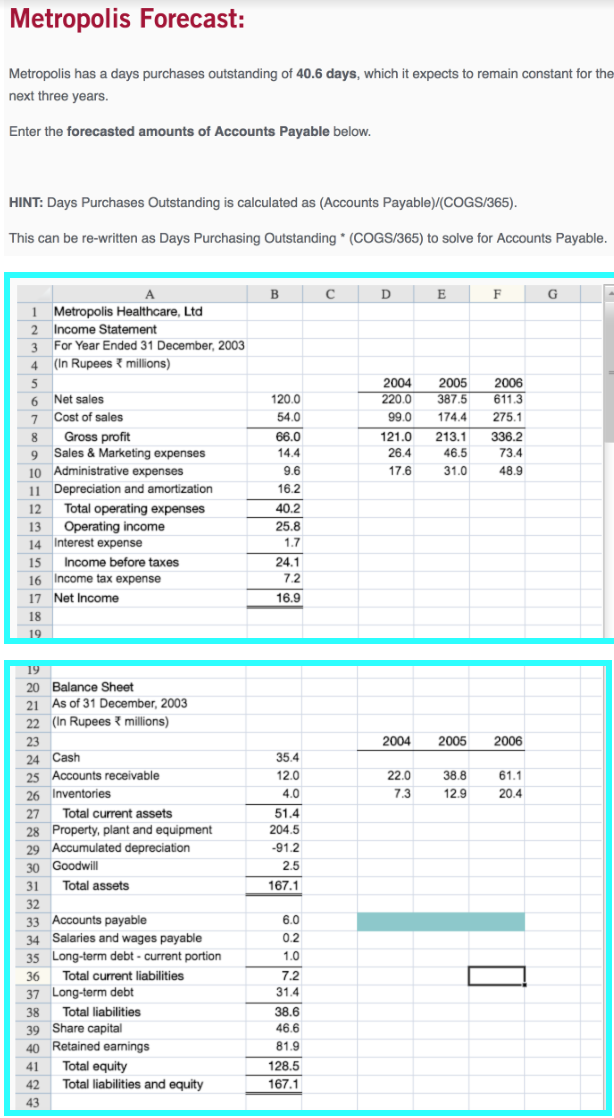
2004: Days Purchases Outstanding is expected to remain constant at 40.6 days. Recall that Days Purchases Outstanding is calculated as (Accounts Payable)/(COGS/365). In order to calculate, we can rearrange this formula to solve for Accounts Payable by multiplying the Days Purchases Outstanding by (COGS/365).
Calculation: 40.6 * (99.0 / 365) = 11.0
Formula: =40.6*(D7/365)
2005: Days Purchases Outstanding is expected to remain constant at 40.6 days. Recall that Days Purchases Outstanding is calculated as (Accounts Payable)/(COGS/365). We can rearrange this formula to solve for Accounts Payable by multiplying the Days Purchases Outstanding by (COGS/365).
Calculation: 40.6 * (174.4 / 365) = 19.4
Formula: =40.6*(E7/365)
2006: Days Purchases Outstanding is expected to remain constant at 40.6 days. Recall that Days Purchases Outstanding is calculated as (Accounts Payable)/(COGS/365). We can rearrange this formula to solve for Accounts Payable by multiplying the Days Purchases Outstanding by (COGS/365).
Calculation: 40.6 * (275.1 / 365) = 30.6
Formula: =40.6*(F7/365)
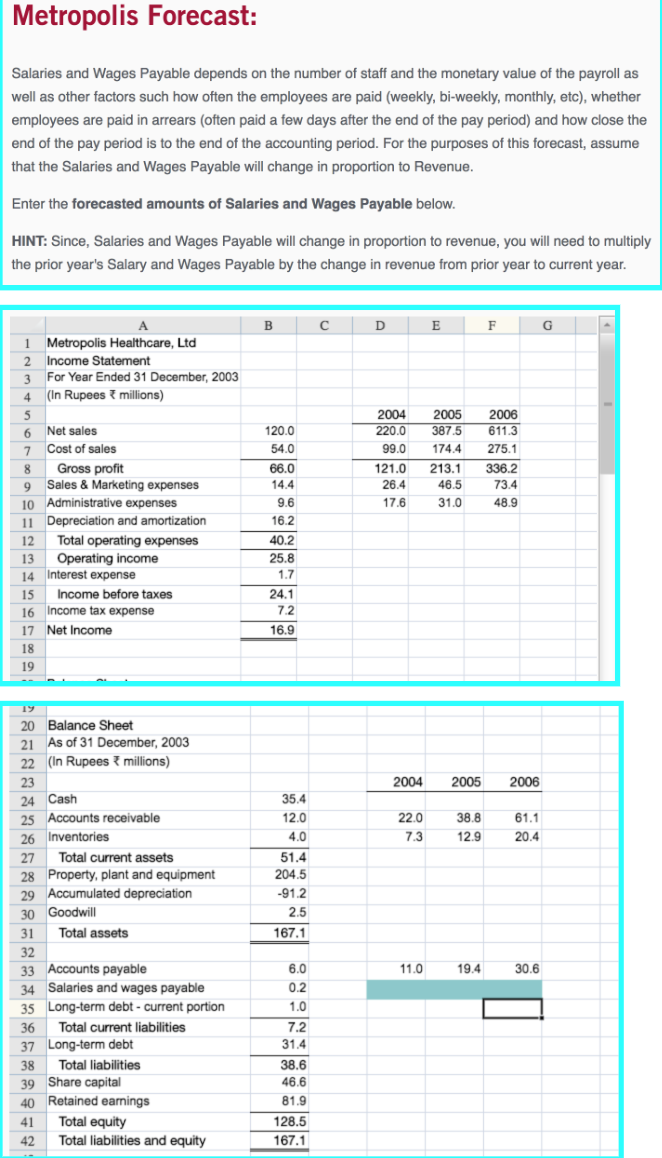
Remember: you should use formulas and linked cells whenever possible when using spreadsheets. The answers below reflect the use of the formulas shown.
2004: Salaries and Wages Payable are expected to change proportionally to revenue. In order to calculate, multiply the prior year’s Salary and Wages Payable by the ratio of this year’s sales to the prior year’s sales.
Calculation: 0.2 * (220.0 / 120.0) = 0.4
Formula: =B34*(D6/B6)
2005: Salaries and Wages Payable are expected to change proportionally to revenue. In order to calculate, multiply the prior year’s Salary and Wages Payable by the ratio of this year’s sales to the prior year’s sales.
Calculation: 0.4 * (387.5 / 220.0) = 0.6
Formula: =D34*(E6/D6)
2006: Salaries and Wages Payable are expected to change proportionally to revenue. In order to calculate, multiply the prior year’s Salary and Wages Payable by the ratio of this year’s sales to the prior year’s sales.
Calculation: 0.6 * (611.3 / 387.5) = 1.0
Formula: =E34*(F6/E6)
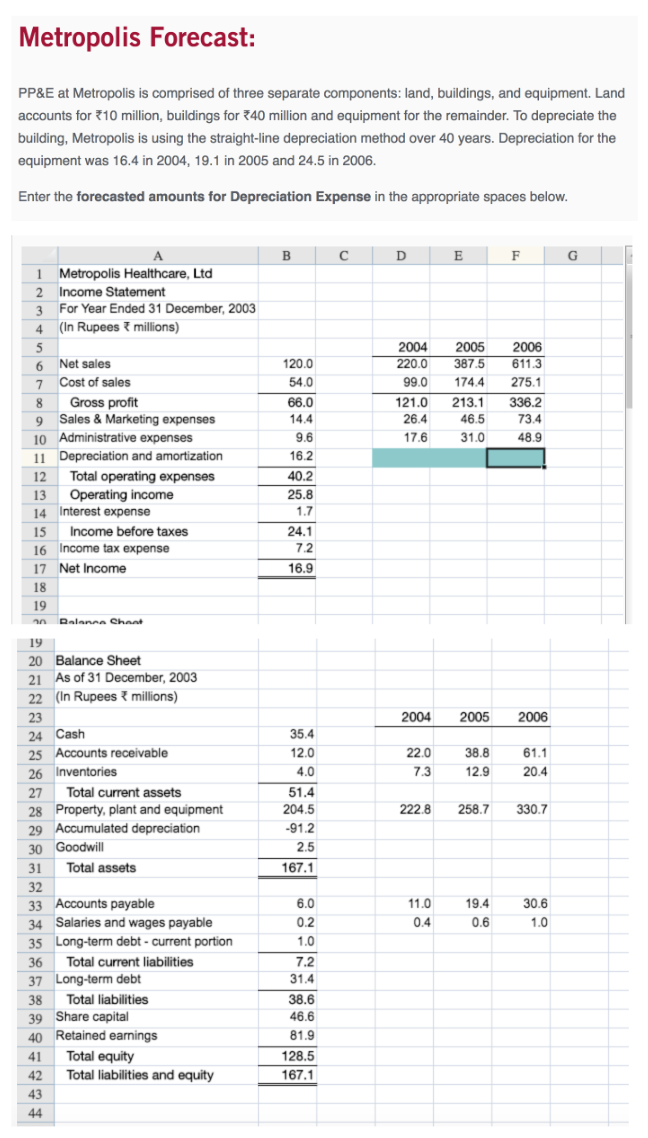
2004: PP&E is comprised of three separate components: land, buildings, and equipment. Land is not depreciated. Depreciation expense for equipment is given, ₹16.4 million. Buildings with an original cost of ₹40 million are being depreciated straight-line over 40 years, so we can simply divide ₹40 million by 40 years to find the depreciation expense on the buildings.
Calculation: = 16.4 + (40 / 40) = 17.4
2005: PP&E is comprised of three separate components: land, buildings, and equipment. Land is not depreciated. Depreciation expense for equipment is given ₹19.1 million, Buildings with an original cost of ₹40 million are being depreciated straight-line over 40 years, so we can simply divide ₹40 million by 40 years to find the depreciation expense on the buildings.
Calculation: = 19.1 + (40 / 40) = 20.1
2006: PP&E is comprised of three separate components: land, buildings, and equipment. Land is not depreciated. Depreciation expense for equipment is given, ₹24.5 million. Buildings with an original cost of ₹40 million are being depreciated straight-line over 40 years, so we can simply divide ₹40 million by 40 years to find the depreciation expense on the buildings.
Calculation: = 24.5 + (40 / 40) = 25.5
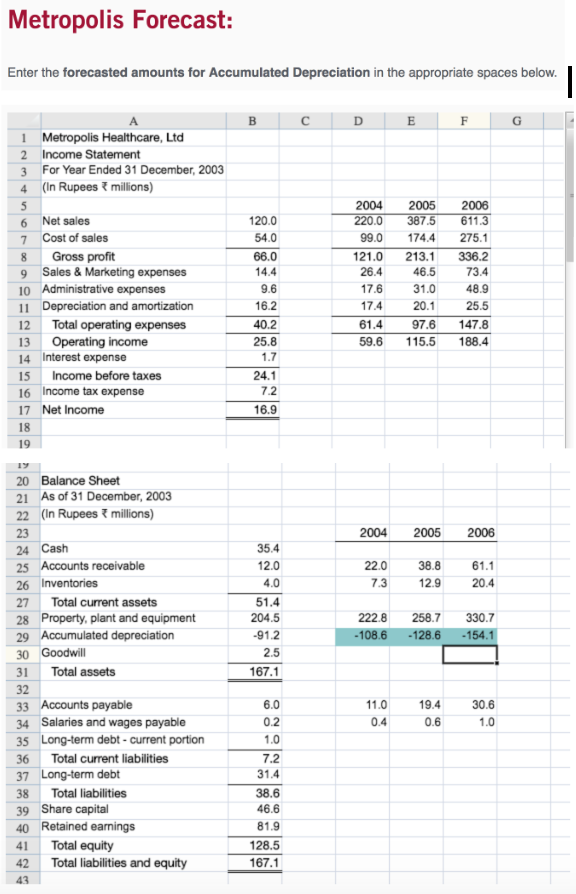
Remember: you should use formulas and linked cells whenever possible when using spreadsheets. The answers below reflect the use of the formulas shown.
2004: Accumulated depreciation is calculated by adding this year’s depreciation expense to the prior year’s accumulated depreciation.
Calculation: (-91.2 - 17.4) = -108.6
Formula: =B29-D11
2005: Accumulated depreciation is calculated by adding this year’s depreciation expense to the prior year’s accumulated depreciation.
Calculation: (-108.6 - 20.1) = -128.6 (Note: due to the use of formulas and rounding, the answer here is -128.6)
Formula: =D29-E11
2006: Accumulated depreciation is calculated by adding this year’s depreciation expense to the prior year’s accumulated depreciation.
Calculation: (-128.6 - 25.5) = -154.1
Formula: =E29-F11
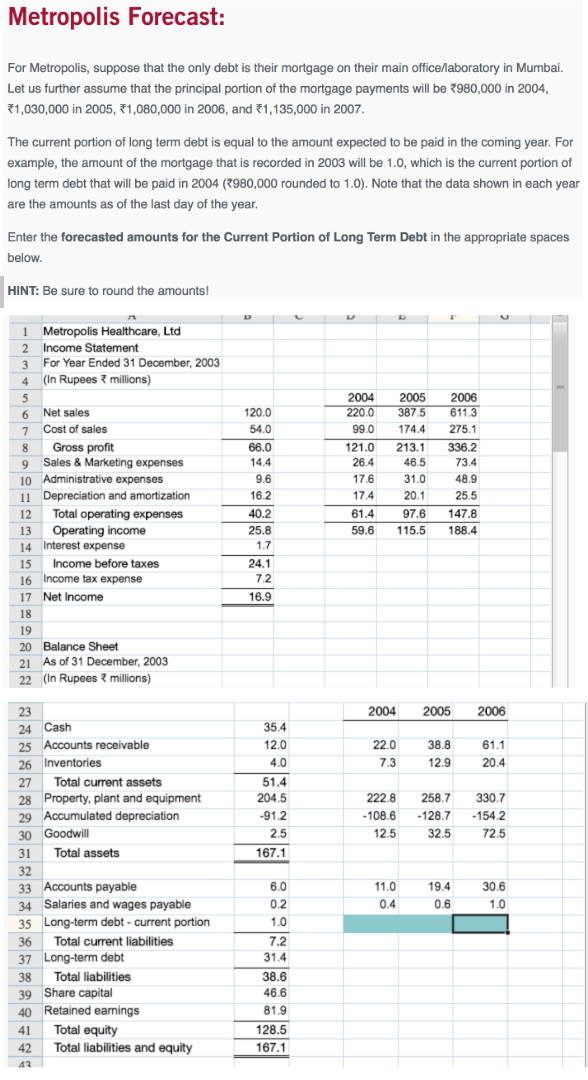
2004: The current portion of long term debt is forecast to be ₹1.03 million (rounded to 1.0). Recall that at December 31, 2004, the current portion of long term debt is equal to the amount expected to be paid in the coming year, 2005.
2005: The current portion of long term debt is forecast to be ₹1.08 million (rounded to 1.1). Recall that at December 31, 2005, the current portion of long term debt is equal to the amount expected to be paid in the coming year, 2006.
2006: The current portion of long term debt is forecast to be ₹1.135 million (rounded to 1.1). Recall that at December 31, 2006, the current portion of long term debt is equal to the amount expected to be paid in the coming year, 2007.
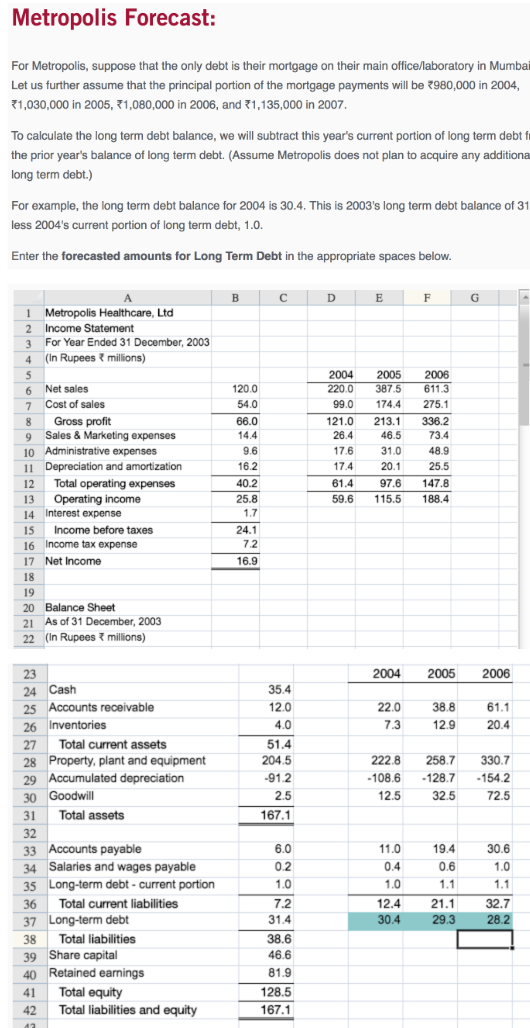
2004: Since no additional long term debt is expected to be acquired, long term debt is calculated simply as the prior year’s long term debt less this year’s current portion of long term debt.
Calculation: 31.4 - 1.0 = 30.4
Formula: =B37-D35
2005: Since no additional long term debt is expected to be acquired, long term debt is calculated simply as the prior year’s long term debt less this year’s current portion of long term debt.
Calculation: 30.4 - 1.1 = 29.3
Formula: =D37-E35
2006: Since no additional long term debt is expected to be acquired, long term debt is calculated simply as the prior year’s long term debt less this year’s current portion of long term debt.
Calculation: 29.3 - 1.1 = 28.2
Formula: =E37-F35
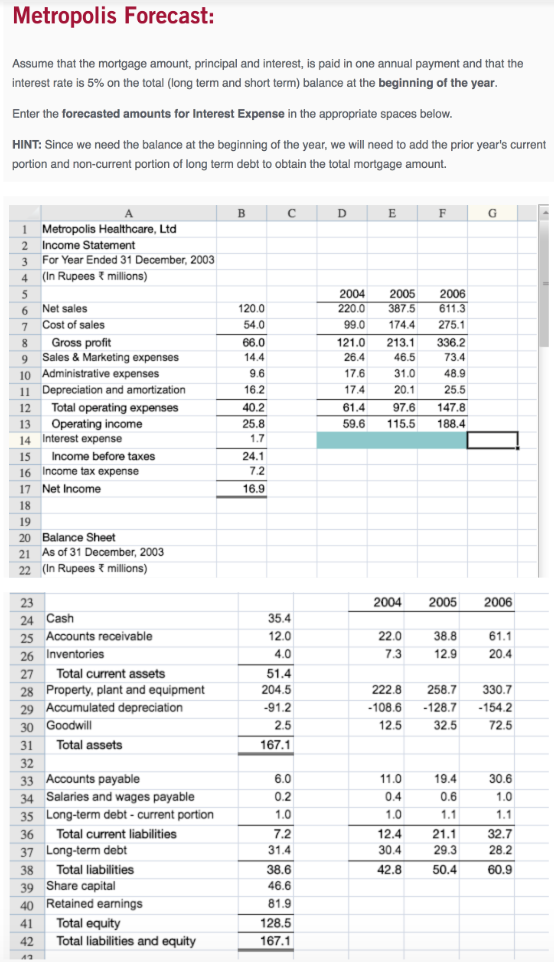
2004: Interest expense is forecast to be 5% of the total long term debt balance at the beginning of the year. In order to calculate, add the prior year’s current portion and non-current portion of long term debt, and multiply by 5%.
Calculation: (1.0 + 31.4) * 0.05 = 1.6
Formula: =(B35+B37)*0.05
2005: Interest expense is forecast to be 5% of the total long term debt balance at the beginning of the year. In order to calculate, add the prior year’s current portion and non-current portion of long term debt, and multiply by 5%.
Calculation: (1.0 + 30.4) * 0.05 = 1.6
Formula: =(D35+D37)*0.05
2006: Interest expense is forecast to be 5% of the total long term debt balance at the beginning of the year. In order to calculate, add the prior year’s current portion and non-current portion of long term debt, and multiply by 5%.
Calculation: (1.1 + 29.3) * 0.05 = 1.5
Formula: =(E35+E37)*0.05
What is the circularity issue with borrowings and interest?
Borrowings are used to determine the interest expense,
which impacts net income and retained earnings.
But retained earnings are used to calculate borrowings.
To resolve the circularity,
you will have to go through a couple of iterations
to get the balance sheet equation to balance.
COMMON STOCK
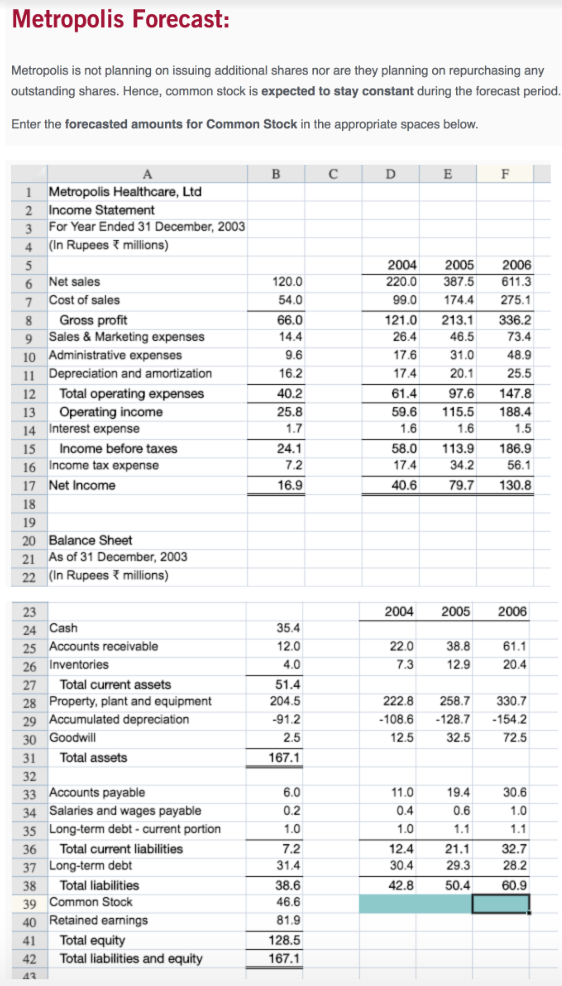
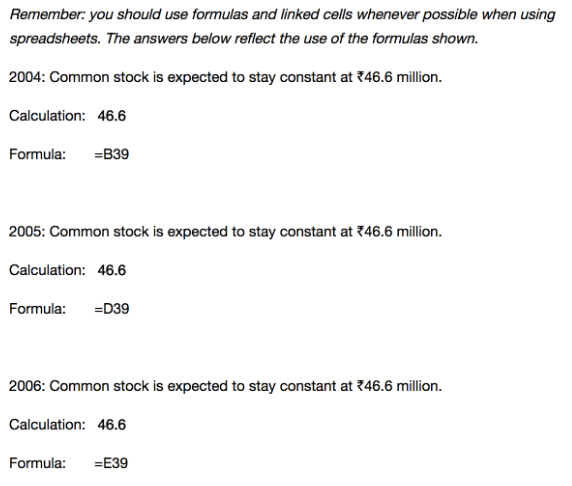
Common stock reflects the amount of funding raised by issuing shares of stock to individuals that will hold a stake in the company. We would generally expect common stock to stay the same from year to year, unless the business is planning on issuing more stock or buying back its own outstanding shares. In our example below, we’ll assume it is going to stay constant from one year to the next.
Define Retained Earnings and how to forcast them.
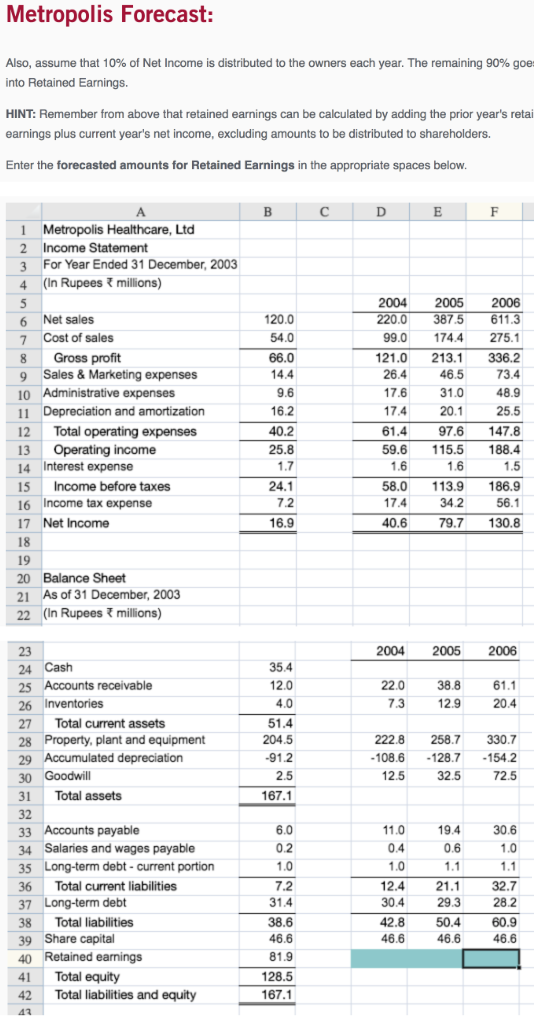
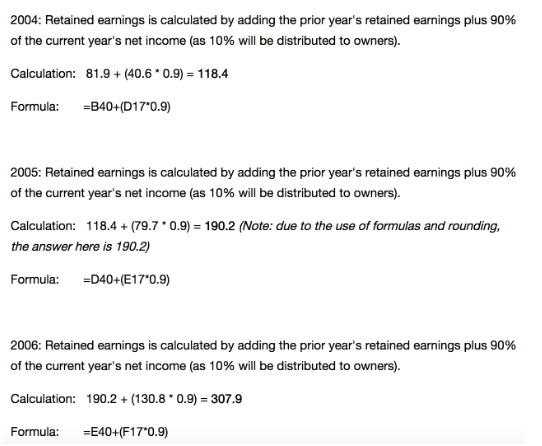
Retained earnings reflects the earnings that have been retained in the business to finance growth or future operations. For any given year, we can forecast retained earnings by adding the amount of prior year retained earnings plus current year net income, excluding amounts to be distributed to shareholders.
How to Forcast Retained Earnings = Previous Retained Earnings + Current Year Net Income (Excluding the amounts to be distributed to shareholders)
How To Solve for a Cash Forecast!
Is a business doesn’t use borrowings you’ll need to solve for cash?
- We simply subtract the balances of the asset accounts that have been forecast from the total liabilities and equity in the forecast to arrive at the forecast for cash.
CASH = EQUITY + LIABILITIES - (Sum of all ASSETS that aren’t CASH) - Note that in forecasts for businesses that finance their operations with borrowings:
- you will solve for borrowings as the plug and
- in forecasts for businesses that do not finance their operations with borrowings
- you will solve for another variable, such as cash, as the plug. In the case of a startup, it may be most appropriate to use equity as a plug, so the company can determine how much equity financing they will need to fund their operations.


