Define homeostasis?
Maintenance of a constant internal environment.
Keep at optimum conditions.
- Body temperature
- Body fluids
- Blood sugar
- Dissolved gasses and pH
Feedback systems
Body responds to a stimulus and puts in place a response to alter that stimulus.
Dynamic equilibrium
Fluctuation around a set point.
Negative feedback
Response causes stimulus to change in a direction opposite to original change. Eliminates stimulus that caused it.
What does negative feedback consist of?
Stimulus: Change in the environment.
Receptor: Detects the change.
Modulator: Processes information and determines response.
Effector: Carries out response (counteracts stimulus).
Feedback: Original stimulus changed.
Positive feedback
Response to stimulus reinforces and intensifies stimulus. Intensified stimulus results in an even greater response.
E.g. Childbirth and Oxytocin Oxytocin causes contractions. Baby’s head pushes against cervix. Stimulation of cervix causes nerve impulses sent to brain. Brain secretes more oxytocin -> contractions continue.
Heat transfer method: Conduction
- Transfer of heat via direct contact with another object. Involves exchange of heat from molecule of higher temp to molecule of lower temp when they vibrate and touch.
- E.g. When we jump in a pool to cool off, heat from out body is transferred to the cooler water particles touching us.
Heat transfer method: Convection
- Transfer of heat to air around body. When cool air makes a contact with our body it heats up and becomes less dense.
- Less dense air rises and is replaced by cooler, denser air.
- Cycle of air is a convection current.
- E.g. Fan or air con helps more away warm air quickly.
Heat transfer method: Radiation
- Transfer of heat without direct contact.
- All objects emit heat to surroundings by radiation.
- Heat will radiate to cooler objects around you (walls, floors).
- Can absorb heat by radiation, from objects hotter than us.
- Transfer of heat travels from hotter object to cooler one.
- E.g. Move to shaded area reduces heat from radiation from sun.
Heat transfer method: Evaporation
- Transfer of heat through evaporation of liquid to gas.
- Heat energy is required to change from a lower energy liquid phase to a higher energy gas phase.
- This heat energy is absorbed from surface of skin, which then cools when water evaporated.
- Heat is lost.
- E.g. Our body loses heat when sweat evaporates from our skin.
Thermoregulation Heat loss
Internal - Evaporation of water from skin and lungs (warm air breathed out, warm urine and faeces).
External - Radiation, conduction and convection to surroundings.
Thermoregulation Heat gain
Internal - Body processes (metabolism – heat is by-product of cell respiration, breakdown of food in cells). Metabolic rate – Rate at which energy is released by breakdown of food. Affected by exercise, stress, body temp.
External - Radiation or conduction from surroundings.
Temprature tolerance
Heat stroke
When body temperature rises but regulatory mechanisms are not working. Core body temp over 42 is dangerous and death occurs if it reaches 45.
Heat exhaustion
Result of extreme sweating and vasodilation. Sweating results in water loss which reduces blood plasma, and vasodilation reduces resistance to blood flow. Blood pressure is reduced and cardiac output decreases.
Hypothermia
Core body temp below 33, metabolic rate decreases so much so that heat production is i
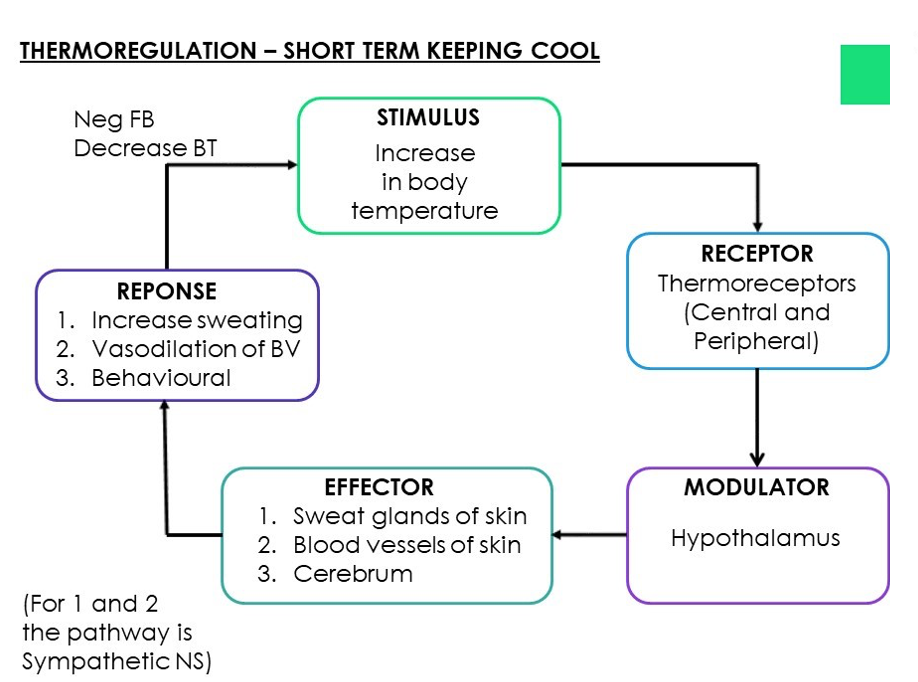
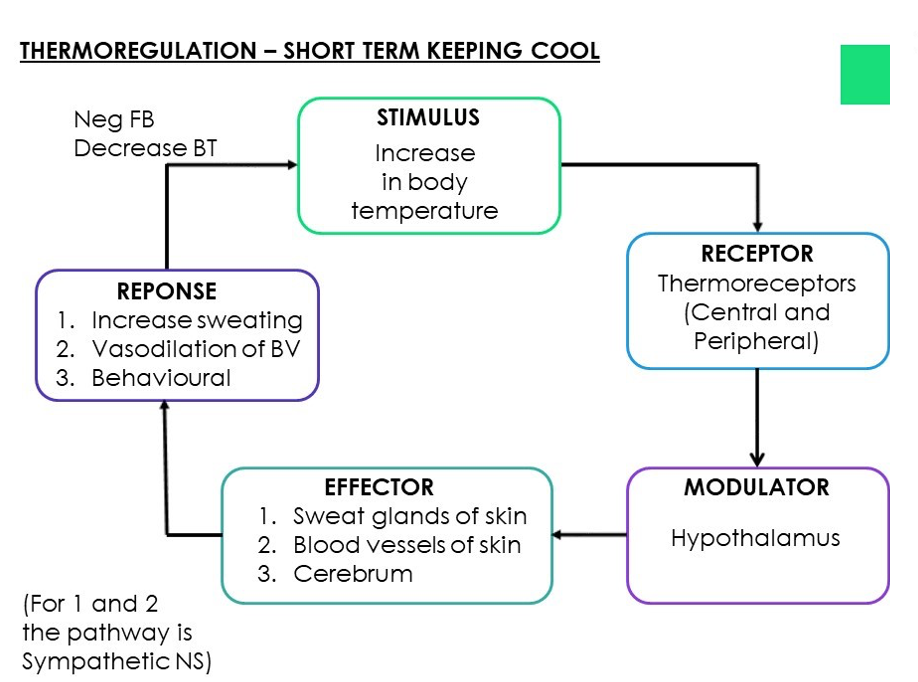
Keeping cool
Vasodilation
Stimulates sympathetic nerves -> Peripheral arterioles dilate -> Increase blood flow to skin -> Surface temp rises -> Heat loss through conduction and radiation.
Sweating
Stimulates sympathetic nerves -> Cells around sweat ducts pump sweat to skin surface -> Sweat evaporated from skin -> Cooling of skin means cooling of blood flowing through skin -> Heat loss through conduction and radiation.
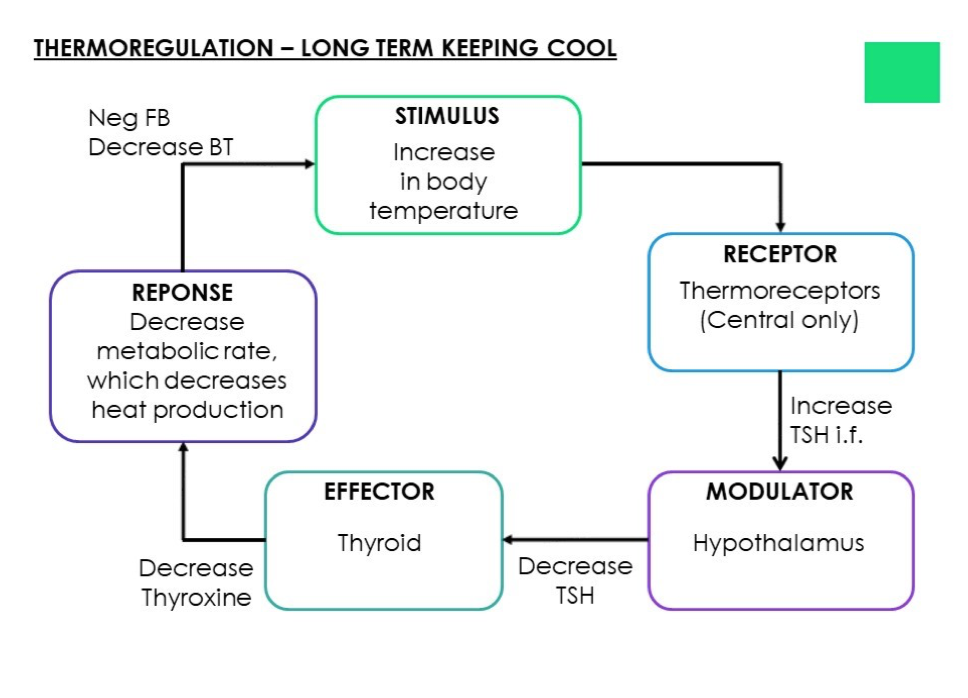
Decrease metabolic rate
Hypothalamus reduces secretion of TSH -> Thyroid decreases secretion of thyroxine -> Decreases metabolic rate -> Less heat produced.
Behavioural
Remove clothes, aircon, reduce physical activity, spread out (increase surface area).
Thermoregulation - Short term keeping cool
Thermoregulation - Long term keeping cool
Thermoregulation - Short term keeping warm
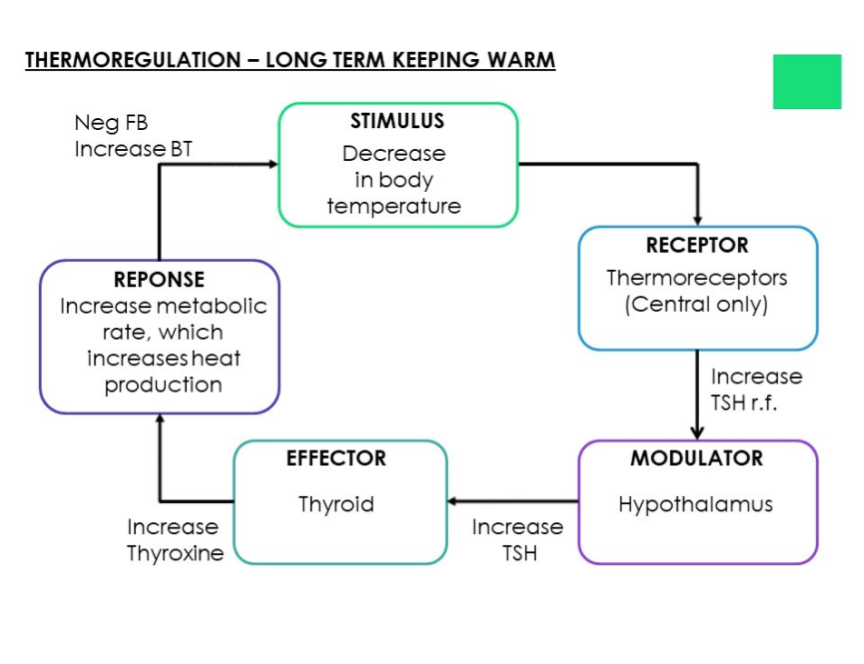
Thermoregulation - Long term keeping warm
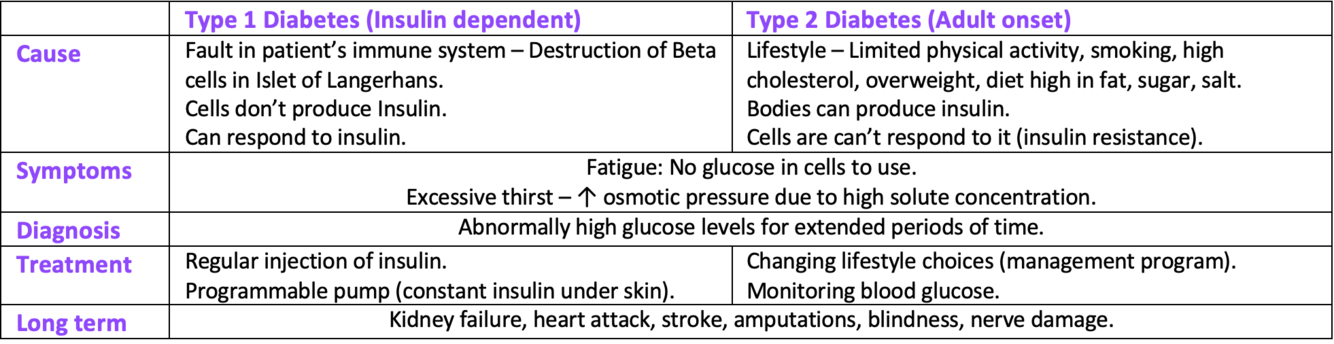
Diabetes
Cause
Symptoms
Diagnosis
Treatment
Long term
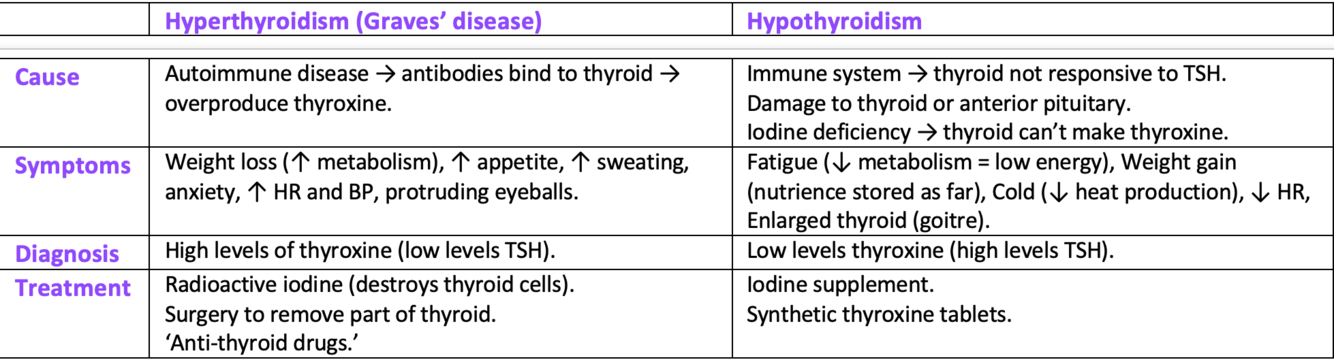
Thyroid disorders
Cause
Symptoms
Diagnosis
Treatment
Long term