How is hypertension defined?
Why is it difficult to define in absolute terms?
a state of chronically and abnormally high arterial blood pressure
- it has a skewed normal distribution so is difficult to define in absolute terms
- this means that HTN should be diagnosed with a range of readings and looking at the overall trend, rather than an isolated reading
Why is it important to identify patients with raised blood pressure?
- it is one of the most important and treatable causes of premature morbidity and mortality
- it is a major risk factor for cardiovascular disease
- it also is a risk factor for stroke, MI, heart failure, chronic kidney disease and cognitive decline
What is the prevalence of HTN?
1 in 3 adults in the UK
- it affects around 31% of men and 26% of women
Why can diagnosing HTN be difficult?
What are the consequences of this?
- HTN can often be asymptomatic
- in this case, diagnosis depends on clinician awareness and opportunistic measurements of BP
- 50% of people with HTN remain undiagnosed and are not receiving treatment
What are the risk factors associated with HTN?
- age
- sex
- women have a lower BP than men up to 65, then between 65-74 women have a higher BP
- ethnicity
- Black African and Black Caribbean at higher risk
- genetic factors
- social deprivation
- lifesytle
- smoking, excessive alcohol, excessive salt, obesity & lack of physical activity
- anxiety / emotional stress
- raises adrenaline and cortisol levels
What is ideal blood pressure and what blood pressure measurement is classed as hypertension?
What type of hypertension are patients assumed to have?
normal BP is < 120/80mmHg
- ranges of 120-140 mmHg for systolic and 80-90mmHg are considered high normal
- HTN is diagnosed with persistent systolic BP > 140mmHg and diastolic BP > 90mmHg or BOTH
- assumed to have essential (primary) HTN as secondary HTN is very rare
- this is HTN in the absence of any pathological cause
When might “white-coat” HTN be suspected?
- if there is a discrepancy of more than 20/10mmHg between clinic and average daytime ABPM / HBPM measurements
When might masked HTN be suspected?
- when clinic blood pressure measurements are normal (<140/90mmHg)
- but average HBPM / ABPM measurements outside the clinic are higher
What is meant by stage 1 HTN?
- clinic BP ranging from 140/90mmHg to 159/99mmHg
- AND subsequent ABPM daytime average of 135/85mmHg to 149/94mmHg
What is meant by stage 2 HTN?
- clinic BP of 160/100 mmHg or higher, but less than 180/120 mmHg
- AND subsequent ABPM daytime average of 150/95 mmHg or higher
What is meant by stage 3 HTN?
- clinic systolic BP of 180 mmHg or higher
- OR clinic diastolic BP of 120 mmHg or higher
After coming to the conclusion that the patient does NOT have HTN, what would you do depending if there is evidence of target organ damage?
Evidence of target organ damage:
- consider investigations to look for other causes of the damage
No evidence of target organ damage:
- repeat clinic blood pressure readings every 5 years
- consider repeating more frequently if clinic BP is close to 140/90mmHg
If someone is found to have high blood pressure in the clinic, what other investigations should be performed?
- a full cardiovascular examination - including peripheral pulses, auscultation for carotid bruits
- body mass index calculation
- fundoscopy
- dipstick urinalysis
- U&Es
If someone is found to have BP > 140/90mmHg in clinic, what should be the next steps?
- if BP >140/90 mmHg then take a second measurement during the consultation
- if the second measurement is substantially different from the first, take a third BP measurement
- record the lower of the last 2 measurements as the clinic BP
- if BP > 140/90mmHg and <180/120mmHg, then offer ambulatory BP monitoring (ABPM) to confirm diagnosis
- if ABPM is unsuitable, home BP monitoring (HBPM) is offered instead
What investigations would be performed to assess for target organ damage in a hypertensive patient?
this involves assessment of the heart, eyes and kidneys
Heart:
- 12-lead ECG to look for LV hypertrophy and signs of coronary heart disease
Eyes:
- fundoscopy to look for signs of hypertensive retinopathy
Kidneys:
- dipstick urinalysis to look for proteinuria and/or haematuria
- these are both signs of glomerular damage
- U&Es, creatinine clearance and eGFR to assess renal function
How would cardiovascular risk be assessed in someone with HTN?
this involves fasting blood glucose and lipid profile
- lipid profile measures the level of serum total cholesterol, HDL, LDL and triglycerides
- high concentration of fasting blood glucose indicates possible diabetes and increases the risk
- 10-year risk of developing CVD can be evaluated using QRISK tool
What is the treatment for stage 1 HTN?
(clinic BP 140/90 - 159/99 and ABPM 135/85 - 149/94)
- assess cardiovascular risk and target organ damage
- offer lifestyle advice
- start drug therapy in cases of increased CVD risk, target organ damage or no improvement
- consider specialist referral if patient <40 or HTN is resistant to treatment
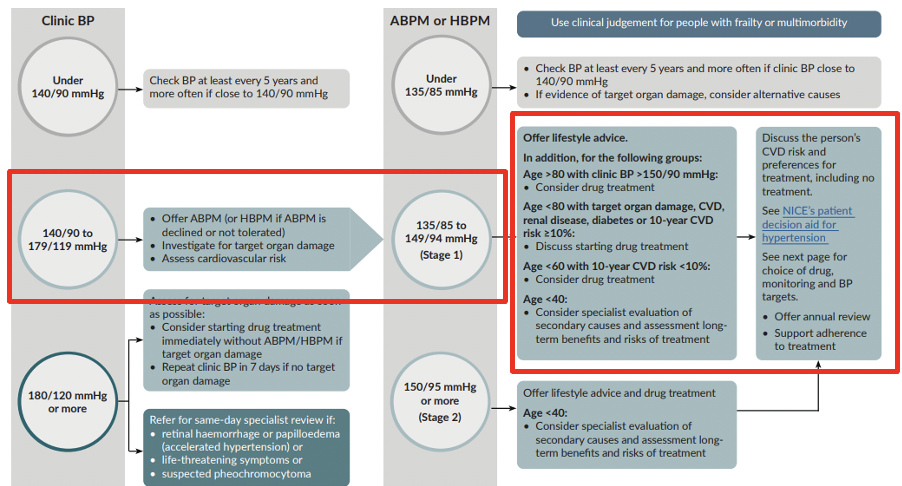
What lifestyle advice may be offered to someone with stage 1 HTN?
- improve diet - especially reducing salt intake to <6g / day
- reduce alcohol intake to no more than 3-4 units (men) or 2-3 units (women) daily
- smoking cessation
- weight loss and improvement in physical activity
- discourage excessive consumption of coffee / caffeinated beverages
What is the treatment for stage 2 HTN?
(BP > 160/100 and < 180/120 or > 159/95 ABPM)
- assess cardiovascular risk and target organ damage
- start drug therapy and advise on lifestyle interventions
- consider specialist referral if <40 or HTN is resistant to treatment
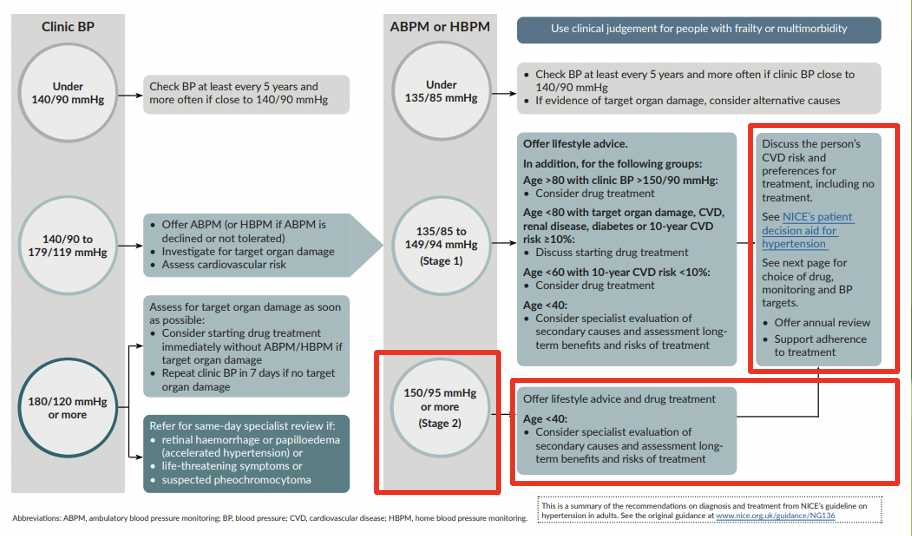
What is different in the treatment of stage 3 HTN?
- drug therapy is started immediately without ABPM or HBPM and regardless of target organ damage and CVD risk
How are BP targets different based on age?
- the aim of treatment is to gradually reduce and maintain BP at the target
Age < 80 years:
- clinic BP < 140/90mmHg
- ABPM < 135/85mmHg
Age > 80 years:
- clinic BP < 150/90mmHg
- ABPM < 145/85mmHg
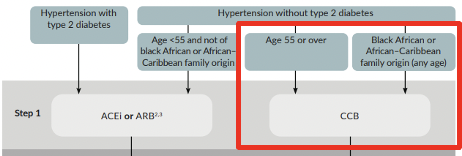
What is involved in the first step of pharmacological treatment for HTN?
- patients < 55 are started on an ACEi or ARB
- patients > 55 or who are black or of African or Carribbean heritage (any age) are started on a CCB
- patients with type 2 diabetes are started on a ACEi or ARB
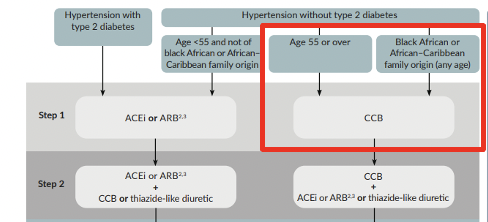
What is the involved in the second step of pharmacological treatment for HTN?
if patient is taking ACEi / ARB:
- add CCB or thiazide-like diuretic
if patient is taking CCB:
- add ACEi / ARB or a thiazide-like diuretic


-
Multimorbidity & Frailty48
-
Big 4 - Colorectal Cancer38
-
Big 4 - Breast Cancer41
-
Hypertension28
-
Diabetes65
-
Big 4 - Prostate Cancer34
-
Asthma50
-
COPD47
-
Chronic Kidney Disease63
-
Big 4 - Lung Cancer44
-
Oncological Emergencies76
-
Atrial Fibrillation52
-
Stroke & TIA50
-
Heart Failure49
-
Ischaemic Heart Disease30
-
Radiotherapy51
-
Inflammatory bowel disease / Irritable bowel disease67
-
GORD + Diverticulitis27
-
Eczema & Psoriasis32
-
Urology96
-
Acute Neuro23
-
Hyperthyroidism & Graves Disease41
-
Hypothyroidism & Hashimoto's Thyroiditis27
-
Osteoarthritis24
-
Rheumatoid Arthritis59
-
Carpal Tunnel Syndrome22
-
Gastroenteritis37
-
Peptic Ulcers13
-
Hepatitis40
-
Liver Cirrhosis56
-
Rarer Causes of Cirrhosis66
-
Parkinson's Disease40
-
Interpreting LFTs19
-
Septic & Reactive Arthritis10


