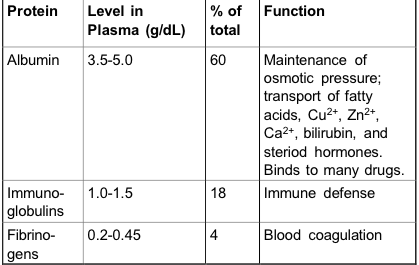
The 3 most abundant plasma proteins
Antigen
Any foreign molecule bound selectively by antibodies
Immunogen
Molecule (protein, carbohydrate, nucleic acid) that induces antibody production
Antigenic determinant/ epitope
Small region of a larger molecule (like a protein) that elicits the production of a specific antibody
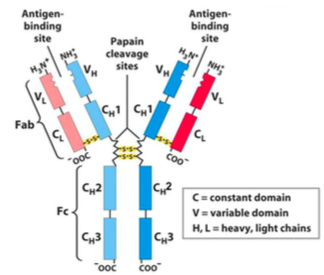
There are __ peptide chains in an antibody
___ holds the 2 heavy chains of an antibody together and a light chain to the heavy chain.
Within the ___ chain there are 3 constant domains and 1 variable domain.
4 peptide chains
Disulfide bonds.
The heavy chain has the 3 constant domains (CH1-CH3) and 1 variable domain (VH); defines the class of immunoglobulin
The light chain can be one of two types
lambda or kappa
Both have constant (CL) and variable (VL) regions
The variable domains from both the heavy and light chains all face to one end of the molecule and serve as
antigen binding sites to the specific epitopes
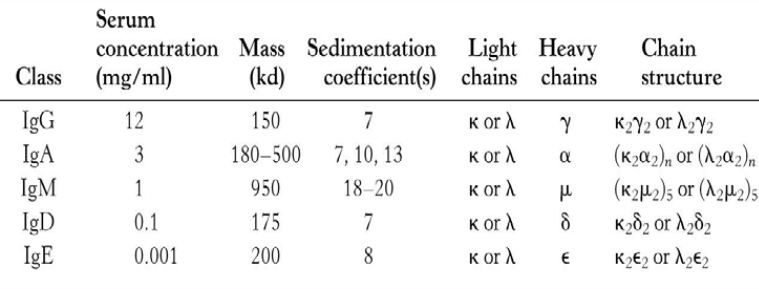
The five immunoglobulin classes GADEM all have different ___ chains.
Match the chain with teh class.
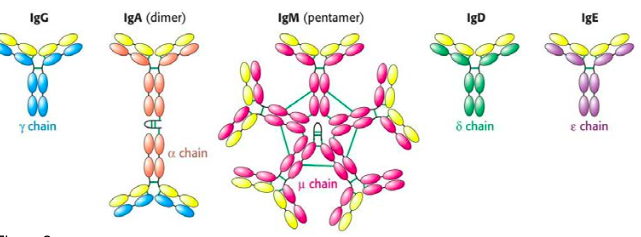
Which Igs contain multiples of the 2heavychain,2lightchain tetramer?
IgA is a dimer
IgM is a pentamer
The individual constant and variable domains are supersecondary structures.
Describe the Immunoglobulin fold in constant domains vs variable domains
Each domain is composed of B-strands that form anti-parallel B-sheets.
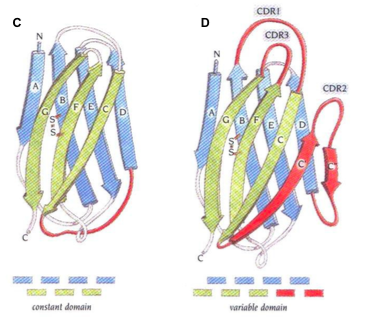
- Constant domains* - 7 strands held together in a 4-3 arrangement by hydrogen bonds or hydrophobic interactions between the R groups.
- Variable domains* - 9 strands held together in a 5-4 arrangement
Complementarity Determining Regions
What are they and where are they?
Area of hypervariable amino sequence that is complementary to the epitope; serve as antigen-binding sites.
In the variable region of antibody light and heavy chains; they’re in the loops that connect the antiparallel B strands (3 loops from light chain, 3 loops from heavy chain)
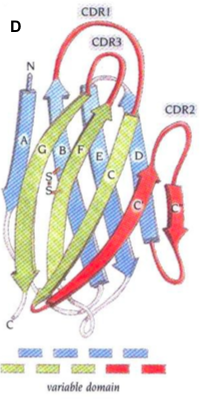
The combine dvariability of the 12 CDR sites from all 4 peptide chains provides the diversity for
antibody:epitope interactions
The regions between CDRs are called
Framework regions
Steps of an ELISA immunoassay
ELISA shows the quantitation of any protein in a sample
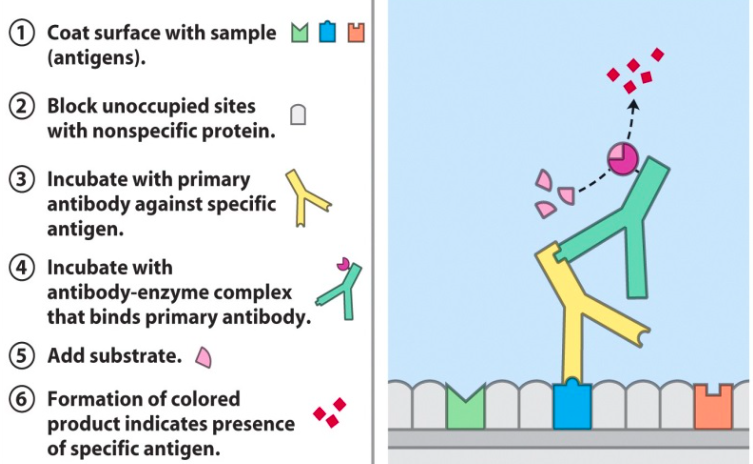
The primary antibody is specific for the protein/antigen of interest.
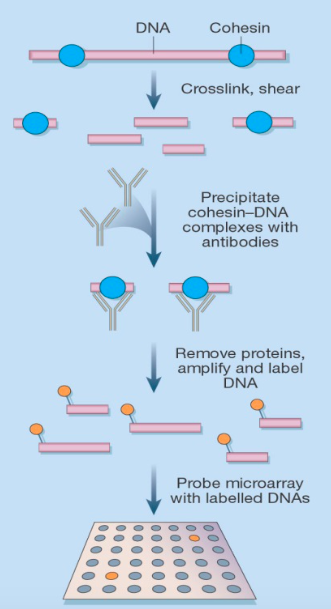
ChIP
Purpose & steps
- Purpose
- Demosntrates whether specific proteins are associated with specific regions on the genome
- Determines specific locations in the genome where epigenetic modifications occur
- Steps
- Crosslink protein to DNA
- Shear DNA into short pieces
- Use antibodies to immunoprecipitate proteins from the mixture
- Sequence the immunoprecipitated DNA
Polyclonal vs Monoclonal antibodies
Polyclonal antibodies are produced by B lymphocytes in response to antigens; it’s a range of different antibodies that recognize all the different epitopes on the target antigen.
- Occurs in your body all the time
Monoclonal antibodies: synthesized by a population of identical B lymphocytes in a cell culture all producing antibodies to only one epitope; it’s a homogenous antibody population that all recognize tehs ame epitope.
- Used for therapy against one epitope
Myelomas
- Cancer of plasma cells (B-lymphocytes that secrete Igs)
- Elevated Ca2+, renal failure, anemia, bone lesions (CRAB)
- Markers
- High serum [monoclonal antibody/Mprotein]
- Urinate Bence Jones protein (monoclonal light chains)
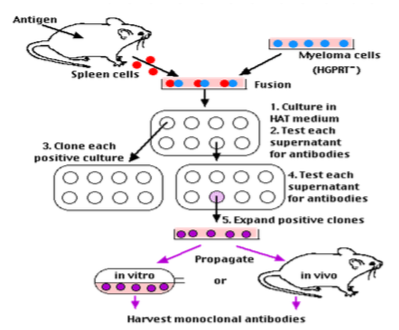
Producing monoclonal antibodies: how can cells making antibodies against one specific epitope be isolated from the rest of the B cells in the polyclonal population and also be made immortal (myeloma cells)?
- Inject an antigen into a mouse to produce a polyclonal population of antibodies against the antigen
- Remove and fuse the spleen cells with myeloma cells, which are engineered to be HGPRT negative (won’t grow in a HAT medium)
- Spleen cells that can’t fuse with myeloma cells will die because they are mortal; myeloma cells will die since they can’t grow in the HAT medium
- Only the hybridomas (antibody-producing spleen cells + immortal myeloma cells) can grow in the HAT medium
- Titrate the survivors so no more than 1 cell in a single well and let them grow.
- Assay the supernatant for an antibody against the antigen of interest and then clone –> monoclonal populations
Our monoclonal antibody may be very specific for the target epitope, but humans would hae an immune response to a mouse Ig.
how did we address this?
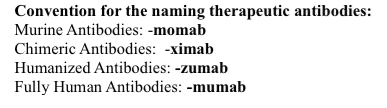
Chimeric monoclonal antibody: variable domain from mouse, but the rest is from humans
mouse hypervariable CDRs cloned in-frame to the human framework for both light and heavy chains
If something ends in -mab, what is it?
Monoclonal antibody .
A drug ending in -mab is an antibody-based therapeutic agent
Western blots / Immunoblots
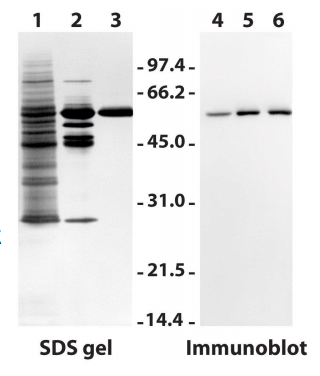
- Separate proteins on SDS gels
- Transfer to membrane
- Block membrane with nonspecific protein
- Incubate with primary antibody
- Incubate with antibody-enzyme that binds to primary antibody
- Add substrate
- Colored product precipitates on membrane where the specific protein is located
Most abundant plasma protein
albumin
Most abundant immunoglobulin in plasma
IgG
The antigen binds at the __ terminal of the antibody
N


-
Human Chromosome24
-
DNA Analysis and Technology18
-
DNA Replication, Damage, and Repair19
-
Gene Regulation15
-
Transcription and RNA Processing25
-
Translation and Protein Processing56
-
GPCR Signaling22
-
Single Pass Transmembrane Receptor Signaling29
-
End of CSB- Genetic recombination23
-
Actin/Cytoplasmic Filaments and Cell Motility35
-
Collagen35
-
Extracellular matrix38
-
Enzymes51
-
Microtubules41
-
Glycolysis54
-
Gluconeogenesis39
-
Glycogen Metabolism39
-
PDH & CAC57
-
ETC & Ox Phos34
-
Fatty Acids64
-
Lipoprotein complexes and cholesterol transport32
-
Hemoglobin and myoglobin23
-
Sickle Cell Anemia & Thalassemia24
-
Pentose Phosphate Pathway26
-
Immunoglobulins25
-
erythrocytosis9
-
ER-GOLGI TRAFFICKING AND ENDOCYTOSIS56
-
GLYCOBIOLOGY80


