Calculating new rates for existing product
- select target overall avg prem or RC
- finalize rating algorithm
- select final new rates for each RV
- select final additive amounts
- derive final base rate needed to achieve target prem
Expense Fees
- premium can be split into multiplicative and additive portions of rating algorithm
- multiplicative = base rate and all RVs
- additive = fixed expense fee
fixed expense fee per exposure
fixed expense per exposure/(1-V-Q)
deriving new base rate without rating factor changes
- can simply change base rate
- need to decide whether to change additive component or not
proposed BR = curr BR * (prop avg prem - prop add fee)/(curr avg prem - curr add fee)
deriving new base rate with rating factor changes
- EoE
- Approximated average rate differential
- Approximated change in average rate differential
EoE
- rerate all policies using all new rates and seed base rate then calc new base rate
- most accurate but requires detailed data and calculations
prop BR = seed BR * (prop avg prem - prop add fee)/(avg prem with see & new rate - prop add fee)
Approximated average rate differential
- calc proposed exposure-weighted avg rating factor then calc new base rate
- approximated by calc exposure weighted avg new rating factor for each RV and multiply them together
- less accurate since it ignores distributional bias between RVs
- can make more accurate by weighting by current variable prem at base levels
prop BR = (prop avg prem - prop add fee)/prop avg rating factor
Approximated change in average rate differential
- calc change in average rating factor instead of calculating factor directly and take inverse of this to get off-balance factor
- approximated by calc off-balance factor for each RV for which we are changing rates and mult together to get total off-balance
- less accurate than EoE
- takes less time since looking at only RVs that are changing
prop BR = curr BR * (prop avg prem - prop add fee)/(curr avg prem - curr add fee) *OBF
-can make more accurate by weighting by current variable prem at base levels
OBF
OBF=Πexposure weighted current rel i/Πexposure weighted proposed rel i
change in exposure-weighted avg relativity
change in exposure-weighted avg relativity = exposure weighted proposed/exposure weighted current-1
minimum premiums
-used to make prem for individual policy will cover expected fixed expenses and some minimal amount of expected losses
effect = (prem with min/prem without min)-1
-to approx. offset this prem impact, multiple BR by offset factor
BR offset = 1/(1+offset)
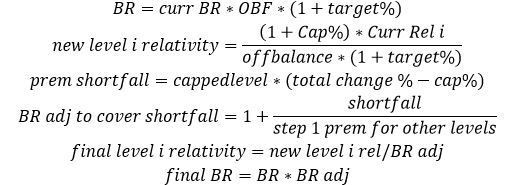
rate capping: non-base level
- lower factor for that level and then increasing BR to makeup for lost premium, then readjust factor for capped level downwards due to BR increase in order to maintain same capped amount
- relatibity adjustment is only for level being capped
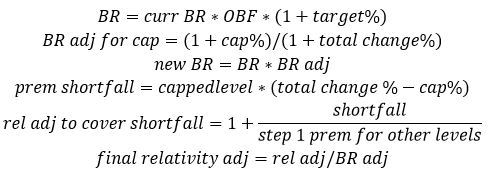
rate capping: base level
- lower base rate and then increasing factors for other levels to makeup for lost premium -> increase in other factors will have to make up for prem lost from cap and prem reduction from base rate decrease
- calc relativities for each non-base level using final rel adj (BL will remain at 1)
rate capping for 1 variable
-if want to cap impact of RC for single variable, need to make up any premium loss resulting from cap on other levels of variable to obtain same overall target prem
Expected Distribution used for RCs
-usually RCs are measures on impact to in-force OLP, if RCs result in change in MOB, it can alter total prem or profitability if profit varies by class
using competitor rates: adjusting competitor expense fee
FE: subject FE per exposure/competitor FE per exposure
using competitor rates: adjusting competitor BR and expense fee
VE: Competitor VPLR/subject VPLR
using competitor rates: adjusting BR
LCs: subject expected LC/competitor LC
shortcut for OBF
OBF = indicated chaenge factor for base level (using LRA)

-
Reserving - basics41
-
Reserving - other techniques39
-
Reserving - ALAE6
-
Reserving - ULAE18
-
other reserving8
-
Data, Profit, and Background23
-
Addressing an Imbalanced Fund Ins Eqn16
-
one time and continuous changes25
-
development and expenses20
-
CMP & risk classification17
-
univariate and multivariate25
-
special classifications32
-
credibility16
-
individual risk rating17
-
implementation19
-
errata27


