Han et al. 2013 made mice smarter, how?
Put human progenitor cells into mice
Produced human like astrocytes in mice
Mice performmed better in cognitive tests and showed enhanced long term potentiation of synapses (LTP) (mechanism underlying learning and memory)
What does long term potentiation (LTP) has an effect on?
learning and memory
Astrocyte functions
- homeostatic role
- ability to release NTs (gliotransmission)
- formation of astrocytic networks
Name of this synapse?
Three main parts?
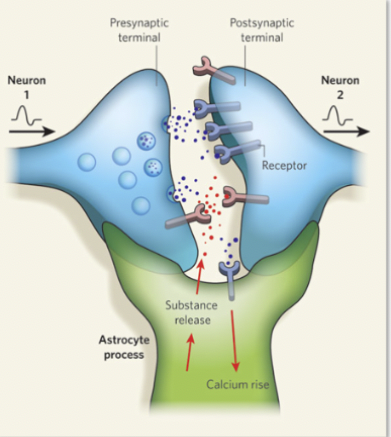
Tripartite synapse
Pre- and post-synaptic terminals
Astrocytic process
In synaptic activity, neurons release NTs and astrocytes response to these with an elevation of …?
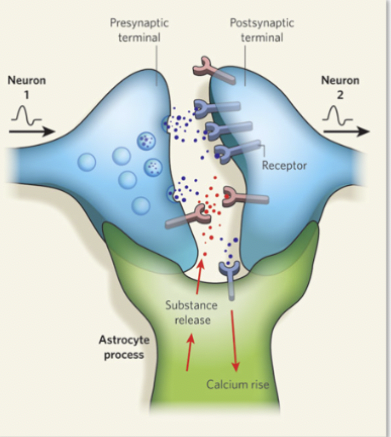
Calcium
When Ca++ increases, leads to a regulated release of gliotransmitters:
(4 main ones)
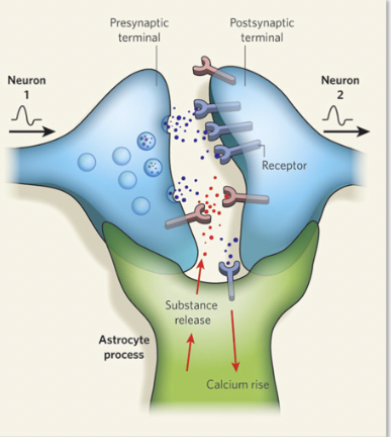
Glutamate
GABA
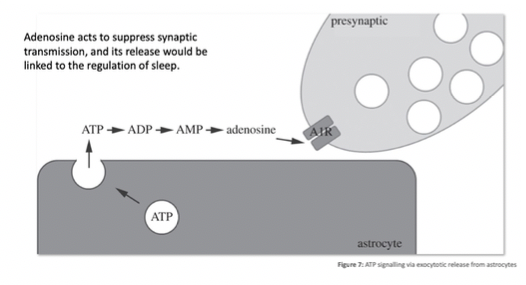
ATP - adenosine
D-serine
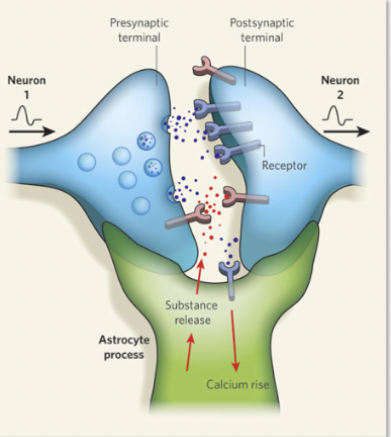
What are the consequences of astrocyte modulation at the tripartite synapse for brain function and behaviour?
memory, sleep regulation (these because of LTP)
cognition
- possible role in memory and sleep regulation
- modulates long term potentiation LTP, by strengthening of synaptic connectivity
- experiments in vivo support idea of astrocyte involvement in cognition
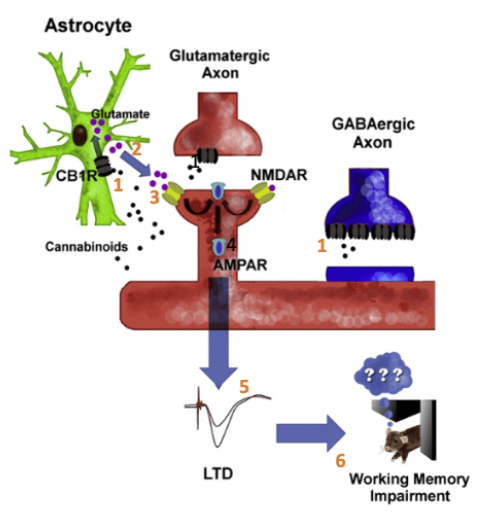
Han et al. 2012 gave cannabinoids to mice under some conditions.
What were the different conditions?
What were the effects?
Conclusion?
What is the most common effect of cannabinoid toxication in humans?
Groups of (mutant) mice lack type 1 cannabinoid receptor CB1R either in:
- astrocyte –> no memory loss (astrocytes functioning saved memory)
- glutamatergic axon –> memory loss
- GABAergic axon –> memory loss
Astrocytes play an important role in memory and cognition
[even more than glutamatergic and GABAergic neurons!]
In humans: short term memory loss
Astrocytes release ATP –> adenosine
What is the function of adenosine in synaptic transmission, and what does it regulate?
Regulates sleep homeostasis
Halassa ey al. 2009
Tested astrocyte sleep homeostasis in mice, how?
Adenosine accumulation provokes sleep
Adenosine antagonist, like caffeine, promotes wakefulness
Protein SNARE needed for exocytotic release. Mice lacking snare couldn’t release ATP and adenosine. Demonstrated that:
Astrocytes play an important role in sleep homeostasis and cognitive impairment associated with sleep loss
Astrocytes connect with other astrocytes with…?
Forming astrocyte …?
In this connection, two proteins can be found?
Allows intercellular communication, how?
Gap junctions
Astrocyte networks
Connexin - 30, Connexin -40
Allows ions and small molecules to passage.
Astrocyte gap junctions can be studied in transgenic animals with knocked out connexin 30 and 43. What is the consequence of this knock out?
Can’t form gap junctions - astrocyte networks


