How does the composition of breast change with aging and how is this related to imaging and ease of diagnosis?
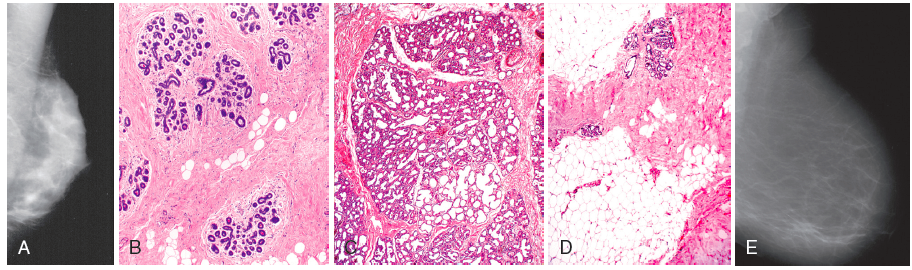
- Young women = ↑ fibrous interlobular stroma which appears radiodense or white on imaging; makes diagnosing tougher.
- Older women have ↑ adipose tissue, which appears more radiolucent and helps with the interpretation of images
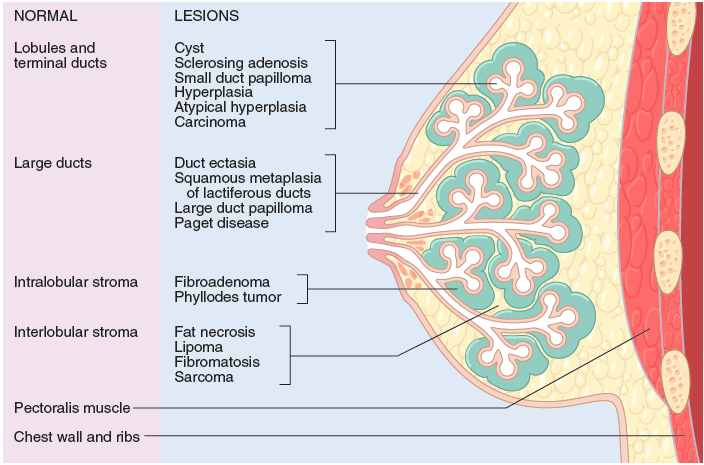
What 2 lesions of the breast arise in the intralobular stroma?
- Fibroadenoma
- Phyllodes tumor
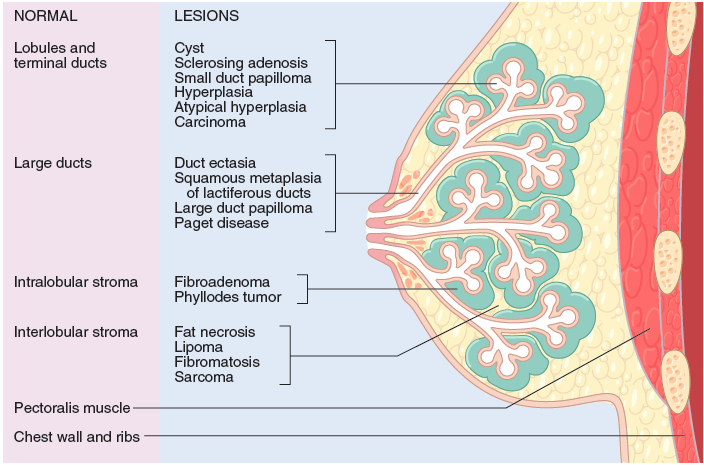
What 4 lesions can arise in the interlobular stroma of the breast?
- Fat necrosis
- Lipoma
- Fibromatosis
- Sarcoma
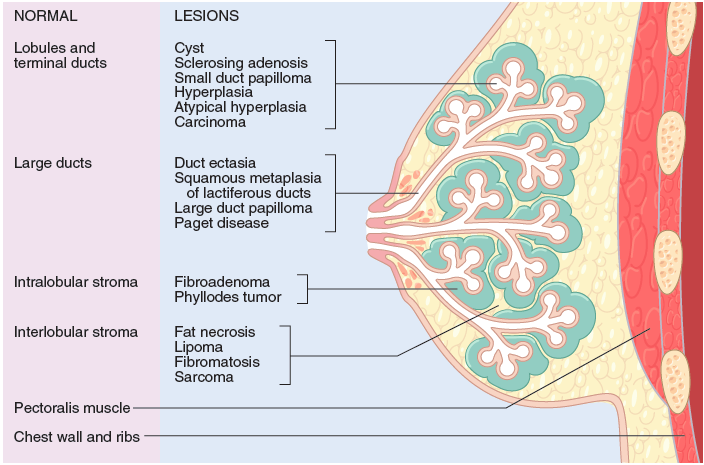
What 4 lesions can arise in the large ducts of the breast?
- Duct ectasia
- Squamous metaplasia of lactiferous ducts
- Large duct papilloma
- Paget disease
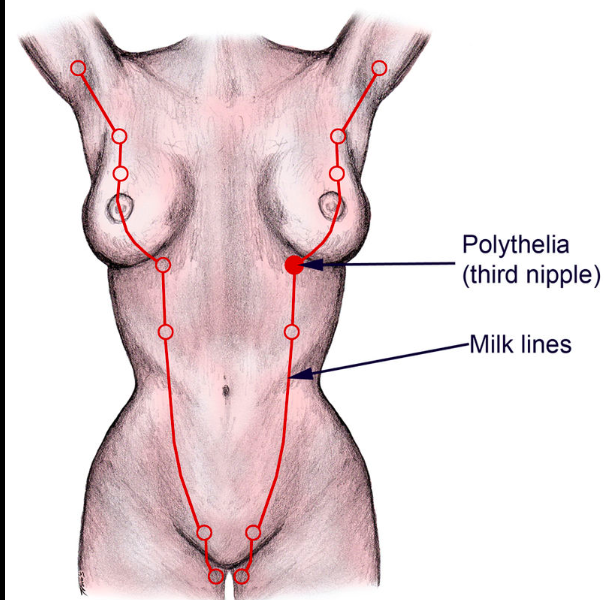
What are milk line remnants and how do they most commonly come to attention clinically?
- Supernumerary nipples or breast, anywhere from axilla –> perineum
- Present as painful PRE-menstrual enlargements
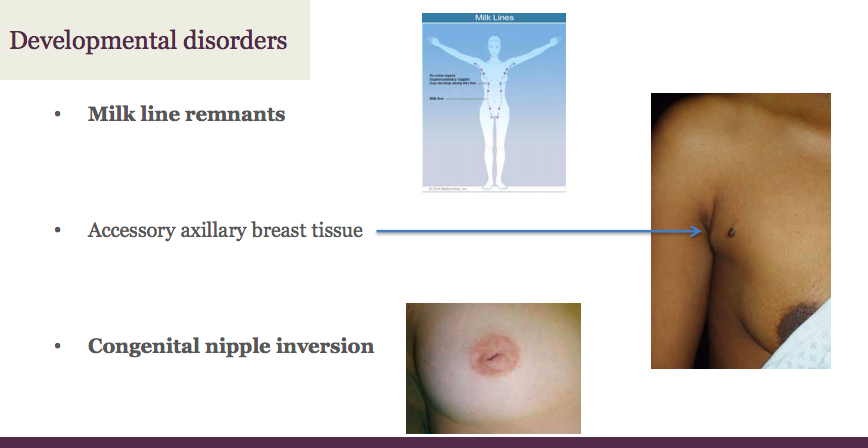
What is the clinical significance of accessory axillary breast tissue; managed how clinically?
- Potential site for malignancy or other lesions
- Prophylactic mastectomies ↓ risk, but do NOT completely eliminate
Why is acquired nipple inversion of greater concern than congenital?
May indicate presence of an invasive cancer or an inflammatory nipple disease
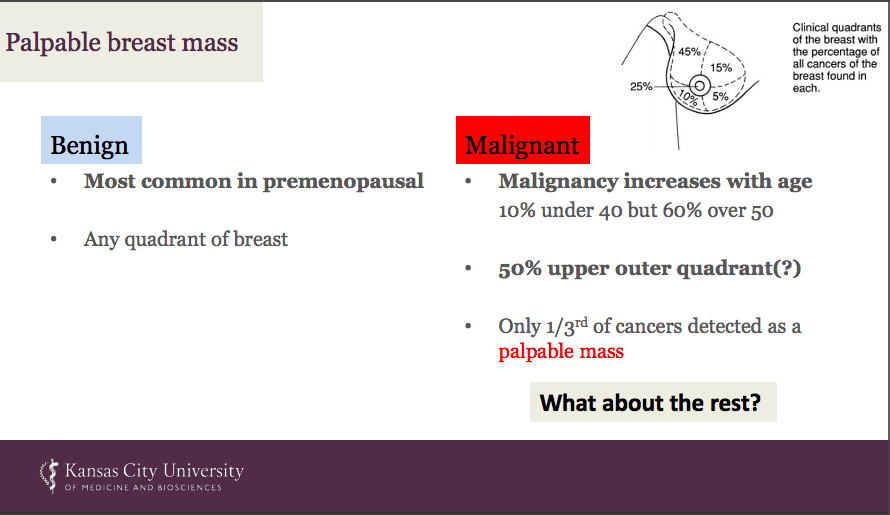
Palpable masses of the breast are most commonly due to what 3 etiologies?
- Cysts
- Fibroadenomas
- Invasive carcinoma
In what setting is nipple discharge most worrisome?
When spontaneous and unilateral; especially >60 y/o
What is the most common cause of bloody or serous discharge from th nipple?
Large duct papilloma
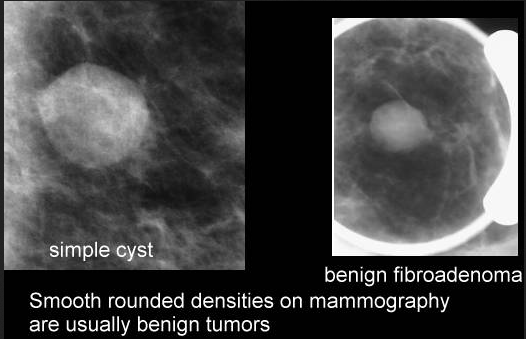
What characteristics of a density detected on mammogram is associated with benign vs. malignant lesions?
- Benign = rounded densities
- Malignant = irregular masses
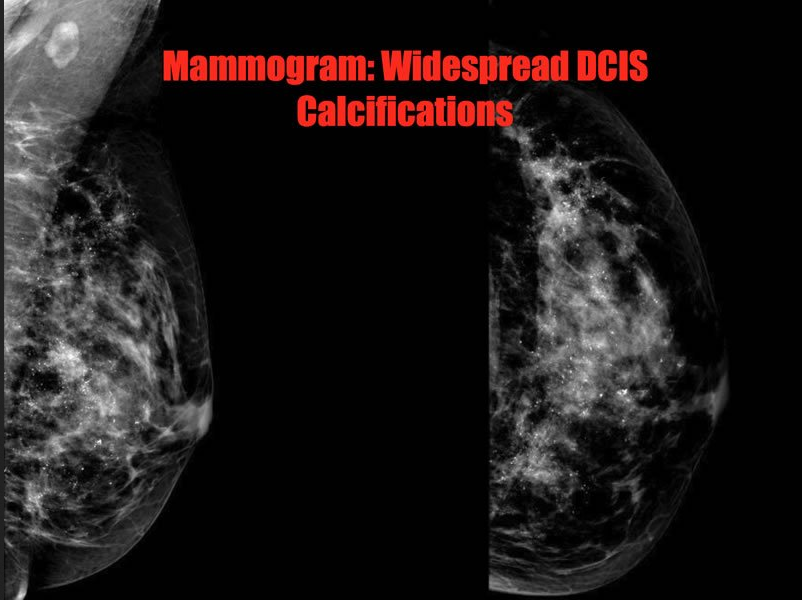
How is DCIS most commonly seen on mammograms?
Calcifications –> small, irregular, numerous and clustered
When does acute mastitis typically occur and what are the signs/sx’s?
- Typically during 1st month of breastfeeding
- Breast is erythematous and painful, and fever is common
Squamous metaplsia of lactiferous ducts (aka recurrent subareolar abscess, periductal mastitis, and Zuska) disease commonly presents with what signs and sx’s?
- Painful erythematous subareolar mass
- Inverted nipple
Risk factors for squamous metaplsia of lactiferous ducts (aka recurrent subareolar abscess, periductal mastitis, and Zuska) include?
- Smoking
- Vitamin A deficiency
What are the key morphological features of squamous metaplsia of lactiferous ducts (aka recurrent subareolar abscess, periductal mastitis, and Zuska)?
- Keratinizing squamous metaplasia of nipple ducts
- Intense chronic granulomatous inflammation
What are the distinguishing features, signs and sx’s of duct ectasia?
- Palpable periareolar mass w/ thick, white nipple secretions and occasionally skin retractionb
- NO pain or erythema!
Duct ectasia most commonly occurs in which age group and what is a risk factor?
- Women 40-60 y/o
- Usually multiparous (birthed more than one child)
In duct ectasia the ectatic ducts are filled with inspissated secretions and numerous what?
Lipid-laden macrophages
What is the common clinical presentation of fat necrosis of the breast and what is a risk factor?
- Painless, palpable mass + skin thickening or retraction
- May also have mammographic densities or calcifications
- 50% of women have hx of breast trauma or prior surgery
How does lymphocytic mastopathy (aka sclerosing lymphocytic lobulitis) most commonly present; associated with what underlying disorders?
- Single or multiple HARD palpable masses or mammographic densities
- Most common in women w/ T1DM or autoimmune thyroid disease
- Autoimmune basis
What are the 3 principal morphological changes associated with nonproliferative breast changes (fibrocystic change)?
- Cysts
- Fibrosis
- Adenosis
How can a FNA of a cyst associated with nonproliferative breast changes help confirm the diagnosis?
Dissapearance of the mass after FNA of its contents
The nonproliferative breast change, adenosis, is defined as what; and is a normal feature seen in which women?
- ↑ in the number of acini per lobule
- Normal feature of pregnancy


-
Lecture 1: Ante- and Perinatal Pharm54
-
Lecture 7: MHT/SERMS30
-
Lecture 9: The Breast100
-
Lecture 5: Normal and Abnormal Breast Exam30
-
Lecture 2: Pap Smear, Cervical Dysplasia, Cancer27
-
Lecture 10: Early Pregnancy Loss, Ectopic, and Rh Isoimmunization57
-
Lecture 11: Normal Pregnancy: Antepartum Care43
-
Lecture 13: Fetal Heart Monitoring28
-
Lecture 12: Normal Labor and Delivery35
-
Lecture 7.1: Vulva, Vagina, and Cervix63
-
Lecture 7.1: Body of th Uterus and Endometrium100
-
Lecture 8: Fallopian Tubes and Ovaries101
-
Lecture 8.1: Gestational and Placental Disorders57
-
Lecture 14: Medical Conditions in Pregnancy40
-
Lecture 17: HTN disorders in pregnancy19
-
Lecture 18: Dysf. Labor Uterine Contractility and Dystocia29
-
Lecture 19: Multfetal Gestation and Malpresentation30
-
Lecture 20: Obstetric Hemorrhage and Puerperal Sepsis43
-
Lecture 8: Benign and Malignant Conditions of the Vulva and Vagina35
-
Lecture 9: Benign Conditions of Uterus, Cervix, Ovary and FT's43
-
Lecture 16: Obstetrical Complications22
-
Lecture 15: Operative Delivery18
-
Lecture 6: Puberty, Disorders of Development, Menstrual Disorders I & II64
-
Lecture 4: Pelvic Relaxation and Incontinence10
-
Lecture 3: Contraception and Sterilization45


