Motor System Hierarchy
Basic definitions
Functional segregation
•Motor system organised in a number of different areas that control different aspects of movement
Hierarchical organisation
- high order areas of hierarchy are involved in more complex tasks (programme and decide on movements, coordinate muscle activity)
- lower level areas of hierarchy perform lower level tasks (execution of movement)
Lower level = spinal cord -‐ this is mainly involved in reflex movements (Rest of the body)
Level 2 = Brainstem
This is the centre of integration of different inputs coming from the vestibular system, the vision system and the auditory system (face and neck)
Level 3 = Motor Cortex
This consists of the:
Primary Motor Cortex
Premotor Cortex
Supplementary Motor Area
This is where the movements are programmed and where the voluntary movements are initiated
Level 4 = Association Cortex
This contains the parietal and frontal cortex
This is not, strictly speaking, part of the motor pathway, but it influences the planning and execution of movements
Spinal motor tracts: summarise the functional organization of the spinal cord (motor tracts) distinguishing between its two pathways
There are TWO main parts of the Pyramidal (descending) System:
Corticobulbar Tract -‐ starts in the cortex, then exits and innervates the muscles in the face
Corticospinal Tract -‐ starts in the cortex and innervates the muscles of the arms and legs
- The descending pathway has two side loops and these go to the basal ganglia and cerebellum
- Analogy -‐ if you imagine that the motor command to perform an action is at the roof, it has to take a lift to go all the way down to the ground floor for the muscle to accomplish an action. While the information travels down it stops at different levels: cerebellum and basal ganglia
- At the cerebellum and basal ganglia the information gets checked and approved
- If it is the correct information, the command reaches the muscles and the action is performed
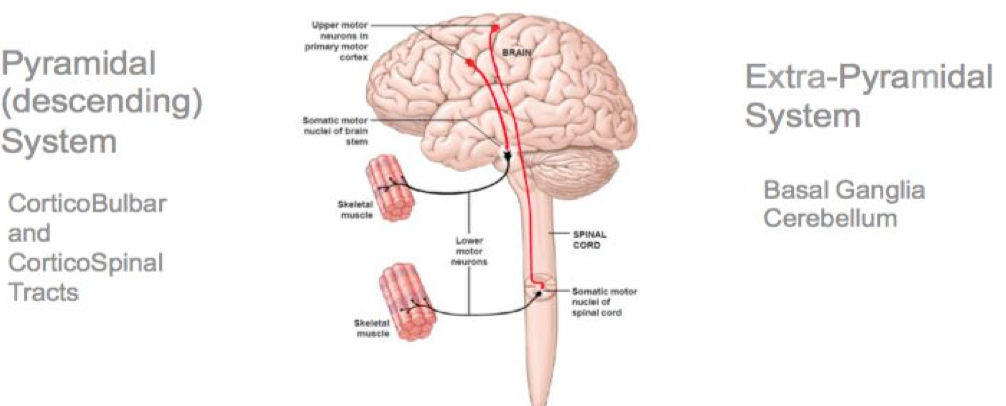
Corticospinal tracts: discuss the anterior corticospinal pathways
Descending Motor Pathways
The descending pathways are divided into two based on their functions
Lateral Pathways
- Lateral corticospinal tract
- Reticulospinal tract
If you follow the corticospinal and corticobulbar tracts from where they originate to the muscles, they follow this route
- They start in the primary motor cortex (Betz cells), they descend and go through the brainstem all the way down (in the pons they are not visible)
- The cross over to the other side at the medulla oblongata at the pyramidal decussation
- Once they cross over they continue all the way down the spinal cord
- They synapse with a lower motor neurone and exit the spinal cord into a peripheral nerve to reach the skeletal muscle
- This is the pattern of innervation for the arms, legs and trunk
- The pathway for the corticobulbar tract is somewhat similar
- The upper motor neurons start in the motor cortex then they go down into the brainstem and they synapse with a second motor neurone and they exit to the muscles of the face
- 90% of fibers that cross over form the lateral corticospinal tract
- They control mainly the distal musculature
RUBROSPINAL Tract
- Originate in the RED nucleus of the midbrain
- It is an alternative by which voluntary motor commands can be sent to the spinal cord
- So if there is a lesion to the primary motor cortex then the body can still compensate and other descending tracts get activated and this is what the rubrospinal tract is meant to do
- It has a role in movement velocity
- A lesion in the rubrospinal tract will result in voluntary movements being a lot slower
Lateral functions:
- Control of proximal and distal muscles
- Voluntary movements of arms and legs
Corticospinal tracts: discuss the medial corticospinal pathways
Medial pathways:
- Vestibulospinal tract
- Reticulospinal tract
- Tectospinal
- Anterior corticospinal tract
Function:
- Control of axial muscles
- Balance and posture
Lateral and Medial Vestibulospinal Tract
- Lateral originates in the lateral vestibular nucleus (brainstem)
- Medial originates in the medial vestibular nucleus
- They mediate postural adjustments and head and eye movements
NOTE: these tracts are named based on where they originate and where they travel from e.g. corticospinal -‐ originate in the cortex and travel through the spinal cord
Pontine and Medullary Reticulospinal Tract
Both originate in the brainstem’s reticular formation
They go down the brainstem to the spinal cord they then go out of the spinal cord and innervate muscle is involved in complex actions:
- Orienting
- Stretching
- Maintaining a complex posture
Tectospinal Tract
- Originates in the superior colliculus (brainstem)
- Function unknown
- Most likely to be involved in reflexive turning of the head to orient to visual stimuli
Anterior Corticospinal Tract
- Originates in the cerebral cortex
- Control of proximal musculature
- NOTE: the 90% of the axons that do cross make up the lateral corticospinal tract
- The anterior corticospinal tract fibres cross over at the level of the spinal cord
Discuss Somatotopical Organisation
This is called Penfield’s Motor Homunculus
- In the motor cortex there is a representation of the muscles of different parts of the body
- IMPORTANT: the more we use a muscle, the bigger the representation of that muscle in the cortex
- The motor homunculus is very distorted because different parts of the body get used more than other parts
- This is different in all of us -‐ the cortical representation of the hand in a child is much smaller than that of a pianist
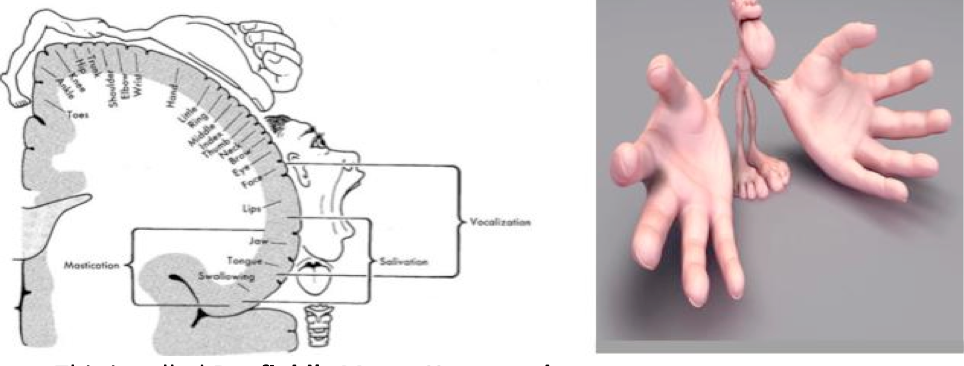
Motor cortex: recall the location and organisation of the primary motor cortex; explain the role of the premotor cortex and supplementary motor area
Motor Cortex
There are THREE parts to the motor cortex that are found in the frontal lobe
They are anterior to the central sulcus
- Primary Motor Cortex or M1 -‐ Broadmann’s Area 4
- Premotor Cortex -‐ Broadmann’s Area 6
- Supplementary Motor Area -‐ Broadmann’s Area 6
1. Primary Motor Cortex
Broadmann’s area 4:
- Location: frontal lobe, on precentral gyrus, anterior to the central sulcus
- Function: control fine, discrete, precise voluntary movement + Provide descending signals to execute movements
- Anterior cerebral artery – vasculature: stroke
The most important cells in the primary motor cortex are the BETZ CELLS
- These are also called pyramidal cells
- They are located in the 5th layer in the grey matter
- The corticospinal tracts originate from here
2. Premotor cortex
- Location: frontal lobe anterior to M1
- Function: planning of movements
- Regulates externally cued movements
e.g. seeing an apple and reaching out for it requires moving a body part relative to another body part (intra-personal space) and movement of the body in the environment (extra-personal space)
3. Supplementary motor area
- Location: frontal lobe, anterior to primary motor cortex (medially)
- Function:
- planning complex movements; programming sequencing of movements
- Regulates internally driven movements (e.g. speech)
- SMA becomes active when thinking about a movement before executing that movement
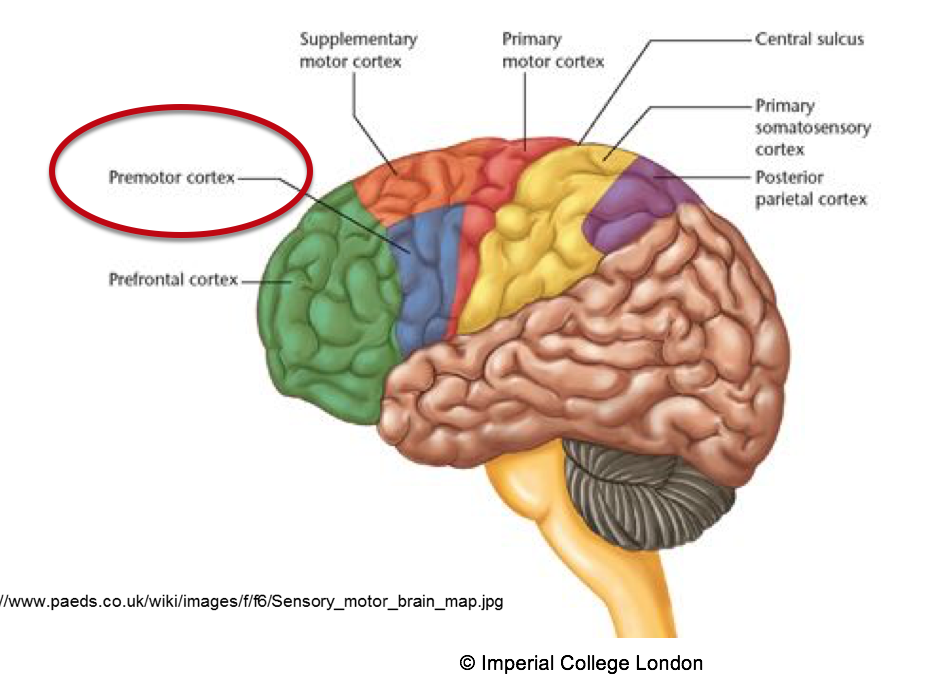
Discuss the association cortex and its function
Association Cortex
- Brain areas that aren’t strictly motor areas because their activity does not correlate with motor output/act
- This is the highest level in the hierarchy
- Association cortex is everything that isn’t motor cortex
- They aren’t motor cortex because they don’t have any upper motor
- neurones but they are important because they feedback to the motor cortex and they ensure that movements are targeted accurately to objects in the external space
- So the motor cortex gives the commands and all other cortical areas help
- in producing smooth movements
- The association cortex has TWO main components:
- Posterior Parietal Cortex -‐ ensures movements are targeted accurately to objects in external space
- Prefrontal Cortex -‐ involved in the selection of appropriate movements for a particular course of action
Recognize the different types of motor neurons
- Lower motor neuron
Spinal cord, brainstem - Upper motor neuron
Corticospinal, corticobulbar - Pyramidal
Lateral corticospinal tract - Extrapyramidal
Basal ganglia, cerebellum
Upper motor neurone lesions: recognise the signs and symptoms of upper motor neuron lesions
Caused by:
- Cerebral infarction
- Corticospinal tract
Initially you get loss of function (‘negative signs’)
This leads to:
- Paresis = graded weakness of movement
- Paralysis (plegia) = complete loss of muscle activity
After a few weeks of having this lesion you will get increased abnormal motor function (‘positive signs’)
This is due to the loss of inhibitory descending inputs
This results in:
- Spasticity = increased muscle tone
- Hyperreflexia = exaggerated reflexes
- Clonus = abnormal oscillatory muscle contraction
Babinski’s Sign = very important sign of an upper motor lesion. If you stroke the plantar side of the foot, the toes will flex and the big toe will also flex (in a normal subject) but after upper motor neurone lesions the toes will fan and the big toe will go up
Also called the extensor plantar response
NO muscle atrophy
You will have muscle disuse but this will only lead to partial atrophy
This is because it’s the lower motor neurones, exiting from the spinal cord that bring nutrients to the muscle
So in upper motor neurone lesions you will NOT see atrophy
NOTE: with upper motor neurone lesions you will see the effects on the contralateral side of the body
Apraxia
A disorder in skilled movement NOT caused by weakness, abnormal tone or posture or movement disorders (tremors or chorea)
Patients are NOT paretic (partial motor paralysis) but have lost information about how to perform skilled movements
This is not because they’ve lost motor command to the muscle but is instead because they have lost the information on how to perform the skilled movements
This happens with lesions of the inferior parietal lobe and the frontal lobe (premotor cortex and supplementary motor area)
Any disease of these areas can cause apraxia, but stroke and dementia are the most common causes
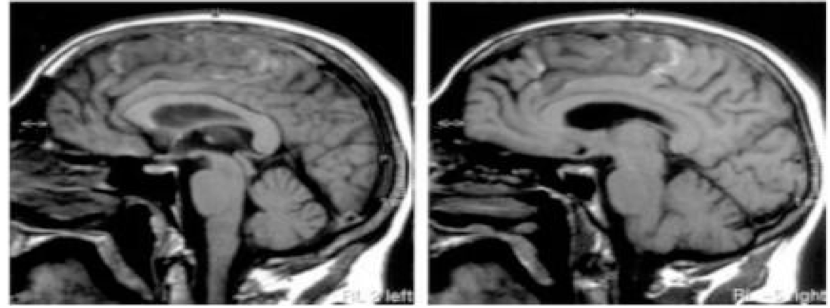
- MRI of a person who suffered a bilateral supplementary motor area infarct
- The motor command from the primary motor cortex is still there but this person will have apraxia
- They will not be able to perform coordinated movement
Lower motor neurone lesions: recognise the signs and symptoms of lower motor neuron lesions
(not a learning outcome)
Lower Motor Neurone Lesion
Affects the second motor neurone (the one that starts in the grey matter of the spinal cord and exits to form peripheral nerves)
Lower motor neurone lesions have the opposite set of signs to upper motor neurone lesions
- Hypotonia (reduced muscle tone)
- Hyporeflexia (reduced reflexes)
- Muscle Atrophy -‐ the metabolic trophic support to the muscle is lost
- Fasciculations -‐ damaged motor units produce spontaneous action
- potentials, resulting in a visible twitch
- Fibrillations -‐ twitch of individual muscle fibres -‐ these aren’t visible to the naked eye but can be recorded if the patients have needle electromyography
Motor neuron disease: summarise the pathophysiology of motor neuron disease
Motor Neurone Disease
Progressive neurodegenerative disorder of the motor system -‐ it is a spectrum of disorders
MND can affect only upper motor neurones, only lower motor neurones or both
When MND affects both upper AND lower motor neurones it is called Amyotrophic Lateral Sclerosis (ALS)
Symptoms:
Upper motor neuron signs
- Increased muscle tone (spasticity of limbs and tongue)
- Brisk limbs and jaw reflexes
- Babinski’s sign
- Loss of dexterity
- Dysarthria
- Dysphagia
Lower motor neuron signs
- Weakness
- Muscle wasting
- Tongue fasciculations and wasting
- Nasal speech
- Dysphagia
Why dysphagia?
- Innervation of the tongue starts in the motor cortex
- The upper motor neurone synapses with the lower motor neurone which is the hypoglossal nerve
- These neurones will have degenerated resulting in dysarthria and dysphagia
- fasciculations as a sign of lower motor neurone disorder and it will also be spastic -‐ the tone will increase as a sign of upper motor neurone lesion
Neuromuscular junction: recall the structure and function of the neuromuscular junction
Transmission across synapses
- The membrane potential of the post synaptic neurone can be altered in two directions by inputs
- It can be made be made less negative (brought closer to the threshold for firing) -‐ this is an excitatory post-‐synaptic potential (EPSP)
- Or it can be made more negative (hyperpolarised) -‐ this is an inhibitory post-‐ synaptic potential (IPSP)
- You get GRADED effects -‐ whether the post-‐synaptic neurone fires or not is dependent on the summation of the various inputs
Activation of the neuromuscular junction: Similar to normal synaptic junction but with a muscle
- A NMJ is a specialised synapse between the motor neurone and the motor end plate on the muscle fibre cell membrane
- Acetylcholine gets released from the presynaptic cell when the SNARE proteins interact with the membrane (they are involved in the amalgamation of the vesicle membrane with the presynaptic membrane)
- Calcium influx triggers the acetylcholine release
- If you record the membrane potential across the muscle fibre, you can see that at any one point there are small changes in membrane potential
- These are NOT action potentials but rather just small changes in membrane potential that happens as vesicles are constantly dumping their contents into the synaptic cleft
- These are called miniature end plate potentials (mEPP)
Motor neurons: summarise the organisation of alpha motor neurons within the spinal cord
Alpha Motor Neurones
- These are also called ventral horn cells, anterior horn cells or lower motor neurones
- They innervate the extrafusal muscle fibres of the skeletal muscle
Intrafusal = skeletal muscle fibres that serve as specialised sensory organs (proprioceptors) that detect the amount and rate of change in length of a muscle
Extrafusal = standard skeletal muscle fibres that are innervated by alpha motor neurones and generate tension by contracting, thereby allowing for skeletal muscle movement
- Activation of alpha motor neurones causes skeletal muscle contraction
- There are coiled, spring like sensory receptors in the muscle called spindles that, when stretched, feedback to the CNS and allows an excitatory reflex to be generated which is what you want when your patella ligament gets hit by a tendon hammer
Motor Neurone Pool = collection of lower motor neurones that innervate a single muscle
Arrangement of alpha motor neurones
They are found in the anterior/ventral horn of grey matter
-Somatotopic – extensor and flexor muscles
Flexors = flex the muscles and allow you to curl up into a ball DORSAL
Extensors = allow you to be as tall and long as possible VENTRAL
They have some kind of arrangement within the ventral horn
Motor units: define the term “motor unit” and compare different types
Motor Unit
IMPORTANT: one alpha motor neurone can innervate SEVERAL muscle fibres
But it is also important to note that every muscle fibre is only innervated by ONE ALPHA NEURONE
So the muscle fibres innervated by the pink fibre can NOT also be innervated by the blue fibre
However under pathological conditions, e.g. when a nerve has been cut, the axon can sprout and being to innervate muscle fibres that are already innervated by other motor neurones
Motor Unit Definition: a single motor neurone together with all the muscle fibres that it innervates. It is the smallest functional unit with which to produce force.
The number of muscle fibres innervated by a single alpha motor neurone varies and is reflected by the function of the muscle
Muscles in the EYE have a low innervation ratio (number of fibres innervated by a single motor neurone) because this needs to be finely
controlled
If loads of muscle fibres are innervated by a single motor neurone, then
when that motor neurone fires, ALL of the muscle fibres will contract
The quadriceps do not need a low innervation ratio because you want POWER from this muscle rather than delicate control
Humans have around 420,000 motor neurones and 250,000,000 muscle fibres
On average each motor neurone supplies about 600 muscle fibres (but this is a useless calculation because the innervation isn’t even)
Types and properties of motor units
Types of Motor Unit
- This is talking about the functional properties of the different motor units
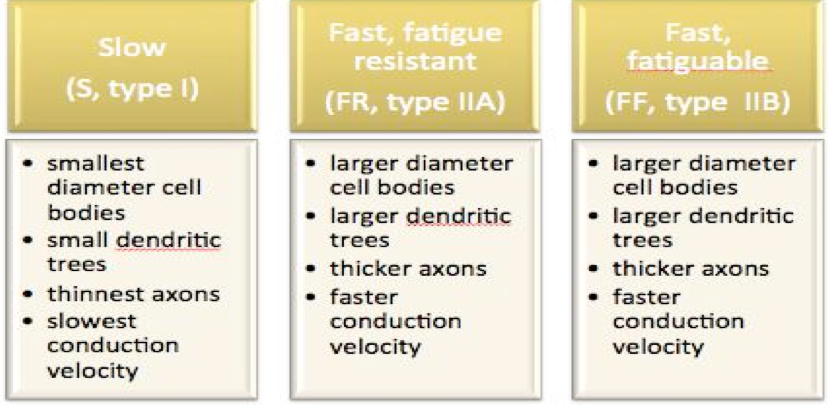
- We have SLOW and FAST muscles
- Slow muscles don’t produce much force but they can work for a long time
- Postural muscles are mainly slow muscles (e.g. soleus)
- Fast muscles are further subdivided into:
Fast Fatigue Resistant (Type 2a)
Fast Fatiguable (Type 2b)
The alpha motor neurones that innervate these different types of muscle have specific characteristics (listed above)
Thicker axon = faster conduction velocity
In terms of distribution, specific types of muscle fibre aren’t grouped into specific areas, they are fairly spread out
Properties of Motor Units
If you stimulate a slow muscle fibre you will find that it will generate its peak force much more slowly than the fast fibres
Fatigue resistant muscles produces more force than the slow fibres and the force is produced more quickly
Fatiguable -‐ this produces a LOT of force and does this very quickly but it also gets fatigued very easily
NOTE: the y axis for force is measured as a percentage of maximum voluntary contraction (MVC) which allows normalisation of the data
Regulation of muscle force
Two mechanisms by which the brain regulates the force that a single muscle can produce.
Recruitment: recruiting more motor units (smaller units (generally slow twitch) are recruited first)
- Motor units are not randomly recruited. There is an order to this.
- Governed by the “Size Principle”. Smaller units are recruited first (these are generally the slow twitch units).
- As more force is required, more units are recruited.
- This allows fine control (e.g. when writing), under which low force levels are required
Rate coding: changing the frequency with which you send action potentials down the nerves
- A motor unit can fire at a range of frequencies. Slow units fire at a lower frequency.
- As the firing rate increases, the force produced by the unit increases.
- Summation occurs when units fire at frequency too fast to allow the muscle to relax between arriving action potentials.
Neurotrophic Factors
There are a whole host of factors that are produced within the nerve and are transported throughout the nerve to maintain the nerves integrity and function
These are neurotrophic factors
They are a type of growth factor and they prevent neuronal death
They promote the growth of neurons after injury
CNS neurones don’t regenerate after injury unlike peripheral nerve -‐ the explanation is that in the CNS you have millions of axons as opposed to a few thousand so the consequences of rewiring incorrectly is not worth it
Effect of Neurotrophic Factors
A slow muscle was taken and the alpha motor neurone that innervated it was removed and transplanted into a fast muscle
So the slow nerve was transplanted to the fast muscle and vice versa
After allowing a few weeks recovery, he stimulated the fast nerve that was supplying the previously slow muscle and noticed that it started to become** **fast
And the previously fast muscle was starting to become slow
He reasoned that the action potentials can’t be the only thing being delivered to the muscle
There must be something else that the nerve is doing the governs the way the
Spinal motor tracts: summarise the functional organisation of the spinal cord (motor tracts)
Corticospinal/Pyramidal Tract = voluntary movement pathway
It is called corticospinal because it goes from the motor cortex to the spinal cord
NOTE: there is only one synapse between the brain and the big toe -‐ the upper motor neurone crosses over at the pyramidal decussation and synapses with a lower motor neurone in the ventral horn of grey matter. The lower motor neurone then projects out of the spinal cord and joins with a sensory nerve coming in to form a peripheral nerve
There are a lot of extrapyramidal tracts that are concerned with automatic movements in response to stimuli
There are lots of movements that your body makes without you being aware of it e.g. postural movements to prevent you from falling
There is some somatotopic arrangement within the corticospinal tract -‐ the letters relate to the part of the spinal cord i.e. L = lumbar
Spinal reflexes: recognise a range of spinal reflexes, including stretch reflex, flexion / withdrawal reflex, crossed extension reflex); distinguish hypo- and hyperreflexia; explain the concept of supraspinal control of reflexes
A reflex is an automatic and often inborn response to a stimulus that involves a nerve impulse passing inward from a receptor to a nerve centre and then outward to an effector (as a muscle or gland) without reaching the level of consciousness
The magnitude and timing of the coordinated muscle contraction and relaxation is determined by the intensity and onset of the stimulus E.g. if the biceps were tapped, the reflex occurs quickly and is related in size to how hard the biceps were hit
- Differ from voluntary movements in that once they are released, they can’t be stopped
- Important for maintaining upright posture and for reducing damage to parts of the body
Reflex Arc
If there is any indication that there might be some damage to the central or peripheral nervous system, you will do a reflex test
For a reflex you need an afferent signal, some kind of relay neurone (not always) and a motor neurone
Reflexes need afferents:
A muscle is stretched and the amount of force the muscle produces in the reflex action is recorded
The amount of force the muscle produces increases as a result of the reflex but this doesn’t happen if you do NOT have the dorsal roots
So you need a sensory input for a reflex to take place
This is why reflexes can be lost when you’ve damaged motor nerves OR sensory nerves
Reflex testing can help determine whether there has been a sensory loss or a motor loss
If you can voluntarily contract the muscle then there is probably nothing wrong with the motor neurones
If you then hit the tendon and nothing happens, since you can voluntarily contract it, is indicates a sensory loss
How many synapses are there?
We measure the volley (action potential) as a stimulus is set up in one of the two nerves
This is a set up where a sensory nerve innervating a flexor or a sensory nerve innervating an extensor has been stimulated
The recording device to the top left is recording the direction of the afferent signal coming past the recording device
The recording device on the right is measuring a change in membrane potential
When you stimulate one of the nerves going through the dorsal root, you will record a volley (action potential) going past the recorder
If the afferent fibres from the extensor are stimulated you will get a monosynaptic connection with the efferent then you get contraction of the extensor
This is equivalent to tapping the patellar tendon and getting a reflex contraction
Bottom left graph -‐ shows the afferent volley -‐ a recording of the set of action potentials going past the recording device on the top left
The graph directly above shows a huge excitatory potential recorded in the motor neurone
This occurs just about 0.7 ms after the afferent volley has gone past the recording equipment
This is indicative of a SINGLE SYNAPSE between the afferent and efferent
When you hit the patellar ligament with a tendon hammer, not only do you excite the quadriceps muscle, you also INHIBIT the hamstrings
So there is an excitatory signal to the quadriceps and an inhibitory signal to the hamstringsIn general terms: there is an inhibitory signal to the antagonist at the same time as the excitatory signal to the agonist
If you stimulate the flexor nerve, e.g. nerve to the hamstrings, and record the volley as it goes past -‐ the quadriceps will be inhibited
Not only will the membrane potential be going in the OPPOSITE DIRECTION (as it is inhibitory), but it will also take TWICE AS LONG from the start of the volley to the change in membrane potential of the efferent
This is indicative of there being more than one synapse between the afferent and efferent
Generally it is about 0.7 ms for each synapse in this set up
The monosynaptic (stretch) reflex
Striking the patellar tendon makes the quadriceps stretch
This sends an afferent signal that excites the efferents to the quadriceps and inhibits the efferents to the hamstrings
The Hoffman (H-‐) Reflex
You can’t rely on the knee-‐jerk reflex on its own with a tendon hammer because the reflex depends very much on which part of the tendon is hit and how hard it is hit
Hoffman came up with a way in which the stimulus can be identical every time the reflex is tested -‐ it makes sure that the stimulus has the same duration and amplitude so you know that any change in reflex size is NOT due to the input (this can’t be guaranteed with a tendon hammer)
Hoffman reasoned that he could bypass the physical stretch of the muscle
If he had a nerve containing sensory and motor fibres -‐ if he delivered an electrical stimulus to this nerve then it would carry the impulse along the sensory fibre to the spinal cord and via a reflex arc back to the muscle
This is the Hoffman Reflex and it is commonly used to test the integrity of reflex pathways
If you stimulate the nerve at the back of the knee you will see two twitches:
Direct motor response -‐ going from the motor neurone that has been stimulated, directly to the muscle causing contraction
This is the M wave (motor wave)
A short time later you will see another response in the EMG and there will be another twitch
This is caused by the action potential in the sensory neurone going back to the spinal cord and exciting the motor neurone -‐ H wave
Sensory nerves are more amenable to electrical stimuli because they are larger so you can get a response from a sensory nerve (H wave) at lower stimulus intensity than the M wave
Stimulation of the sensory neurone also means that you can feel the stimulus before you get the twitch
Flexion Withdrawal and Crossed Extension
There are lots of polysynaptic reflexes that go up and down the spinal cord to innervate groups of muscle on the same side
There are also reflexes that cross the spinal cord to the other side such that the other limbs do something to keep us upright
These are polysynaptic reflexes called flexion withdrawal and crossed extensor
Supraspinal Control of Reflexes
Traditionally we think of reflexes as being automatic and steriotyped behaviours (sneeze, cough) in response to stimulation of peripheral receptors
But there is some descending control of reflexes
If you are testing the knee-‐jerk reflex on someone and you ask them to clench their teeth, the reflex you get when you tap their patellar tendon will be 2 or 3 times greater
This is the Jendrassik Manoeuvre
So there is a very large inhibitory control over reflexes which becomes evident when you remove this contol
This scientist remove the cerebral hemisphere from the rest of the brainstem of a cat and kept the cat alive
He elicited reflexes by stretching the hind leg of the cat
Before decerebration, he found that when he stretched the cat’s leg, the muscle in the hind leg contracted in a reflex action
After decerebration, when he stretched the hind leg he found that there was a HUGE INCREASE IN THE SIZE OF THE RESPONSE generated by the muscle and there was a lot MORE TONE that remained after the muscle had been stretched
This is similar to the spasticity seen in an arm or leg in someone who has had a stroke
IMPORTANT: if you remove the descending inhibitory control then you will get very BRISK REFLEXES and SPASTICITY in muscles
In upper motor neurone lesions you get an upregulation of the reflex control of these muscles such that tone is generated when you don’t want tone to be generated and reflexes will be much larger
There is a descending inhibitory control over reflexes which becomes evident when this control is lost
Hyper-reflexia is due to stroke
Strokes are an example of UPPER MOTOR NEURONE LESIONS
Strokes lead to a loss of descending inhibition of reflexes so you get HYPER-REFLEXIA
Clonus -‐ muscular spasm involving repeated, often rhythmic, contractions
Babinski’s Sign -‐ if you stroke the bottom of their foot you will see plantar extension where their toes fan out (NOTE: if you do a babinski test on a child (under 18 months) it will show the babinski sign because the child’s corticospinal tract is not fully developed)
Hypo-‐Reflexia
Below normal or absent reflexes
Mostly associated with LOWER MOTOR NEURONE LESIONS


