What are the classifications of fungi?
- Unicellular (yeast) - Filamentous (moulds) - Dimorphic
What are the characteristics of Unicellular (yeast) fungi
- Facultative anaerobes - Reproduce asexually by budding - Produce colonies on agar
What are the characteristics of Filamentous (moulds)
- Aerobes - Reproduce by condida (asexual spores) - Produce mycelia on agar
How do the two forms of the Filamentous fungi look like?
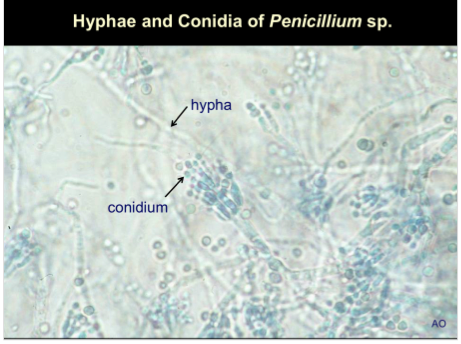
- Hypha = Filament
- Has septa
- Condidum
- At the ends of hypha
- Can break off and aerosolize
What contributes to the pathogenicity of Fungi?
A lot but most fungi are saprophytes
Live in the environment, important in recycling organic matter
Very few fungi are pathogenic
Most virulent are Dimorphic fungi because they can adapt easily from a saprophytic lifestyle (growing as aerobes in room temperature in filamentous form) and when they get into the body they can then convert into facultative anaerobe form which they do at 37 degrees. They often have mechanisms to overcome our immune system. THEY ARE UNCOMMON
What does Histoplasma capsulatum cause? and where does it grow?
- Cause of pneumonia
- Grow in bat’s dungs/open pyramids
What is an example of delayed toxicity form a Fungi?
Liver damage from Alfatoxin from Aspergillus parasiticus
What are Dermatophytes?
Dermatophytes are fungi that require keratin for growth. These fungi can cause superficial infections of the skin, hair, and nails
Pathogenicity
Anthromorphilic < Zoomorphilic < Geophilic*
*because they are least adapted to living on humans
We react to their metabolites
Causes tinea
What are some examples of Subcutaneous mycoses?
- Mycetoma
- Bacterial = Acintomycetoma
- Streptomyces species, the one that gives Streptomycin
- Fungal = Eumycetoma
- Bacterial = Acintomycetoma
- Chromoblastomycosis
- Dematiaceous
- Phaehypnomycosis
- Dematiceous fungi with mycelia in tissues
What are some examples of opportunistic Mycoses?
- Candidasis
- Cryptococcosis
- Asperigillosis
Candidasis
Thrush = Mucocutanous
Unusual immunodeficiency = Chronic mucocutaneous
Systemic = Found in immunosuppressed host
All of the them are opportunistic, but there is always a reason for it.
Acute mucocutaneous = Herald disease, its telling you something is wrong with the patient.
- Newborn baby can get thrush from the Cancida in mother’s vagina
- It might be someone who is taking antibiotics which has disturbed microbiota
○ Broad spectrum antibiotics will kill Lactobacilli but not candida so it will flourish.
- Could be evidence of diabetes
Chronic mucocutaneous
- Very specific immune deficiency, not one type of immuno deficiency, only for cancida and never develop systemic candidasis.
- Not in people who are GENERALLY immunosuppressed
- Tends to become granulomatous
Systemic
Often fatal
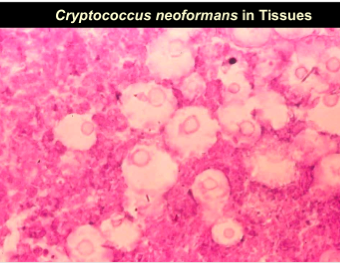
Cryptococcsis
AIDS defining illness
- Pulmonary infection & Meningitis
Agents
- C. neoformans/C. Gattii
C. Gattii = More common in australia than other parts of the words
- Has some association with Eukalyptus trees
- Not necessarily a herald/opportunistic
Disease are the same
- Pulmonary infection which is almost always ASYMPTOMATIC
- Route of entry is pulmonary
- Sometimes sit beyond the lungs go to the blood and end up in the meninges
- Has a prominent capsule, so tend to go to meningies, because phagocytes don’t work well in meningies
Neoformans and C. Gatiii are AIDS defining illnesses
Aspergillosis
Filamentous infection
3 different forms
- Saprophyte
○ Inhale chlamidia, gets into cavity from TB in upper lobe, sets up home there
○ But they don’t like it, but they can cope because they are aerobic
○ Can grow very slowly, patient may develop reaction (cough, asthma)
- Allergic
○ ID-Reaction
§ Manifestation in skin, blisters, between the fingers
§ Saprophytic growing there
- Systemic Aspergilosis
○ Very serious
○ Not uncommon because we see a lot of immunocompromised patients in hospitals, treat with broad spectrum antibiotics to get rid of a lot of microbiota –> they get infected with Fungi because no immune system of bacteria can prevent them
What are the diagnostic tools for identifying Fungal infection?
- Latex Agglutination
- Cryptococal meningitis
- PCR
- Culture
- MALDI-TOF
What are targets of antifungals?
- Ergosterol in cytoplasmic membrane
- polyenes affect integrity (amphotericin B)
- The rest affects synthesis
- Nucleic acids
- 5-flurocytosine
How are polyenes not toxic to humans?
They are toxic but there is lower affinity of the drug for cholesterol synthesis compared to ergosterol
What determiens the specificity of 5-flurocytosine?
Cytosine deaminase is only in Fungi
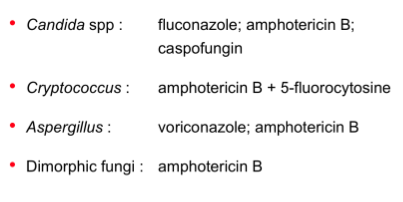
Treatment of systemic fungal infections