- Definition of a clinical trial LO
- Purpose of a clinical trial LO
- Fair comparison of effect and safety, a clinical trial needs to be:
- Any form of planned experiment which involves patients and is designed to elucidate the most appropriate method of treatment for future patients with a given medical condition
- To provide reliable evidence of treatment efficacy (improve the health) and safety (not to harm) defined group under specific conditions.
- • Reproducible – in experimental conditions
- Controlled – comparison of interventions
- Fair – unbiased without confounding
Explain the disadvantages of non-randomised clinical trials and the use of historical controls
– Non-randomised clinical trials
– Comparison with historical controls
- What is a non-randomised control trial? Disadvantages?
- What is a historical control? Problems?
- Receiving a new treatment vs receiving the standard treatment (allocation)
- Allocation bias – by patient, clinician or investigator
- Confounding – known and unknown
- had the standard treatment VS receiving a new treatment
BUT for the ‘standard treatment’ group:
- selection often less well defined, less rigorous
- treated differently from ‘new treatment’ group
- less information about potential bias/confounders
- unable to control for confounders
Outline the steps involved in a randomised controlled trial (RCT) LO
- Definition of factors LO
- Conduct of the trial LO
- Comparison of outcomes LO
- – The disease of interest
– The treatments to be compared
– The outcomes to be measured
– Possible bias and confounders
– The patients eligible for the trial
– The patients to be excluded from the trial - • Identify a source of eligible patients
• Invite eligible patients to be in the trial
• Consent patients willing to be in the trial
• Allocate participants to the treatments fairly, i.e. without bias or confounding
• Follow-up participants in identical ways
• Minimise losses to follow-up
• Maximise compliance with treatments
I C A FLC
- Is there an observed difference in outcome between the treatment groups?
– Could the observed difference have arisen by chance, i.e. is it statistically significant?
– How big is the observed difference between the treatment groups, i.e. is it clinically important?
– Is the observed difference attributable to the treatments compared in the trial?
Describe suitable ‘outcome measures’ for clinical trials
- Reasons for pre-defining outcomes LO
– Primary and secondary outcomes
– Types of outcomes
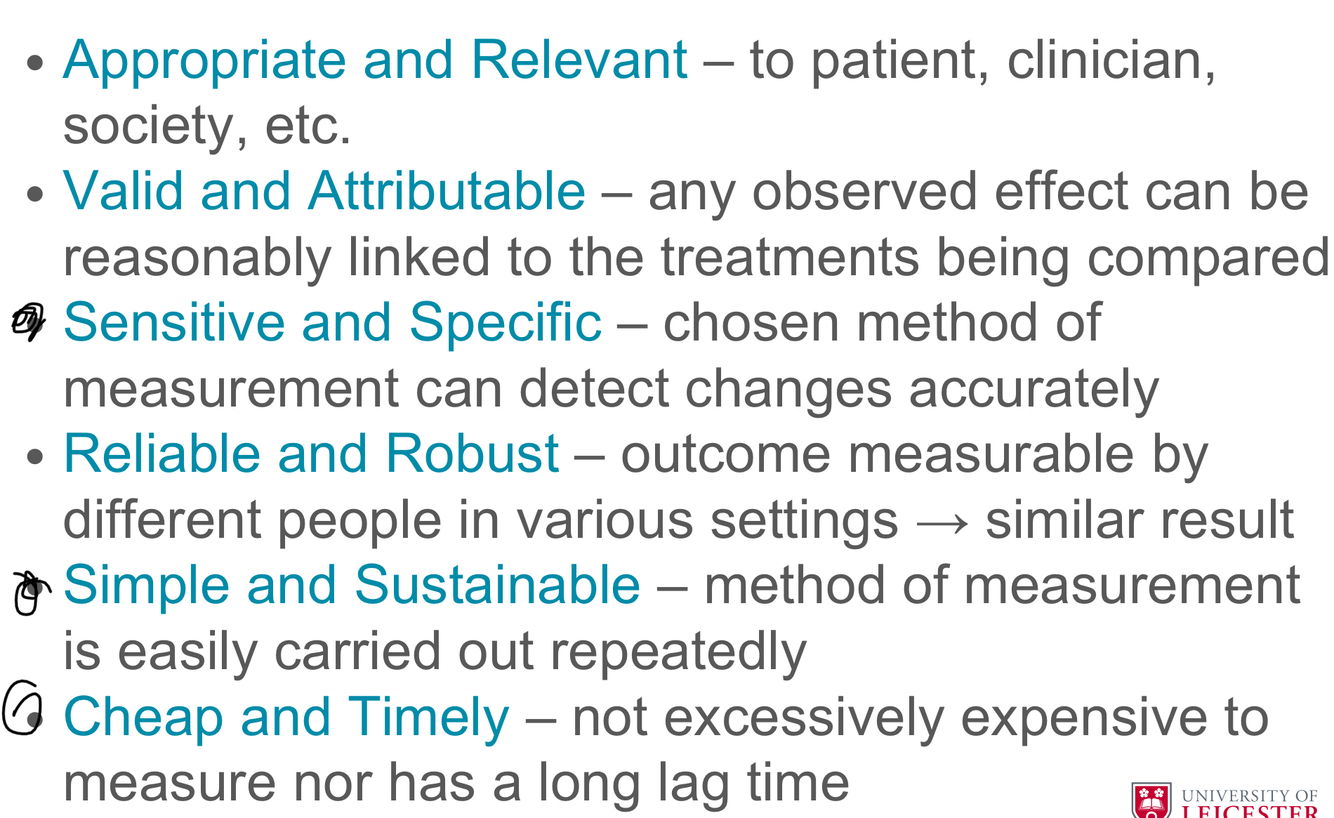
– Features of an ideal outcome
– Timing of measurements
- Need to define what, when and how outcomes are to be measured before start of the clinical trial:
– prevent ‘data dredging’, ‘repeated analyses’
– protocol for data collection
– agreed criteria for measurement and assessment of outcomes - • Primary outcome (preferably only one primary outcome – used in the sample size calculation)
• Secondary outcomes (other outcomes of interest, often includes occurrence of side-effects)
- • Patho-physiological, e.g. – tumour size – thyroxine level – ECG changes
- Clinically defined, e.g. – death (mortality) – disease (morbidity) – disability
- Patient-focused, e.g. – quality of life – psychological well-being – social well-being – satisfaction
- Image
- • Baseline measurement of relevant factors – monitoring for inadvertent differences in groups
- Monitoring outcomes during the trial – monitoring for possible effect, i.e. is one group being disadvantaged? – monitoring for adverse effects, i.e. are individual patients being harmed?
- Final measurement of outcomes – comparing final effect of treatments in trial
• Discuss the advantages of ‘random allocation’ and ‘blinding’ to minimise confounding and bias in the estimation of treatment effects LO
What do we mean by…
- Non-random allocation
- Random allocation and randomisation? How to randomise?
- Knowing the treatment allocation
- Blinding (or masking) e.g.
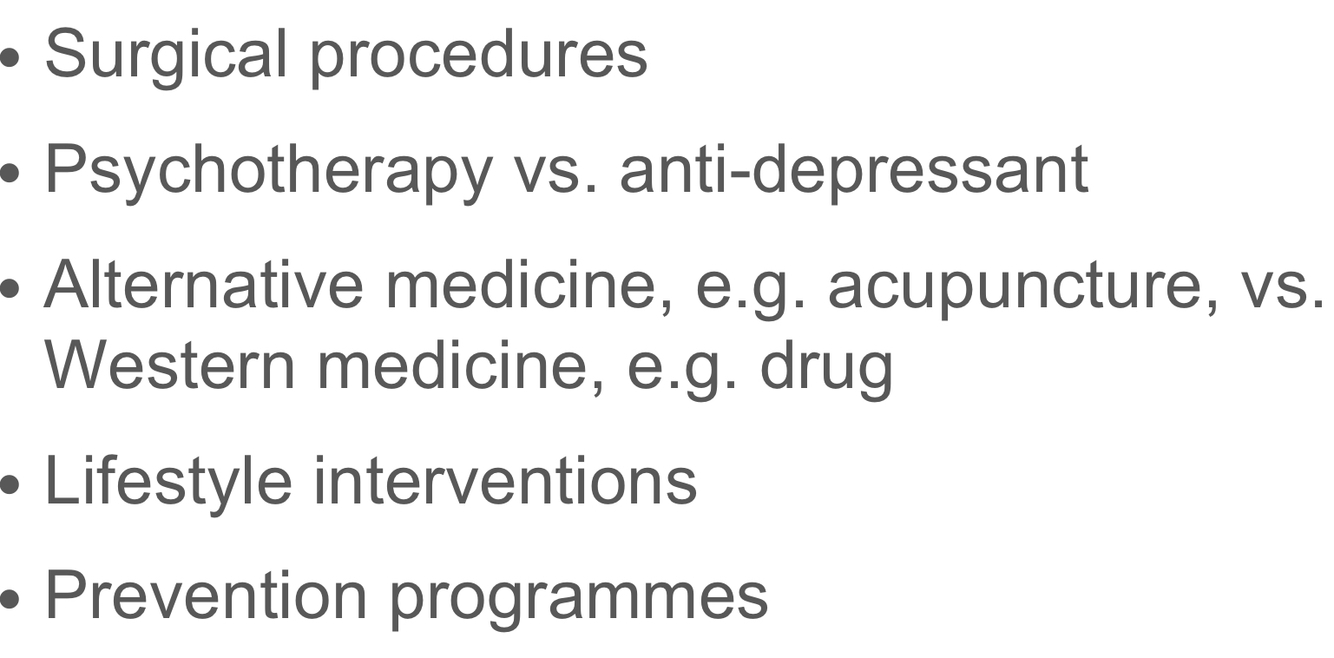
- Give examples where blinding is difficult
- Allocation of participants to treatments by a person, historical basis, geographical location, convenience, numerical order, etc. leads to the potential for allocation [aka. selection] bias and confounding factors to unwittingly cause unidentified differences between the treatment groups being compared.
- • Minimal allocation bias – randomisation gives each participant an equal chance of being allocated to each of the treatments in the trial
• Minimal confounding – in the long run, randomisation leads to treatment groups that are likely to be similar in size and characteristics by chance
number generators, coin, tables
- Knowledge of which participant is receiving which treatment may bias the results of a clinical trial, e.g.
– Patient may alter their behaviour, other treatment, or even expectation of outcome (behaviour effect)
– Clinician may alter their treatment, care and interest in the patient (non-treatment effect)
– Investigator may alter their approach when making measurements and assessing outcomes (measurement bias)
- Minimal allocation bias
DOUBLE BLIND - patient & clinician/ assessor does not know where patients have been allocated (& thus does not know treatment given)
Examples:
Aim to make the treatments appear identical in every way, e.g. appearance, taste, texture, dosage regime, warnings
• Use a designated pharmacy to label identical containers for the treatments with code numbers, and to have a code sheet detailing which code number corresponds to which treatment
• Describe the ‘placebo effect’, what a ‘placebo’ is, and how a ‘placebo’ addresses the ‘placebo effect’
What do we mean by..
- Comparing with ‘no treatment’
- The placebo effect
- Placebo
- Ethical implications of placebo
- The effect of comparing a ‘new treatment’ vs no treatment is to leave one unsure as to whether any observed difference was due to the ‘new treatment’ or to the fact that the group was receiving care.
- Even if the therapy is irrelevant to the patient’s condition, the patient’s attitude to his or her illness, and indeed the illness itself, may be improved by a feeling that something is being done about it
- A placebo is an inert substance made to appear identical in every way to the active formulation with which it is to be compared, e.g. appearance, taste, texture, dosage regime, warnings, etc. The aim of a ‘placebo’ is to cancel out any ‘placebo effect’ that may exist in the active treatment
- only be used when no standard treatment is available
Discuss how to deal with ‘losses to follow-up’ and ‘non-compliance’
- Give examples of losses to follow-up. How do we deal with losses to follow up.
- Reasons for non-compliance with treatments – An issue for the analysis.
- How to avoid non -compliance ?
- Not every participant remains in the trial:
– their clinical condition may necessitate their removal from the trial (appropriate)
– they may choose to withdraw from the trial (unfortunate)
- Make the follow-up practical and minimise inconvenience
- Be honest about the commitment required from participants
- Avoid coercion or inducements
- Maintain contact with participants
- – mis-understood the instructions
– not like taking their treatment
– they may think their treatment is not working
– they may prefer to take another treatment
– they can’t be bothered to take their treatment – etc.
- • Simplify the instructions
• Ask about compliance
• Ask about effects and side-effects
• Monitor compliance, e.g. tablet count, urine level, blood level
Differentiate between ‘explanatory’ and ‘pragmatic’ trials and be able to explain the meaning of the term ‘intention-to-treat’ analysis LO
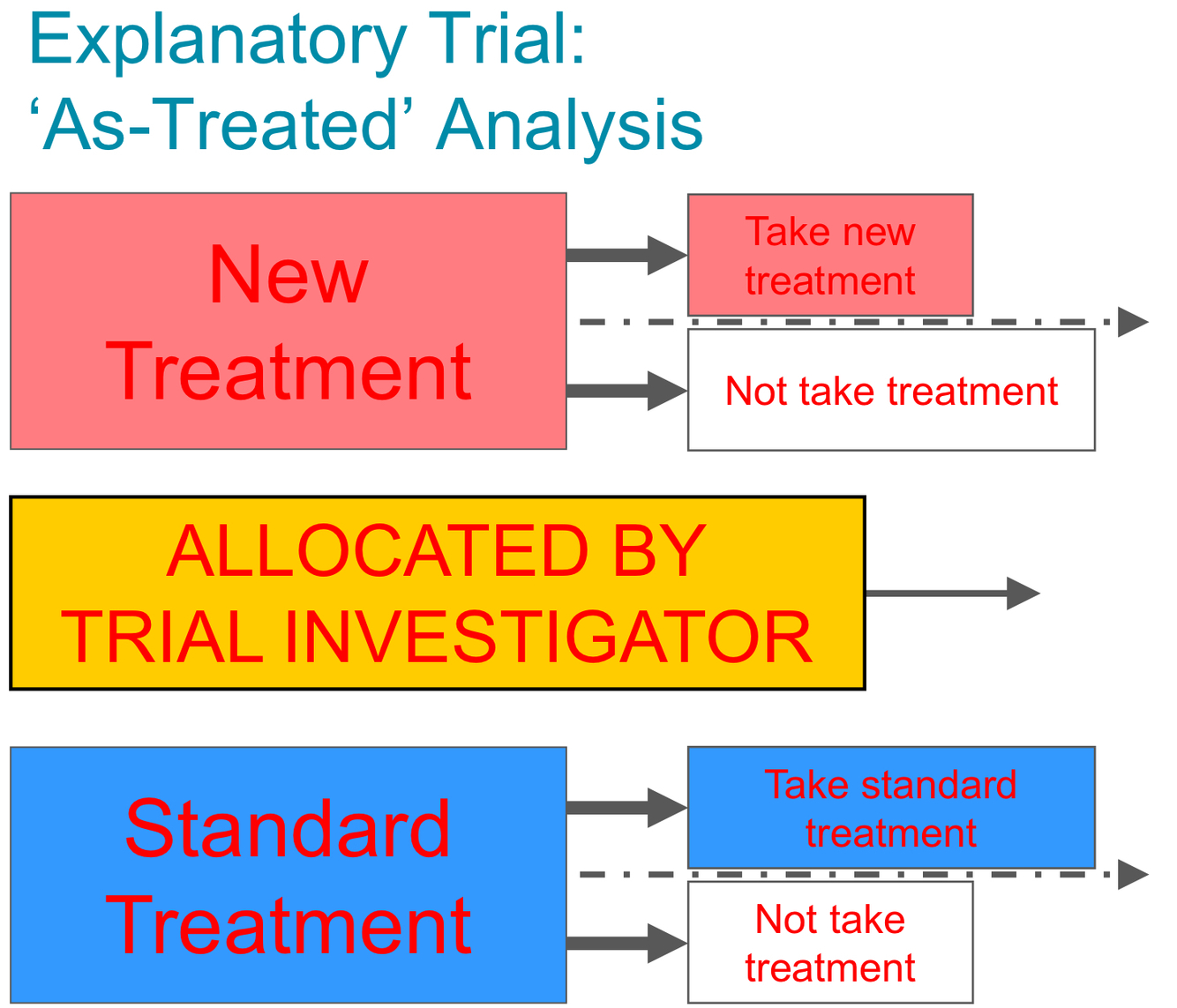
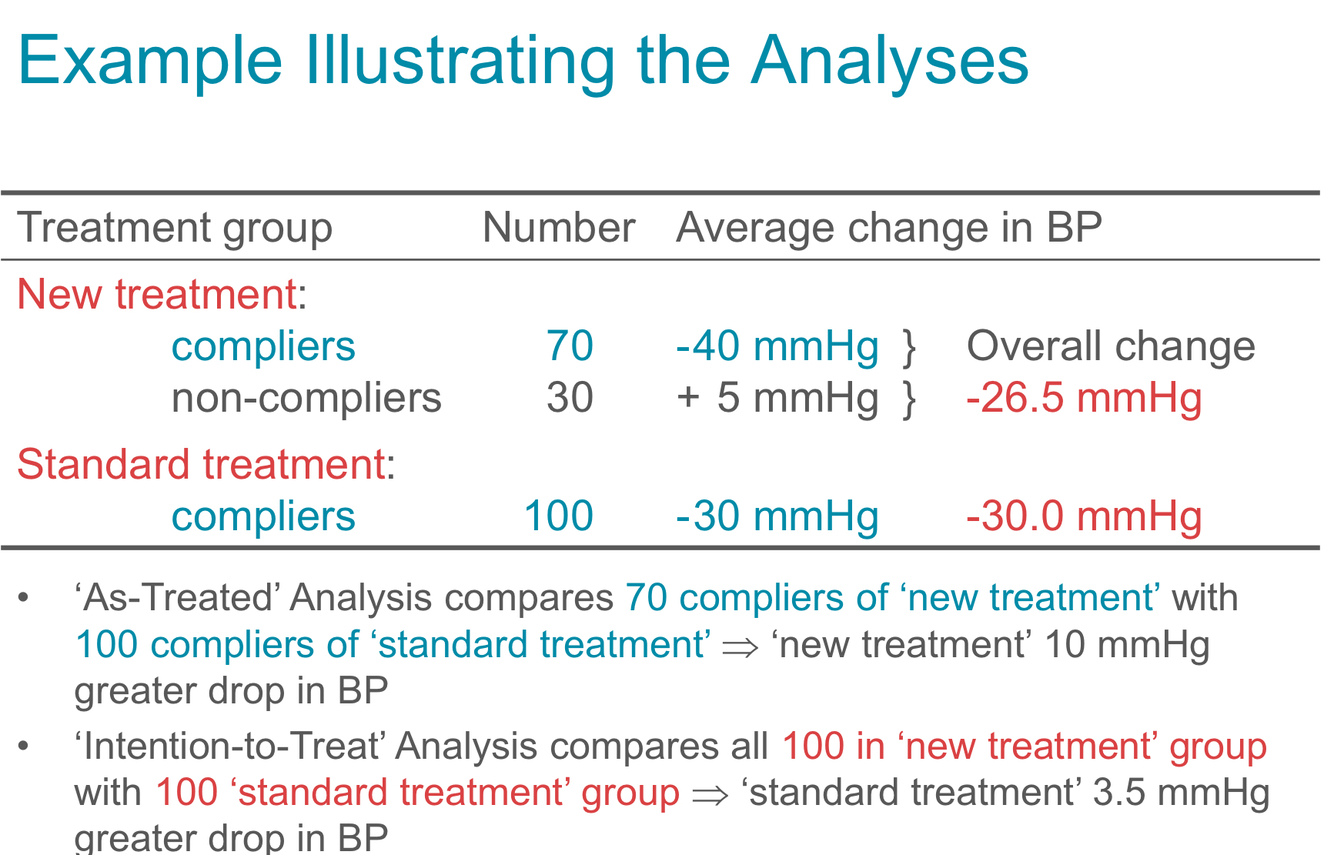
- Explanatory Trial: ‘As-Treated’ Analysis
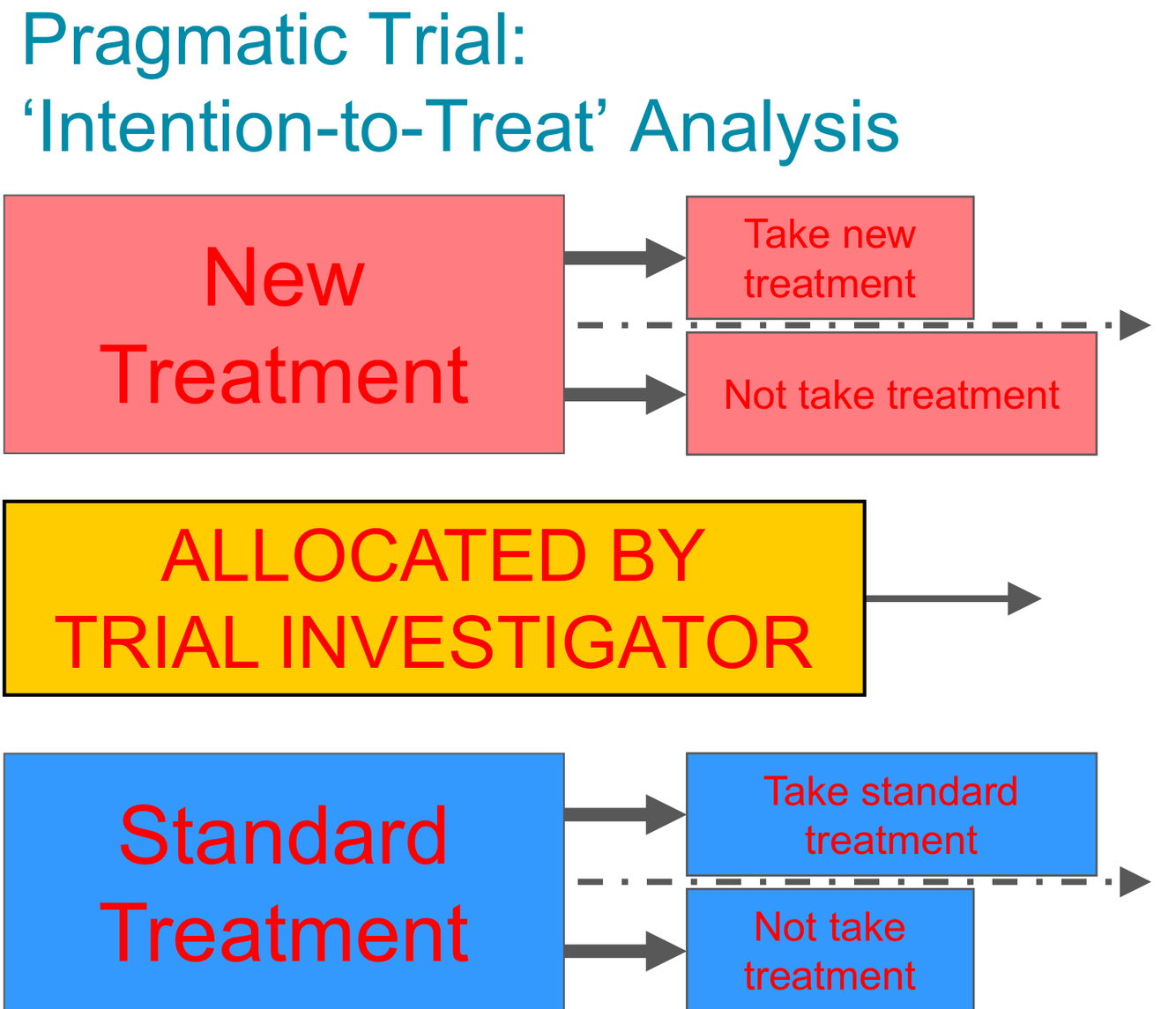
(Pragmatic Trial: ‘Intention-to-Treat’ Analysis
‘As-Treated’ vs. ‘Intention-to-Treat’)
- Analyses only those who completed follow-up and complied with treatments
- Compares the physiological effects of the treatments
BUT loses effects of randomisation
• Non-compliers are likely to be systematically different from compliers ⇒ selection bias & confounding
Differentiate between ‘explanatory’ and ‘pragmatic’ trials and be able to explain the meaning of the term ‘intention-to-treat’ analysis
– Explanatory Trial: ‘As-Treated’ Analysis
– Pragmatic Trial: ‘Intention-to-Treat’ Analysis
– ‘As-Treated’ vs. ‘Intention-to-Treat’
• Analyses according to the original allocation to treatment groups (regardless of whether they completed follow-up or complied with treatment)
• Compares the likely effects of using the treatments in routine clinical practice
ALSO preserves effects of randomisation → minimal selection bias and confounding
‘As-Treated’ vs. ‘Intention-to-Treat’
- ‘As-Treated’ analyses tend to give larger sizes of effect
- ‘Intention-to-Treat’ analyses tend to give smaller and more realistic sizes of effect
Clinical trials should normally be analysed on an ‘Intention-to-Treat’ basis
Discuss the ethical principles involved in medical research involving human subjects
- ‘Declaration of Helsinki’ 2013 (Paragraph 3)
- – Collective Ethic
– Individual Ethic
- Health of patient must come first, act in the interest of the patient
2.• Collective Ethic:
– All patients should have treatments that are properly tested for efficacy and safety
• Individual Ethic:
– The Principle of Beneficence
– The Principle of Non-Maleficence
– The Principle of Autonomy
– The Principle of Justice
Individual Ethic:
– RCTs do not guarantee benefit
– RCTs may result in harm
– RCTs allocate treatment by chance
– RCTs place burdens and confer benefits
Describe the issues that should be considered for a clinical trial to be regarded as ethical
– Clinical equipoise
– Scientifically robust
– Ethical recruitment
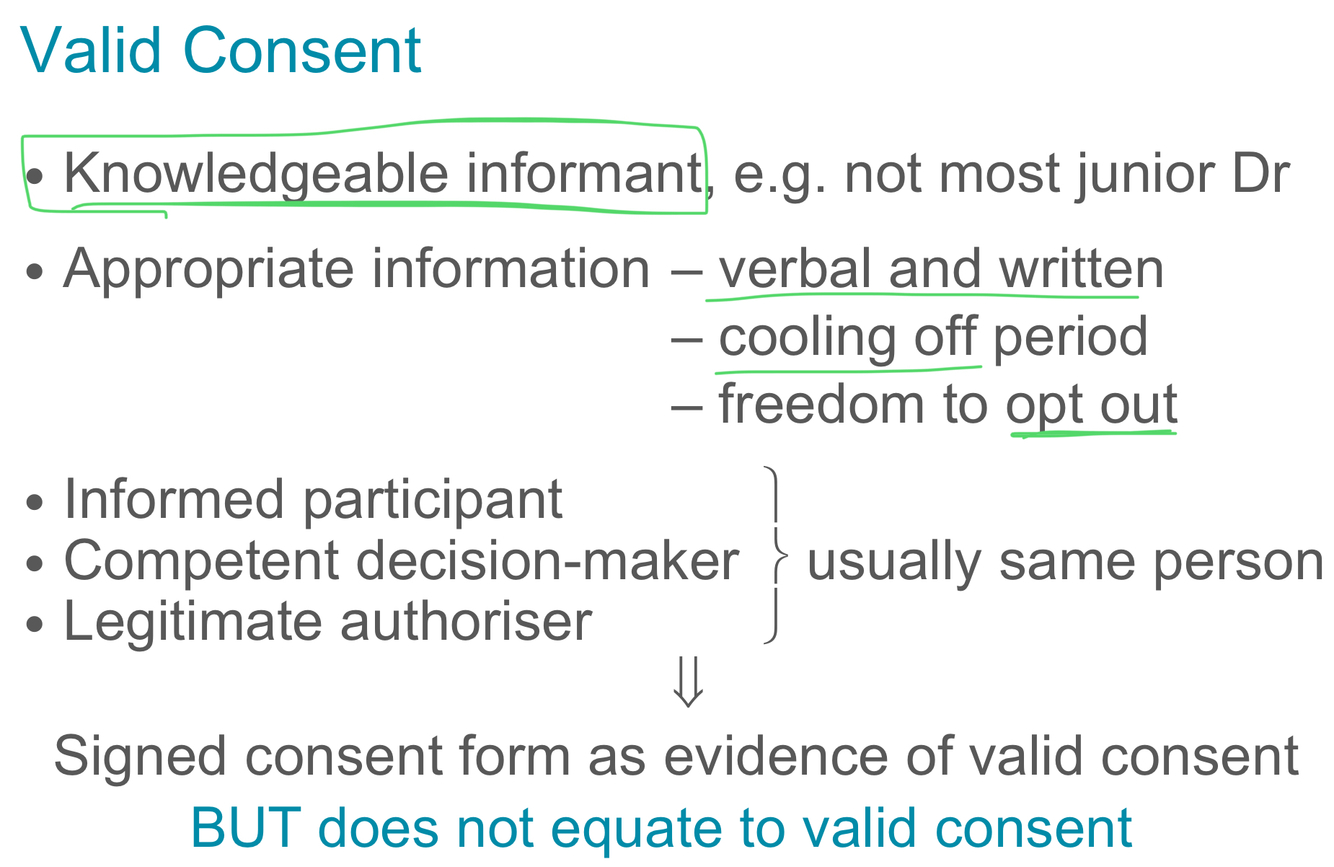
– Valid consent
– Voluntariness
Clinical Equipoise : reasonable uncertainty or genuine ignorance about the better treatment or intervention (including non- intervention)
Scientifically Robust (1): appropriate study design, asked a valid que, acceptable risks of possible harm compared to benefits
Ethical recruitment:
Inappropriate inclusion of:
– participants from communities that are unlikely to benefit (e.g. AIDS drugs trials in Developing World countries)
– participants with a high risk of harm with respect to potential benefits, (e.g. pregnant women)
– participants likely to be excluded from analysis, e.g. a small sub-group of Chinese
Inappropriate exclusion of:
– people who differ from an ideal homogenous group, e.g. non-White people, women, co-morbidities (usually elderly)
– people who are difficult to get valid consent from, e.g. immigrants, mentally ill, children, prisoners
decision should be free from coercion or manipulation
- Examples of coercion: non-access to ‘best’ treatment, lower quality of care, disinterest by clinician
- Examples of manipulation: exploitation of emotional state, distortion of information, financial inducements
Describe the role and function of a Research Ethics Committee
NHS Trust/PCT R&D Office & Research Ethics Committee focus particularly on:
- Scientific design and conduct of the study
- Recruitment of research participants
- Care and protection of research participants
- Protection of research participants’ confidentiality
- Informed consent process
- Community considerations

-
Session 3: Cardiac arrhythmias/Lipid and cholesterol metabolism96
-
Session 497
-
Session 597
-
Session 761
-
Session 843
-
Session 991
-
Session 1054
-
Session 1189
-
Session 1269
-
Session 1356
-
Session 1430
-
Session 15 opioids37
-
Session 8 RA48
-
Session 226
-
Session 118
-
Session 617
-
Important info1
-
Opioids other was corticosteriods19
-
Pop Sci13


