Epiglottitis is a cellulitis of the supraglottis with the potential to cause airway compromise, and should be treated as a surgical emergency until the airway is examined and secured.
What organism most commonly causes epiglottitis?
- haemophilus influenza type B
- therefore a risk factor is non-vaccination with HiB vaccine
What is the clinical presentation of epiglottitis?
- sore throat
- dysphagia
- drooling
- toxic appearance
- acute distress
- fever
- tripod position
- difficulty breathing
- muffled voice, stridor, irritability
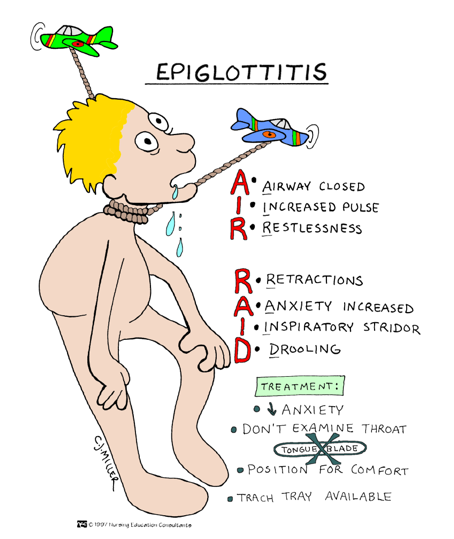
If you suspect epiglottitis, what should you not do?
- no action should be taken that could stimulate a child w/ suspected epiglottitis
- do not examine throat, lie pt down, separate from parent or take blood as this may evoke complete airway obstruction
- it’s a clinical diagnosis
- lab or other interventions should not preclude or delay timely control of the airway in a suspected case of epiglottitis
What are the relevant investigations for epiglottitis?
- laryngoscopy → key to confirming diagnosis, but also therepeautic as an airway can be established in same setting if a direct laryngoscopy comences, this should be performed in the OR as an emergency surgical airway can be obtained if endotracheal intubation is not possible
- lateral neck radiograph → only to be obtained w/ HCP capable of securing airway with proper equipment available during the test
What is the management of epiglottitis?
- secure airway + supplemental oxygen
- if intubation not possible during laryngoscopy then tracheostomy
- intravenous antibiotics → co-amoxiclav or ceftriaxone
- adjuncts → corticosteroids, racemic epinephrine, prolonged intubation
The tracheal tube can normally be removed after 24hrs and the child has normally totally recovered in 2-3 days, Abx treatment continues for 3-5 days
Acute otitis media (AOM) is part of a spectrum of inflammatory conditions affecting the middle ear. These range from a single episode of AOM, recurrent episodes of AOM, otitis media with effusion (OME or ‘glue ear’) and chronic suppurative otitis media.
What are the risk factors for AOM?
- day care attendance -> inc exposure to resp viruses
- older siblings -> inc exposure to resp viruses
- young age
- family history
- absence of breastfeeding
- immunological deficiency
AOM is generally preceded by a viral URTI that causes congestion of the respiratory mucosa of the nasopharynx + eustachian tube.
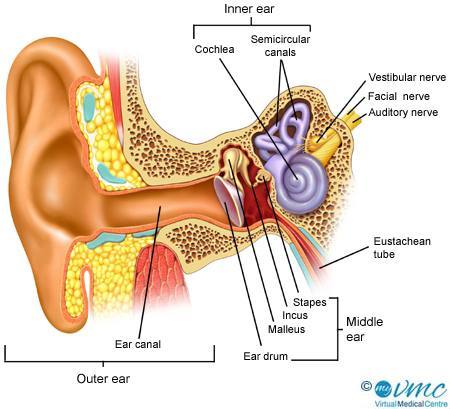
80% of children experience at least one episode of AOM before the age of 2 years w/ a peak incidence between 6-11 months.
What are the most common causative organisms for Acute Otitis Media?
- streptococcus pneumonia
- haemophilus influenzae
- moraxella catarrhalis
- streptococcus pyogenes
What are the clinical features of acute otitis media?
- ?preceding viral resp illness
- acute onset otalgia (ear pain)
- fever
- irritability
- crying
- sleep disturbance
- vomiting
- poor appetite
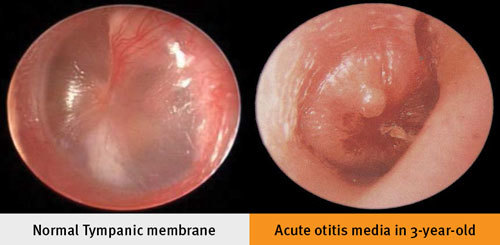
- physical examination → bulging, erythematous or opaque tympanic membrane, with impaired mobility, perforation can occur +/- purulent ear discharge
What investigations can be done for AOM?
- rarely required
- but culture of fluid taken directly from middle ear via tympanocentesis may be useful in immunocompromised children + those <6months, where AOM may be associated w/ an unusual or more invasive pathogen
What is the treatment for acute otitis media?
- natural course of AOM is 3 days but can be up to 1 week
- use analgesia + antipyretics for symptom control → paracetamol, NSAIDs, calpol
- IF antibtioics then 5-day course of amoxicillin (*)
- erythromycin or clarithromycin for penicillin allergies
(*) coming up on next cards
For acute otitis media, the use of antibiotics is more difficult given the self-limiting nature of the condition in most cases. Three separate antibiotic prescribing strategies may be used according to the age + clinical assessment of the child.
When should antibiotics be prescribed immediately?
- if under 2 years w/ bilateral AOM
- if presenting w/ AOM + ear discharge
- if initially managed without abx but show no improvement after 4 days
- if systemically unwell
- if at high risk of complications due to immunocompromise or other PMHx
For AOM, when should there be no antibiotic prescribed?
- most children + their parents can be reassured that abx are genrally not required in this condition
- their use may be associated w/ side-effects such as n+v, rashes, diarrhoea + can contribute to antibiotic resistance
- parents should be advised to re-present if symptoms worsen or if there is no improvement in 4 days
In certain situations it may be more practical to provide a delayed prescription for antibiotics. For AOM, when should there be delayed antibiotic prescibing?
- prescription should be collected if there is no improvement after 4 days
- significant worsening of symptoms at any stage
Any child w/ suspected acute complications of AOM (mastoiditis, meningitis or facial nerve paralysis) should be urgently referred for ENT assessment
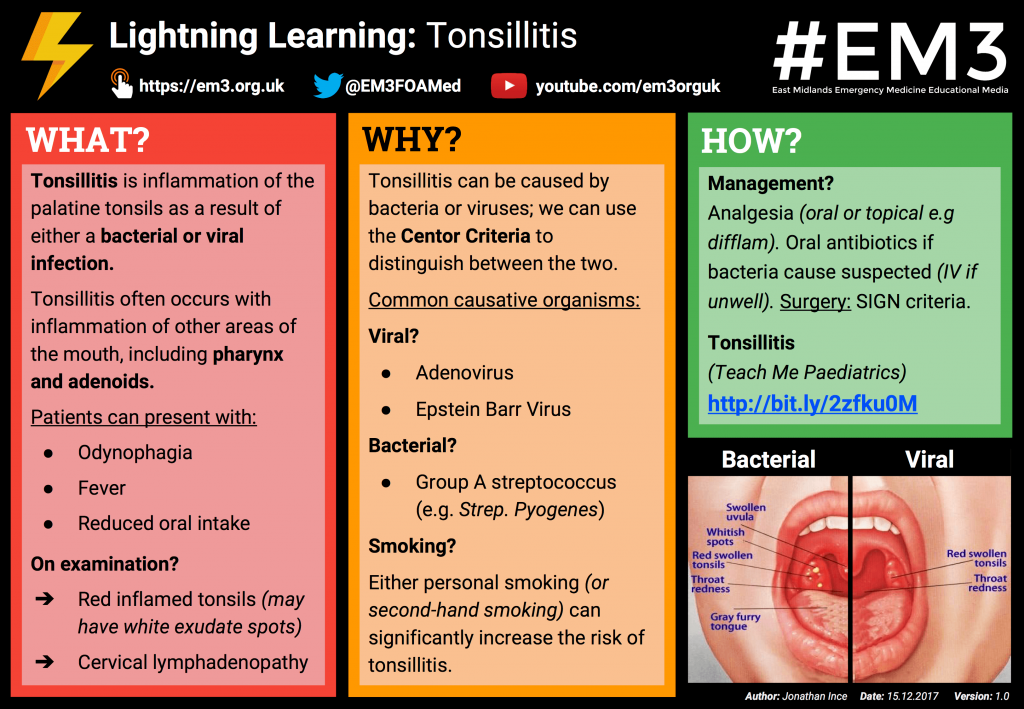
Tonsillitis is inflammation of the palatine tonsils as a result of either bacterial or viral infection. It will often occur in conjunction w/ inflammation of other areas of the mouth, giving rise to terms tonsillopharyngitis (pharynx also involved) and adenotonsillitis (adenoids also involved).
What are the bacterial and viral organisms responsible for tonsillitis?
- Bacterial →
- group A beta-haemolytic streptococci (GABHS) (strep pyogenes)
- group C beta-haemolytic streptococci
- mycoplasma pneumoniae
- neisseria gonorrhoea
- Viral →
- adenovirus
- epstein-barr virus
- rhinovirus
- coronavirus
- enterovirus
- influenza + parainfluenza
It is difficult to differentiate between viral or bacterial aetiology. Blood testing should include an infectious mononucleosis screen.
What are the clinical features of tonsillitis?
- generally lasts 5-7 days
- if >7 days → consider glandular fever
- odynophagia + reduced oral intake
- fever
- halitosis
- new onset snoring (or even apnoeic)
- shortness of breath
- physical examination → red inflamed tonsils, white exudate (pus) spots on tonsils, cervical lymphadenopathy (most commonly lymph nodes in the region of upper 1/3rd SCM)
Tonsillitis is a clinical diagnosis. Antibiotics will most likely benefit a patient when their sore throat is caused by streptococcal bacteria. Centor criteria will aid in the diagnosis or exclusion of GABHS-tonsillitis and determine whether antibiotics are an option.
What is the Centor criteria?
Was developed to try and differentiate between bacterial and viral tonsillitis based on clinical symptoms, there are four key criteria:
- tonsillar exudate
- tender anterior cervical lymphadenopathy or lymphadenitis
- fever or history of fever
- absence of cough
a score of 3 or more is highly suggestive of bacterial infection (40-60% likelihood) and a score of 2 or less suggests bacterial infection is unlikely (80% likelihood)
The first key decision for tonsillitis is whether the patient requires inpatient admission or not.
What factors suggest severe tonsillitis + an urgent admission and assessment?
- resp compromise (tachypnoea, low sats, use of accessory muscles) or apnoeic episodes -> suggest tonsils are so large that they are affecting the child’s ability to ventilate, alternatively could be epiglottitis
- pts who are unable to eat or drink are at risk of dehydration - they should be admitted for treatment + monitoring until able to drink again
- pts who have been treated w/ appropriate antibiotics in community who are still not getting better should also be admitted for IV therapy + further investigation
Paracetamol and iboprufen are effective pain relief in tonsillitis + can be alternated in order to give effective pain relief. Topical analgesia such as difflam (benzydramine) spray/mouthwash can be helpful to reduce pain and allow child to swallow oral analgesic agents.
What is the role of antibiotics in treating tonsillitis?
- NICE recommend antibiotics should not be routinely given for tonsillitis
- in pts fulfulling 3 or more Centor criteria, there is option of antibiotics to cover Group A strep
- also abx for those systemically unwell, with complications (eg quinsy) or at serious risk of complications due to comorbidity
- antibiotic of choice → penicillin
- data suggests cephalosporins may be more effective (?)
- co-amoxiclav often avoided due to small risk of permanent skin rash if tonsilitis is due to glandular fever
Tonsillectomy is reserved for patients with recurrent, troublesome tonsillitis. What are the indications for tonsillectomy?
- sore throats caused by tonsillitis
- 5 or more episodes of sore throat per year
- symptoms for at least a year
- episodes of sore throat that are disabling + prevent normal functioning
What is cystic fibrosis?
- autosomal recessive condition
- caused by mutatipon in CFTR gene
- this receptor is responsible for the transfer of chloride ions out of the cell + inhibition of the adjacent epithelial sodium channel (ENaC)
- bc no chloride pumped out of the cell + sodium floods into the cell uninhibited, the cell content becomes v concentrated w/ a high osmolality that draws water in from outside
- results in thick dehydrated mucus -> builds up in lumens in body
- more than 1600 known genetic mutations for CF w/ delta F508 mutation accounting for more than 70% of mutations in UK population
- 1 in 25 caucasians are carriers + disease affects 1 in 2500 live births
What is the pathophysiological impact of CF in the respiratory tract?
- CTFR gene encodes CTFR protein - a chloride channel, present in numerous epithelial tissues
- chloride driven against its concentration gradient using ATP
- in airway, CTFR present on airway epithelial cells + submucosal glands
- when defective → results in disruption to chloride ion movement + also affects sodium reabsorption → reduces amount of water in secretions
- this results in reduced airway surface liquid
- the airway surface liquid is an important component of the mucociliary escalator + has key immunological functions
- effects of reduced airway surface liquid serve to impede mucus clearance
- the altered lung environment provides a niche for bacterial growth
- main infective agents are S. Aureus, H. Influenzae and P aeruginosa
What is the pathophysiological impact of CF in the pancreas?
- pancreatic duct usually occluded in-utero causing permanent damage to exocrine pancreas
- rendering pts w/ CF ‘pancreatic insufficient’
- pancreatic insufficiency is closely related to genotype
- over time, endocrine pancreas affeced
- 28% of those older than 10yrs requiring treatment for CF-related diabetes mellitus
What is the pathophysiological impact of CF in the GI tract?
- small intestine secretes viscous mucus which can cause bowel obstruction in-utero → can cause meconium ileus
- in the biliary tree in-utero, CF can cause cholestasis → neonatal jaundice
- later in life, same pathology → distal intestinal obstruction syndrome (DIOS) + CF-related liver disease
What is the pathophysiological impact of CF in the reproductive tract?
- 98% of men w/ CF are infertile
- due to congenital absence of vas deferens
- in women, nutrition likely to be an important predictor of successful pregnancy
- it is suggested that timing of pregnancy be carefully planned
- as pregnancy often associated w/ deterioration in lung health

-
Neonatology (1s)38
-
Neonatology (2s + 3s)23
-
Respiratory (1s)44
-
Respiratory (2s + 3s)40
-
Cardiovascular46
-
Neurology + Development (1s)39
-
Neurology + Development (2s + 3)40
-
Nephrology45
-
Gastrointestinal Disease45
-
Metabolic, Endocrine + Growth47
-
Immunology, Allergy + Derm33
-
Infections37
-
MSK + Joint4
-
Haemotology + Oncology21


