What is inflammation?
Inflammation is a response to injury of vascularised living tissue (indicated by the suffix -itis)
Identify 4 purposes of inflammation
- Deliver defensive materials (blood cells and fluid) to a site of injury
- Protect the body against infection
- Clear damaged tissue
- Initiate tissue repair
In terms of time, distinguish between acute and chronic inflammation
- Acute inflammation evolves over hours or days (innate and stereotyped)
- Chronic inflammation evolves over weeks, months or even years
What is acute inflammation?
Acute inflammation is a rapid response to an injurious agent which aims to deliver mediators of host defence (leucocytes and plasma proteins) to the site of injury
In acute inflammation, leucocytes and plasma proteins need to be delivered because local defences are not adequate.
Describe the mechanism of delivery of these defences
- Most defensive agents circulate in the blood in inactive form and when needed, they are delivered and activated
- They leave the blood vessels at the site of the injury without interrupting blood flow to other tissues
- This process is controlled by chemical mediators
Identify 5 major causes of acute inflammation
- Foreign bodies e.g. splinters, dirt, sutures
- Immune reactions
- Infections e.g. bacterial, viral, parasitic
- Tissue necrosis
- Physical and chemical agents e.g. burns, frostbite, irradiation
What are 5 cardinal signs of acute inflammation?
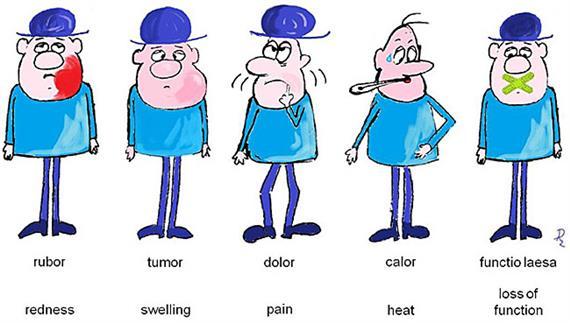
Describe the initial tissue change in acute inflammation, how it is achieved and result of this
- Brief period of arteriolar vasoconstriction (lasting a few seconds)
- Vasodilatation of the arterioles occurs due to vasoactive mediators e.g. histamine
- Resultantly, flow accelerates in the capillaries and capillary pressure rises
Result = increased fluid and leucocyte delivery to the area of injury
heat and redness
What follows vasodilation in acute inflammation?
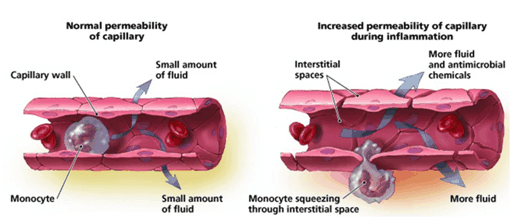
- Venular leakage (increased permeability)
- Plasma escapes through gaps between endothelial cells
- Resultantly, an increased haematocrit within the venules increases resistance to blood flow within them
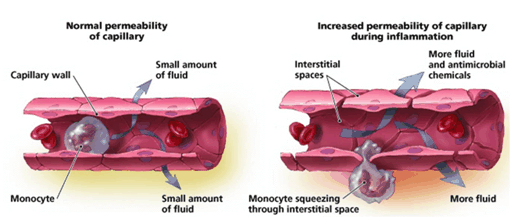
In 5 steps, outline the effects of vasodilation and increased venular permeability in acute inflammation
- Hampers blood outflow from the area of injury
- Increases pressure upstream causing vasodilation of upstream vessels
- Blood flow slows down
- Thus, there’s greater exudation of fluid into the tissue spaces = increased oncotic pressure
- Greater delivery of plasma proteins to the site of injury
= odema (fluid builds up in the interstitual space so dilutes toxins)
Outline the properties, location, action and effects of histamine in acute inflammation
- Properties: vasoactive amine, readily available in cells/platelets
- Location: stored in granules of mast cells, basophils and platelets
- Action: released in response to stimuli such as physical damage, immune reactions and complement components
- Effects: pain, arteriolar dilatation and venular leakage
Outline the properties, location and effects of serotonin in acute inflammation
- Properties: vasoactive amine, readily available
- Location: stored in the granules of platelets
- Effects: similar vascular effects as histamine
What are prostaglandins and what do they do in inflammation?
- Prostaglandins are substances produced in inflammation from cell membrane phospholipids
- They cause vasodilatation, fever and increase pain sensitivity
Describe how the production of prostaglandins can be blocked to reduce pain and swelling
- Production can be blocked by aspirin and NSAIDs
- These drugs inhibit cyclo-oxygenase (the enzyme that produces prostaglandins from arachadonic acid)
Identify 2 other substances with vasoactive properties
- Leukotrienes
- Bradykinin
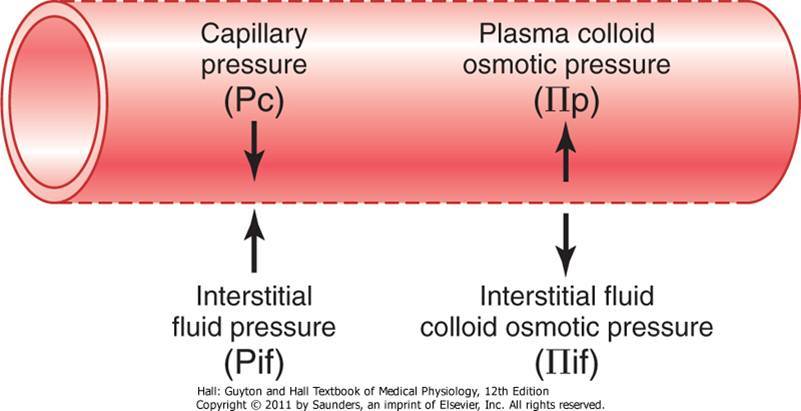
Acute inflammation throws off the equilibrium of fluid exchange in the microcirculation. Starling’s law describes the forces involved in this equilibrium.
What are the forces?
Discuss the roles of endothelium in acute inflammation
- The endothelium of the capillaries and venules acts as a semipermeable membrane
- This allows the escape of water and electrolytes but retains plasma proteins
The exchange between the blood and tissue spaces depends on the four forces below.
Describe this
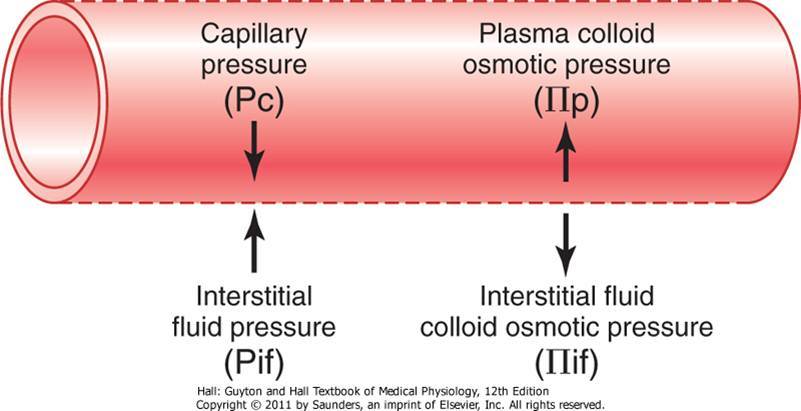
- The main force driving fluid out of the vessels is the hydrostatic pressure of the blood
- The main force driving fluid back into the blood is the colloidal osmotic pressure of the plasma proteins
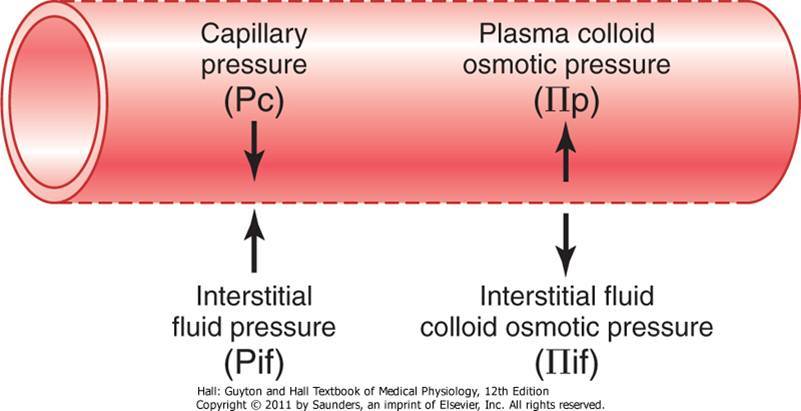
What is the impact of the altered vascular elements (vasodilation and venular leakage) on the forces in Starling’s law?
- Arterioles dilate increasing capillary pressure as pressure in the veins increase, hence, driving more fluid out of the blood
- Plasma proteins escape into the tissue spaces, raising the osmotic pressure there and reducing colloid osmotic pressure
What is the significance of vasodilation and increased permeability in acute inflammation?
- Increased flow of fluid (with its plasma proteins) out of the vessels into the tissue spaces
- Delivery of plasma proteins to the site of injury
What happens to the excess fluid in the tissue spaces during acute inflammation?
Excess fluid drains from the tissues in the lymphatics taking with it micro-organisms and antigens which are presented to the immune system within the lymph nodes
Identify the three main types of defensive proteins in the exudate and describe their actions
- Opsonins – coat foreign materials to enhance phagocytosis
- Complement – a group of proteins locally assembled to produce a bacteria-perforating structure
- Antibodies – bind to the surface of micro-organisms and also act as opsonins
Compare and contrast exudate and transudate
- Exudate is the protein-rich tissue fluid that develops in inflammation
- Transudate is the protein-poor ultrafiltrate of plasma occurring in normal vessels
Identify the chemical mediators involved in vascular leakage
- Histamine
- Serotonin
- Bradykinin
- C3a, C4a and C5a
- increase the spaces in between the endothelial cells and increase permeability


-
S1) Introduction to Pathology36
-
S5) Haemostasis50
-
S5) Thrombosis and Embolism50
-
S1) Cell Injury98
-
S2) Acute Inflammation96
-
S2) Learning from the Dead11
-
S3) Chronic Inflammation48
-
S4) Healing and Repair55
-
S6) Atherosclerosis58
-
S7) Cellular Adaptations55
-
S8) Introduction to Neoplasia38
-
S8) Invasion, Metastasis and Effects of Neoplasms38
-
S9) Causes & Mechanisms of Neoplasia39
-
S10) Incidence, Prognosis & Treatment of Neoplasms43
-
Clinical Conditions48


