How to bring a problem in standard form?
Just rewrite it to include slacks.
How to do a simplex iteration?
Put in simplex tableau (note that everything needs to be multiplied by -1 in the objective function).
Check the lowest value (for min highest) value in the objective function, that is the entering variable, using the minimum ratio test find the leaving variable.
Make sure that the entering variable is 1, and in all the others 0.
How to formulate the dual problem?
Rewrite the function s.t. you put y1, y2, … in front of every constraint, rewrite it s.t. you have x1(….) + x2(…). These are the constraints, they are ≥ then the objective coefficient (if they are ≤).
Then the dual objective is min (if max) and then c1y1 + c2y2 + … where c is every constraint. Don’t forget y ≥ 0
How to find the optimal values when B-1 is given?
Just B-1 b, where b are the values of the constraints.
How to find the optimal values of the dual when B-1 is given?
Calculate cTB B-1, where cB are the coefficients of the optimal values in objective function.
How to find how large a value needs to become before it becomes “intresting”?
Compute the n-th value of the dual function with the optimal values (of the dual), minus this by the constraint and that is it.
How to derive a fractional cut?
- Rewrite to keep all integer values before the = sign, and all the fractions behind, make sure all values behind the equality are negative.
- Take what is behind the equality sign and ≤ 0.
- Rewrite s.t. any fraction (without variable) is behind the ≤
How to give the LP-relaxation and the best value in a 0-1 knapsack problem?
Just rewrite the in {0, 1} to in [0, 1]. Then take the fraction between every coefficent and the constraint. And add in the order from highest to lowest, add the last as a fraction. Don’t forget to give the objective value.
How to solve the 0-1 knapsack-problem using B&B?
Start with the first solution, then add the constraint from the highest (first) value (so set to zero and one) and calulate. Continue from highest to lowest fraction. You can stop adding constraints when:
- All constraints met
- No bound attained (usually similar as one)
- Not feasible
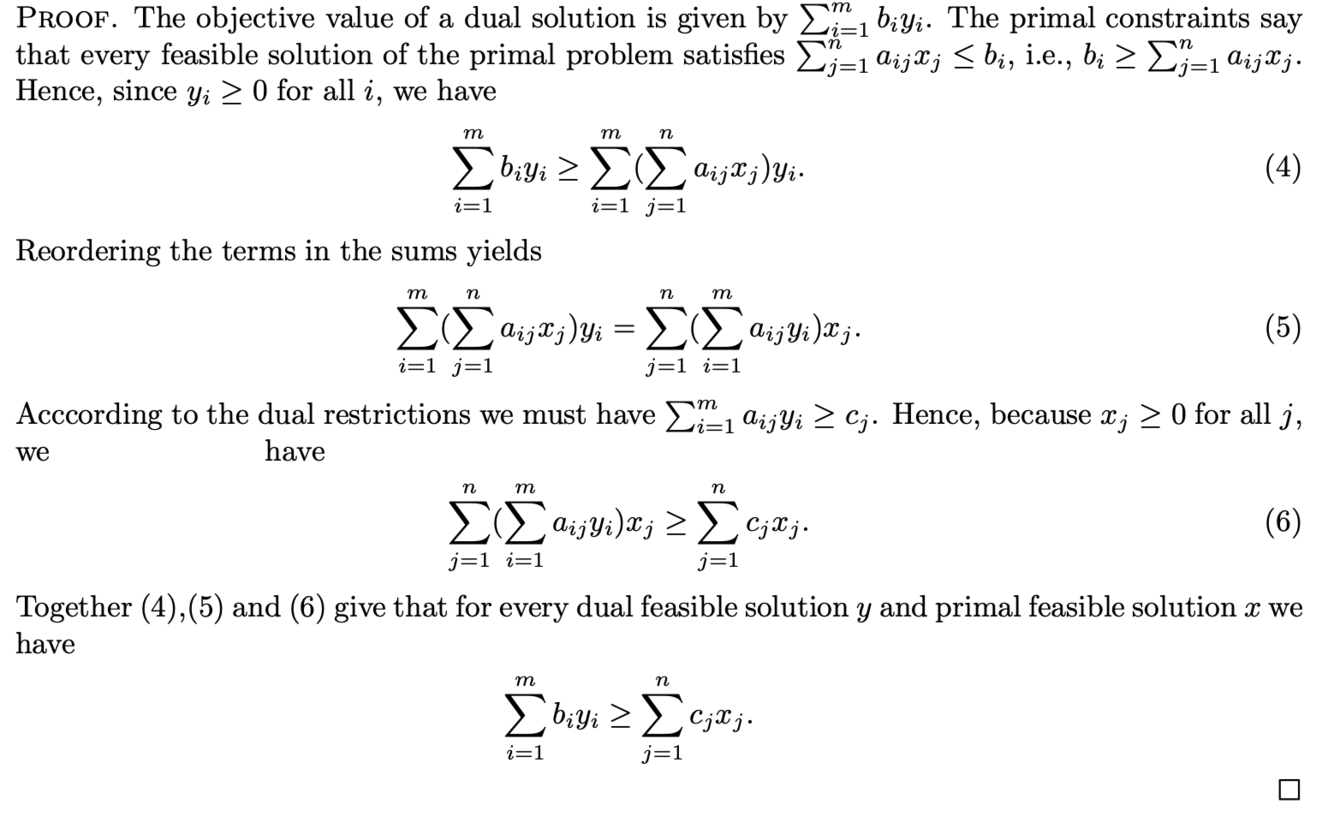
What is the proof of weak duality?
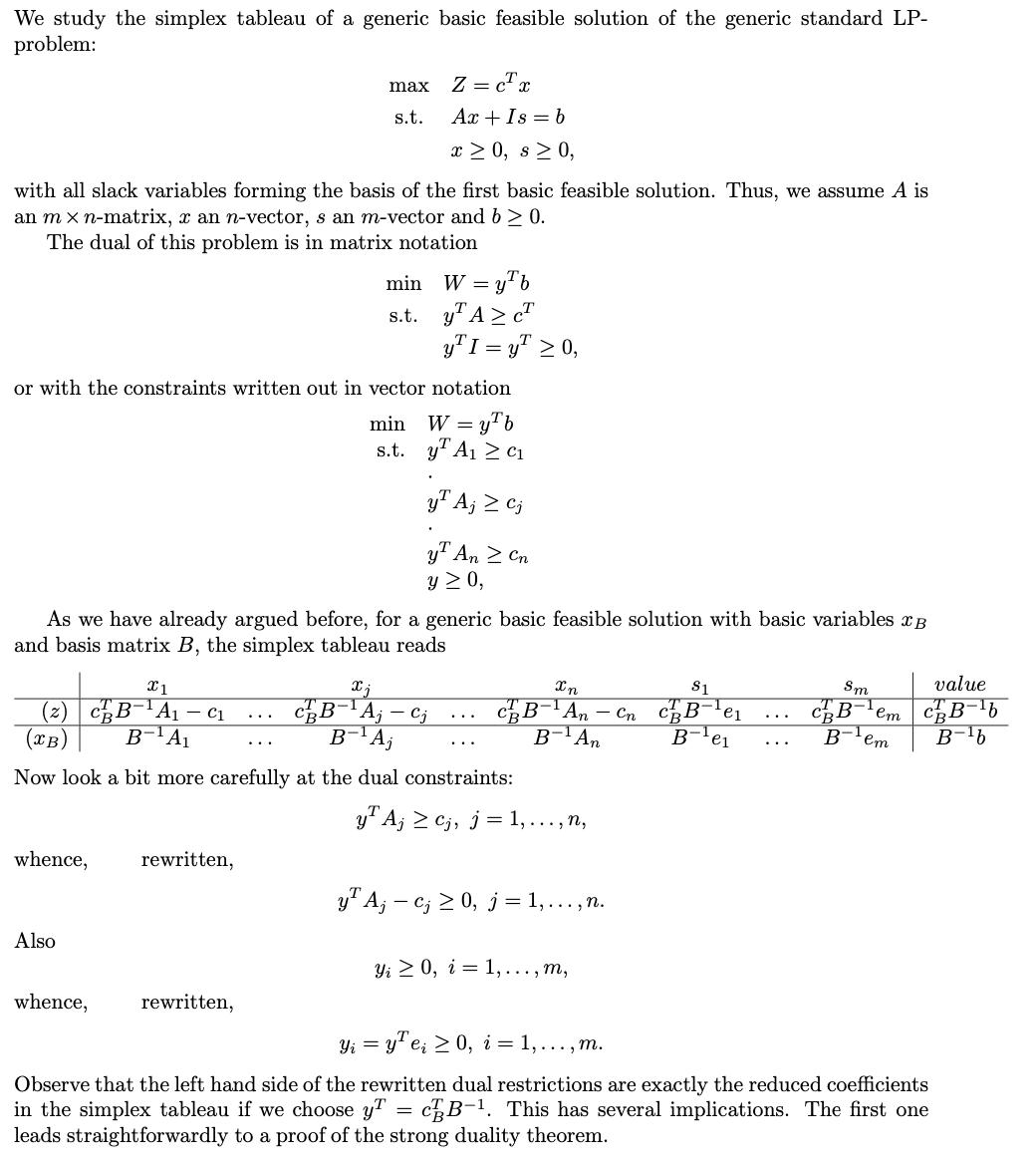
What is the proof of strong duality?
How to proof a Lagrange relaxation?
Claim that the following:
- Restrictions are L(𝜆) are also in ZI
- In addition, for every feasible solution x of ZI we have sumn j=1 dijxj = ei or, equivalently, ei −sumnj=1dijxj = 0 for all i = 1 , . .., m.
- Hence, sum mi=1λi(ei − sumnj=1dijxj) = 0 and L(λ) ≥ZI for all feasible solutions x of ZI, so L(λ) is a relaxation of ZI. This holds for all possible values of λ ∈ Rm.
How to show that a basic feasible solution is optimal using B-1(, and the dual)?
- Calculate the solution of the dual first (cBT B-1)
- Calculate cBTB-1Ai - ci, where ci is the coefficient, and Ai is a vector of the coeficients of the constrants of xi, calculate this for every non-basic variable
- If these values are all positive then this is a optimal solution.
How to prove optimality using complementary slackness?
Show that:
(constraint value - constraint formula(with xi*))y1* = 0 for all constraints.