Test 3: Integumentary System and Skeletal System Flashcards

(80 cards)

1
Q

What are the functions of the skeletal system?

A

Support: attach ligaments and tendons

Protection: enclose organs in cranial and thoracic cavities

Assistance in Movement

Mineral Homeostasis: stores minerals like calcium and phsophate

Blood Cell Reproduciton: red bone marrow makes red and white blood cells

Triglyceride Storage: Medullary Cavity, in yellow bone marrow

2
Q

What are the 4 structures of bones?

A

Long Bone

Flat Bone

Short Bone

Irregular Bone

3
Q

What are the 2 parts of the long bone?

A

Diaphysis: shaft

Epipysis: ends

4
Q

What is the Periosteum?

A

membrane wrapping around bone, but not bone

5
Q

What is the Medullar Cavity?

A

Hollow passage way through middle of bone

where yellow bone marrow is found

6
Q

What is the Endosteum?

A

It lines the cavitys inside bone

7
Q

What are the 4 types of cells in bone tissue?

A

Osteogenic

Osteoblasts

Osteocytes

Osteoclasts

8
Q

Osteogenic Cells

A

found on surface of bone and in the periosteum

capable of mitotic division

9
Q

Osteoblasts

A

bone forming cells

found at the margins of the bone

10
Q

Osteocytes

A

Mature bone cells

found in lacunae

11
Q

Osteclasts

A

bone-dissolving cells

contain many nuclei

12
Q

what is the Bone Matrix comprised of?

A

Collagen Fibers

Hydroxyapatite: calcium and phosphate

25% water

50% salts

25% fibrous proteins

13
Q

Hematopoiesis occurs in…

A

the spongy bone of long bones

stimulated by, Hematopoietin: hormone that stimulates blood cell formation

14
Q

Ossification/Osteogenesis

A

The formation of bone on a connective tissue base

15
Q

Embryo Skeleton

A

mostly cartilage, slowly replaced by bone

16
Q

What are the 2 possible ways of Ossification?

A

Intramembranous Ossification

Endochondral Ossification

17
Q

Intramembranous Ossification

A

bones originate within a sheet-like connectvie layer of tissues

broad, flat bones (skull bones, except the mandible)

18
Q

Endochondral Ossification

A

bones begin as hyaline cartilage

form models for future bones

most bones of the skeleton

19
Q

Stages of Endochondral Ossification

A

formation of bone collar

cavitation of the hyaline cartilage

periosteal bud invasion and spongy bone formation

medullary cavity formation, secondary ossification centers appear

ossification of epiphyses, hyaline cartilage only reamins in epiphyseal plates

20
Q

Functional Zones in long bone growth

A

Growth Zone: epiphyses pushed away from diaphysis

Transformation (calcifcation) Zone: matrix becomes calcified

Ossification Zone: new bone formation occurs

21
Q

Bone Growth and Remodeling

A

cartilage continually grows/is replaced by bone

bone is resorbed and added by appositional growth

22
Q

Hormonal Regulation of Bone Growth

A

Children/Infants: epiphyseal plate activity stimulated by growth hormone

Puberty: testosterone and estrogen promote growth spurs, and masulinization/feminization of specific parts of skeleton

Later: growth spurts end through epiphyseal plate closure

23
Q

Bone Deposition

A

occurs where bone is injured or weak

24
Q

Vitamins required for Bones

A

Vitamin C: collagen fiber production

Vitamin A: promote activities associated w/ osteoblasts and osteoclasts

Vitamin D: to absorb calcium from food in small intestines
25
Bone Calcium storage for....
nerve impulse transmission muscle contraction blood coagulation gland/cell secretions cell division
26
Falling blood calcium levels =....
Parathyroid gland releases PTH PTH consists of osteoclasts to degrade bone matrix and return clacium to blood stream
27
Rising blood calcium levels=.....
PTH shut down, Calcitonin released Calcitonin stimulates calcium salt deposit in bones
28
Wolff's Law
a bone grows or remodels in response to the forces or demands placed upon it ex: long bones are thickets along shaft (where bending stress is greatest, i.e. deltoid process on humerus) curved bones are thickets where they are most likely to buckle (ribs)
29
Fractures classified by...
position bone ends after fracture completeness of break orientation of bone to long axis whether or not bone penetrated skin
30
Fracture
a break in any bone
31
Open Fracture
compound fracture, bone breaks through the soft tissue
32
Closed Fracture
simple fracture, bone does not break through soft tissue
33
Comminuted Fracture
bone fragments in 3 or more pieces common in the elderly
34
Greenstick Fracture
incomplete fracture where 1 side breaks while other side bends common in small children \*think\* young saplings branches bend before breaking\*
35
Impacted fracture
one part of the bone is crushed into another portion of the bone
36
Epiphyseal Fracture
epiphysis seperates from diapysis along epiphyseal plate where cartilage cells are dying
37
Colles' Fracture
fracture that occurs at the distal end of the radius \*\*Cole broke is wrist sliding\*\*
38
Stress Fracture
hairline incomplete caused by repeated/unusual stress to a weight bearing bone
39
Steps of bone repair
fracture hematoma fibrocartilaginous callous forms bony callous forms bone remodeling
40
Osteoporosis
reabsorption out paces deposit spongy bone of spine must vulnerable seen most often in postmenopausal women
41
Osteomalacia
bones are inadequately mineralized=softened/weakened bones caused by insufficient vitamin D/calcium
42
Paget's Disease
excessive bone formation and breakdown high ratio of woven to compact bone causes spotty weakening of bone osteoclasts reduce/osteoblasts continue spine, pelvis, femur, and skull
43
Pituitary Dwarfism
occurs without growth hormone to stimulate growth along epiphyseal plates
44
Pituitary Gigantism
excess growth hormone released before epiphyseal plates seal
45
Acromegaly
excess secretion of growth hormone causes gigantic fucking hands, feet, and jaws
46
General Characteristics of the Integumentary System
protective covering composed of several tissues maintain homeostasis retards water loss regulates body temperature houses sensory receptors synthesize chemicals excretes small amounts of water
47
Keratinocytes
produce substances that stimulate development of white blood cells
48
What are the layers of the skin?
Epidermis Dermis Subcutaneous Layer: below the dermis; not actually a true layer of skin
49
Subcutaneous Layer (hypodermis)
Made up of: loose connective tissue/adipose tissue; contains some blood vessels function: insulate
50
Characteristics of the Epidermis
Stratified Squamos Epithelium Keratinized lack of blood cells melanocytes produce melanin
51
Layers of the Epidermis
Stratum Comeum Stratum Lucidurn Stratum Granulosum Stratum Epinosum Stratum Basale
52
Dermis
connective tissue with collagen and elastic fibers 2 regions: papillary, reticular
53
Papillary Region
superficial layer; areolar tissue w/ elastic fibers dermal papillae
54
Reticular Region
deeper portiono of the dermis dense irregular connective tissue
55
What helps give skin color
melanin carotene, hemoglobin
56
Melanin
UV light stimulates enzymatic activity within Melanosome= increase in melanin production
57
Carotene
yellow-orange pigment and precursor to vitamin A
58
Hemoglobin
bright red color when oxygenated
59
Albinism and Vitiligo
1. lack of functional melanocytes 2. melanocytes die off slowly over time
60
Accessory structures of the skin do what....
function to protect the body and sweat glands regulate body temperature
61
Hair: where is it found, what controls it:
: not found on soles, palms, lips, nipples, external genitals : genetics and horomones control thickness and distribution of hair
62
Characteristics of Hair Follicles
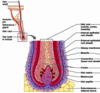
surrounds the root of hair - a tube like depression of epidermal cells into the dermis containts: papilla, root, shaft, dead epidermal, melanin attatched to arrector pili
63
4 types of skin glands
Sebaceous Eccrine Apocrine Ceruminous
64
Sebaceous Glands
Simple, branched, acinar glands everywhere except palms secrete sebum
65
Eccrine Glands
simple, coiled, tubular glands produce sweat: mostly water, salts, urea
66
Sudoriferous glands
sweat glands that empty their contents onto the skin surface via pores and hair follicles exist as eccrine and apocrine glands
67
Apocrine Glands
simple, coiled, tubular glands produce protein and lipid rich secretions found in auxillary and groin regions
68
Ceruminous glands
modified glands of external ear secrete earwax/cerumen
69
Mammary Glands
functional in women/ modified sweat glands
70
Finger nails
tightly packed, hard, keratinized epidermal cells from tip to base organizations is: Free Edge of Nail Body of Nail Lateral Nail Fold Lunula Eponychium (cuticle)
71
Thermoregulation
Homeostatic regulation of body temp
72
Cutaneous Sensations:
sense pressure and temperature
73
Meisner's Corpuscles
sense light touch
74
Pacinian Corpuscles
sense deep pressure
75
Healing wounds: 2 ways
Epidermal Wound Healing: superficial wounds only Deep Wound Healing: occures when a wound extends into the dermis or subcutaneous area
76
Hypertrophic Scar
over production of collagen fibers where a wound as heeled, does not extend beyond the boundaries of the wound
77
Keloid Scar
over growth of collagen fibers, extends beyond the boundaries of the wound
78
Developmental Anatomy Stages
8 weeks: fertilization cells arise from the ectoderm 11 weeks: dermis forms from mesoderm, nails form 9-12 weeks: hair follicles form, lanuga seen a 5th and 6th months 20 weeks: sudoriferous glands form 6 months: vernix caseous forms
79
Vernix Caseous
mixture of dead epidermal cells, secretions from sebacious glands, and dead hair cells
80
What happens when we age?
collagen fibers stifen, decrease in # and break elastic fibers lose elasticity and clump sweat production diminishes melanocytes dwindle subcutaneous fat is lost skin is thinner and harder to heal
