What is Complement?
Describe the complement system aka complement:
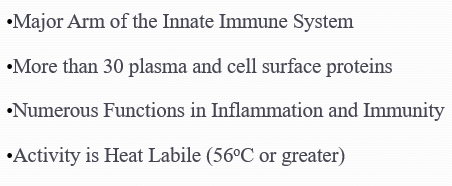
- Evolved as part of innate immunity
- collection of soluble proteins present in blood and other body fluids.
- Composed of >30 different plasma proteins, produced mainly by liver.
- In absence of infection circulate in an inactive form.
What are stages of complement action?
What are zymogens?
- proteases of the complement system that are initially synthesized as inactive pro-enzymes.
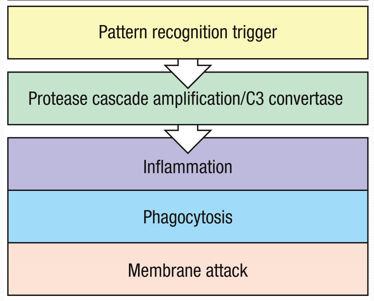
- Complement pathways are triggered by proteins that act as pattern recognition receptors to detect the presence of pathogens. This detection activates an initial zymogen, triggering a cascade of proteolysis which complement zymogens are activated sequentially, each becoming an active protease that cleave sand activates many molecules of the next zymogen in the pathway, amplifying the signal as the cascade proceeds.
Define opsonization
coating a pathogen with antibodies and/or complement proteins so that it can be more readily taken up and destroyed by phagocytic cells.
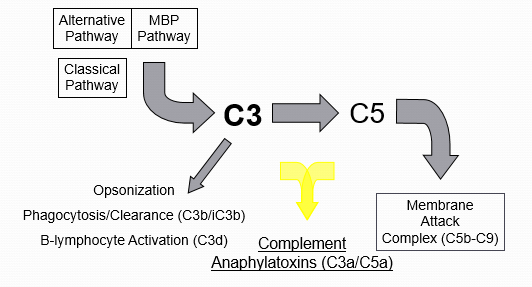
What are the functions of the complement?
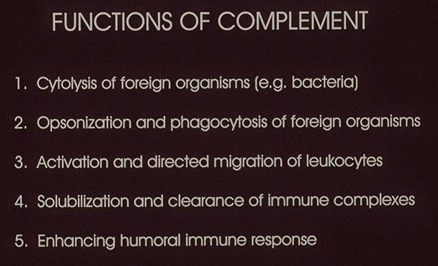
2 = most important of the functions
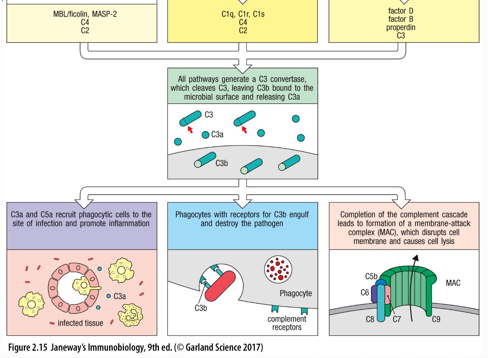
Main 3 effector pathways = Inflammation, phagocytosis, and membrane attack.
3a and 5a are important to mobilize leukocytes to migrate to infection
Complement activation is largely confined to ______ on which it is initiated.
-surface
[mechanisms to control the complement cascade from activating elsewhere in body; C4b and C3b are inactivated by hydrolysis unless its exposed thioester rapidly makes a covalent bond; C2 becomes susceptible to cleavage by C1s only when it is bound by C4b]
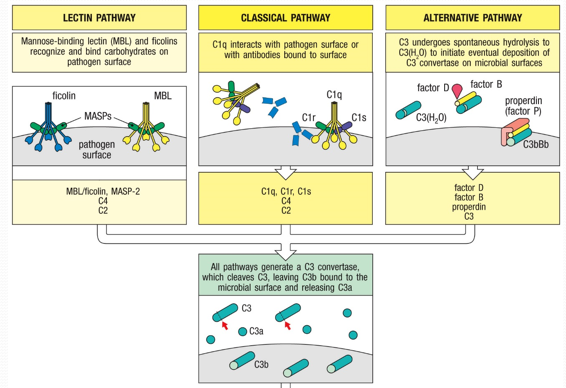
List 3 pathways of activation of the complement system
What is the critical step in complement activation that leads directly or indirectly to all effector activities in the complement system?
C3 cleavage
What is C3 involved in?
What’s a key feature of C3b?
See diagram for C3.
Key feature of C3b = Ability to form a covalent bond with microbial surfaces which allows innate recognition of microbes to be translated into effector responses. Covalent bond formation is due to a highly reactive thioester bond (on alpha chain of C3) that is hidden inside the fodled C3 protein and cannot react until C3 is cleaved. C3b reacts with a hydroxyl or amino group on the nearby microbial surface. If no bond is made, the thioester is rapidly hydrolyzed, inactivating c3b; a way that the alternative pathway is inhibited in healthy individuals.
What do all pathways have in common?
All pathways generate C3 convertase
How is the classical pathway activated?
C1q interacts with pathogen surface or with antibodies bound to surface
- primarily IgG and IgM immune complexes
- IgM > IgG3 > IgG1 > IgG2
- IgG4, IgA,IgD, and IgE do not activate
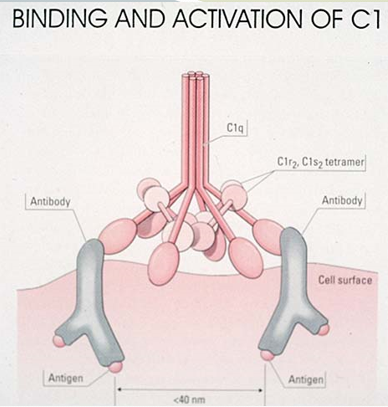
Detail the structure of C1
C1q = hexamer of trimers, composed of monomers that contain an amino-terminal globular domain and a carboxy-terminal collagen-like domain. 6 globular heads of the C1q molecule are held together by their collagen tails.
-C1q = pathogen sensor of the classical pathway. Recognition function of C1q resides in the globular heads (need 2 or more heads to interact with ligand).
C1q binds to 1) surface components on some bacteria (e.g. certain proteins of bacterial cell walls and polyanionic structures such as the lipoteichoic acid on gram-positive bacteria) and 2) binds to CRP
-C1r and C1s are closely related to MASP-2
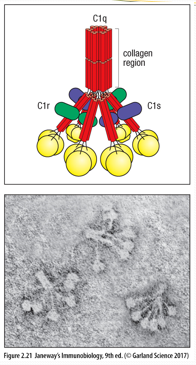
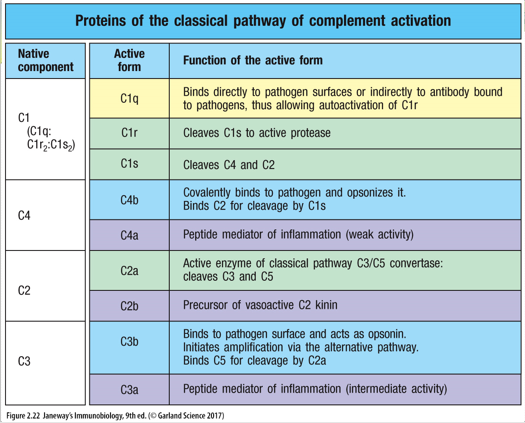
In the classical pathway,
- C1 is composed of? functions?
- C4 is composed of? functions?
- C2 is composed of? functions?
- C3 is composed of? functions?
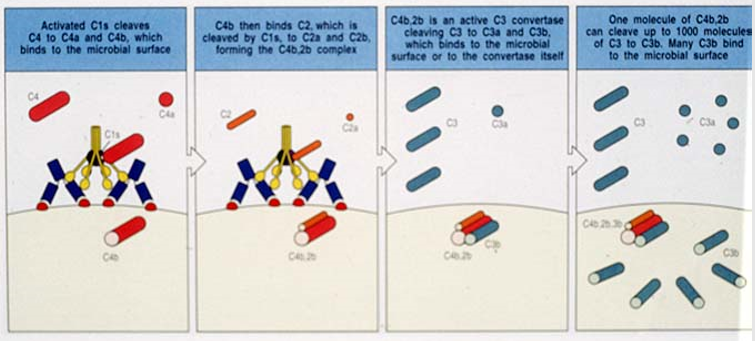
In the classical pathway, how is C4b,2b complex formed and what does it do?
1) Activated C1s –> C4 cleavage to C4a & C4b
2) C4b binds to C2 which is cleaved by C1s to C2a & C2b
3) C4b,2b complex (formerly known as C4b2a - very confusing but the larger subunits are traditionally ‘b’) is formed and is an active C3 convertase –> C3b & C3a
1 molecule of C4b, 2b complex can cleave 1000 molecules of C3 to C3b –> many C3b bound to microbial surface.
What is the main function of C1q in an immune response?
- bind to the constant, Fc, region of Abs that have bound pathogens via their antigen-binding sites
- C1q thus links effector functions of complement to recognition provided by adaptive immunity
- this limits usefulness of C1q in fighting first stages of an infection but some antibodies e.g. natural antibodies are produced by the immune system in the apparent absence of infection
- most natural antibody is of IgM class and most efficient at binding C1q.
In the lectin (MBL) pathway for the MBL-MASP complex,
- MBL is ___-like
- MBL-associated serine protease is ____ & ____
- like -MBL-MASP binds to ______ on gram-___ bacteria
- Initiates classical pathway activation _____ of Ab
- MASP cleaves ___ & ____
C1q-like;
C1r & C1s-like;
polysaccharides on gram-negative bacteria;
independent;
C4 & C2
Diagram of MBL pathway
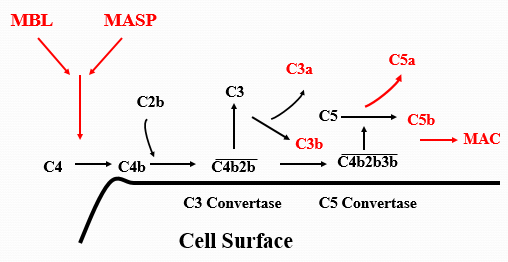
In the MBL pathway,
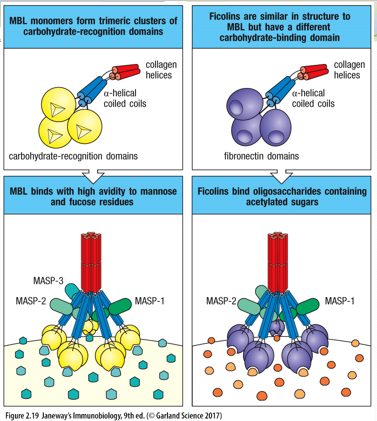
- MBL monomers form trimeric clusters of _____
- recognition domains and MBL binds with high avidity to ____ and ____ residues. They associate with MASP-(___ to ___)
- Ficolins are similar in structure to MBLs but have a different ______-binding domain which is a _____ domain. Ficolins bind _____ containing _____ sugars. They associate with MASP-(___ to ___)
- trimeric clusters of carbohydrate-recognition domains; high avidity to “mannose” and “fucose” residues; MASP-1, MASP-2, and MASP-3
- carbohydrate-binding domain which is a fibronectin domain; oligosaccharides containing acetylated sugars; MASP-1 and MASP-2
In the MBL pathway,
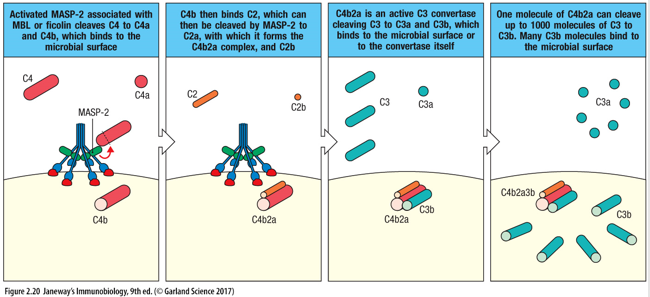
- Activated MASP-2 associates with ____ or ____ which cleaves _____ to ____ and _____, which binds to the surface
- C4b then binds to ____ which can then be cleaved by ____.
- ______ is an active C3 convertase and cleaves C3 to C3b and C3a.
- ______ is an active C5 convertase
- MBL or ficolin which cleaves C4 to C4b and C4a; C4b binds to microbial surface
- C4b then binds to C2 which can then be cleaved by MASP-2
- C4b2a is an active C3 convertase (can also be listed as C4b2b)
- C4b2a3b is an active C5 convertase (can also be listed as C4b2b3b)
What activates MASP-2 in the lectin pathway?
MASP-1 when MBL binds a pathogen surface and a conformation change occurs in MASP-1.
How does C4 bind to the microbial surface?
Through a reactive thioester on C4b, similar to C3b
The alternative pathway is an amplification loop for C3b formation. How is this done?
- The alternative pathway has a unique C3 convertase: C3bBb (C3b bound to a cleavage fragment of plasma protein factor B)
- C3bBb cleaves many C3 molecules and therefore can acts as an amplification loop to increase C3b production rapidly.
How is the alternative pathway activated?
2 ways
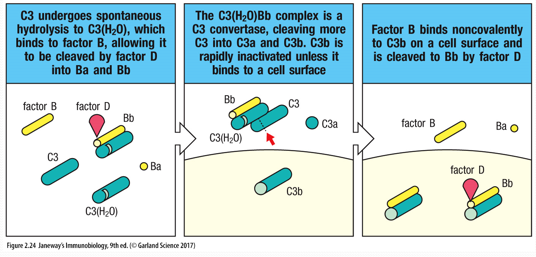
- By action of the lectin or classical pathway: C3b binds factor B on pathogen surface and bound factor B is cleaved by plasma protease factor D à Ba & Bb
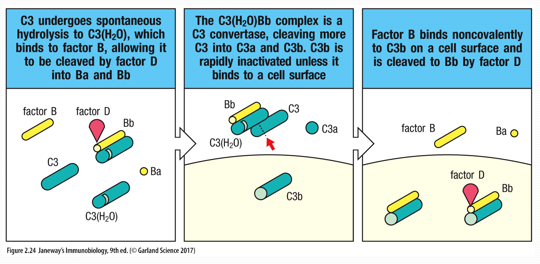
- Spontaneous hydrolysis (known as ‘tickover’) of the thioester bond in C3 to form C3(H20)
- C3 is abundant in plasma and tickover causes steady, low production of C3(H20)
- C3(H20) binds factor B cleavage by factor D short-lived fluid-phase C3 convertaseC3(H20)Bb.
- Small amounts of fluid-phase C3(H20)Bb can cleave many C3 C3a & C3b but most C3b is inactivated by hydrolysis except for some that attach to microbial surface by thioester bond.