What is the gamete distinction between males and females?
Males have lots of small gametes and females have few large gametes.
Describe sex chromosome types for most male and most female mammals?
Most females have two X sex chromosomes and most males have a single X sex chromosome and a smaller Y sex chromosome.
The X and Y sex chromosomes pair in the course of _____ and segregate, but are not ________ along their length. Most genes on the X chromosome are _______ from genes on the Y chromosome.
meiosis, homologous, different
Sex determination is?
the mechanism by which sex is established.
What is it called when both sexes are present in the same organism? These organisms are said to be?
hermaphroditism
monoecious meaning one house
What is it called when an organism has either a male or a female structure separate? Among these sex may be determined by three things. Name them?
dioecious meaning two houses. Humans are dioecious. Among dioecious species sex may be determined chromosomally, genetically or environmentally.
Sex is determined in mamales by the ________ system. It can be different in other organisms like insects or birds. Ie Isopod males have ________ chromosomes while females have ________ chromosomes.
- XX/XY
- two Z (ZZ)
- ZW
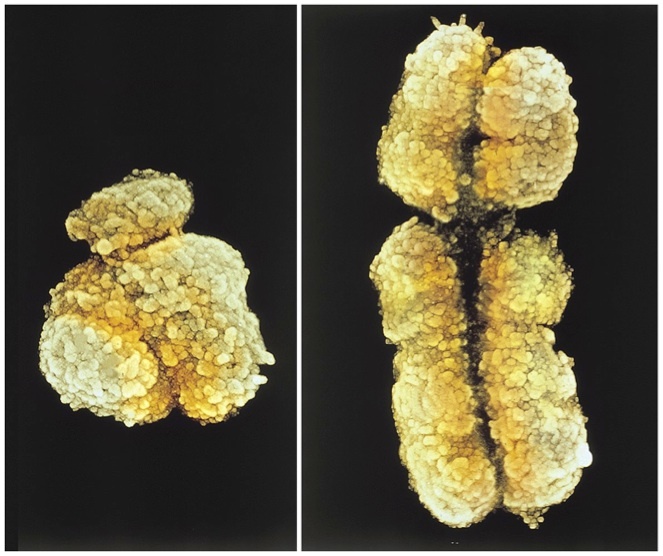
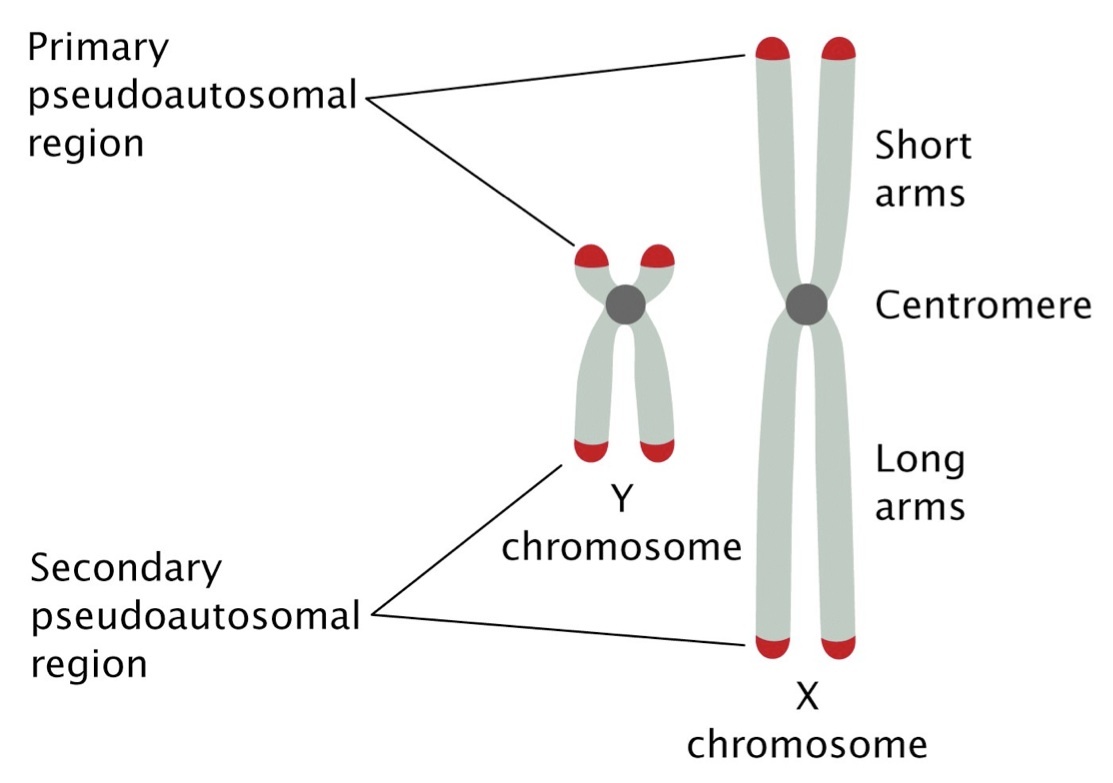
The Y chromosome differs in the X chromosome in size and shape explain?
Y on the left is smaller and has different shape. see below
- The platypus and echidna are what type of animal?
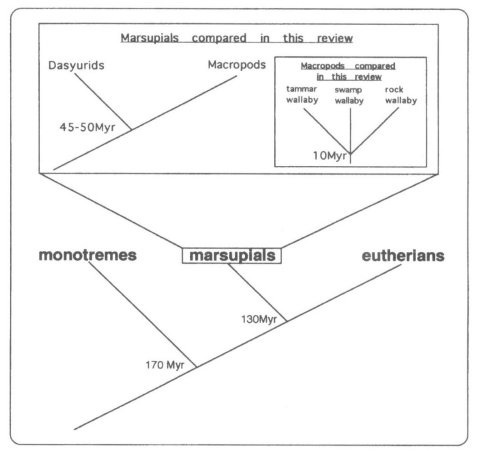
- How do they sit on the evolutionary tree?
- And how many X and Y chromosomes do the platypus and echidna have?
- What else is unique about these two?
- Monotreme
- Monotremes are the first offshoot on the mammalian evolution tree
- The platypus is a mammal that has 10 sex chromosomes (10 X for female, 5 X and 5 Y for male), Echidna had 10X in female, 5X and 4Y in male
- Form a long chain during meiosis and they have both bird and reptilian homologous areas
Genetic content of X and Y chromosomes is _______
different
Do males and females contain the same number of alleles at sex-linked loci? This produces what?
No, This produces distinct inheritance patterns
The term sex refers to what? and Sex is established by what?
- phenotype (usually two phenotypes, male and female)
- sex determination
What year was the first X chromosome was discovered in male insect cells?
1891
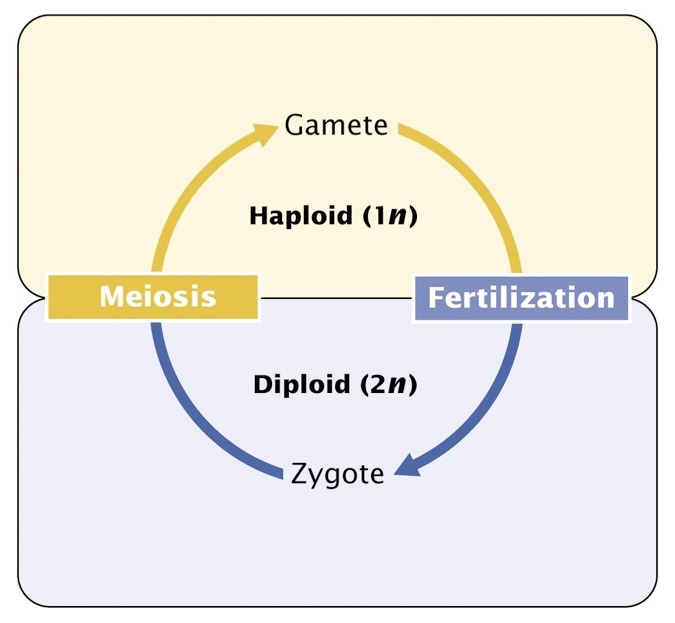
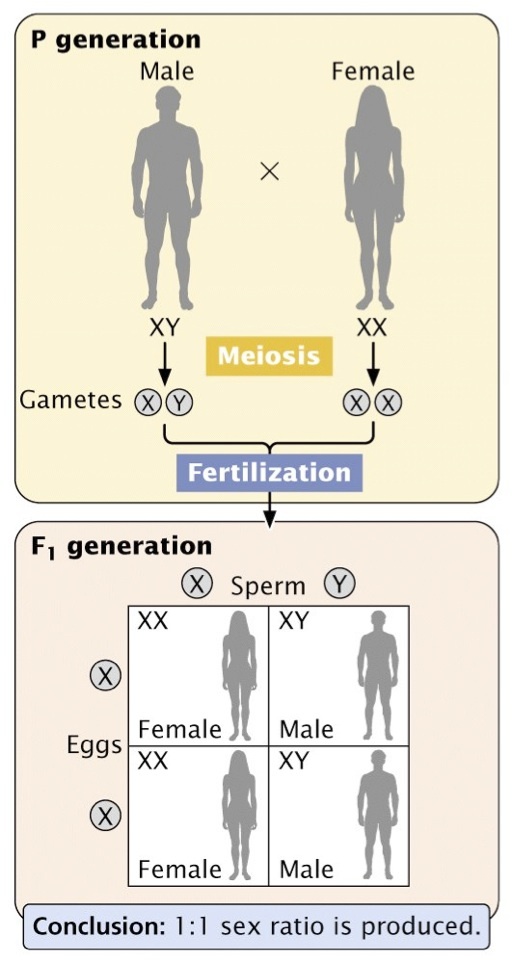
Explain how X and Y chromosomes are separated between male and female during meiosis and through to fertilisation.
Because female has XX female gametes can only ever be X but male gametes can be X or Y, ie ovum only is ever X while sperm can by X or Y.
The sex chromosomes in humans are X and Y. The non-sex chromosomes are called what?
autosomes
Explain XX-XO sex determination in relation to a well known insect.
Females have 2X and males 1X. The O represents that there is no chromosome. In meiosis females gamete get an X each while male gametes get an X and the other half get no sex chromosomes. So in fertilisation the XX forms females and XO form males.
Because males produce two different types of gametes with respect to the sex chromosomes they are said to be the
Heterogametic sex
Females which produce two gametes that are all the same with respect to the sex chromosomes are the
homogametic sex
What organisms use XX-XY as sex determination?
some plants, insects and reptiles and all mammals.
X and Y are not generally homologous but they do pair and segregate to different cells during meiosis. They pair because X and Y chromosomes are homologous in small regions called?
psuedoautosomal regions which are the regions they carry the same genes. See picture of humans below.
Explain ZZ-ZW sex determination and what organisms use this?
ZW is female
WW is male, use Z and W to differ from XX-XY, ie it is opposite. This system is found in birds, snakes, butterflies, some amphibians and some fishes.
Haplodiploidy is?
a sex-determination system in which males develop from unfertilized eggs and are haploid, and females develop from fertilized eggs and are diploid.
In this system, sex is determined by the number of sets of chromosomes an individual receives. An offspring formed from the union of a sperm and an egg develops as a female, and an unfertilized egg develops as a male. This means that the males have half the number of chromosomes that a female has, and are haploid.
bees, ants, and wasps use this system
females 2n, males n
genic sex determination is
when sex can be determined without sex chromosomes.
Must remember that even in systems that have sex chromosomes sex is still only determined by genes. For instance in mammals a gene SRY on the Y chromosome determines the male phenotype.
Environmental sex determination is?
when the environment determines sex.
slipper limpet - stacks ontop of each other females on bottom then males on top and the stack goes on and on female, male etc.
turtles - warm temperatures produce females at certain times of the year while alligators reverse is true.

-
Intro-Ch1-P1-926
-
Intro-Ch1-P1-9-Reverse26
-
Intro-Ch1-P9-14End27
-
Intro-Ch1-P9-14End-Reverse27
-
Top1-Ch2-P15-1924
-
Top1-Ch2-P15-19-Reverse24
-
Top1-Ch2-P19-2425
-
Top1-Ch2-P19-24-Reverse25
-
Top1-Ch2-P24-42End28
-
Top1-Ch2-P24-42EndReverse28
-
Top2-Ch3-P43-4822
-
Meiosis in plants-Ch2-P35-3710
-
Top2-Ch3-P43-48-Reverse22
-
Top2-Ch3-P48-71End19
-
Top2-Ch3-P48-71EndReverse19
-
Top3-Ch4-P73-7825
-
Top3-Ch4-P73-78Reverse25
-
Top3-Ch4-P78-97End26
-
Top3-Ch4-P78-97EndReverse26
-
Top4-Chp5-P99-10420
-
Top4-Ch5-P99-104Reverse20
-
Top4-Ch5-P105-11721
-
Top4-Ch5-P105-117Reverse21
-
Top4-Ch5-P117-13318
-
Top4-Ch5-P117-133Reverse18
-
Top5-Ch6-P135-14620
-
Top5-Ch6-P135-146Reverse20
-
Top5-Ch6-P146-160End22
-
Top5-Ch6-P146-160EndReverse22
-
Top6-Ch7-P161-16721
-
Top6-Ch7-P161-167Reverse21
-
Top6-Ch7-P168-202End33
-
Top6-Ch7-P168-202EndReverse33


