Fatal Medication Errors (FME)
- The “July effect”; FME in teaching hospitals were shown to increase by 10% above expected levels during the month of July.1 This spike in FME has been attributed in part to the large number of doctors that start their residencies at this time.
- FME constitute a leading cause of fatal motor vehicle accidents in the U.S. (probably > motor vehicle accidents)
Pharmacokinetics
Concentration in plasma is always changing
It is dynamic, response is always going up and down on dose-response cuve around the efficacy point
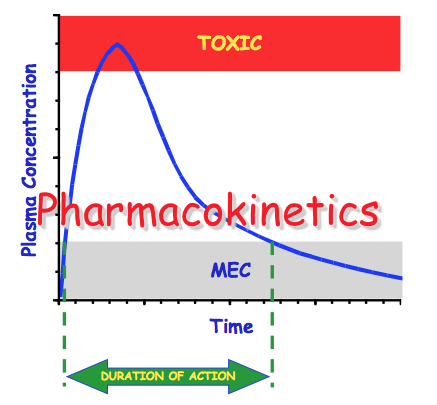
Concentration of Free Drug
Assume that free concentration of drug in plasma equal to the concentration of drug bound to receptors. It is regulated by many things, absorption, excretion, site of action, etc…
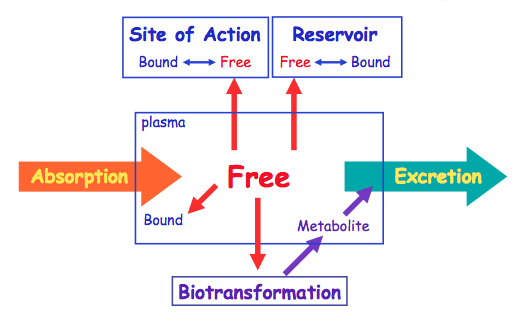
What are the major mechanims of drug transport?
- Passive Diffusion
- Filtration
- Endocytosis
- Facilitated Diffusion
- Active Transport
Passive Diffuesion
- Passively move across membrane due to concentration gradient*
- Remember, at any point in time drug is going both ways across membrane, BUT the NET response is the way it is moving…
- It will eventually become equilized and move to steady state…
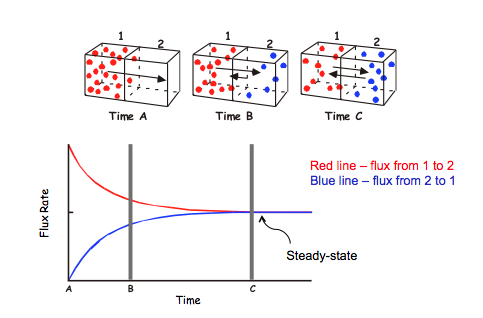
Passive Diffusion main points..
- Does not require energy input - energy is provided by the gradient
- It does not saturate (approach some maximum rate of flux) when the chemical concentration gradient is large
- It is not inhibited by structurally similar compounds – every compound behaves independently
Rate of Passive Diffusion
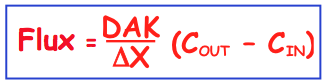
Respresneted by the FIck equation
- Concentration gradient - (Cout– Cin)
- Diffusion constant (inversely proportional to size) - D
- Membrane:water partition coefficient (measure of relative lipid solubility) - K
- Membrane surface area - A
- Membrane thickness - deltaX
- Permeability constant (P) – DAK/deltaX (vol/time)
Know what flux is proportional to and what is it iinversely proportional to (if size of membrane is doubled.. what will happen to flux)
It is directly proportional to P
Effect of Ionization on passive diffusion
- Ionized compounds do not cross membranes very well (not soluable in membrane - lipds)
- Neutral compounds DO cross membrane (they are somewhat soluable)
- Acid is a proton donor
- Base is a proton Acceptor
- So many drugs are weak acids or weak bases.. if they accept or give up a proton it will effect how they cross the membrane
Ion trapping - if there is a pH gradient, compounds will be ‘trapped’ on one side of membrane or the other
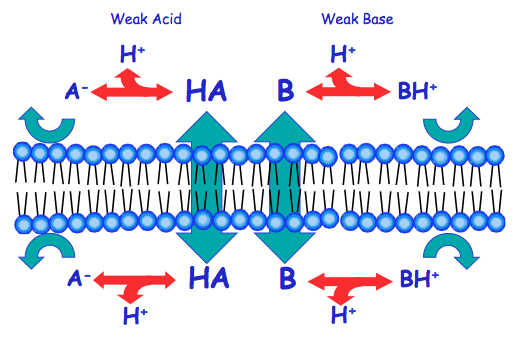
How do we manage ionization effects?
Use Henderson-Hasselbach equtation
So if we know the pH we can calcualte the concentrations of inoized and neutral forms of weak acids and weak bases..
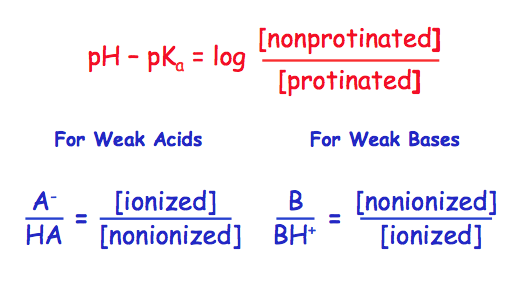
Ion Trapping
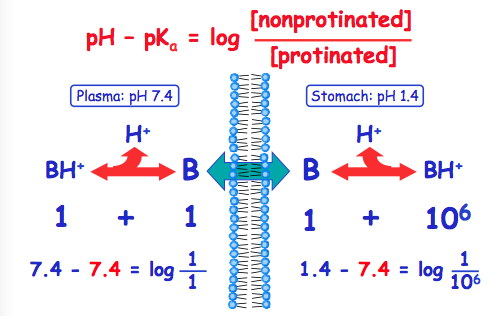
Concentration may differ on either side of membrane.. how does this effect weak acids adn bases..
So on right side there is a million of the protinated Base for each neutral Base.. There are 500,000 times more of drug (BH) on the right side - they are trapped
- Weak bases will tend to be trapped in realitively acidic environments
- Weak acids will tend to be trapped in realitively basic environments
Diphenhydramine is a weak base…
- Approximately 70% of drugs in current use
are weak bases - A weak base (pKa = 8.98) due to the primary amine group, it is > 95% ionized at physiological (7.4) pH.
The process of ion trapping provides a likely explanation for which one of the following observations? (drugs ‘trapped’ in urin as ions will be eliminated while those present in urine as the neutral form will be reabsorbed)
(sodium bicarb increases pH, ammon Cl decreases pH)
admin of sodium bicarb to increase urine pH promotes renal elim of weak base
Admin of ammonium chloride to decrease urin pH promotes renal reabsorption of weak base
admin of amm chl to dec urin e pH promoteds renal elim of weak acid
Admin o sodium bicarbo to increase urin pH promotes rena elim of weak acid
admin of sodeium bicar bo increaese urin pH promontes renal reabsor of waek acid
Renal elimination vs Renal absorption (in reabsorption, the neutral form will follow water back across the membrane)
A - It will be neutral so it wont be eliminated
B - Weak base will be ionized form (no absorption)
C - Weak acid wiil be neutral (absorbed)
D - YES
E - Weak acid will be ionized (eliminated)
Bulk Flow Mechanisms
- Filtration - flow of fluid through a channel
- (filtration) Capillary beds have large pores (they are leaky), large particles (30,000 to 40,000 mol weights) can pass from plasma to extracellular fluid (water)
- Endocytosis - Cell wall invaginates and engulfs a volume of fluid (can be selective or non-selective)
- Opposite is exocitosis
Carrier mediated mechanism
Facilitated Diffusion
Facilitated Diffusion
- Movement down electrochemical gradient
- Selective & inhibited by similar chemicals
- Saturate at high substrate concentrations
Carrier Medicated Mechanisms
Active Transport
Active Transport
- Movement against electrochemical
gradient - Requires energy
- Primary (ATP hydrolysis) vs. secondary
(coupled to another compound’s gradient) - Selective & inhibited by similar chemicals**
- Saturate at high substrate concentrations**It binds a substrate, it has a binding site for a specific compound. It can bind that substrate (or similar structure, antagonist, etc)
Carrier Mediated Mechanisms
ATP binding cassette (ABC) Super family
ATP-binding cassette (ABC) superfamily
- Active transporters (1° mechanism)
- Move substances out of cells or into cell organelles
- e.g., p-Glycoprotein (MDR1) (multi drug resistant protein)
p-glycoprotein is imporant… In tumor cells they over express this p-glycoprotein transporter - it actively pumps drugs out of cells..
Carrier Mediated Mechanism
Solute Carrier (SLC) superfamily
Solute carrier (SLC) superfamily
- Participate in facilitated diffusion (can transport ions) and active (2º) transport
- Move substances into and out of cells
- e.g., SERT, DAT (major role in the
nervous system, dopamine and serotonin termination (reuptake))
Carrier Mediated Mechanisms
Both ABC and SLC are very important
Both (ABC and SLC)
- Pharmacologically important
- Work in concert to move compounds into and out of cells
Work with metabolizing enzymes to facilitate drug elimination - Targeted by specific drug therapies
- Can account for many drug toxicities, drug-drug interactions**, and inherited susceptibilities
What attribute of both ABC and solute carrier transporters is most likely to explain their role in many drug-drug inteactions?
Both act to transport ionized drugs across cell membranes
Both are capable of transporting compounds against their concentration gradient
Both are coded for by very large gene families
Both are selective and inhibitite by closely related compounds
Both obtain required energy from hydrolysis of ATP
A - True, but doesnt provide mechanism for drugdrug interactions
B - Solute carrier transporters operate through secondary mech and some through facillitated (so not accross grad)
C - No
D - YES. Idea that these are selected and inhibited by closly related compounds.. So if have two drugs with similar structures they will compete
E - Some do, but not all, SLC is facilitated
Absorption of Drugs
- Most drugs are absorbed by passive diffusion
- Routes of administration
Enteral - “via the intestines”
Parenteral - “outside the intestines” - Realative rate of uptake: IM >_ SC >_ Oral, takes longest for oral to be absorbed
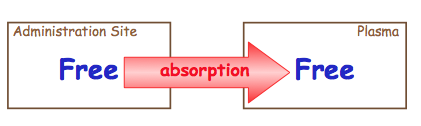
Oral route of drugs
Advantages and Disadvantages
Advantages
- Easy admin
- Cheap
- Safety
- Good pt compliance
Disadvantages
- Some drugs are destroyed in GI tract (too acidic)
- 1st pass metabolism (liver acts on oral drugs before it even hits systemic circulation)
- Variable rate - Rate of uptake is variable - GI tract is ‘on demand’ depending on when ppl eat
Bioavailability of Oral drug dosing
What is it and how to measure it
- Fraction (f; from 0 to 1) of the administered dose that enters the general circulation
- Oral bioavailability (pharmacokinetic method) = AUC oral / AUC iv
- where AUC refers to the area under the plasma concentration-time curveArea under curve/ area under curve
What is Lipinski’s Rule of 5
(oral drug dosing)
Most drugs exhibiting good bioavailability possess the following attributes
- Not > 5 H-bond donors (O or N with 1 or more H)
- Not > 10 H-bond acceptors (total O or N)
- Molecular mass < 500
- Octanol:water partition coefficient (log basis) < 5
• Describes a relatively small, moderately lipophilic molecule**
• Influential basis for evaluating potential drug candidates
If a drug violates Lipinski’s Rule of 5 it will not be produced* Drug companies want to formulate oral forms of drugs.
SL (dosing)
Rectal
IV
Sub Lingual
- good becuase it often avoids 1st pass metabolism
Rectal
- often avoids 1st pass (mostly)
When something is injected IV -
- control dose perfectly, control timing perfectly, rapid form of administration, BUT once you inject it you cant take it back (if oral, there is a window of opportunity to reverse the efects.. pump it out if OD)


-
Week 2 - Cell Biology102
-
Week 3 - Microbiology Bacterial Structure80
-
Week 3 - Microbiology Viral Structure30
-
Week 3 - Microbiology Fungal Structure21
-
Week 3 - Microbiology Bacterial Growth and Physiology44
-
Week 3 - Tetrahydrofolate, Vitamin B12, and S-Adenosylmethionine74
-
Week 3- Glycogen Metabolism82
-
Week 3 - Microbiology Viral Replication83
-
Week 3 - Microbiology Tumor Virology55
-
Week 3 - Intro to Antibiotics70
-
Week 3 - Nucleotide Metabolism43
-
Week 3 - Microbiology - Bacterial Pathogenesis and Host Defense41
-
Week 3 - C.Diff Case Study37
-
Week 3 - Cholesterol Metabolism49
-
Week 3 - Steroid Hormone Synthesis13
-
Week 3 - Microbiology Vial, Fungal, and Parasite Pathogensis61
-
Week 3 - Antibiotics - Cell Wall Inhibitors47
-
Week 3 - Microbiology - Bacterial Genetics47
-
Week 3 - Microbial Diagnosis21
-
Week 4 - Antibiotics: Inhibitors of Nucleic Acid Synthesis48
-
Week 4 - Antibiotics: Inhibitors of Protein Synthesis61
-
Week 4 - Personalized Medicine27
-
Week 4 - Cytochrome p-450 Enzymes22
-
Week 4 - Intro to Physiology17
-
Week 4 - Intro to Cardiovascular Physiology19
-
Week 4 - Pharmacodynamics43
-
Week 4 - Pharmacokinetics58
-
Week 4 - Case Study: Drinking as a lifestyle19
-
Week 4 -Pulmonary (Resperatory) Physiology17
-
Week 4 - Renal (Kidney) Physiology13
-
Week 4 - GI Physiology13
-
Week 4 - Fructose Pathway18
-
Week 4 - Galactose Pathway11
-
Week 4 - Pentose Phosphate Pathway21
-
Week 4 - Pharmacokinetics Continued53
-
Week 4 - Gluconeogenesis33
-
Week 4 - Integration of Metabolism4
-
Week 5 - Transport Across Membranes46
-
Week 5 - Cell Division24
-
Week 5 - Ion Channel Physiology40
-
Week 5 - Cell Death0
-
Week 6 - Immunology0


