- Depolarisation of a neurone
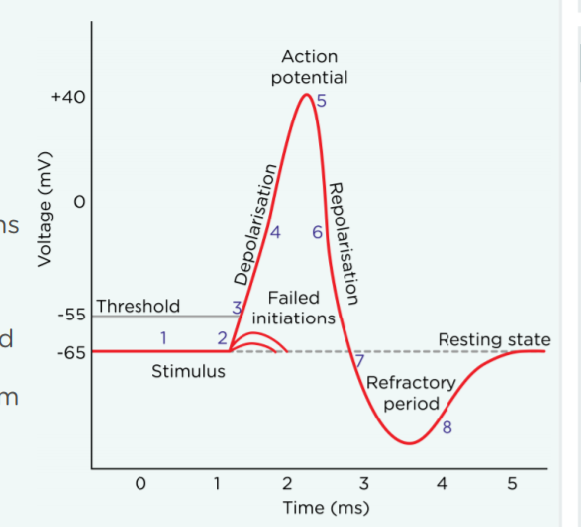
When the neurone receives an impulse from sensory receptors, sodium channels on the dendrites open, leading to the movement of Na+ ions into the cell causing depolarisation
- If depolarisation reaches the threshold potential…
If this depolarisation reaches the threshold potential it activates voltage-gated sodium channels causing an action potential.
- Repolarisation of a neurone
After Voltage-gated sodium ion channels close, and voltage-gated potassium channels open, causing Repolarisation as K+ ions leave the cell
- Hyperpolarisation
Outward diffusion of K+ ions causes hyperpolarisation and the voltage-gated potassium channels close
- Return to resting membrane potential
Finally, the Sodium potassium pump returns the cell to the resting membrane potential.
What is the refractory period?
is the period in an action potential where the axon can’t be depolarised to initiate a new action potential. It limits the frequency of action potentials and ensures action potential are discrete & only travel in one direction.
Nature of action potentials
Action potentials are an all or nothing response because once the threshold is reached each action potential always depolarises the axon to the same voltage by voltage-gated sodium channels.
Draw an action potential diagram

-
The Nervous System25
-
Muscles6
-
Muscle Contraction9
-
Receptors4
-
Neuromuscular Junction9
-
Neurones and Resting Potential8
-
Transmission of Action Potentials5
-
Cholinergic synapse9
-
Action Potentials8
-
Anaerobic Respiration10
-
Biomass5
-
Production and Productivity7
-
Succession6
-
Microorganisms in Nutrient Cycles6
-
Ecosystems and Population Size9
-
Conservation14
-
Populations5
-
Photosynthesis15
-
Aerobic Respiration20
-
Cloning Animals7
-
Cloning Plants5
-
Control of Blood Glucose Concentration0
-
Diabetes7
-
Communication Systems10
-
Homeostasis7
-
Immobilised Enzymes7
-
Eukaryotic Cells15
-
Prokaryotic Cells0
-
Water10
-
Methods of Studying Cells9
-
Monomers & Polymers4
-
Lipids7
-
Inorganic Ions11
-
Carbohydrates14
-
Biochemical Tests8
-
Proteins17
-
Globular proteins6
-
Fibrous proteins8
-
DNA and RNA7
-
ATP6
-
Enzymes3
-
DNA Double Helix & Replication6
-
Genetic Information9
-
Protein synthesis6
-
Cell membranes7
-
Passive transport7
-
Active transport4
-
Mitosis20
-
Specialised cells13
-
Gas exchange6
-
Meiosis14
-
Surface area to Volume ratio4
-
Stem cellls10
-
Disease8
-
Cell-mediated Immunity2
-
Primary & Secondary Response3
-
Human Gas Exchange System13
-
Mass Transport in Animals15
-
Plant Responses & Hormones17
-
Mutations14
-
Water transport in plants0
-
Defences7
-
Vaccination and medicines14
-
The heart22
-
Components of the immune systems13
-
Humoral immunity3
-
Biodiversity21
-
Classification15
-
Natural selection9
-
Variation10
-
Kidney failure8
-
Control of Temperature10
-
Transcription factors0
-
Genes and alleles11
-
Monohybrid inheritance1
-
Dihybrid inheritance3
-
Linkage4
-
Epistasis7
-
Chi-squared test7
-
Microorganisms10
-
Electrophoresis4
-
Polymerase Chain Reaction (PCR)5
-
Disease COPY8


