You have been called to the general medical ward to see a 65-y.o. male admitted for syncope for investigation. On arrival, you find ward staff providing CPR. When you attach the patient to the monitor and pads it displays the following rhythm (see image).
Your initial action is to:
- Continue CPR for 2 minutes
- Immediately intubate the patient
- Immediately defibrillate using 200J
- Give adrenaline 1 mg IV
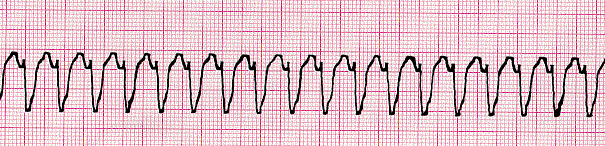
Your initial action is to:
- Continue CPR for 2 minutes
- Immediately intubate the patient
- Immediately defibrillate using 200J
- Give adrenaline 1 mg IV
Atropine is indicated for:
- All asystolic arrests
- Symptomatic bradycardia
- Ventricular fibrillation after the 4th shock
- All of the above
Atropine is indicated for:
- All asystolic arrests - no, not used in any arrest algorithm!
- Symptomatic bradycardia
- Ventricular fibrillation after the 4th shock
- All of the above
In reference to the following rhythm strip:
- There is co-ordinated atrial electrical activity
- The rate is less than 90 BPM
- A beta-blocker may be used to slow the rate
- The patient should be immediately defibrillated

In reference to the following rhythm strip:
- There is co-ordinated atrial electrical activity
- The rate is less than 90 BPM
- A beta-blocker may be used to slow the rate
- The patient should be immediately defibrillated
The correct management of a patient in pulseless electrical activity includes:
- Immediate defibrillation with 360J
- 300 mg of IV amiodarone
- 1 mg of IV adrenaline every 2 minutes
- High quality CPR
The correct management of a patient in pulseless electrical activity includes:
- Immediate defibrillation with 360J - PEA is not a shockable rhythm.
- 300 mg of IV amiodarone - only used in shockable rhythms
- 1 mg of IV adrenaline every 2 minutes - adrenaline is used every 2 cycles, not every 2 minutes
- High quality CPR
Chest compressions should be delivered:
- At a rate of 130 BPM
- At a compression: ventilation rate of 15:2 in the adult patient
- With an equal duty cycle of compressions and recoil
- Continuously in asystolic arrest
Chest compressions should be delivered:
- At a rate of 130 BPM - no, 100-120 BPM
- At a compression: ventilation rate of 15:2 in the adult patient - no, 30:2
- With an equal duty cycle of compressions and recoil
- Continuously in asystolic arrest - no, should stop for breaths and for analysing rhythm
Underlying conditions which may lead to cardiac arrest in adults include:
- Ischaemic heart disease
- Metabolic disturbances
- Massive trauma
- All of the above
Underlying conditions which may lead to cardiac arrest in adults include:
- Ischaemic heart disease
- Metabolic disturbances
- Massive trauma
- All of the above
Adrenaline:
- Is given as a 1 mg dose in cardiac arrest
- Causes vasodilation of all blood vessels
- Reverts ventricular fibrillation to sinus rhythm
- Should only be given to patients in ventricular tachycardia
Adrenaline:
- Is given as a 1 mg dose in cardiac arrest
- Causes vasodilation of all blood vessels - no, only those of brain and heart, it causes peripheral vasoconstriction
- Reverts ventricular fibrillation to sinus rhythm - not really, it does improve contractility
- Should only be given to patients in ventricular tachycardia - no, is given also to patients in PEA or asystole
The following rhythm:
- Has a rate of between 40-60 BPM
- Has a narrow QRS complex
- P waves appear to be unrelated to the QRS complex
- All of the above
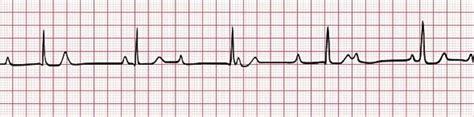
The following rhythm: (is a 3rd degree HB)
- Has a rate of between 40-60 BPM
- Has a narrow QRS complex
- P waves appear to be unrelated to the QRS complex
- All of the above
A 25-y.o. male is admitted after being found floating face down in a friend’s pool. On arrival to the emergency department, paramedics are delivering CPR. Your initial action is to:
- Connect the patient to the pulse oximeter
- Ensure that effective CPR is in progress
- Defibrillate the patient as soon as the defibrillation pads have been attached
- Gain IV access
A 25-y.o. male is admitted after being found floating face down in a friend’s pool. On arrival to the emergency department, paramedics are delivering CPR. Your initial action is to:
- Connect the patient to the pulse oximeter
- Ensure that effective CPR is in progress
- Defibrillate the patient as soon as the defibrillation pads have been attached
- Gain IV access
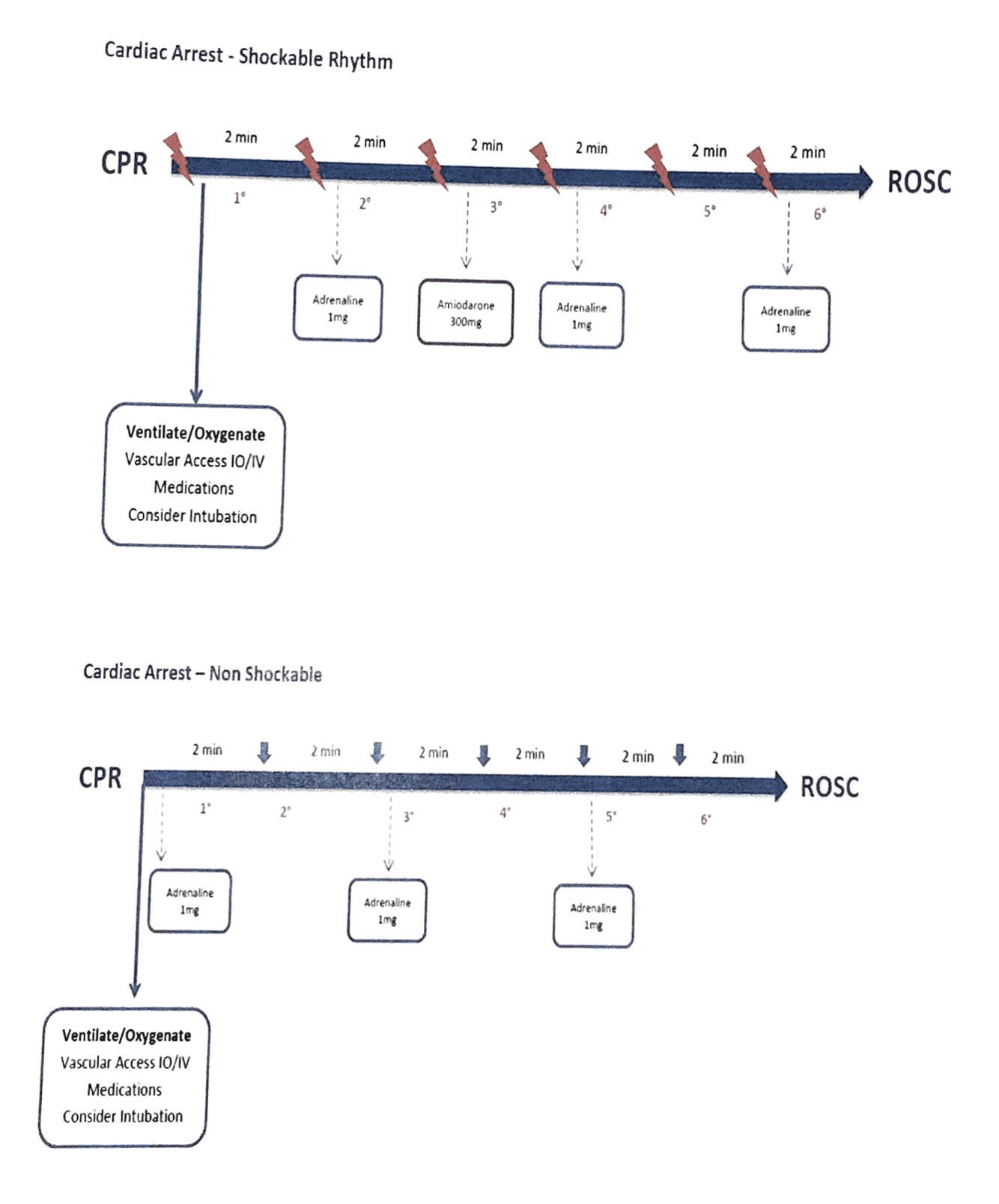
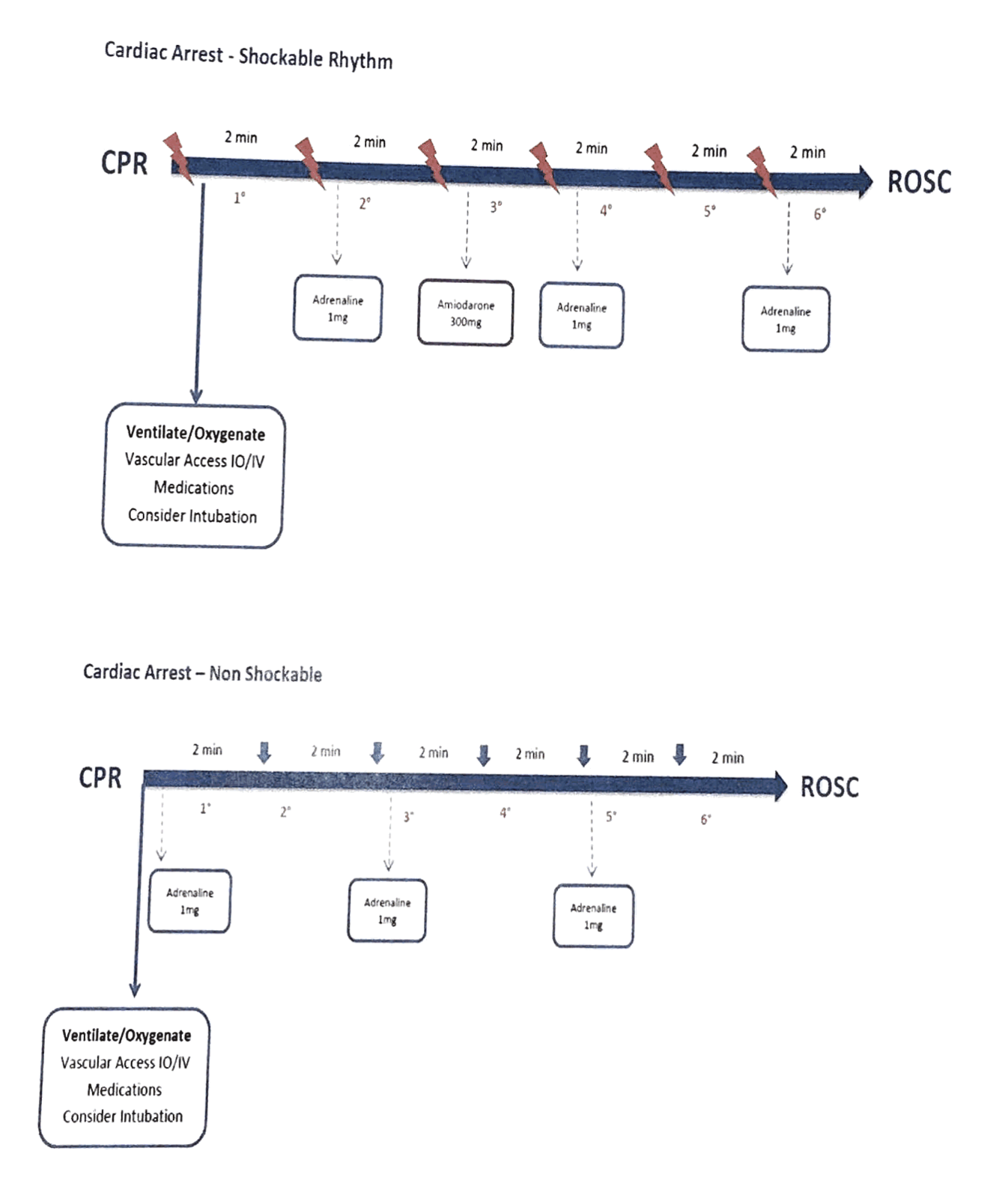
With both shockable and non-shockable algorithms, the first step is CPR.
Defibrillation:
- Should be attempted for all cardiac arrests
- Should be delivered at 150 J using a monophasic defibrillator
- Will always revert ventricular tachycardia to sinus rhythm
- Should be attempte as soon as the pads have been attached in ventricular fibrillation
Defibrillation:
- Should be attempted for all cardiac arrests - incorrect, only shockable rhythms
- Should be delivered at 150 J using a monophasic defibrillator - incorrect, is at 360 J for monophasic defibrillators and 200 J for biphasic
- Will always revert ventricular tachycardia to sinus rhythm
- Should be attempte as soon as the pads have been attached in ventricular fibrillation
Blood sugar levels in the post resuscitation period:
- Should be maintained at a level of 4-10mmol
- Should be attended every 1/2 hour
- Should only be checked if hypoglycaemia suspected
- Are rarely below 20mmol
Blood sugar levels in the post resuscitation period:
- Should be maintained at a level of 4-10mmol
- Should be attended every 1/2 hour
- Should only be checked if hypoglycaemia suspected
- Are rarely below 20mmol
A precordial thump:
- Should be used for asystolic arrest
- Should only be attempted after 15 min of CPR
- May be attempted in a witnessed, monitored VT arrest
- Should only be undertaken by a cardiologist
A precordial thump:
- Should be used for asystolic arrest
- Should only be attempted after 15 min of CPR
- May be attempted in a witnessed, monitored VT arrest
- Should only be undertaken by a cardiologist
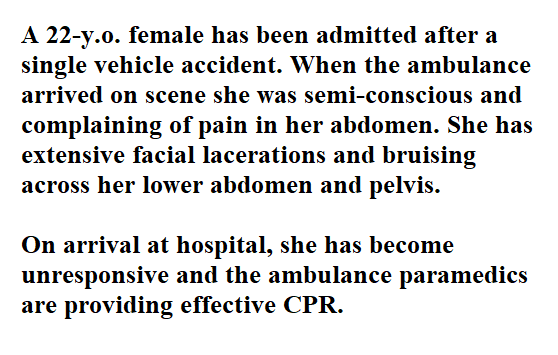
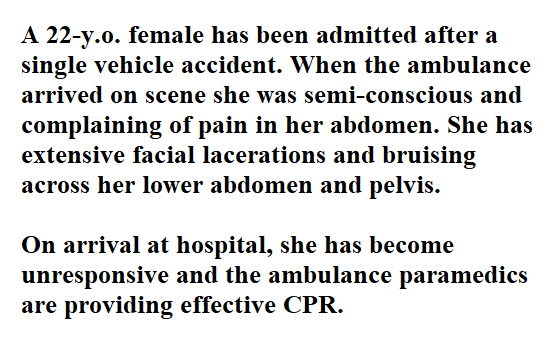
Read the attached scenario.
Your initial action includes:
- Order an abdominal x-ray
- Set up for immediate intubation
- Attach monitoring leads and pads to the patient
- Place an indwelling catheter
Your initial action includes:
- Order an abdominal x-ray
- Set up for immediate intubation
- Attach monitoring leads and pads to the patient
- Place an indwelling catheter
Read the attached scenario.
When you attach the defibrillator pads and perform a charge and check the monitor, it displays the following rhythm shown.
Your next action is to:
- Deliver a precordial thump
- Continue CPR for 2 minutes before delivering a shock
- Deliver a shock of 200J
- Give amiodarone 300mg IV
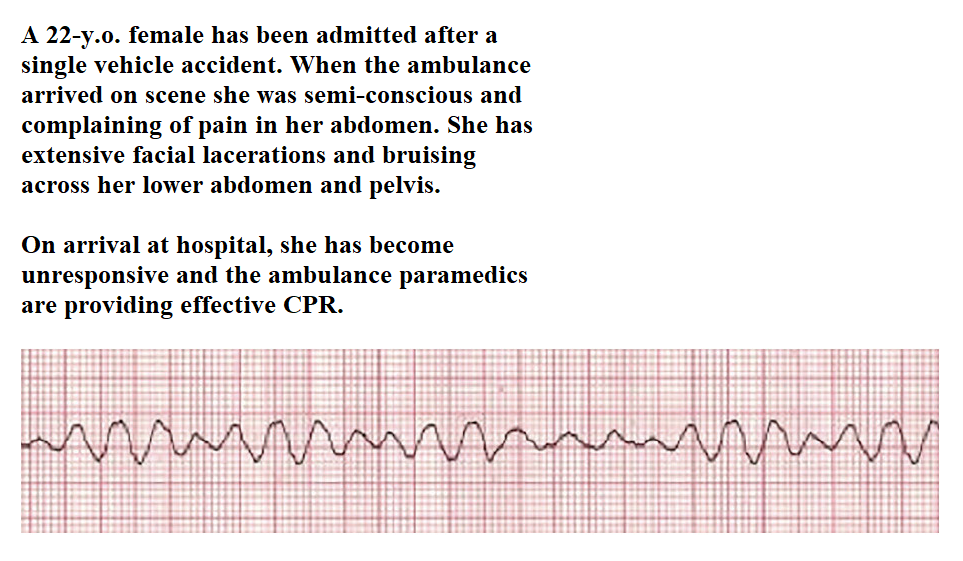
Your next action is to: (VF seen)
- Deliver a precordial thump
- Continue CPR for 2 minutes before delivering a shock
- Deliver a shock of 200J
- Give amiodarone 300mg IV
Following the second unsuccessful attempt at defibrillation, you would:
- Give adrenaline 1 mg IV
- Decrease the joules of the defibrillator to deliver a shock of 150 J
Intubate thepatient - Deliver compressions at a ratio of 15:2
Following the second unsuccessful attempt at defibrillation, you would:
- Give adrenaline 1 mg IV
- Decrease the joules of the defibrillator to deliver a shock of 150 J
Intubate thepatient - Deliver compressions at a ratio of 15:2
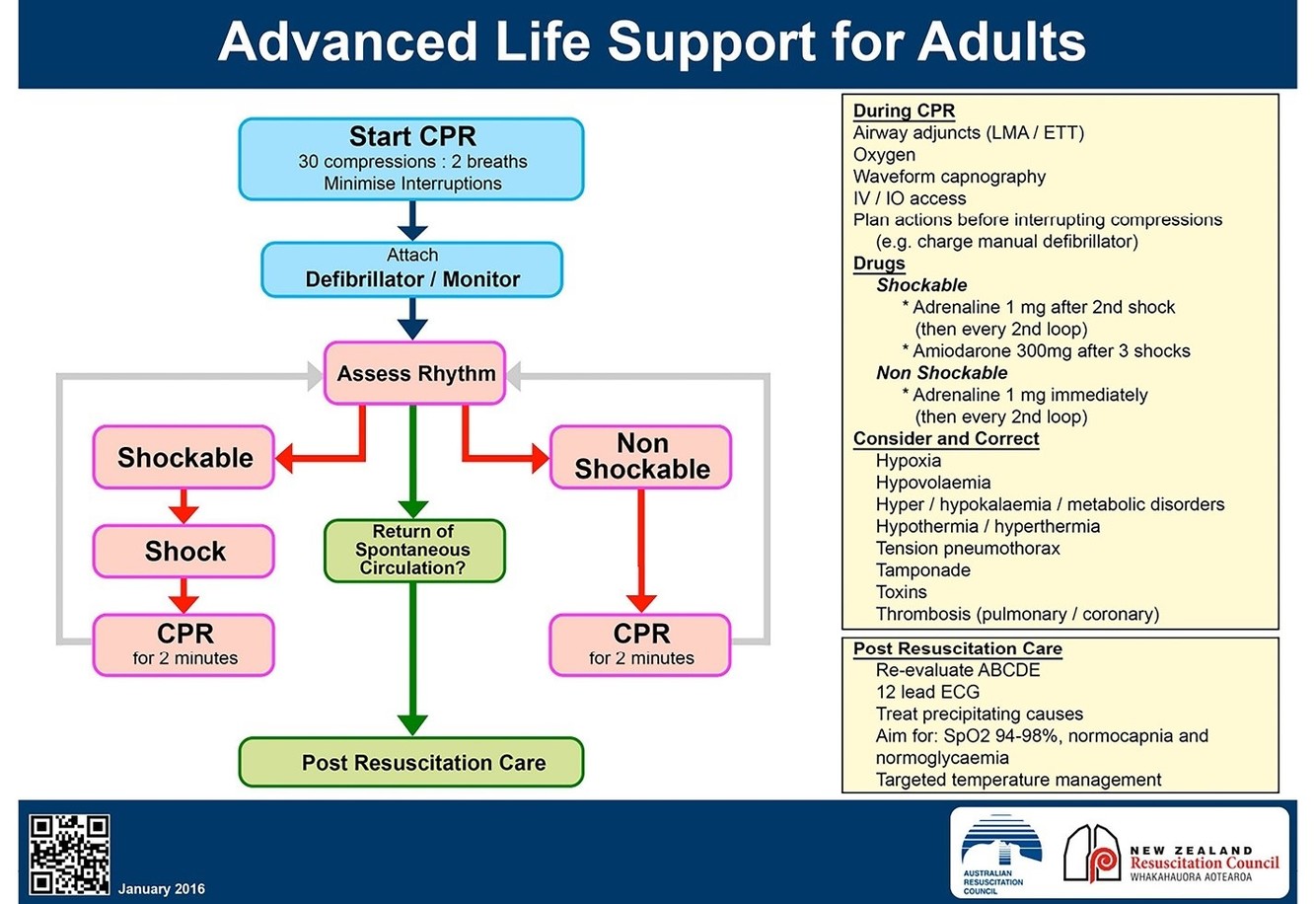
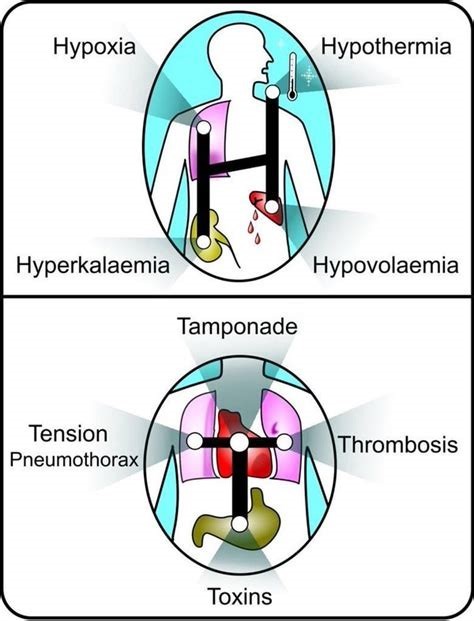
Based on the reported injuries which reversible causes would you consider more likely in this patient?***
- Tension Pneumothorax
- Cardiac tampoade
- Hypovolaemia
- Toxin Ingestion
a) All of the above
b) 1 & 3
c) 2 & 4
d) 3
- Tension Pneumothorax
- Cardiac tampoade
- Hypovolaemia
- Toxin Ingestion
a) All of the above
b) 1 & 3
c) 2 & 4
d) 3
The P wave:
- Represents ventricular depolarisation
- Is normally less than 0.11 s in duration
- Should be inverted on a normal ECG
- Is never seen in asystole
The P wave:
- Represents ventricular depolarisation
- Is normally less than 0.11 s in duration
- Should be inverted on a normal ECG
- Is never seen in asystole
Bag-valve-mask ventilation during basic life support:
- Should be delivered at a rate of 25 breaths/min
- Should be provided using a two-operator technique
- Should allow for delivery of 750 mL of air
- Will not lead to gastric inflation.
Bag-valve-mask ventilation during basic life support:
- Should be delivered at a rate of 25 breaths/min - no, should be 6-10 b/min
- Should be provided using a two-operator technique
- Should allow for delivery of 750 mL of air
- Will not lead to gastric inflation.
Adenosine:
- Is indicated for all bradyarrhythmias
- Has a half-life of 5 min
- Can only be given via a central line
- Should be given as a rapid bolus
Adenosine:
- Is indicated for all bradyarrhythmias - no, it is indicated for tachyarrhythmias, primarily SVT
- Has a half-life of 5 min - no, has a half-life of 10 s
- Can only be given via a central line
- Should be given as a rapid bolus
Endotracheal intubation:
- Should be attempted early in all cardiac arrests
- Should only be undertaken by an experienced practitioner
- Is an easy and important intervention in cardiac arrest
- Is the only way to ensure good ventilation of the patient’s lungs
Endotracheal intubation:
- Should be attempted early in all cardiac arrests
- Should only be undertaken by an experienced practitioner
- Is an easy and important intervention in cardiac arrest
- Is the only way to ensure good ventilation of the patient’s lungs

-
EMC Practice Questions130
-
ALS and BLS Course65
-
ALS and BLS Practice Questions20
-
1.1 Principles of Emergency Medicine27
-
1.2a Resuscitation (A - Airway)24
-
1.2b Resuscitation (B - Breathing)18
-
1.2c Resuscitation (C - Circulation) & Anaphylaxis16
-
1.2d Resucitation (D - Disability)13
-
1.2e Resuscitation (E - Exposure & Environment)1
-
1.2f Resuscitation (ALS & BLS)19
-
1.2g Resuscitation - IV and IO Access9
-
1.2h IV Fluids and Dehydration4
-
1.2i Resuscitation (Shock and Sepsis)38
-
1.3 Trauma21
-
1.4 Pain Management16
-
1.5 Mental and Behavioural Disturbances5
-
1.6 Infectious Diseases0
-
2.6 Orthopaedic Emergencies1


