T/F: Transporters are typ more efficient than ion channels.
False
Ion channels are more efficient that xprtrs: can pass up to 100 mil ions/sec (per channel); 105 x faster than any known xprtr.
Channel transport is always ______ (up/downhill) and typ involves transport of the following four ions: __, __, __, __.
Channel transport is always downhill (can’t be coupled to energy source for active/uphill xprt) and typ involves transport of the following four ions: Na+, K+, Ca2+, and Cl-.
Aquaporins are permeable to ______ and impermeable to _____.
Aquaporins are permeable to water and impermeable to ions.
Solutes both inside and outside the cell contribute to the net osmotic gradient. Describe ea of these forces as well as the net direction of water flow until balancing via turgor/osmotic pressure.
- Fixed anions - neg charged organic molecules confined inside cell
- IC Cations - balance out charge of fixed anions.
- Osmotic grad created by fixed anions/IC cations is balanced by an opp osmotic grad due to high concen of EC inorganic ions (Na+ and Cl–).
- Resultant small osmotic force tends to “pull” water into cell → cell swells until osmotic pressure balances.
Despite a net osmotic gradient pulling water into the cell, most animal cells don’t display a large change in volume. Why?
Cytoplasm in most animal cells is gel-like → resists large changes in volume in response to changes in osmolarity.
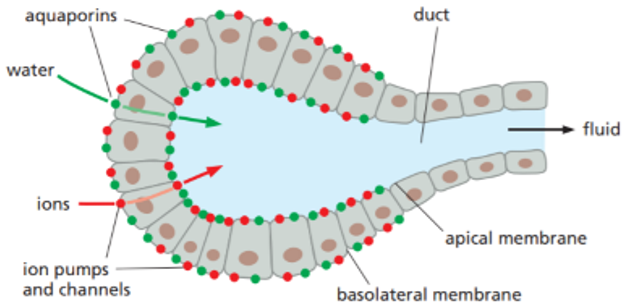
All bio mems are moderately permeable to water. Beyond simply increasing the rate of water transport, what makes aquaporins so imp?
Aquaporins provide signif more rapid xprt of water while completely blocking ions → avoids disrupting ion grads.
- partic abundant in cells wh req rapid xprt of nutrients/water, e.g. epithelial cells of kidney or exocrine cells.
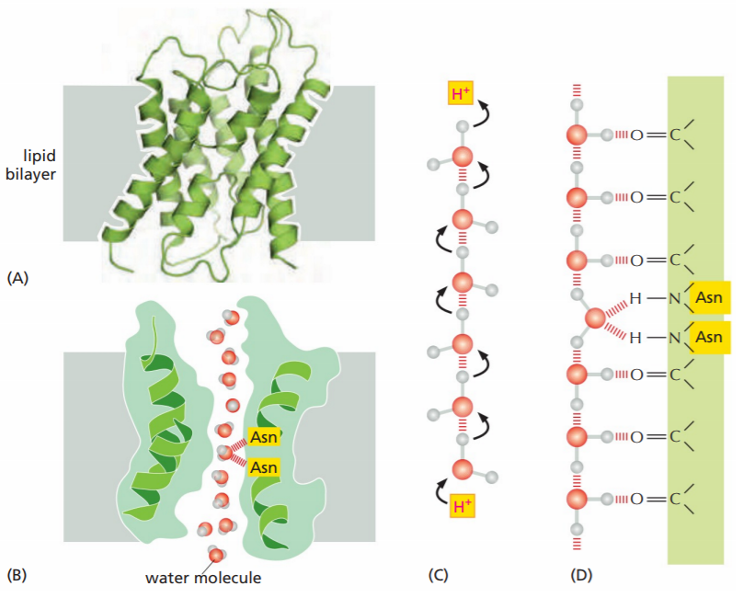
Aquaporins form narrow pores lined w hphilic AAs on one side and hphobic AAs on other. What specific AA(s)/side chains contrib to the hphilic side, and what effect does this have on how water molecules traverse thru the channel?
Aquaporins form narrow pores lined w hphilic AAs on one side and hphobic AAs on other.:
- Hphilic AAs incl two asparagines (Asn; N) and other AAs w carbonyl (C=O) side chains.
- Water molecules traverse mem in single file → follow path of carbonyl oxygens.
- Both physically too narrow and energ unfav for any hydrated ion to enter.
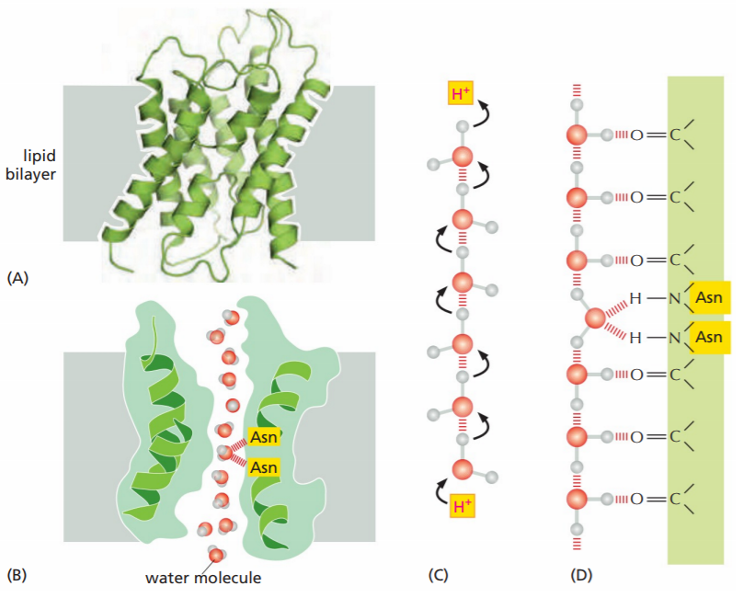
Aquaporins form narrow pores lined w hphilic AAs (Asn and other AAs w carbonyl side chains) on one side and hphobic AAs on other, resulting in water traversing the mem in single file, following the path of carbonyl oxygens. Why can’t hydrated ions also pass in single file?
Both physically too narrow and energ unfav for any hydrated ion to enter, e.g. K+, Na+, Ca2+, or Cl– ions; nor H+.
- The two strategically placed Asn’s bind O of central water molecule in the line of water molecules traversing pore, making both valences of central O unavailable for H-bonding and imposing a bipolarity on entire column of water molecules
- Impossible to rapidly make/break H-bonds → H+ cannot diffuse thru pore.
- Recall: H+ (as H3O+) typ diffuses thru water v rapidly.
- Peptide bonds have an electric dipole: partial neg charge on O of C=O (C-terminal) and partial pos charge on N of N-H (N-terminal) → in alpha helix, H-bonds align dipoles, and thus every alpha helix has a net electric dipole along its axis → facilitates single-file traversing of water.
Wh two imp props distinguish ion channels fr aquaporins?
Ion channels are gated and show ion selectivity (selectivity filter).
Describe how ion channels show ion selectivity (selectivity filter).
Ion channels show ion selectivity (selectivity filter):
- Pores must be narrow enough in places to force ions into close contact w walls of channel → only approp sized/charged ions can pass.
- Permeating ions must shed most/all of assoc water to pass thru narrowest part of channel (selectivity filter) → limits rate of passage.
- As ion concen ↑ → flux of ion thru channel ↑ proportionally, then levels off (saturates) at a max rate.
As ion concen ↑, how does flux thru an ion channel change?
As ion concen ↑ → flux of ion thru channel ↑ proportionally, then levels off (saturates) at a max rate.
Ion channels are gated: w prolonged stim (chem/elec), most ion channels go into _____ (open/closed) state → refractory until stim removed.
Ion channels are gated: w prolonged stim (chem/elec), most ion channels go into closed (desensitized/inactivated) state → refractory until stim removed.
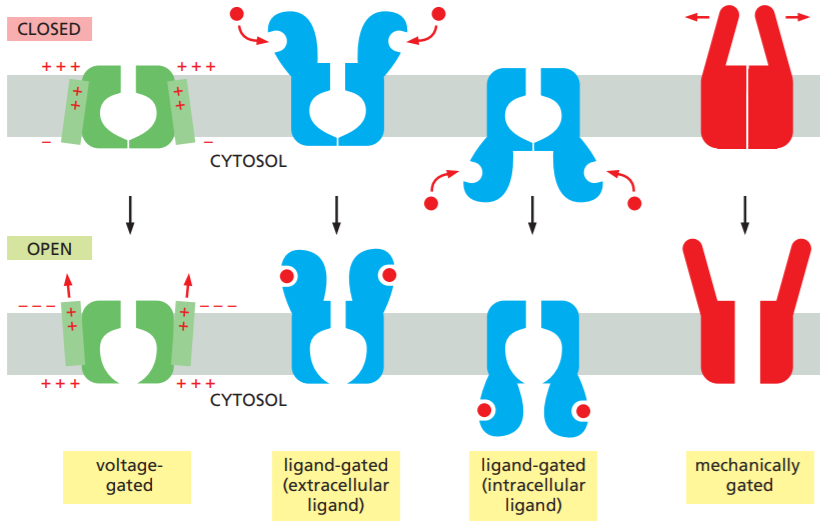
What are the three most common types of gated ion channels?
Voltage, mechanical, and ligand-gated ion channels are the most common.
- Ligand can be either an EC mediator (e.g. nxmtr-gated) or an IC mediator, e.g. ion-/ntide-gated channels.
- Protein de/phosphorylation also regulates activity of many ion channels.
_______ channels are a subset of K+ channels wh open even in unstim/resting state.
K+ leak channels are a subset of K+ channels wh open even in unstim/resting state → make pmem much more permeable to K+ than other ions → critical role in maintain Vr.
- There are leak channels for Na+ and other ions, but K+ leak channels are much more abundant → more signif role in maintaing Vr.
- Recall: Vr is typ neg: Na/K pumps (antiporters) transport 3 Na+ out and 2 K+ in w ea ATP hydrolyzed → establishes a cgrad for both K+ and Na+ → K+ freely leak out and Na+ leak in much more slowly → established an egrad (neg inside) → rate of K+ leaking out ↓ and Na+ leaking in ↑ → K+ and Na+ reach an equilibrium state according to their respective echem grads → net Vr is neg.
Mem potential in animal cells deps mainly on ______ channels and the ___ gradient across the pmem.
Mem potential in animal cells deps mainly on K+ leak channels and the K+ echem gradient across the pmem.
- Recall: Na+ leak channels also present, but much less abundant.
- echem equilibrium results in negative Vr.
T/F: Mem pot (charge diff across mem) can result both fr active pumping and passive ion diffusion.
True
Mem pot (charge diff across mem) can result both fr active pumping (e.g. Na/K pumps) and passive ion diffusion (e.g. K+ leak channels).
- Animals: mem-pot across pmem deps mainly on passive ion movements.
- Electrogenic H+ pumps in inner mito mem generate most of mem-pot across this mem.
- Electrogenic pumps also generate most of mem-pot across pmem in plants/fungi.
K+ leak channels are primarily responsible for the resting mem potential (Vr). What, then, is the purpose of Na/K pumps, and what effect do they have on Vr?
Recall: Na/K pump - P-type ATPase; an ATP-driven antiporter that pumps 3 Na+ out and 2 K+ in for ea ATP hydrolyzed, i.e. active xprt (not passive like K+ leak channels).
- Vr is typ neg: Na/K pumps establish a cgrad for both K+ and Na+ → K+ freely leak out and Na+ leak in much more slowly → establishes an egrad (neg inside) → rate of K+ leaking out ↓ and Na+ leaking in ↑ → K+ and Na+ reach an equilibrium state according to their respective echem grads → net Vr is neg
- Na/K pumps set up and maintain the necessary ion grads (partic Na+, also K+) wh drives xprt of most nutrients into animal cells, as well as play a crucial role in regulating cytosolic pH.
- Hence, Na/K pumps indirectly establish Vr thru secondary active xprt.
Which equation is used to quantify equilibrium conditions across mem?
Nernst equation - quantifies equil condition → calc theoretical Vr if we know ratio of IC/EC ion concens.
- Pmem of a real cell is not exclusively permeable to K+/Cl– → actual Vr typ not exactly equal to that predicted by Nernst equation for K+/Cl–.
T/F: a signif amount of inorganic ions must cross the pmem to set up a mem potential.
False
Only minute # of inorganic ions must cross pmem thru to set up mem-pot, i.e. ion concens virtually unchanged.
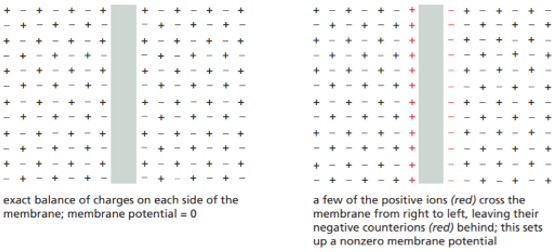
Describe what might happen upon the sudden inactivation of Na/K pumps.
Sudden inactivation of Na/K pump → slight drop in mem-pot (less neg) occurs immediately, but K+ equilibrium mechanism—wh generates majority of mem-pot—persists.
- As long as IC [Na+] stays low & IC [K+] stays high → K+ equil mechanism persists → maintains mem-pot for many minutes.
- I.e. the echem grad for K+ remains relatively balanced: K+ effuses thru leak channels (along cgrad), but still resisted by its egrad (neg Vr).
- After some time, K+ AND other ion leak channels (e.g. Na+ leaking in) result in a slight depolarization (less neg Vr).
Bacterial K+ channels are composed of ___ (2/4/6) _____ (identical/diff) xmem subunits wh form a central pore. Ea subunit contribs ____ (2/4/6) α helices, wh form a cone w its wide end facing the ___ (IC/EC space) where K+ ions _____ (enter/exit) fr the channel. A short α helix called the _______ connects the xmem helices and forms a crucial “selectivity loop” that acts as a __________. The selectivity loops are lined by _______ of polypeptide backbones (peptide bonds).
Bacterial K+ channels are composed of 4 identical xmem subunits wh form a central pore. Ea subunit contribs 2 α helices, wh form a cone w its wide end facing the EC space where K+ ions exit fr the channel. A short α helix called the pore helix connects the xmem helices and forms a crucial “selectivity loop” that acts as a selectivity filter. The selectivity loops are lined by carbonyl oxygens of polypeptide backbones (peptide bonds).
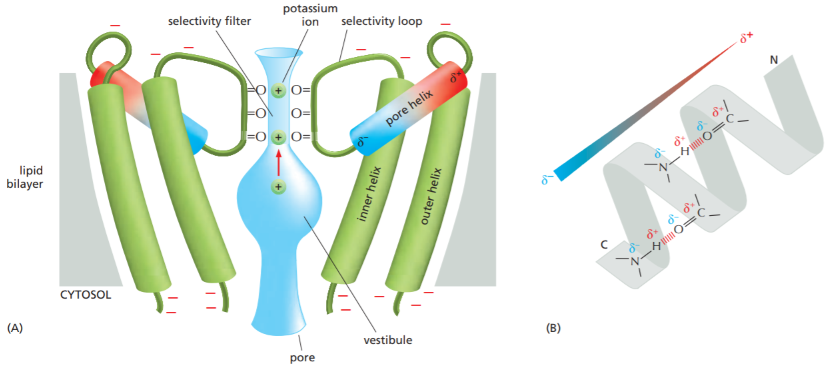
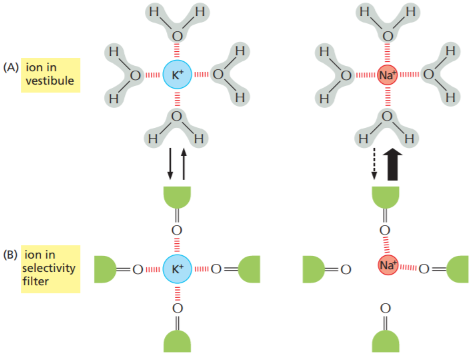
The selectivity filter of bacterial K+ channels is formed by “selectivity loops” lined by carbonyl oxygens of polypeptide backbones (peptide bonds). Explain how these carbonyl oxygens select for ions.
Selectivity filter of bacterial K+ channels:
- Carbonyl oxygens are rigidly spaced at exact distance to accommodate selected ion.
- E.g. Na+ cannot enter K+ channel bc carbonyl O’s are too far away apart to compensate for energy expense assoc w loss of water molecules req’d for entry.
- Recall: Na+ has smaller atomic size.
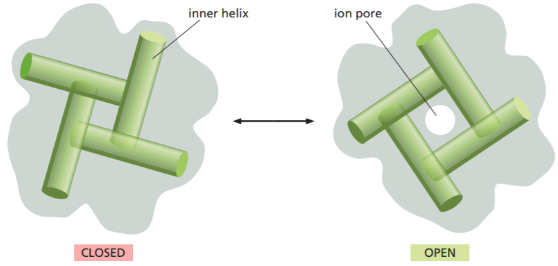
Describe the gating mechanism shared by many ion channels.
Dep on partic type of channel, helices tilt, rotate, or bend during gating → either obstruct/open path for ion xprt.
- Gating helices typ allosterically coupled to domains that form ion-conducting pathway → conform change in gate (e.g. in response to ligand binding) → conform change in conducting pathway (opens/closes).
- E.g. closed K+ channel → inner helices tilt → pore constricts like a diaphragm at its cytosolic end → bulky hphobic AA side chains block small opening remains and prevents entry of ions.
All orgs must sense/respond to int/ext mech forces (e.g. sound, touch, pressure, shear forces, and gravity, or osmotic pressure and mem bending), yet channels directly linked to mechanical gating are v rare. How, then, do cells respond to mech forces?
Mechanosensitive channels - v rare; few directly linked to mech gating.
- E.g. auditory hair cells in human cochlea: contain v sensitive mech-gated ion channels, but ea of ~15,000 individual hair cells is thought to have total of only ~50–100.
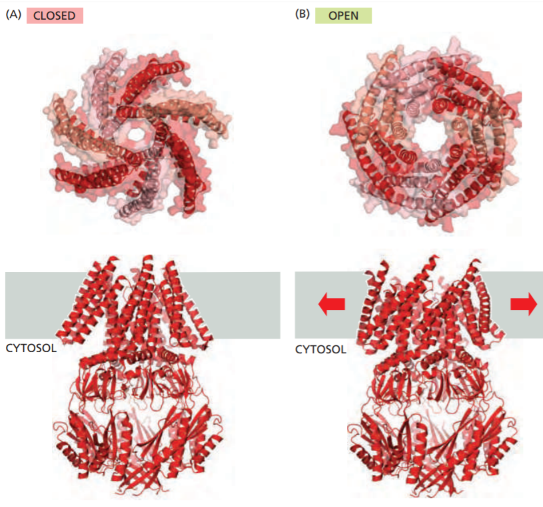
Cells have several diff channels that open at diff levels of pressure:
- Mechanosensitive channel of small conductance—the MscS channel—opens at low/mod pressures.
- Composed of seven identical subunits; in open state, form pore ~1.3 nm in diam—just big enough to pass ions/small molecules.
- Large cytoplasmic domains limit size of molecules that can reach pore.
- Mechanosensitive channel of large conductance—the MscL channel—opens at high/v high pressure to 3+ nm; last resort.


-
Ch.4 - Protein Struc/Func73
-
Ch.7, Part 1 - DNA to RNA42
-
Ch.1/2 - Intro & Chem Components of Cells24
-
Ch.11 - Membrane Structure50
-
Ch.15, Part 1 - Cell Compartments54
-
Endomem Sys & Protein Sorting (BIO201 Review)42
-
Ch.7, Part 2 - RNA to Protein38
-
Ch.12, Part 1 - Membrane Transport58
-
Ch.12, Part 2 - Channels & Electrical Properties of Membranes73
-
Ch.15, Part 2 - Cell Compartments78
-
Ch.16 - Cell Signaling106
-
Ch.17 - Cytoskeleton98
-
Ch.18 - Cell Division Cycle97
-
Ch.19 - Sex Reprod & Genetics17
-
Ch.20 - Tissues, Stem Cells, Cancer106


