Signal molecules can take many forms. Name seven.
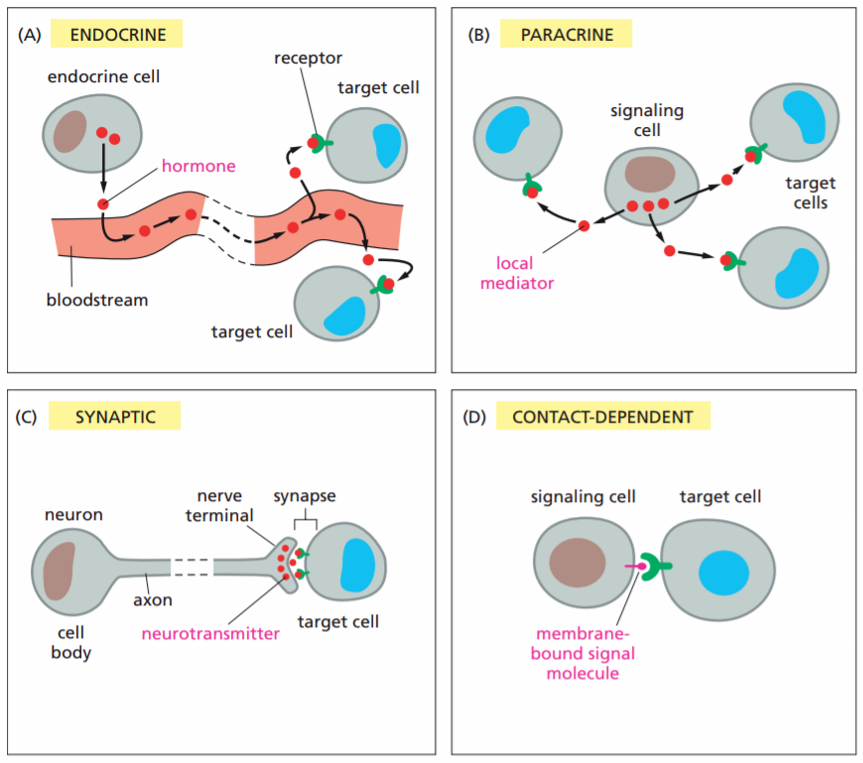
Signal molecules can be proteins, peptides, AAs, nucleotides, steroids, FA derivatives, or even dissolved gases (NO); typ rely on only a handful of basic comm styles: endocrine, paracrine, synaptic, and contact-dep.
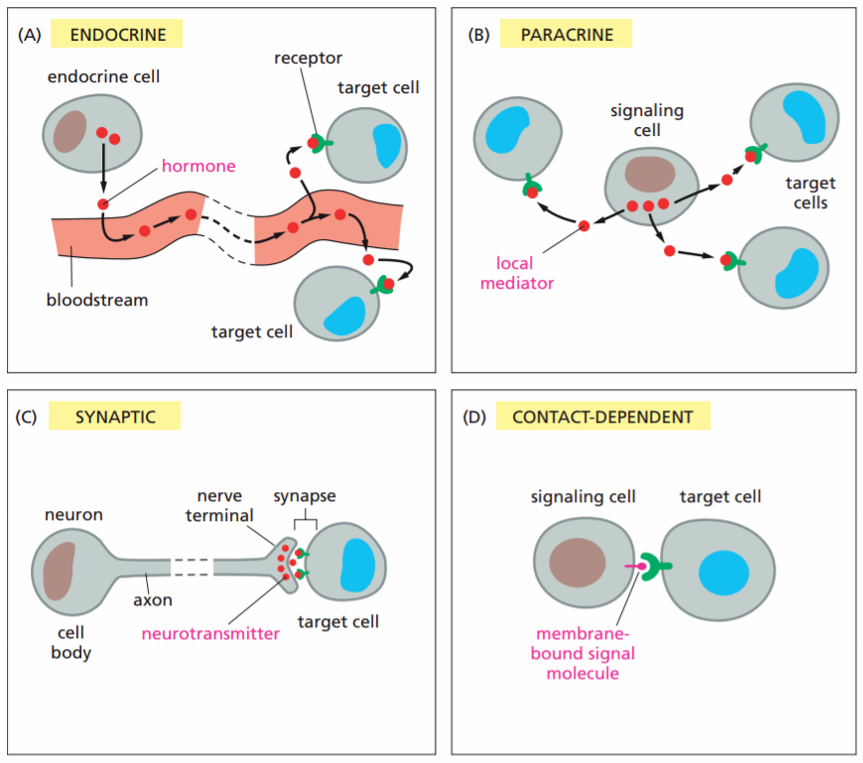
Signal molecules can be proteins, peptides, AAs, nucleotides, steroids, FA derivatives, or even dissolved gases. However, they rely on only a handful of basic comm styles, such as: _______, ________, ________, and _________.
Signal molecules can be proteins, peptides, AAs, nucleotides, steroids, FA derivatives, or even dissolved gases. However, they rely on only a handful of basic comm styles, such as: endocrine, paracrine, synaptic, and contact-dep.
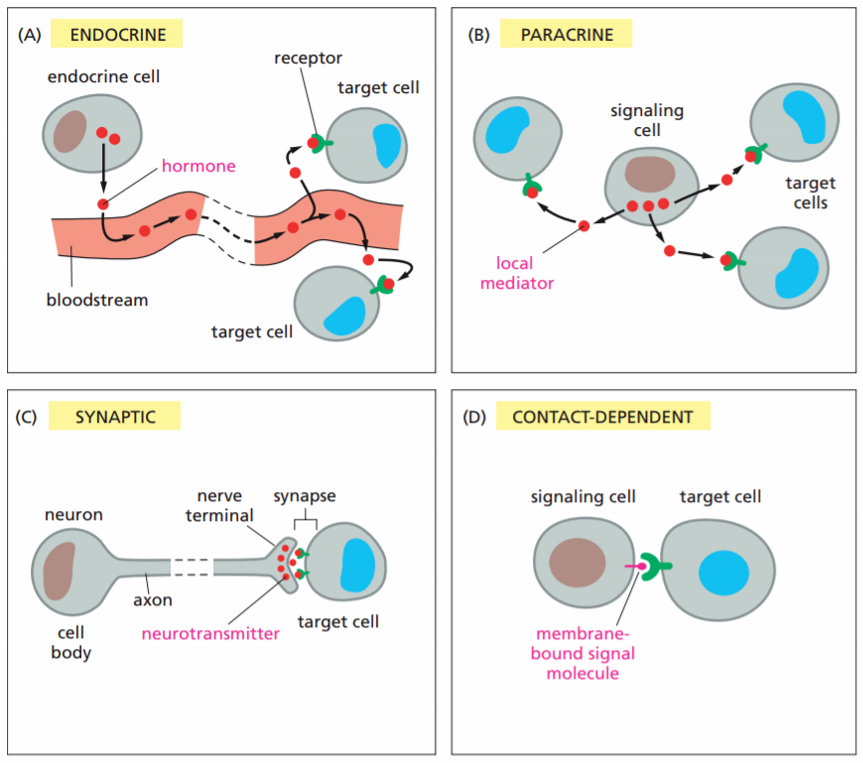
Diff types of cell-to-cell comm vary most critically in ______ and _______.
Diff types of cell-to-cell comm vary most critically in speed and selectivity. From slowest/least selective to fastest/most selective: endocrine, paracrine/autocrine, synaptic, contact-dep.
- Endocrine signals - lowest speed and selectivity: Endocrine glands prod hormones → secreted into bloodstream → widely distributed thru/o body (or plant’s sap).
- Paracrine signals - released into local ECF → act locally.
- Incl many signals that regulate inflam at site of infection or control cell proliferation in healing wounds.
- Autocrine signals - target same cell that produced signal; e.g. cancer cells promote own survival.
- Synaptic signals - xmtd electrically along nerve cell axon to terminals → transduced into chem signal in form of secreted nxmtrs (into synaptic cleft) → synapse on adj target cells.
- Long distance; but fast and v specific.
- Contact-dep signals - cell-surface signal directly binds receptor on adj cell, i.e. no secretion.
- Direct physical contact → most intimate and short-ranged form of comm.
- E.g. embryonic dev - allows adj cells to specialize.
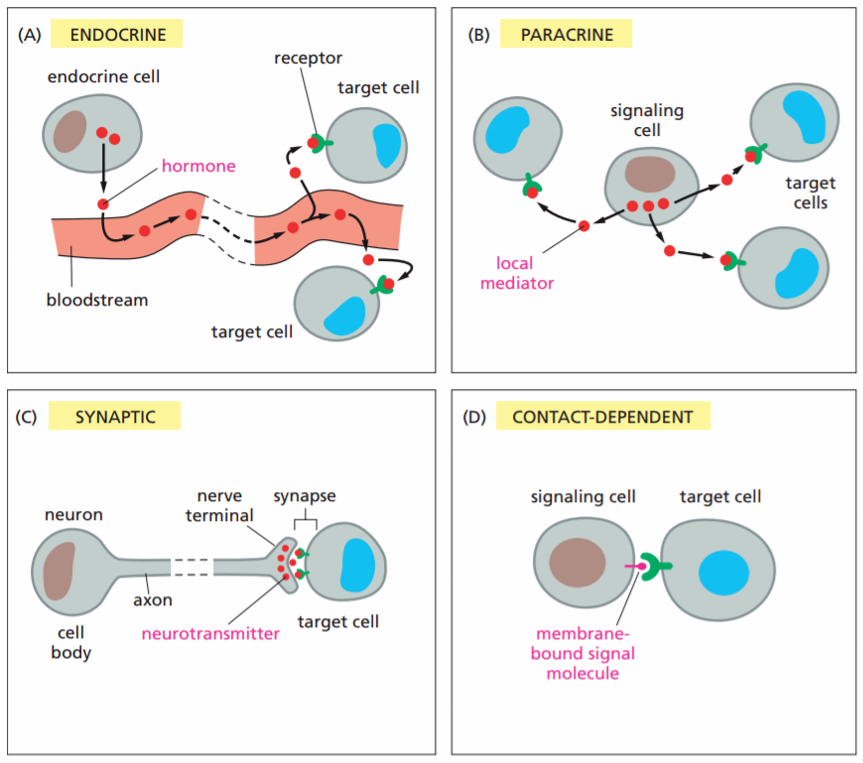
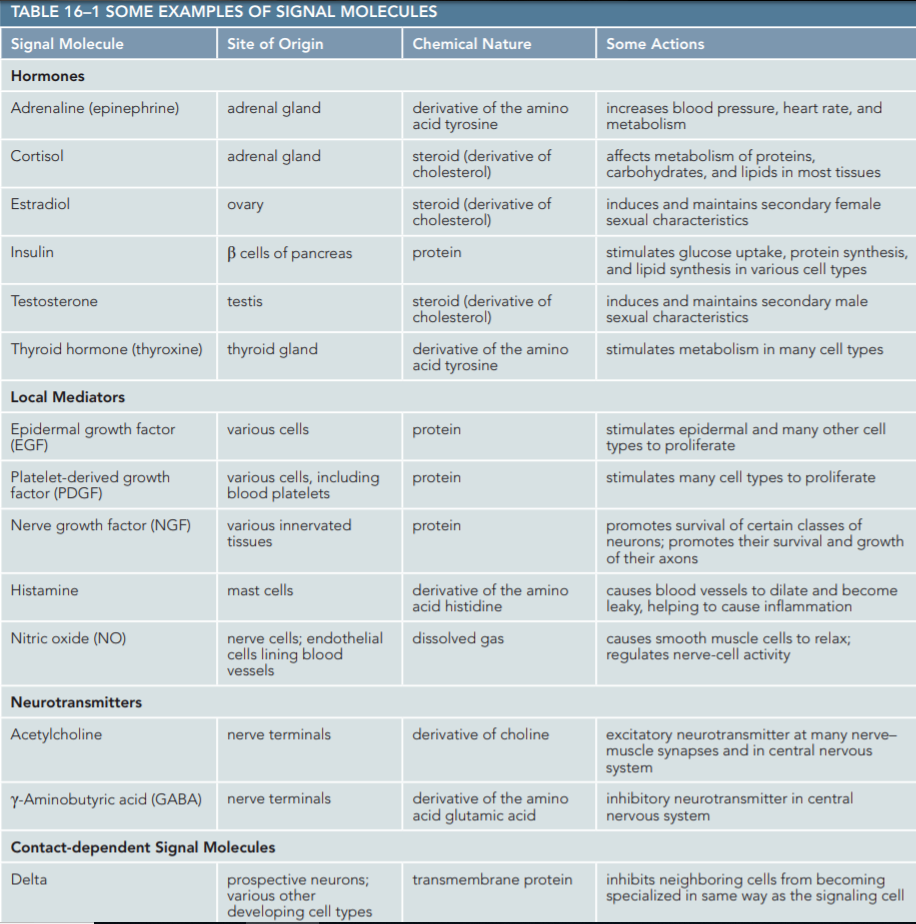
Name at least one example of a hormone, local mediator, nxmtr, and contact-dep signal molecule, incl its site of origin, chemical nature, and some of its effects.
- Hormone - e.g. EPI: derivative of tyrosine (tyr/Y) synthd in adrenal gland (on top of kidneys) → ↑ HR/BP and metabolism.
- Local mediator (para/autocrine) - e.g. platelet-derived growth factor (PDGF): protein synthd by various cells, incl blood platelets → stims many cell types to proliferate.
- Nxmtr - e.g. ACh: choline derivative synthd in nerve terminals → typ excitatory (EPSP), but can be inhibitory in some cell types.
- Contact-dep - e.g. delta: xmem protein synthd in prospective neurons and various other developing cell types → inhibits adj cells fr becoming specialized in same way as signaling cell.
To remain a local stimulus, paracrine signals must be prevented fr straying too far fr points of origin. How might this could be accomplished?
Most paracrine signaling molecules are v short-lived after they are released fr a signaling cell: they are either degraded by EC enzymes or are rapidly taken up by adj target cells. In addition, some become attached to ECM and are thus prevented fr diffusing too far.
Each cell responds to a ______ (limited/expansive) set of EC signals, dep on its ______ and ______.
Each cell responds to a limited set of EC signals, dep on its history and current state.
- Cells are v selective - based on specialized function and presence of appropriate receptors.
Signals can alter a cell’s shape. What else can they effect?
Signal effects - can alter cell’s shape, movement, metabolism, gene expression, or combo of these.
Signals typ conveyed into IC signals → IC relay → alter activity of _______ proteins wh have direct effect on behavior of cell.
Signals typ conveyed into IC signals → IC relay → alter activity of effector proteins wh have direct effect on behavior of cell.
- Diff types of cells respond to same signal in diff ways.
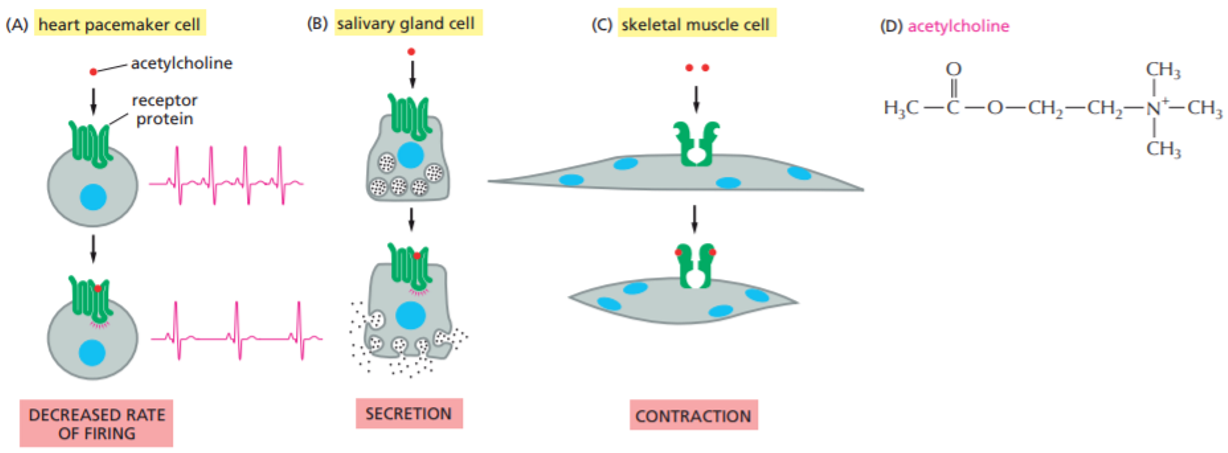
- E.g. ACh: ↓ firing rate of heart pacemaker cells, but ↑ secretion of saliva fr salivary glands; both types of cells have same ACh receptors; additionally, ACh binds to a diff receptor on skeletal muscle → cell contracts.
T/F: The EC signal acts as the ‘message’, i.e. all cells respond to partic EC signal the same way.
False
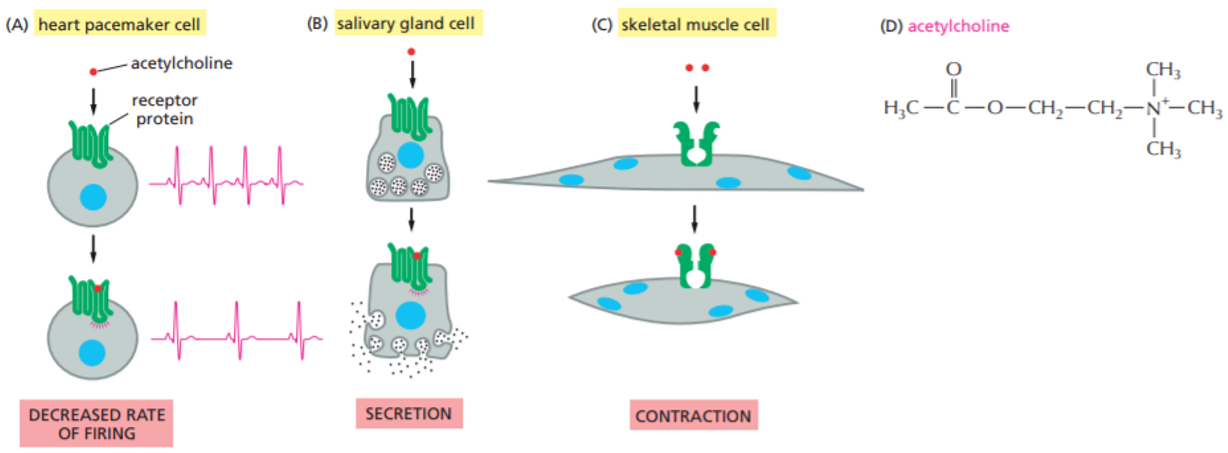
IC relay differs b/w cells → diff types of cells respond to same signal in diff ways.
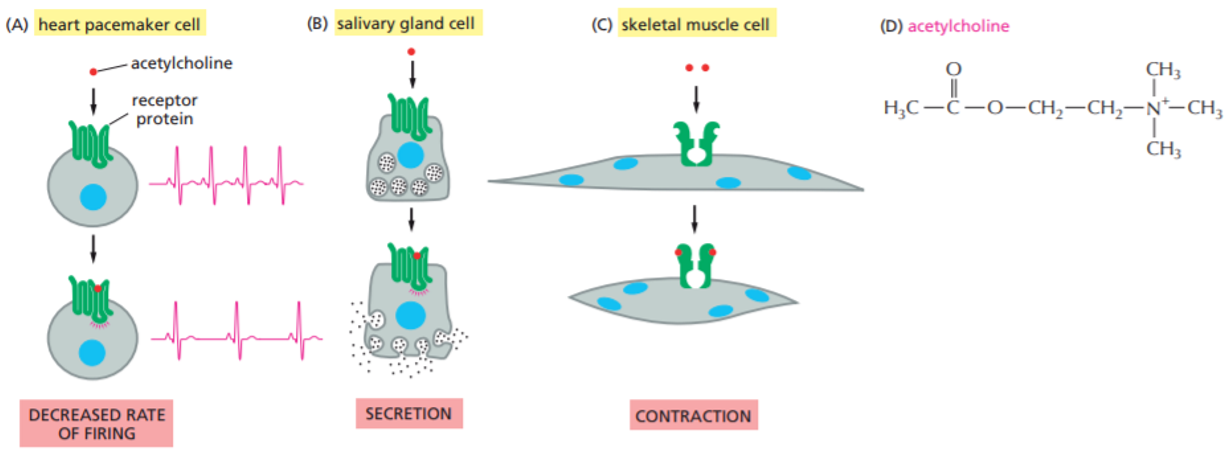
- E.g. ACh: ↓ firing rate of heart pacemaker cells, but ↑ secretion of saliva fr salivary glands; both types of cells have same ACh receptors; additionally, ACh binds to a diff receptor on skeletal muscle → cell contracts.
- EC signal alone is not the message; it’s how target cell receives/interprets the signal.
T/F: Cells typ posses only one or a few diff types of receptors.
False
Cells typ possess many diff receptors → simult response → subtle and complex control via diff combos.
- Presence of one signal often modifies effects of another.
- One combo might enable cell to survive; another might drive it to differentiate in some specialized way; and another might cause it to divide.
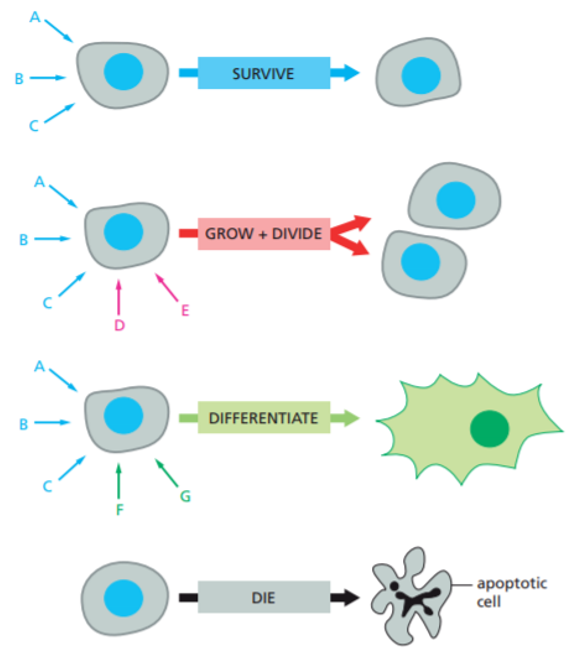
- Absent any signals, most animal cells undergo apoptosis.
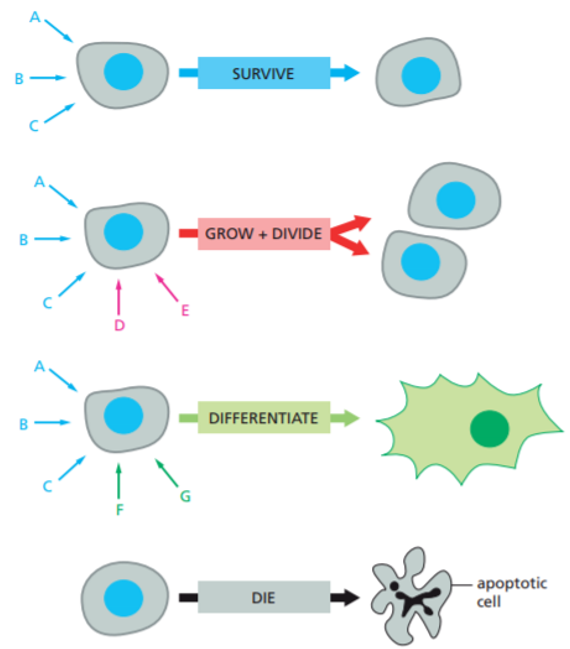
Absent any signals, what is the response of most animal cells?
Absent any signals, most animal cells undergo apoptosis.
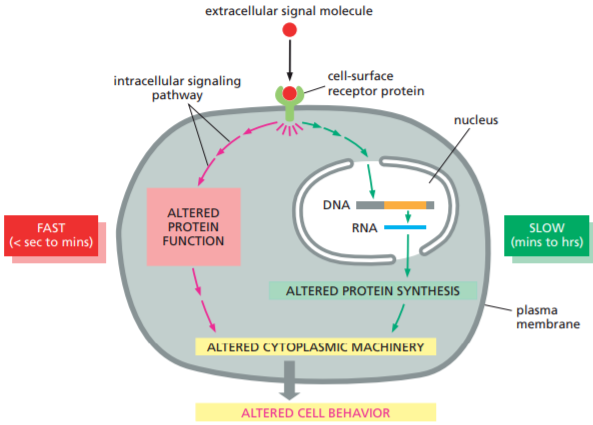
EC signals vary in their speed of transmission and range of distribution. A cell’s response to these signals can also be fast or slow, dep on what needs to happen upon receival. Describe such diffs in fast and slow responses.
- Fast signals - affect activity of proteins already present inside target cell.
- E.g. ACh stims skeletal muscle to contract w/i milliseconds.
- Typ incl changes in cell movement, secretion, or metabolism.
- Slow signals - req changes in gene expr → prod of new proteins.
- Typ incl cell differentiation or cell growth/division.
EC signals typ fall into two classes—EC or IC receptor signals—dep on what feature of the signal?
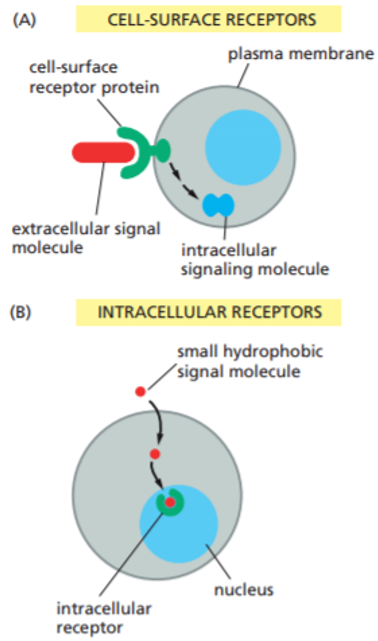
EC signal molecules typ fall into two classes, dep on pmem permeability.
- EC receptor signals - largest class; too large/hphilic to cross pmem of target cell → bind EC receptor proteins → generate 1+ IC signal molecules.
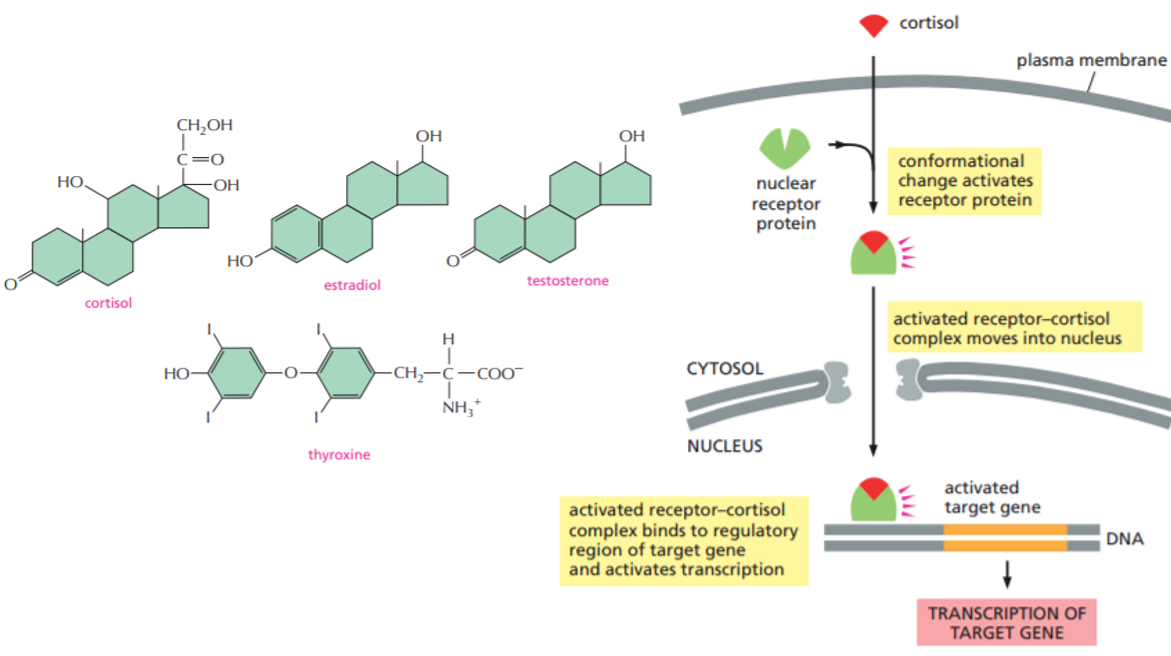
- IC receptor signals - small/hphobic enough to pass thru pmem → bind IC receptors in cytosol/nucleus or activate IC enzymes directly; incl steroid hormones (e.g. cortisol, estradiol, testosterone) & thyroid hormones (e.g. thyroxine), and nitric oxide (NO).
Describe how nuclear receptors function.
Nuclear receptors - incl BOTH cytosolic and nuclear receptors; activated by hormone (IC receptor signal) binding → act as xcr regulators (in nucleus).
- Mechanism overview: cell unstimulated, w nuclear receptors typ inactive → hormone binds IC receptor → IC receptor changes into active conform wh can promote/inhibit xcr of specific target genes.
- E.g. cortisol: prod by adrenal gland in response to stress → crosses pmem to bind/activate cytosolic receptor protein → receptor-hormone complex xprtd into nucleus via nuclear pores → active receptor can bind specific regulatory seqs in DNA and activate/repress xcr of specific target genes.
- Other hormone receptors are already bound to DNA, even in absence of hormone.
T/F: Some hormone receptors are bound to DNA, even in absence of hormone.
True
Some hormone receptors are bound to DNA, even in absence of hormone.
- E.g. Hormone crosses pmem → binds cytosolic receptor → releases IC signal → enters nucleus thru nuclear pores → binds DNA-bound hormone receptor → regulates xcr.
T/F: Ea hormone binds diff nuclear receptor, and ea receptor acts at a diff set of regulatory sites in DNA.
True
Ea hormone binds diff nuclear receptor, and ea receptor acts at a diff set of regulatory sites in DNA.
- A given hormone typ regulates diff sets of genes in diff cell types → evoke diff physio responses in diff target cells.
Testosterone shapes formation of external genitalia and influences fetal brain dev. At puberty, it triggers dev of male secondary sexual characteristics. Some v rare individuals are genetically male (have both an X and Y chromo) but lack testosterone receptors as result of a mutation. Describe how such an individual would develop?
They would develope as females—same path that genitalia and brain would develope if neither male nor female hormones were produced.
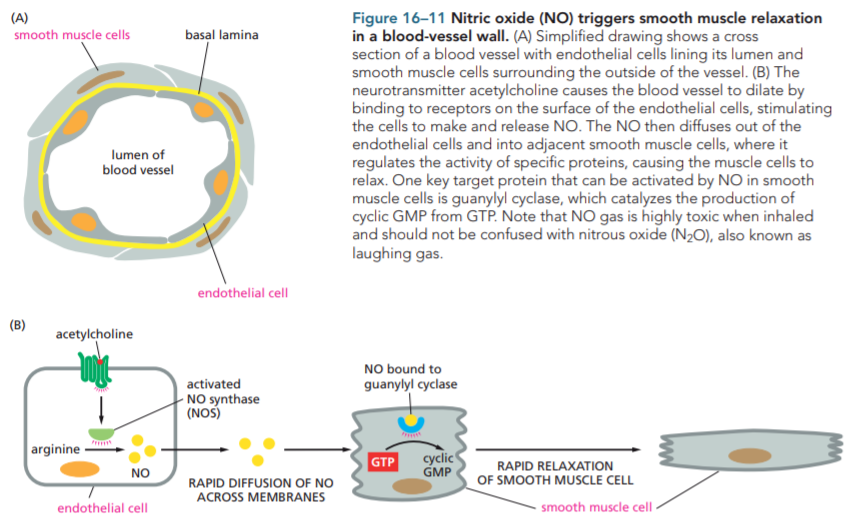
Some dissolved gases can cross pmem and activate IC enzymes directly. One such gas, nitric oxide (NO), typ targets guanylyl cyclase in smooth muscles. Describe this mechanism of action, such as in the relaxation of endothelial cells that line all blood vessels.
Smooth muscle (blood vessel) relaxation mechanism: nerve endings secrete ACh → ACh binds EC receptors on endothelial cells → activates NO synthase (NOS) inside endothelial cell → NOS catalyzes synth of NO fr arginine (arg/R) → NO rapidly diffuses out of endothelial cell, thru basal lamina, and into surrounding smooth muscle cell → NO binds/activates guanylyl cyclase inside smooth muscle cell → catalyzes synth of cGMP fr GTP → cGMP causes smooth muscle cell to relax → blood vessel dilates.
- Nitric Oxide (NO) gas - synthd fr arginine (arg/R); diffuses readily fr site of synth into adj cells → quickly converted into nitrates/nitrites (w half-life of ~5-10 sec) by reacting w oxygen and water outside cell.
- Guanylyl cyclase - NO diffuses thru mem → binds/activates guanylyl cyclase → catalyzes synth of cGMP fr GTP → cGMP acts as small IC signal → final effect of NO signal chain (e.g. blood vessel relaxation).
- E.g. Viagra: blocks enzyme that degrades cGMP → prolongs NO signal.
- cGMP is v similar in struc/mechanism of cAMP, a much more commonly used IC signal.
- Endothelial cells - flattened cells that line every blood vessel.
The vast majority of signals are too large/hphilic to diffuse thru pmem, instead bind to EC receptors on pmem and generate new IC signals. Describe several crucial functions that IC signals perform.
IC relay until interaction w effector proteins (metabolic enzymes, cytoskeletal protein, or xcr regulators) → cell response, e.g. altered metabolism, cell shape/movement, or gene expr (on/off).
IC signals perform many crucial functions:
- Relay signal onward → help spread it thru cell.
- Amplify signal → ↑ sensitivity to EC signal, i.e. few EC signals reqd to evoke large IC response.
- Detect signals fr 1+ IC signal pathway → integrate them before relaying signal onward.
- Distribute signal to 1+ effector protein → creates branches in info flow and evoke complex response.
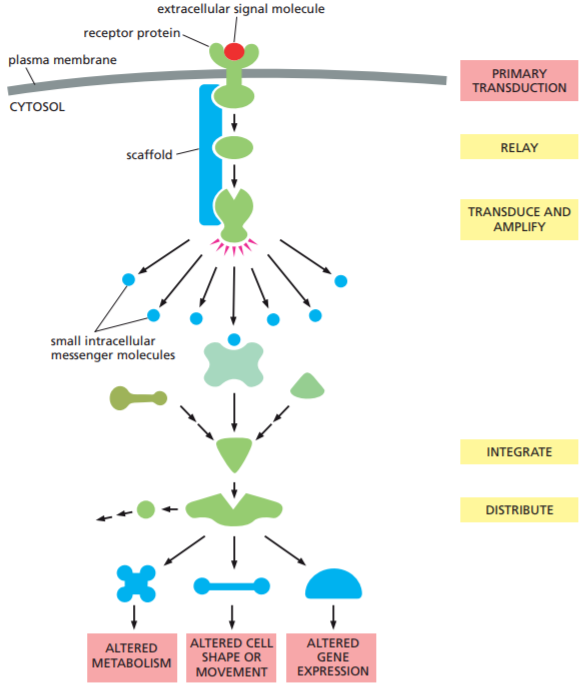
Some proteins in IC path may be held in close proximity by _________ → activated at specific location w/i cell and w greater speed/eff/selectivity.
Some proteins in IC path may be held in close proximity by scaffold proteins → activated at specific location w/i cell and w greater speed/eff/selectivity.
IC signal pathway is typ subject to feedback regulation → complex responses. Wh type of feedback can result in switch-like responses? Oscillating responses?
IC signal pathway is typ subject to feedback regulation → complex responses.
- Positive feedback can generate all-or-none, switch-like responses.
- Negative feedback can generate oscillating responses.
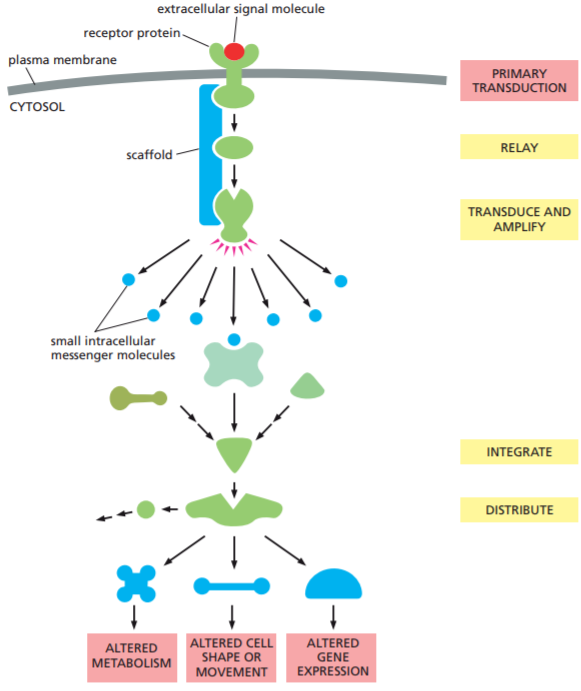
In principle, how might an IC signal amplify the signal as it relays it onward?
The IC signal protein could be an enzyme that produces a large # of other small IC signals (e.g. cAMP or cGMP). Or, it could be an enzyme that modifies a large # of IC target proteins (e.g. by phosphorylation).
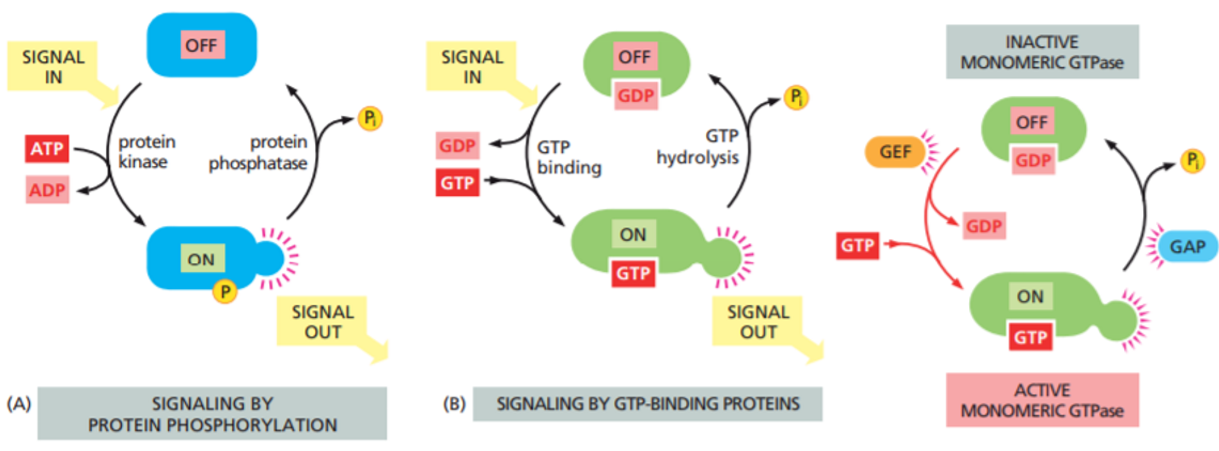
Some IC signal proteins act as molecular switches: receive signal → toggle fr inactive to active state → stim/suppress other proteins in pathway → persist in active state until some other process inactivates/switches them off again. Why is switching off so critical, and what are two classes of molecular switch proteins?
Switching off is critical - every activated protein in pathway must be reset to original, unstim’d state → enables signal pathway to recover and xmt additional signals.
Two classes of molecular switch proteins:
- In/activated by phosphorylation - much larger class; protein kinase covalently attaches P group onto switch protein; protein phosphatase hydrolyzes P group fr switch protein.
- GTP-binding proteins - smaller class; active when GTP bound, inactive when GDP bound.
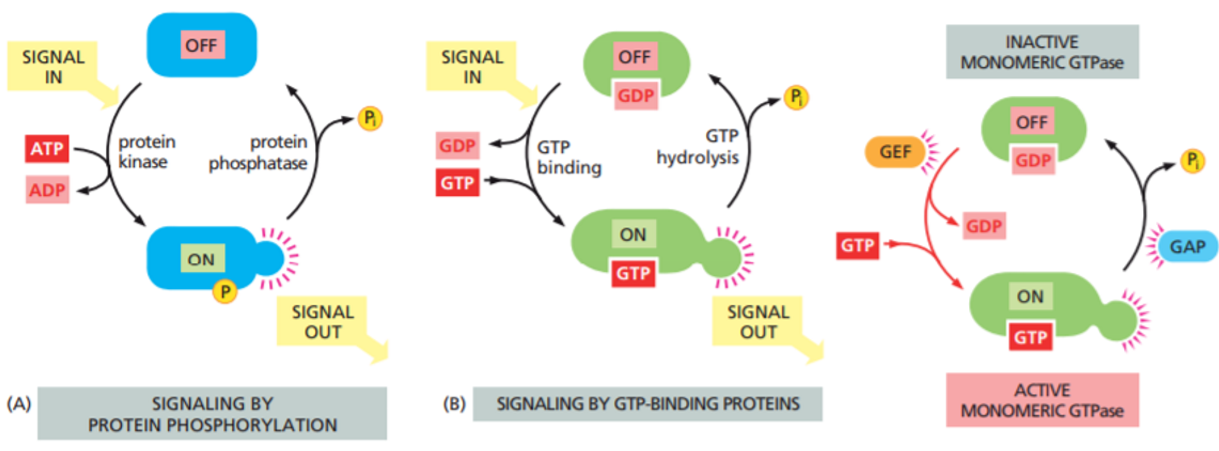
Many switch proteins are themselves protein kinases. Describe how this helps amplify, distribute, and regulate a signal.
Many switch proteins are themselves protein kinases → often organized into phosphorylation cascades: one protein kinase, activated by phosphorylation, phosphorylates next protein kinase in the seq, etc. → signal xmtd onward and, in the process, amplifies, distributes, and regulates it.
- Recall: two classes of swtich proteins - those in/activated by phosphorylation or GTP-binding.
- Activity of switch protein deps on balance b/w protein kinase/phosphatase activity.
- Two main types of protein kinases in IC signal path: ser/thr kinases (most common) and tyr kinases.


-
Ch.4 - Protein Struc/Func73
-
Ch.7, Part 1 - DNA to RNA42
-
Ch.1/2 - Intro & Chem Components of Cells24
-
Ch.11 - Membrane Structure50
-
Ch.15, Part 1 - Cell Compartments54
-
Endomem Sys & Protein Sorting (BIO201 Review)42
-
Ch.7, Part 2 - RNA to Protein38
-
Ch.12, Part 1 - Membrane Transport58
-
Ch.12, Part 2 - Channels & Electrical Properties of Membranes73
-
Ch.15, Part 2 - Cell Compartments78
-
Ch.16 - Cell Signaling106
-
Ch.17 - Cytoskeleton98
-
Ch.18 - Cell Division Cycle97
-
Ch.19 - Sex Reprod & Genetics17
-
Ch.20 - Tissues, Stem Cells, Cancer106


