Chapter 6 - The Cardiorespiratory, Endocrine, and Digestive Systems Flashcards

After completing this deck, the fitness professional will be able to identify and summarize the structure and function of the cardiorespiratory, endocrine, and digestive systems. (76 cards)

1
Q

What is transported in the blood?

A
  • Oxygen
  • Nutrients
  • Waste products
  • Hormones
2
Q

Testosterone is released from what gland in both males AND females?

A

Adrenal gland

Testosterone is also released from the testes in males. Testosterone is responsible for the growth and repair of tissues.

3
Q

Define:

Valsalva maneuver

A

The process of exhaling against a closed windpipe.

Valsalva maneuver is very common in inexperienced exercisers, especially those lifting weights.

4
Q

Define:

Tachypnea

A

Breathing rate of over 24 breaths per minute.

5
Q

True or False:

Exercising will increase insulin sensitivity.

A

True

Exercise will stimulate the cells to accept and use insulin, allowing sugar to enter the cells to be used in metabolism.

6
Q

True or False:

A personal trainer can diagnose hypertension.

A

False

A personal trainer cannot diagnose any condition. If a client comes to you and you check their blood pressure as a part of the assessment and notice it is high, you should wait a few minutes and recheck it. If it is still elevated, you should refer your client to their healthcare provider to observe their blood pressure.

7
Q

What do white blood cells do?

A

Help with infection and immunity.

8
Q

Fill in the blank:

________ are very small veins that connect capillaries to major veins.

A

Venules

9
Q

True or False:

Blood is found in all empty spaces in your body.

A

False

Blood is found within blood vessels. Blood carries nutrients and oxygen to all parts of the body, transports waste products, and is used in immunity.

10
Q

Where is the thyroid located?

A

Neck

11
Q

After eating a donut, the pancreas will release what hormone in order to lower blood glucose levels?

A

Insulin

12
Q

What muscles are needed for proper exhale?

A
  • Internal intercostals
  • Abdominal muscles
13
Q

Define:

Bradypnea

A

Breathing rate less than 8 breaths per minute.

14
Q

What are the three regions of the digestive system?

A
  1. Head and neck
  2. Upper GI tract
  3. Lower GI tract
15
Q

What is the largest artery in the body?

A

Aorta

The aorta leaves the heart and transports oxygenated blood to the rest of the body.

16
Q

What is the color of deoxygenated blood?

A

Red

Blood is always red because of iron. The only difference is in the brightness of the color. When blood does not contain oxygen, blood is a maroon color; with the presence of oxygen, blood will be a more vibrant red.

17
Q

What blood vessels are the site of the gas exchange in the body?

A

Capillaries

18
Q

Strength training and moderate-intensity exercise will increase levels of what hormones?

A
  • Testosterone
  • Growth hormone
  • IGF
19
Q

Fill in the blank:

The superior chambers of the heart are called _____.

A

Left and Right Atria

20
Q

What gland releases human growth hormone?

A

Pituitary

21
Q

True or False:

It is safe for a client with hypertension to perform the Valsalva maneuver while learning how to deadlift.

A

False

The Valsalva maneuver will increase blood pressure.

22
Q

What are the steps of the heart conduction, starting at the SA Node?

A
  1. SA Node
  2. AV Node
  3. Bundle branches
  4. Purkinje fibers
23
Q

Where are your adrenal gland(s) located?

A

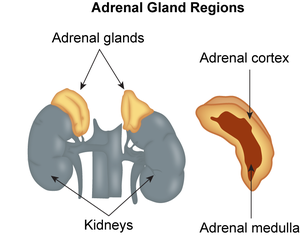
Above the kidneys

The adrenal glands have 2 divisions. The innermost section - called the medulla - secretes catecholamines such as epinephrine and norepinephrine needed for fight or flight. The outer division - called the cortex - is responsible for the creation and secretion of mineralocorticoids (such as aldosterone needed for water and salt balance), glucocorticoids (such as cortisol), and sex hormones.

24
Q

How is cardiac muscle different than skeletal muscle?

A
  • Cardiac muscle is involuntary
  • Cardiac muscle fibers are shorter and more tightly connected than skeletal.
  • Cardiac muscle contains intercalated discs
25
What is the flow of blood vessels starting from the heart?
1. Heart 2. Aorta 3. Artery 4. Arteriole 5. Capillary 6. Venule 7. Vein 8. Vena Cava
26
What is the order of airflow through the respiratory system, starting at the nasal cavity and ending at the alveolar sac?
1. Nasal cavity 2. Oral cavity 3. Pharynx 4. Larynx 5. Trachea 6. Primary bronchi 7. Bronchioles 8. Alveoli 9. Alveolar sacs
27
What is the name for the **stress** hormone that is used for tissue catabolism?
Cortisol ## Footnote *Catabolism means to break apart. Tissue catabolism refers to breaking down tissues such as muscles.* *For more about stress and how the human body processes stress in relation to performance, click [here](http://blog.nasm.org/sports-performance/stress-recovery-and-performance)!*
28
What is the flow of food, from the mouth to the anus?
1. Mouth 2. Esophagus 3. Stomach 4. Small intestine (duodenum, jejunum, ileum) 5. Large intestine (cecum, ascending colon, transverse colon, descending colon, sigmoid colon) 6. Rectum 7. Anus
29
What are the two main hormones that are responsible for controlling blood sugar?
* Insulin (decreases blood sugar) * Glucagon (increases blood sugar)
30
# Fill in the blank: The heart is contained in the \_\_\_\_\_, an area of the chest located within the thoracic cavity.
Mediastinum
31
What are the 3 parts of the **small intestine**?
1. Duodenum 2. Jejunum 3. Ileum ## Footnote *​The duodenum and jejunum are responsible for the absorption of macronutrients. The ileum is responsible for the absorption of salts, vitamins, and electrolytes.*
32
What is the function of the respiratory system?
To collect oxygen from the external environment and transport it to the tissues of the body and remove carbon dioxide from the body. ## Footnote *For more information on the respiratory system, click [here](http://www.youtube.com/watch?v=bHZsvBdUC2I).*
33
# True or False: Exercise can improve intestinal function.
True
34
# Fill in the blank: The average resting heart rate for a healthy adult is \_\_\_\_\_\_.
Between 70 and 80 beats per minute. ## Footnote *Heart rate can fluctuate throughout the day. Resting heart rate refers to heart rate when your body is relaxed. In highly trained athletes, the resting heart rate will be lower than average because of the efficiency of the heart.*
35
What blood vessels have thin walls with valves and are used to transport blood back to the heart?
Veins
36
Epinephrine and norepinephrine are sympathetic or parasympathetic in nature?
Sympathetic ## Footnote *Epinephrine (or adrenaline) and norepinephrine will stimulate the fight or flight response (which is also referred to as sympathetic function).*
37
What is the function of the cardiovascular system?
To **transport and deliver blood** from the heart to the tissues of the body and back to the heart. ## Footnote *To learn more about the cardiovascular system, click [here](http://www.youtube.com/watch?v=X9ZZ6tcxArI&t=530s).*
38
Clients on blood thinners or anticoagulants may bruise after massage or foam rolling. Why?
These medications alter clients' blood clotting abilities that may make them bruise easier.
39
What gland is also known as the "**master gland**"?
Pituitary ## Footnote The pituitary gland is known as the master gland because it controls the function of several other endocrine glands.
40
Food in the stomach is called what?
Chyme ## Footnote *Chyme is a mix of food and stomach acid. Stomach acid is needed to help break apart protein.*
41
What does the Frank Starling Law of the Heart state?
Stroke volume increases when there is an increased venous return and ventricular filling. ## Footnote *Increase ventricular filling improves contractile force as a result of a greater stretch of muscle fibers in the heart.*
42
# True or False: During exercise, you should check a client's pulse using the carotid artery in the neck.
False ## Footnote *Putting pressure on this artery reduces blood flow to the brain which can cause dizziness, inaccurate measurement, or in extreme cases loss of consciousness. For these reasons and more, NASM does not recommend this site to check for heart rate on a client and recommends only using the radial artery.*
43
# Fill in the blank: After the blood leaves the pulmonary vein, blood will travel to the \_\_\_\_\_\_.
Left Atria
44
What muscles are needed for proper inhale?
* Diaphragm * External intercostals * Scalenes * Sternocleidomastoid * Pectoralis minor
45
What do platelets do?
Clot blood
46
What is the blood flow of the heart, starting in the vena cava.
1. Vena Cava 2. Right Atria 3. Right Ventricle 4. Pulmonary Artery 5. Lungs 6. Pulmonary Vein 7. Left Atria 8. Left Ventricle 9. Aorta 10. Tissues of the body
47
Is the Valsalva maneuver safe?
It depends ## Footnote *The Valsalva maneuver increases the rigidity of the spine, acting as a natural weight belt, and will protect the spine when lifting heavy loads however it also increases blood pressure and has a compressive force on the heart, making it harder for blood to return to the heart.*
48
# True or False: Weight lifting will cause women to 'bulk up'.
False ## Footnote *Unless there is a hormonal imbalance or a female is taking performance-enhancing supplements, women usually cannot produce muscle hypertrophy to the degree that men can because they have significantly lower levels of testosterone and also have higher levels of estrogen.*
49
What does cortisol do?
Stimulates **gluconeogenesis**, or the breaking down of fat and protein to serve as an energy source.
50
How do you manually find someone's heart rate?
1. Place middle and index finger around the palm side of the wrist, about an inch down from the wrist and on the thumb side. 2. Locate the radial artery by applying light pressure. 3. When finding resting heart rate, count the number of pulses you feel for 60 seconds. 4. When finding heart rate during exercise, count the number of pulses in 6 seconds and add a 0 to the end (If 12 pulses are felt, the heart rate is 120).
51
# Define: Intercalated discs
Discs of tissue that help **hold cardiac muscle cells** together during a contraction and help sync the contraction so the heart can operate as its own functional unit.
52
What stimulates the release of growth hormone?
* Estrogen and testosterone levels * Deep sleep * Vigorous exercise
53
# True or False: As men age, testosterone declines.
True ## Footnote *While the natural decline of testosterone does occur with age, other factors such as overall health and exercise levels have a higher degree of change than age. Men who are active and are free of medical conditions have been shown to have higher levels than men of the same age with sedentary lifestyles and chronic conditions such as hypertension or arthritis.*
54
The systemic side of the heart is the left or right side of the heart?
Left ## Footnote *The left side of the heart, or the systemic side, pumps blood with high oxygen levels to the rest of the body.*
55
What hormone, released from the thyroid, is important in those at a higher risk for **osteoporosis**?
Calcitonin ## Footnote *Calcitonin is responsible for putting calcium into the bones.*
56
What are the three types of **cells** in the **blood**?
1. Red blood cells 2. Platelets 3. White blood cells
57
What are the parts of the **respiratory** airways?
* Alveoli * Alveolar sacs ## Footnote *The respiratory system is comprised of two parts: the conducting airways and the respiratory airways. The conducting airways include the nasal cavity, oral cavity, pharynx, larynx, trachea, left and right pulmonary bronchi, and bronchioles. The respiratory airway is comprised of the alveoli and alveolar sacs.*
58
# Define: Heart Rate
The rate at which the heart beats.
59
# Define: Tachycardia
Resting heart rate **above 100**.
60
Plasma makes up what percentage of blood?
55% ## Footnote *Plasma is the watery matrix part of blood.*
61
How does blood protect the body?
* Prevents excessive bleeding * Contains white blood cells which help fight diseases and sickness
62
The bottom chambers of the heart are termed what?
Left and Right Ventricles
63
How many hours of sleep is recommended for normal endocrine function?
7 to 8 hours per night
64
What is the main region of the brain responsible for **endocrine** function?
The hypothalamus
65
What is considered the natural **pacemaker** of the heart?
SA Node
66
# Fill in the blank: A small artery is called a(n) \_\_\_\_\_\_\_\_.
Arteriole
67
When checking for heart rate you are palpating for what kind of blood vessel?
Artery
68
What are the three **mechanisms** of blood?
1. Transportation 2. Regulation 3. Protection
69
What is the function of the endocrine system?
Regulate bodily functions such as: * mood * growth * development * tissue function * metabolism
70
# Define: Bradycardia
Resting heart rate **below 60**.
71
What direction do arteries carry blood?
Away from the heart.
72
What makes up the **conducting** airway of the respiratory system?
* Nasal cavity * Oral cavity * Pharynx (throat) * Larynx (voice box) * Trachea * Bronchi * Bronchioles
73
Where in your body is your heart?
Obliquely in the center of the thoracic cavity in the chest. ## Footnote *It is a common misconception that the heart is on the left side of your chest. The heart sits directly behind the sternum in the center of the chest, slightly angled toward the left side.*
74
What bones are needed for proper **breathing**?
* Sternum * Ribs * Vertebrae
75
Overtraining will result in high levels of what hormone?
Cortisol
76
The cardiovascular and respiratory systems work together to accomplish what?
* Provide adequate amounts of oxygen to the body * Deliver nutrients * Remove waste such as carbon dioxide