What are the crucial things needed for transmission?
-an active zone, synaptic cleft (wider than normal intracellular space) then postsynaptic density (with receptors)
What is an active zone?
- group of vesicles some of which tethered to the membrane -on the presynaptic membrane
- have about 300 active zones per synapse in a neuromuscular junction (NMJ)
- upon arrival of action potential, activation of voltage activate calcium channels and so get calcium increase and trigger release of vesicles from the active zone, generally one vesicle per active zone (in a frog)
- then depolarisation in the muscle
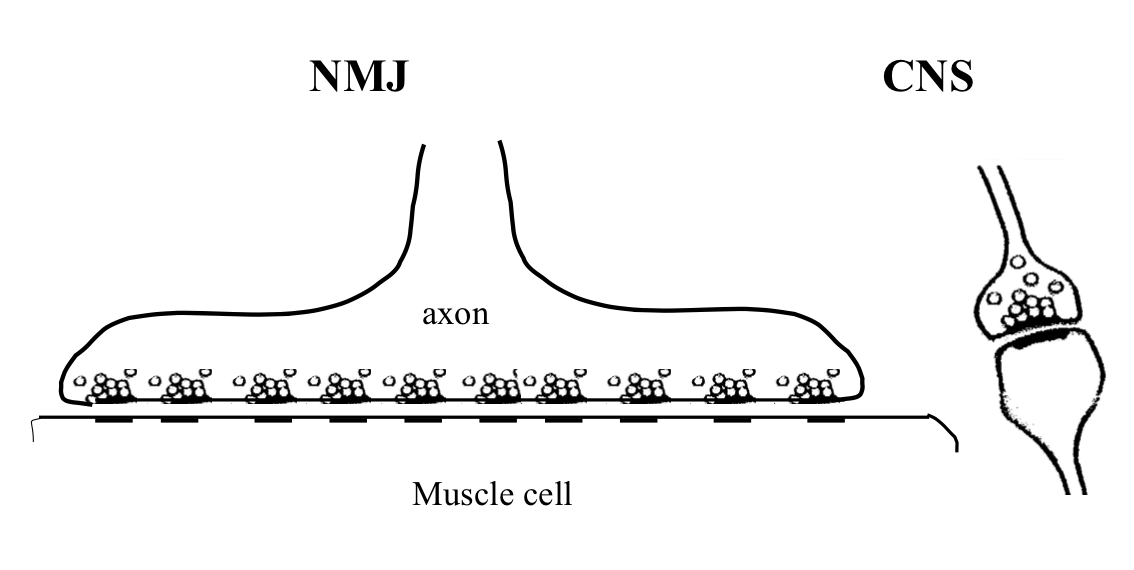
How many active zones are there in mammalian NMJs?
- 10-100
- the number depends on the size of the muscle
How many active zones are there in most hippocampal and neocortical synapses?
-mostly consist of a single active zone
What is the synaptic unit and what does it consist of?
-The synaptic “unit” is the active zone An active zone consists of:
- a pre-synaptic region containing an accumulation of vesicles
- a widened, electron-dense intercellular space (synaptic cleft), typically 20 – 50 nm
- a post-synaptic density, rich in protein. Type I (excitatory) synapses have a thicker PSD than type II (inhibitory)
-the size of synaptic cleft is small enough to not need a transport system, will reach the other end within a milisecond just by diffusion
How many vesicles are released?
- Each active zone releases one or no vesicles per action potential
- The release of a vesicle at an active zone is a probabilistic event
- In the hippocampus, different circuits have probabilities between 10% and 90%
- At the frog NMJ, up to 300 vesicles are released
- number of vesicles depends on no of active zones, one vesicle per active zone
- and often will get zero release, it is not 100% efficient
- probability of vesicle release
How many molecules are in a vesicle?
-Take the example of acetylcholine vesicles at the NMJ:
- [ACh] inside vesicle is 100 mM
- Vesicle diameter is 50 nM, predicting about 10,000 ACh molecules per vesicle
- The number of ACh (and glutamate) molecules is probably half that, because the vesicle has a diminished effective volume
- number of molecules in a vesicle is around 5000, should be a bit higher given the volume (10 000 is predicted, 5000 is real)
- this is probably becaus ethe vesicle contains other things and the available volume is smaller
Can CNS synapses have multiple active zones?
-yes
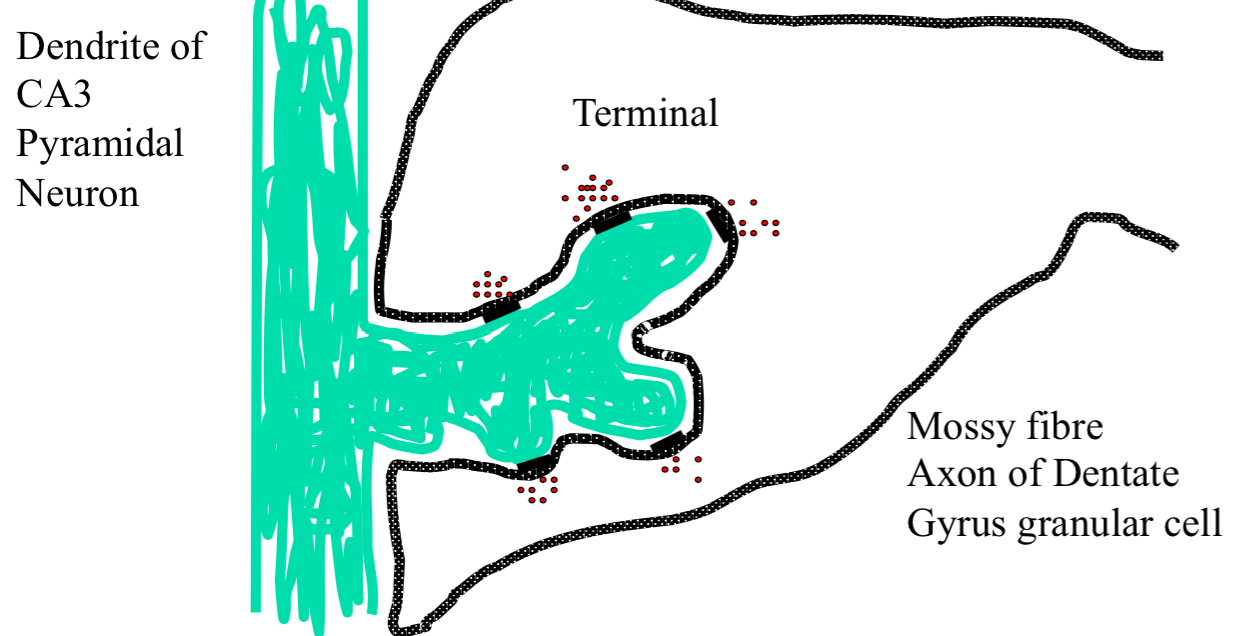
• Best known example is the mossy fibre synapse in the hippocampus: 10 – 40 active zones
- mossy fibre= as each synapse looks like mossy random growth, the terminal wraps around the dendritic spine (containing the postsynaptic densities)
- similar to a NMJ in that you get 1 to 1 relationship in AP to release (almost 100% probability)
What are some characteristics of the mossy fibre synapse?
- the probability due to the location (very close to the cell body) so larger concentration of the signal gontain up to 40 active zones
- some 20/some 35 etc.
- under some circumstances will release only 2 vesicles, sometimes all 40, regulated!
- each active zone when activated
Why is the mossy fiber synapse “stronger”?
- more current flows into the dendrite
- the synapses are located close to the cell body
- Both factors contribute to greater depolarisation of the neuron
How many vesicles are there typically around a synapse and how many are actually available for release?
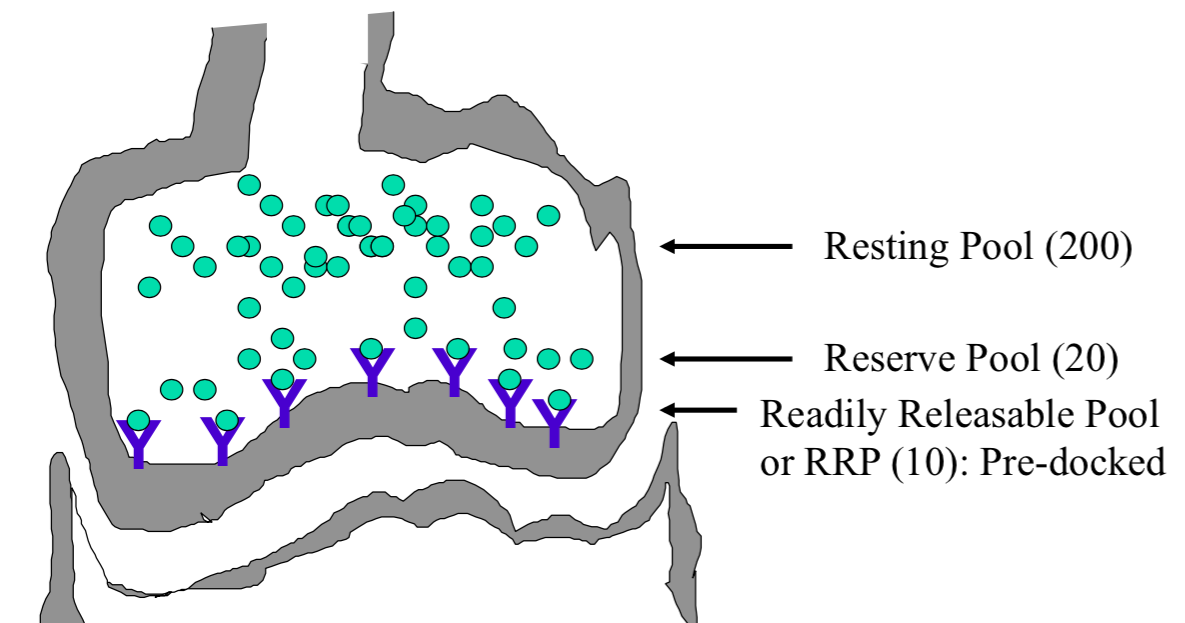
- typically will have a few hundred vesicles but only about 10 that are capable of releasing their contents, these are the ones that are tethered to the presynaptic terminal and ready to be released and those are called the readily releasable pool
- behind them about 20 fully competent vesicles= the reserve pool
- and the rest in the background (200) are tethered to the actin filament, the terminal has a specialised actin network, none of the vesicles are just floating ones, everything is tethered
- when release happens, one of the tehthered sites will become empty and one of the reserve pool vesicles will come in there
What determines the probability of vesicle release?
- The number of pre-docked vesicles
- The sensitivity of the release trigger (Synaptotagmin) to calcium.
- The amount of calcium entry
- The site of calcium entry (VACC are located very close to docked vesicles)
- number of vesicles: seems to not be biologically important the variability
- the sensitivity of the trigger
- contains 5 calcium sites, if all occupied then more likely release, if less occupied then less likely to be released, -snare complex= site of release
- when calcium comes in doesn’t have to fill out the terminal, calcium comes in through the voltage calcium channel, and needs to bind to synaptotagmin (that is located very close so one of the first things it sees)
Do biological membranes fuse spontaneously?
-Biological membranes do not fuse spontaneously
- Electrostaitc repulsion
- Steric hindrance from proteins many biological membranes are studded with proteins
Why can’t membranes fuse spontaneously?
- this is what it looks like, overall tend to be negatively charged
- they spontaneously repel each other electrostatically, the membrane is behind the proteins (so really initially a protein and protein interaction at first)
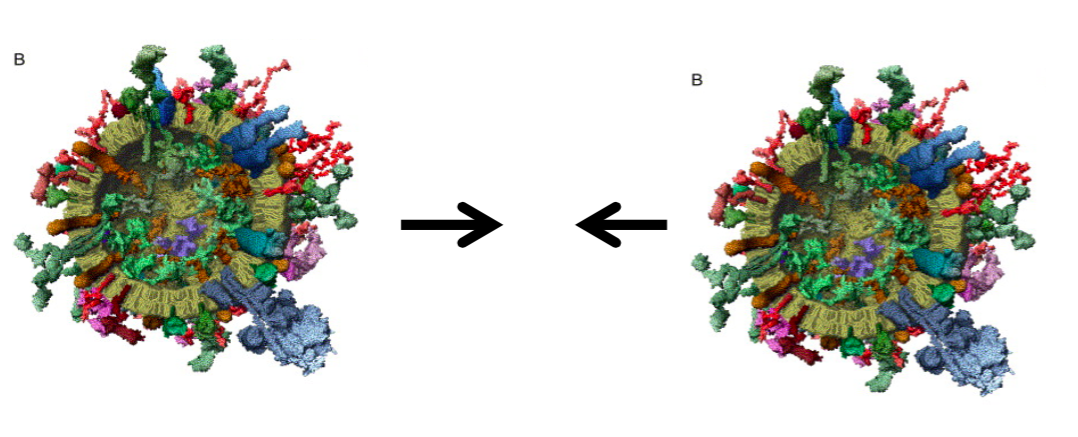
What processes are needed for the fusion of vesicles with vesicles and with other membranes?
- It requires an elaborate protein machinery
- It is tightly regulated
- It is highly specific, not random
- 20-30 proteins specific for fusion
- snare complex= the basis of all vesicle organelle fusions in a cell
What is required for the membrane fusion event?
- formation of a SNARE complex
- An SM protein eg Munc 18
- The SNARE complex draws the two membranous structures together
- The SM protein initiates phospholipid mixing
- Note that calcium is NOT required
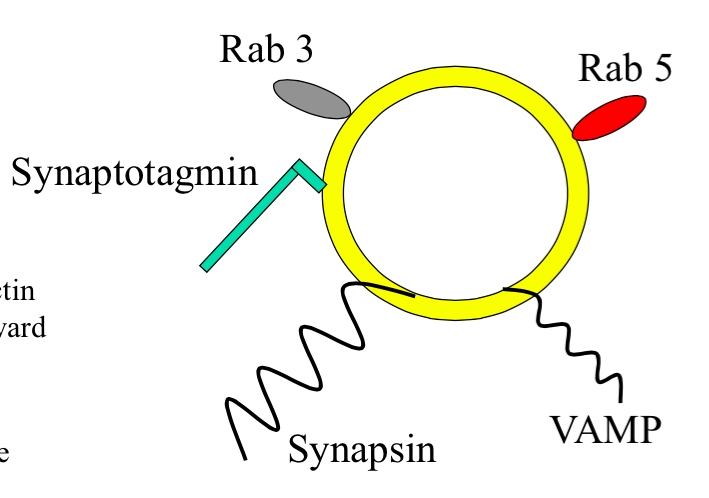
What is a SNARE complex and how it it formed?
- SNARE- gives specificity, depending on the proteins can bind or not
- vesicles have one type of snare, and this one has intracellular part
- made up of superhelix of four alpha helical proteins, determine what it can bind to, vesicle has one snare protein protruding out (synapto brevin)
- membrane of presynaptic terminus intracellularly has two proteins, one has two alpha helices (SNAP25) the other one is called: syntaxin
- so snare complex between vesicle and presynaptic membrane, (when tethered= form SNARE complexes) so complex between presynaptic terminal and vesicle requires synpatobrevin from the vesicle and SNAP25 and syntaxin from the plasma membrane, these are all SNARE protein
- as soon as get SNARE complex it quickly proceeds to fusion, only in case of synaptic release need calcium for release
- in here need an SM protein (eg. Munc18= in neurotransmission),
- snare complex forms, spontaneously forms a superhelix that draws the vesicle almost into the presynaptic membrane (normally this would be enough for fusion but not here, need calcium and SM)
What does the SNARE complex do as the superhelix is formed?
- as the superhelix is formed it steers the vesicle as close to the membrane as possible
- the quaternary SNARE complex is very stable
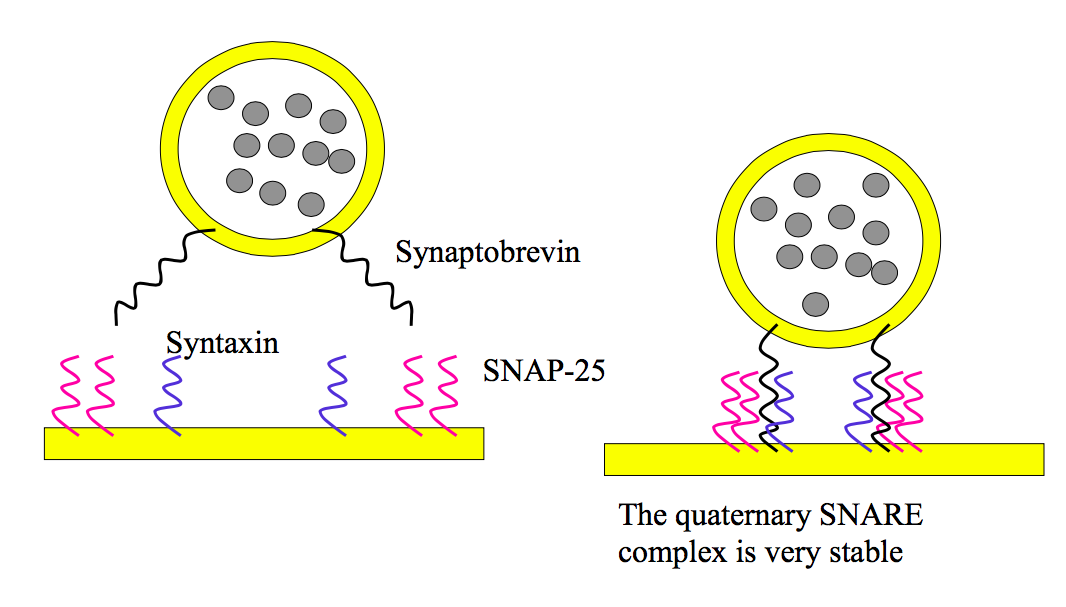
What is this?
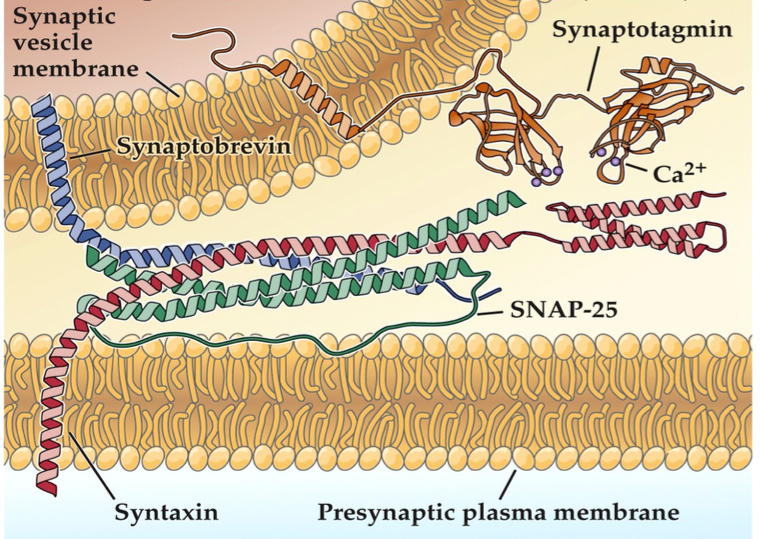
- Molecular mechanisms of exocytosis during neurotransmitter release
- the helices tighten up drawing the structures together, the extra protein: synaptotagmin
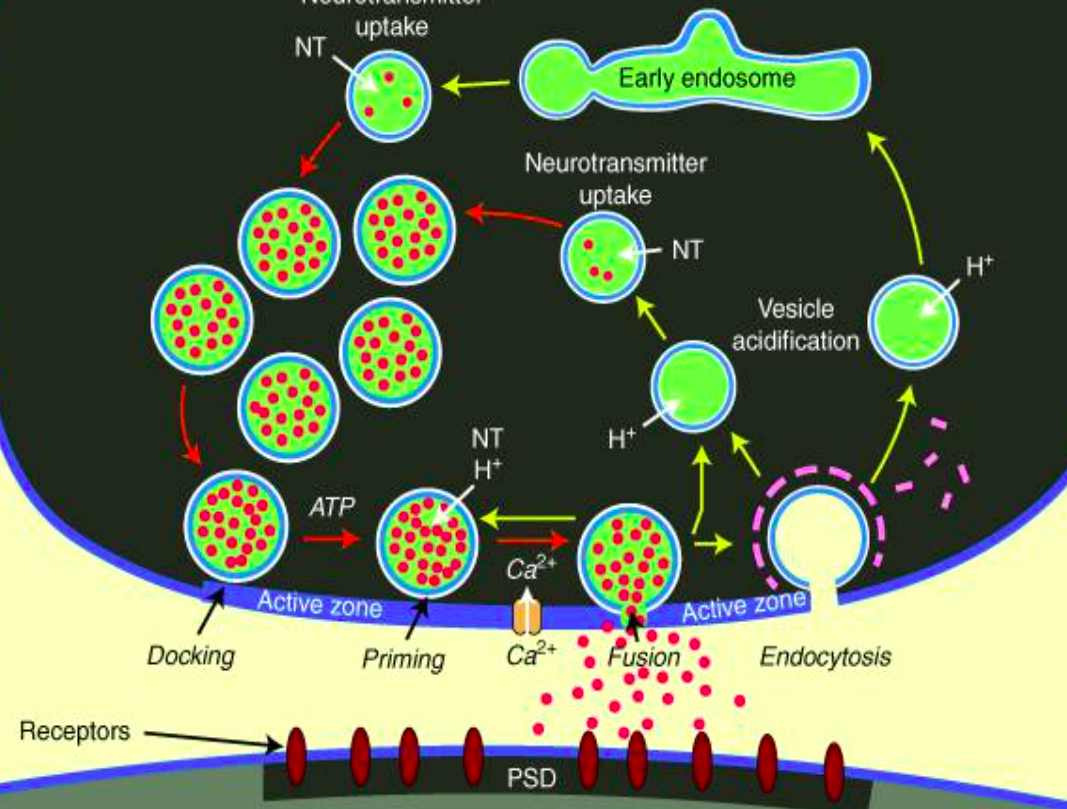
What is the sequence of events with synaptic release?
1. Docking: forming of SNARE complex, the formation of the 10 active zones
2. Priming:calcium related
3. Fusion: leaking of the contents and activation of the receptors
4. SNARE complex dissociation (by NSF): dissociation (by proteolyses)
5. Endocytosis: the vesicle that is part of the presynaptic terminal is withdrawn, endocytosed
6. Reacidification:each vesicle has 2 ATP dependent hydrogen pumps, which pump hydrogen pumps that pump the hydrogen into the vesicle (each pump needs one ATP) related to NA+/K+ ATPase, it only pumps hydrogen one way here! only two pumps per vesicle, if you work out the volume of the vesicle and the pH (7.4 outside the cells) in the vesicles is 4.4 (acidified), the pumps work all the time, at steady state the concentration of hydrogen ion is high, the number of free hydrogen ions however is just 1 or less than 1 (that is due to buffering! lot of proteins and they bidn the hydrogen)
7. Neurotransmitter filling: the neruotransmitter pumps are passive, specific for each transmitter (ACh etc,) they utilise the hydrogen gradients as the energy source, so the hydrogen is more than 1000 more concentrated inside than outside so coupled with movement of the neurotransmitter
What is the detail of re-acidification in synaptic release?
-each vesicle has 2 ATP dependent hydrogen pumps, which pump hydrogen pumps that pump the hydrogen into the vesicle (each pump needs one ATP) related to NA+/K+ ATPase, it only pumps hydrogen one way here! only two pumps per vesicle, if you work out the volume of the vesicle and the pH (7.4 outside the cells) in the vesicles is 4.4 (acidified), the pumps work all the time, at steady state the concentration of hydrogen ion is high, the number of free hydrogen ions however is just 1 or less than 1 (that is due to buffering! lot of proteins and they bind the hydrogen)
What types of vesicle recycling are there?
-the fast and slow routes
Which vesicle recycling route occurs more often and how does it work?
- the fast route is the one used most often
- mostly what happens after fusion is that endocytosis occurs, the vesicle internalizes itself, pinches off from the presynaptic terminal membrane and remains in situ, very close to the membrane where the SNAREs are and may in fact form a SNARE complex again. or go to a reserve pool or go intot he fully competent pool that is right behind the docked vesicles
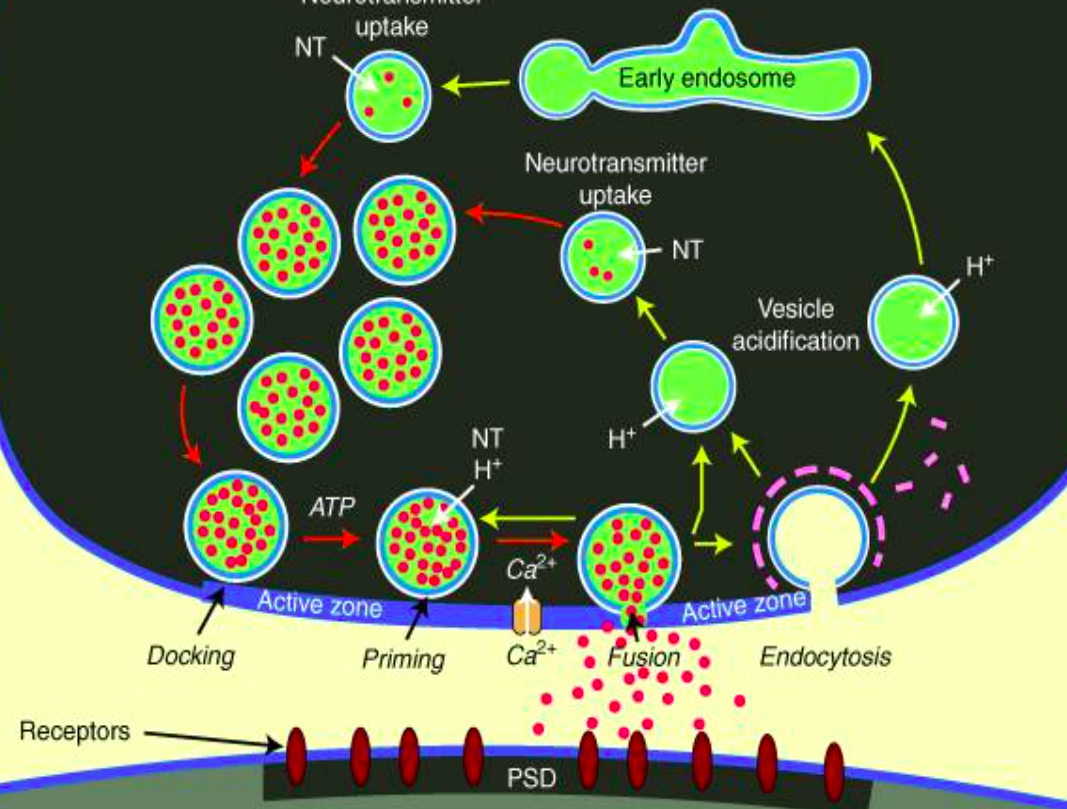
What is the slow route of vesicle recycling?
- about 10% of vesicles undergo the slow route
- the vesicles are transported to the back of the presynaptic terminal where they merge with an early endosome, they diffuse via SNARE complex, undergo protein re-equipment (like going in for a service)
- the slow route is available in order to refurbish the vesicles with new protein


-
Lecture 1- Introduction34
-
Lecture 2- Neurons and glia42
-
Lecture 3- Ionotropic receptors I: Excitation29
-
Lecture 4- Ionotropic receptors II: Inhibition18
-
Lecture 5- AP and AIS28
-
Lecture 6- Mechanosensory Transduction20
-
Lecture 7- Special sensory transduction mechanism15
-
Lecture 8- Measuring neural activity I28
-
Lecture 9- Measuring neural activity II25
-
Lecture 10- Introduction to metabotropic receptors50
-
Lecture 11- Modulation of neuronal functions by metabotropic receptors30
-
Lecture 12- Dopamine27
-
Lecture 14- Stem Cell Therapies for Parkinson's disease32
-
Lecture 15- Synaptic release and presynaptic proteins42
-
Lecture 16- Axonal transport24
-
Lecture 17- Neurotrophins24
-
Lecture 18- Postsynaptic density7
-
Lecture 19- Autonomic nervous system I40
-
Lecture 20- Autonomic nervous system II17
-
Lecture 21- Autonomic nervous system III17
-
Lecture 22- Autonomic nervous system IV14
-
Lecture 23- Spinal injury26
-
Lecture 25- Enteric nervous system I22
-
Lecture 26- Enteric nervous system II12
-
Lecture 27- Modelling of neurons16
-
Lecture 28- Neuropsychiatry and gut14
-
Lecture 29- Gut microbiome16
-
Lecture 30- Injury to the nervous system I27
-
Lecture 31- Injury to the nervous system II23
-
Lecture 32- Repairing the nervous system22
-
Lecture 33- Neuroplasticity I12
-
Lecture 34- Neuronal plasticity II21
-
Lecture 35- Neuronal plasticity III13


